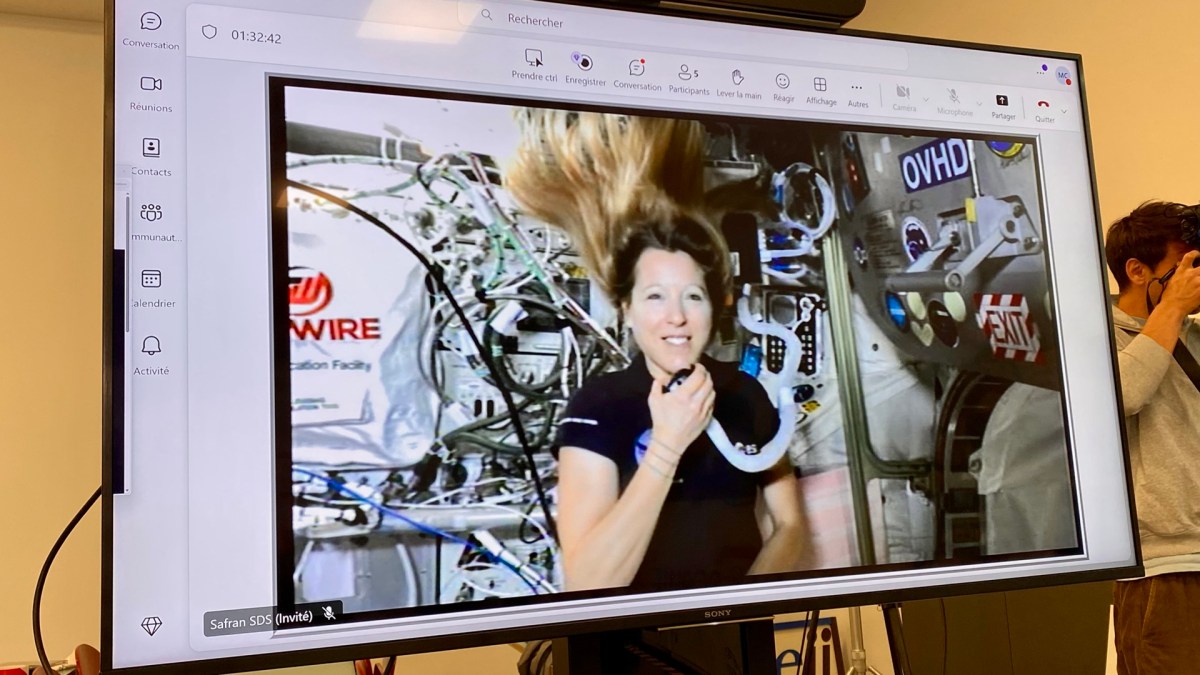
Une vingtaine d'élèves du CP au lycée ont pu avoir un échange en direct avec l'astronaute française Sophie Adenot, à bord de l'ISS. Une prouesse technique que l'on doit à des radioamateurs mobilisés pour faire le lien avec la Station spatiale internationale grâce à une simple antenne.
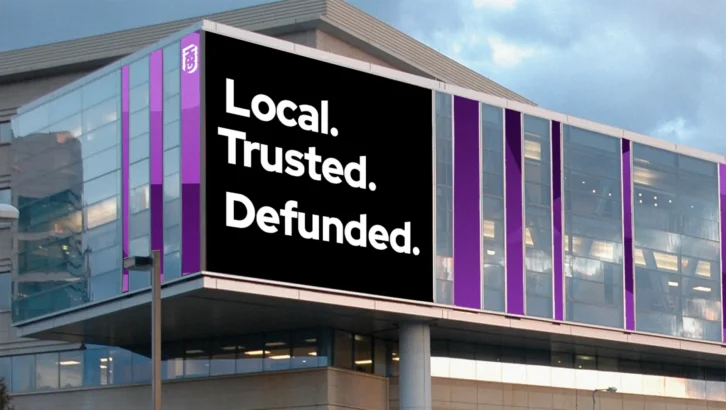
Many NCE stations are part of the public media ecosystem, which is undergoing unprecedented disruption to its funding model. Boston’s GBH posted this image of a modified billboard in front of its building last year. Credit: WGBH(FM/TV)
This is one in a series about trends in noncommercial U.S. radio, here focusing on public and community stations.
The proliferation of noncommercial educational FM stations in the United States may be exciting for public radio, religious broadcasters and community activists. But for many new stations, the financial landscape may not be what they expected when they launched their plans.
The number of NCE FMs reached historic highs in 2025. The year ended with 4,755 of them, almost double their number 20 years ago and up by more than 500 just since 2022. New licenses remain in high demand.
The most recent surge is the result of an FCC NCE filing window in 2021, the first in more than a decade.
Non-profit organizations, schools and native tribes could apply for original construction permits in the FM reserved band, 88.1–91.9 MHz. More than 1,200 applications were received by the commission.
As of early this year the commission had granted more than 800 CPs from the window, most of which are now on the air. CP holders are supposed to build within three years.
The FCC said the window gave startup groups a chance at acquiring new service and provided existing noncom FMs a chance to fill holes in coverage areas in underserved areas.
Most of the new stations are in rural areas or small- to medium-sized towns. Much of the activity is in the midwestern, southern and mountain west regions.
Donation-based NCE FM startups may have counted on receiving federal money but now face unplanned financial hurdles after the government suddenly defunded the Corporation for Public Broadcasting and clawed back many millions of dollars of allocated money for public broadcasting.
Especially vulnerable are licensees who were awarded CPs and had only recently begun operations or hadn’t signed on yet.
“The uncertainty around long-term funding and operating sustainability in some cases has stations waiting to secure enough capital,” said Rima Dael, CEO of the National Federation of Community Broadcasters, “not just to construct facilities, but to operate responsibly for the first several years without relying on funding streams that may no longer be reliable.
“New non-commercial radio stations are entering the field during one of the most complex funding and political environments the sector has faced in decades,” she continued.
“Many are proceeding with greater caution and phased buildouts, prioritizing essential infrastructure first and delaying discretionary investments.”
She said stations are leaning more heavily on volunteer labor, shared services, partnerships with colleges or community organizations, and digital-first strategies to keep costs manageable.
Dael says federal support has historically helped underwrite startup capital costs, including transmission equipment, engineering, compliance and early staffing for NPR- or CPB-qualified stations.
“Without that support, stations must raise substantially more upfront funding before they can reliably go on air.”
Some state or municipal arts and cultural grants to help cover startup costs might be available depending on location, Dael said.
“As a result, most startups are combining tiny public funding with private philanthropy, underwriting and institutional support, if they can get it.”
The public broadcast industry has been fortunate to see an uptick in large gift donations in response to the federal cuts — some are calling it “rage giving.”
Broadcasters also have launched special initiatives specifically to diversify support.
But observers say it will be hard for public media to sustain a surge in donations.
Clockwise: Rima Dael, Mike Henry, Rob Quicke and Alex Curley
Public media consultant Mike Henry of Paragon Consulting says the loss of CPB funds has led new stations to “right-size their operation out of the gate” rather than having to reduce operations, staff or local service later.
“Noncoms owned through a community license, as well as educational licenses through a university or school system, must now rely more heavily on average listeners to sustain them. These stations can also appeal to foundations for financial support, which is a growing motivation for almost all noncom stations that lost CPB funding,” Henry says.
He pointed out that noncoms run by religious broadcasters are insulated from CPB’s demise since they rarely received CPB grants and rely more sources such as local business support through underwriting.
Rob Quicke, founder of the College Radio Foundation and director of the W. Page Pitt School of Journalism and Mass Communications at Marshall University in Huntington, W.Va., says the buzzword for new NCE FMs is collaboration.
“More than ever, collaboration is crucial for survival for NCE stations. Whether with universities, local arts councils, civic organizations or other media outlets, new NCE stations will need as many partners as they can get to improve their long-term stability,” Quicke said.
For example, more than 40 public radio stations across Wisconsin created the Wisconsin News Collaborative, a response to the loss of federal funding.
The collaborative, according to a press release, includes University of Wisconsin’s WUWM (89.7) Milwaukee, White Pine Community Broadcasting’s WXPR (91.7) Rhinelander and Wisconsin Public Radio’s network of 39 stations across the Badger state.
In addition, Quicke said creativity in fundraising ideas and initiatives isn’t only wise, it’s now essential. Those new NCE stations that succeed, he says, will think of themselves as multi-platform media organizations, not just traditional FM outlets.
Innovation also will be ever more important.
“Stations need to embrace digital platforms that increase their reach. From streaming, podcasts and social media, this live and ongoing relationship is important to engage with listeners in their community.”
Alex Curley, founder of Semipublic, says the timing of developments places the many of the new FM stations at an extreme disadvantage.
“The public is currently engaged and interested in the stories of all kinds of stations following the end of federal funding, but the ones that are doing well financially have been able to capitalize on that through national attention. That can require deep connections and a long institutional history — something new NCEs haven’t yet had a chance to establish,” Curley said.
The loss in federal funding also creates a hole on the technical side.
“The biggest engineering challenge NCE FMs face is aging equipment. The Corporation for Public Broadcasting subsidized millions and millions of dollars in tower and satellite uplink hardware every year, but even still there are stations that are using equipment that’s half a century old,” Curley said.
Curley says now is the time to raise money for equipment. “I doubt there will ever be a public more sympathetic to NCE stations than now, especially as public interest inevitably wanes over the next few years.”
Sidebar: Creative Thinking
A loss of $2.2 million in annual funding has prompted a frequency realignment by Buffalo Toronto Public Media for signals that carry its classical and NPR programming.
Among other things it is converting one of its FM stations to a commercial license to air a news-focused format that can be supported by both members and advertisers.
It said more than half of its current funding comes from members. “While community support over the past nine months has been extraordinary, replacing a $2.2 million structural funding loss indefinitely through donations alone would not be realistic or responsible.” A commercial license will provide greater flexibility.
“The federal funding cut put us in a difficult position,” said Tom Calderone, its president and CEO, in the announcement.
“But we are using this moment to think creatively — as we always have — about how we serve our community while protecting BTPM’s essential services.”
Upcoming: Trends in religious noncommercial radio.
This weekend, there will be some old-fashioned record spinning on radio stations across the globe as part of this year’s Vinylthon.
Vinylthon 2026, happening April 18–19, is a fundraising event presented by the College Radio Foundation and designed to provide scholarships for future broadcasters.
Approximately 230 stations, from terrestrial to streaming, many at colleges and universities, are participating. There is still time to register, and your station is encouraged to spin vinyl all weekend long.
Meanwhile, you can stream the special WVYL pop-up station on Live365. The streaming outlet airs one-hours shows from college, community and commercial broadcasters, plus other programs that feature vinyl and other specialty content.
“When you support Vinylthon and WVYL, you are directly helping students who dream of working in radio take their next step into the industry,” said Tim Craig of the College Radio Foundation board.
This year also marks the debut of the Vinylthon Legend Award, which honors individuals who have made extraordinary contributions to radio.
The inaugural recipient is legendary top 40 radio personality John Records Landecker, whose career spans 50 years and is best known for his time on Chicago’s WLS(AM).
Landecker’s “trademark creativity and deep love of music have helped define the sound and spirit of top 40 and oldies radio for generations of listeners and broadcasters,” a Vinylthon release said.
When I talk about doing VHF SOTA activations, people often wonder about what kind of contacts to expect. VHF propagation from a mountaintop can be surprisingly good, and the range of possible contacts runs from the routine to the remarkable. Having done a lot of these activations, I’ve noticed that VHF SOTA contacts tend to fall into three broad categories. Continue reading Three Types of VHF SOTA Contacts→
Ham Radio License Class Buena Vista, Colorado The Technician license is your gateway to the worldwide fun and excitement of Amateur Radio Earn your ham radio Technician class license Learn to operate on the ham bands, 10 meters and higher Learn to use the many VHF/UHF FM repeaters in Colorado Pass your FCC amateur radio license exam in class Schedule: Continue reading Technician Class – Buena Vista, CO→
Three property owners in New York City have received “pirate radio letters” from the Federal Communications Commission.
The Notices of Illegal Pirate Radio Broadcasting inform the owners that unlicensed FM signals were detected coming from their respective properties and that they could be liable for significant financial penalties.
An LLC received a notice about an FM signal on 89.3 MHz coming from its property on West 189th Street of Manhattan last September.
David Duchatellier of the Jamaica neighborhood of Queens received a notice about a signal on 90.1 MHz last November.
And Thomas J. Chavannes and Beverley Dixon-Chavannes, also of Jamaica, got a letter about a signal this past January on 91.9.
New York is one of the markets in which the commission does regular pirate enforcement sweeps. The FCC said it looked into these cases after receiving complaints.
Each owner was given 10 days to respond “by providing evidence that you are no longer permitting pirate radio broadcasting to occur” and requesting them to identify the people engaged in the alleged pirate radio broadcasting on the property.
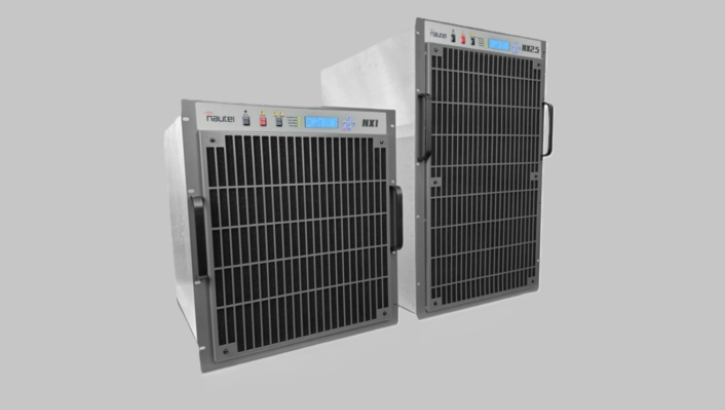
Nautel’s NX1 and NX2.5 AM transmitters will ship this fall.
Nautel will be expanding its NX series of AM transmitters into the low-power market, with two models that support both analog and digital broadcasting.
The additions are the 1 kW NX1 and the 2.5 kW NX2.5. Scheduled to ship in the fall, the transmitters will be exhibited at Nautel’s NAB Show booth.
“Low-power AM transmitters haven’t had these kinds of capabilities in the past,” said John Whyte, Nautel’s head of marketing and product strategy, in a release.
The transmitters are built on the company’s NX series architecture, which Nautel said accounts for approximately 40 MW of high-power AM deployments worldwide.
Both models contain a 250 W RF power module developed to bring the same performance in low-power configurations. The module includes ultra-linear modulation and digital precorrection.
The NX1 and NX2.5 support HD Radio, including MA3 all-digital operation, as well as current DRM modes. They also include Nautel’s digital modulation architecture for linearity and spectral cleanliness.
The models include front‑accessible, hot‑pluggable RF power modules that contribute the same to the final output. Nautel’s HTML‑based user interface provides local and remote monitoring, while built‑in RF instrumentation offers system visibility.
The FCC issued a fine of $60,000 this past week against a Florida man for allegedly operating a pirate radio station.
The penalty is against Aaron Streeter in connection with a station heard on 89.1 MHz in Miami Gardens, Fla., called “Da Pound FM.”
As we reported at the time, the commission announced the proposed fine early last year. It says Streeter has not filed a response to its notice of apparent liability in the months since then. If he doesn’t pay within 30 days the FCC may refer the case to the Justice Department.
According to the original notice, during its 2024 enforcement sweeps in the Miami area, field office agents traced an unauthorized signal to a residence, and saw and photographed an FM broadcast antenna with a coaxial cable running to a nearby shed.
The FCC said agents subsequently spoke to Streeter and that he agreed to stop broadcasting, but that later he allegedly resumed from another location and promoted it on social media including a video showing him broadcasting from a studio, with accompanying text stating, “Family and Friends I’m back with the hottest old school jams right here on 89.1 fm.”
The ruling’s impact is unclear. The U.S. District Court for the District of Columbia noted that since Congress withdrew funding through last year’s Rescissions Act, and because the Corporation for Public Broadcasting has dissolved, no order can provide “meaningful relief” regarding that specific pool of money.
But Judge Randolph Moss repeatedly wrote in the Tuesday ruling that President Trump’s order crossed the line of the First Amendment. Moss was appointed to the D.C. district court in 2014 under President Obama’s administration.
Moss said that the order was issued without regard to nationwide interconnection systems, calling such distribution the “backbones” of public radio and TV.
Colorado Public Radio was a partner in the lawsuit challenging the executive order, along with NPR, Aspen Public Radio and KSUT. CPR said in a release that the ruling prevents the executive order from restricting CPR and other stations from using any federal funds for NPR content. In December, Radio World reported on the stations’ concerns.
NPR, according to its own reporting, said that it was not clear what the decision, which could be appealed by the Trump administration, would mean for the future of federal funding of public broadcasting. But the organization’s comments celebrated the decision.
“Today’s ruling is a decisive affirmation of the rights of a free and independent press — and a win for NPR, our network of stations and our tens of millions of listeners nationwide,” Katherine Maher, NPR’s president and CEO, said in a release.
White House spokesperson Abigail Jackson said in a statement: “This is a ridiculous ruling by an activist judge attempting to undermine the law.”
Representatives from the three Colorado public radio stations, according to a release, said the stations remain prepared to defend the ruling should the Trump administration appeal.
Timeline
The executive order issued by President Trump last May ultimately clawed back $1.1 billion in funding that Congress had set aside for public media outlets. Later last year, it led to a dispute between CPB and NPR over public radio distribution.
The D.C. court acknowledged in its order that while the federal government may impose limits on grants or fund its own speech to promote specific perspectives, “the First Amendment draws a line, which the government may not cross, at efforts to use government power — including the power of the purse — ‘to punish or suppress disfavored expression’ by others.”
Although CPB has been dissolved, the court clarified that this does not render the case moot because the executive order “sweeps beyond the CPB.”
The court is also issuing a permanent injunction to prevent federal agencies from enforcing the executive order.
In a statement, PBS, said it was “thrilled with today’s decision,” calling the president’s order a “textbook unconstitutional viewpoint discrimination and retaliation, in violation of longstanding First Amendment principles.”
We’re previewing technical sessions and trends of the upcoming NAB Show.
NAB Vice President, Advanced Engineering David Layer will give talks about AM radio and hybrid platforms before and during the convention.
Radio World: What will your sessions be about?
David Layer: My presentation to the Public Radio Engineering Conference will focus solely on AM radio, and I plan to spend most of my time telling the audience about all the interesting AM radio-related work ongoing within the National Radio Systems Committee.
As it turns out, my colleague and good friend John Kean is presenting at the PREC as well, also about AM radio, so he and I will be coordinating our presentations as we work together on the NRSC projects. It’s fair to say that John is the brains behind a lot of this work, and we’re fortunate that he is “on the job” here.
This talk will include some of the material I’m discussing at the PREC, in particular on the NRSC’s AM booster project, targeted to a different audience. I also plan to discuss my thoughts on the importance of broadcasters using digital radio signals and why digital plus hybrid — over-the-air plus internet — technology is the best combination to keep their stations “looking as good as they sound.”
RW: The NRSC has been conducting research about AM single-frequency networks. What is the status of that work?
Layer: AM broadcasters are disadvantaged compared to FM and TV broadcasters in that they are not authorized by the FCC to make use of on-channel booster stations.
Also known as single-frequency networks or SFNs, main signal-booster signal combinations can help broadcasters reach listeners within a station’s service area that experience poor reception. Modern transmission technologies, including RF channel simulation tools that accurately model SFNs, and precise timing control between main and booster stations, are being used successfully in the support of SFNs in FM radio and broadcast TV services.
It stands to reason that AM broadcasters should also be able to employ these techniques and improve their coverage and service to listeners.
The NRSC is pursuing an AM booster project with the ultimate goal of developing a technical record to support adoption of a petition for rulemaking at the FCC that establishes rules for AM booster stations.
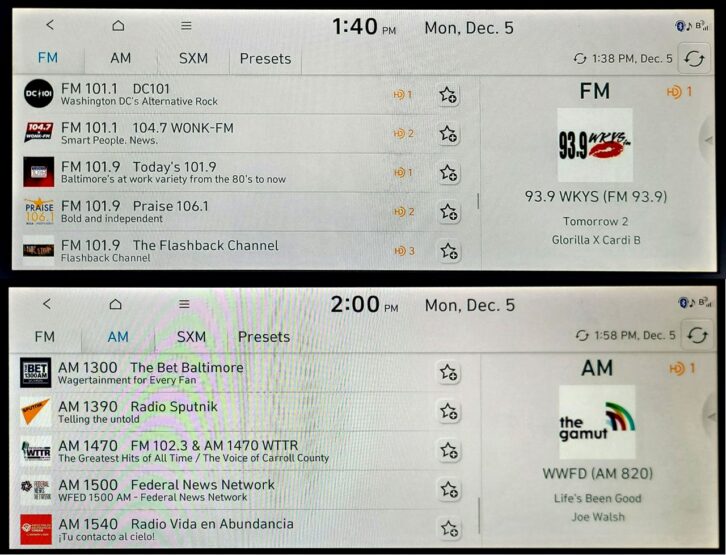
Station lists in a Hyundai Ioniq 5 with DTS AutoStage.
This project is expected to consist of a number of phases including laboratory testing of AM co-channel interference to develop parameters for booster station design; investigation into small antennas suitable for booster station operation; and ultimately construction and field testing of an AM radio SFN utilizing the learnings of the earlier work, under experimental authorization.
Our current challenge is identifying a full-service AM station that we can work with on booster experiments. We hope to identify a station in the Washington, D.C., area as that is where our testing resources are located. Once a plan is in place for conducting tests on a specific station, I expect the other parts of the project will move forward.
RW: Hybrid radio systems like DTS AutoStage are becoming more prevalent in automobiles. What do they portend for the way radio uses metadata and its broader user experience?
Layer: I am a big fan of hybrid radio systems, and DTS AutoStage is clearly leading in this technology. Well-designed hybrid radio systems give the AM and FM radio bands a totally consistent user experience with respect to metadata, where all stations in the band look great with station logos and station information.
NAB recommends that all broadcasters participate in hybrid radio and make the necessary investments to provide great metadata to listeners. At the same time, many broadcasters should also be thinking about how they can support digital radio (i.e., HD Radio) technology and start broadcasting in digital.
There are far more vehicles with HD Radio than with hybrid radio, and the radio “product” on the dash will look better and better as more broadcasters consistently transmit metadata using the HD Radio system.
RW: The number of AM stations in the United States has been declining, slowly but consistently, for some time. What role do you see the band playing in American life in another few years?
Layer: AM radio continues to play a vital role in the emergency infrastructure of the U.S. as the backbone of the Emergency Alert System. This is a role not easily replaced by other technologies, and NAB has been a strong supporter of the AM Radio for Every Vehicle Act, which recognizes this and would keep AM radio in vehicles for the safety of all Americans.
As an audio service, both AM and FM face challenges due to the increased competition that internet-delivered audio represents. I primarily focus on the technical aspect of these services in my role at NAB, and I expect NAB to continue to investigate and encourage use of technologies, like AM boosters and the use of digital radio, that help broadcasters to stand out in this ever more crowded field of choices.
The author is chair of DRM. Her commentaries are a recurring feature at radioworld.com.
For at least half of the globe’s population — the half enjoying internet access — life now is conceivable only in a digital world.
Work, entertainment, shopping and even personal relationships are dependent on personalization and easy access, reliably a click away.
This has fragmented and affected media like television and cinema (not to mention the printed press). Television or movies require appointment viewing, your full attention and the most precious of commodities: time.
Meanwhile AI is poised to deepen the digital revolution to a degree not seen since the internet was introduced.
These are early days but just as the internet made everyone a journalist or publisher, AI can make them a potential broadcaster and publisher. However, AI is not autonomous, and a kernel of journalistic input and curating is at the heart of any AI content.
The place of digital
Where is radio in the digital world? Firmly in its place, especially with digital platforms like Digital Radio Mondiale supporting all broadcast bands.
In the AI age, digital radio is turning its very lack of perceived sophistication into an advantage. It is relatively inexpensive, easy to use, and available where electricity and connectivity are unstable, unaffordable or nonexistent.
It even offers a screen for internet content with news, education, even “back-channel information” to give broadcasters the audience measurements they crave. And radio screens can be used for visually impaired listeners and people needing emergency warnings in one or several languages.
A radio on standby can be brought to life in times of emergencies while you are asleep. And when you are awake, radio allows for multi-tasking. Radio is a good companion when you are stuck in traffic or driving.
Radio listening in cars is a significant driver of digital radio. According to an Edison study in the U.S., car listening rose from 42% of all over-the-air radio tuning in 2015 to 53% late last year.
Radio, whether digital or analog, remains the friend “in your ear,” bringing companionship, immediacy and trust. While AI creates generalized, bland, often uncontroversial or forgettable content (but lots of it), successful radio positions itself as the provider of localized, friendly and comforting content, all underpinned by trust.
In poll after poll radio is cited as one of the most credible sources of news, information and, as lately demonstrated by DRM, e-learning and emergency warnings.
When broadcasters look at the spreadsheets, they see that healthy profits come when channels excel in four key areas: trust, creativity, targeting and measurement.
Does online always win?
Trust is a very valuable commodity and the reason the government of the U.K. recently announced that it will increase funding for one of the most recognized global news organizations, the BBC World Service.
For supporting access to information and independent journalism across the world it will receive an extra $14 million a year for the next three years, an 8 percent increase on last year’s funding settlement. Not all of this will be for radio, but also hopefully not all online, though the new BBC CEO is a former Google man. He will be aware that while online is dominant, many online channels do not do so well compared with traditional media like terrestrial broadcasts.
Thus, British members of Parliament recently warned the BBC that its “digital-first” strategy has shrunk audiences rather than growing them. After cuts in staffing and budgets (since 2022), radio outputs in 13 languages and TV services in six languages, weekly audiences fell by about 30 million!
They forgot to go online. As a result, instead of rising, the World Service’s digital audience fell 11 percent to 131 million since 2021. For example, in Nigeria, audiences were hit after social platforms deprioritized news content, further cutting visibility for BBC material.
The failure of some online channels to perform can be due to other practical reasons.
A survey by Broadcast Media Africa has uncovered a critical “monetization crisis” facing the continent’s digital media industry. While 61% of media organizations in Africa have launched Over-The-Top (OTT) streaming platforms, a staggering 42% of those currently operating have no revenue model in place, streaming content entirely for free. While mobile money has emerged as Africa’s dominant payment rail — used by 68% of Africans as their primary payment method — only 32% of African OTT platforms accept it. It seems that the issue now is not technology but monetization itself, which has become the top priority for the industry.
Here is the digital dilemma
Online or terrestrial? AI would immediately reply with “both.” That isn’t wrong but circumstances are always an extra factor.
In troubled times, the super-technologized Japanese public broadcaster is relaunching shortwave for the Middle East, at least temporarily. Singapore, another highly technological society, has a healthy radio sector that is flourishing even in analog after a failed attempt to adopt DAB. Radio in Singapore has become a $133 million business annually.
Radio is accessible at any time, with live broadcasts running around the clock and without requiring screens or our eyes. Even TikTok is back to radio; the partnership between iHeartMedia in the USA and TikTok, announced last fall, is taking shape with the launch of “TikTok Radio from iHeart.”
The introduction of radio digital terrestrial distribution — using open DRM, DAB or proprietorial HD Radio in the USA — is increasingly becoming a priority. Digital distribution is not just transmitters and encoders; it also means providing rich digital content to audiences. And digital content can be enhanced, reformatted, analyzed and optimized with AI.
It has been said by wise men like Marshall McLuhan that every new medium absorbs the previous ones without eliminating them. An excellent description for digital radio.
While listening in central London to a DRM transmission from my native Romania, in perfect audio, I am even more convinced that digital radio will preserve its unique space by providing audio, information, localism and imagination.
Unpacking the FAA's Boeing 787 Transponder DirectiveAs SARC Communicator editor I read a lot of blogs, club websites and other sources of amateur radio news. This one particularly caught my eye.The sourcehttps://www.paddleyourownkanoo.com/2026/03...
U.K. media regulator Ofcom said 100 small-scale DAB digital multiplexes have now been launched nationally under a program that began about four years ago.
“Small-scale DAB provides a low-cost way for local commercial, community and specialist music services to take to the digital airwaves,” it said.
ExeDAB, serving East Devon, is number 100. It is run by commercial station Radio Exe and community broadcaster Phonic FM. “It brings a variety of additional digital radio services to the towns of Honiton and Sidmouth, including Devoncast Radio and Sid Valley Radio.”
Ofcom quoted its Director of Broadcast Licensing and Program Operations Paul Mercer saying the launch “marks another major milestone meaning that even more listeners can benefit from local, diverse content, as well as boosting the local economy.”
Ofcom has also awarded small-scale DAB multiplex licenses to serve Armagh, Derby, Guildford, Woking, Weymouth, Dorchester and Bridport.
And it said it is consulting on a request by TorDAB Ltd. to change the area to be served by the Torbay small-scale radio multiplex service.
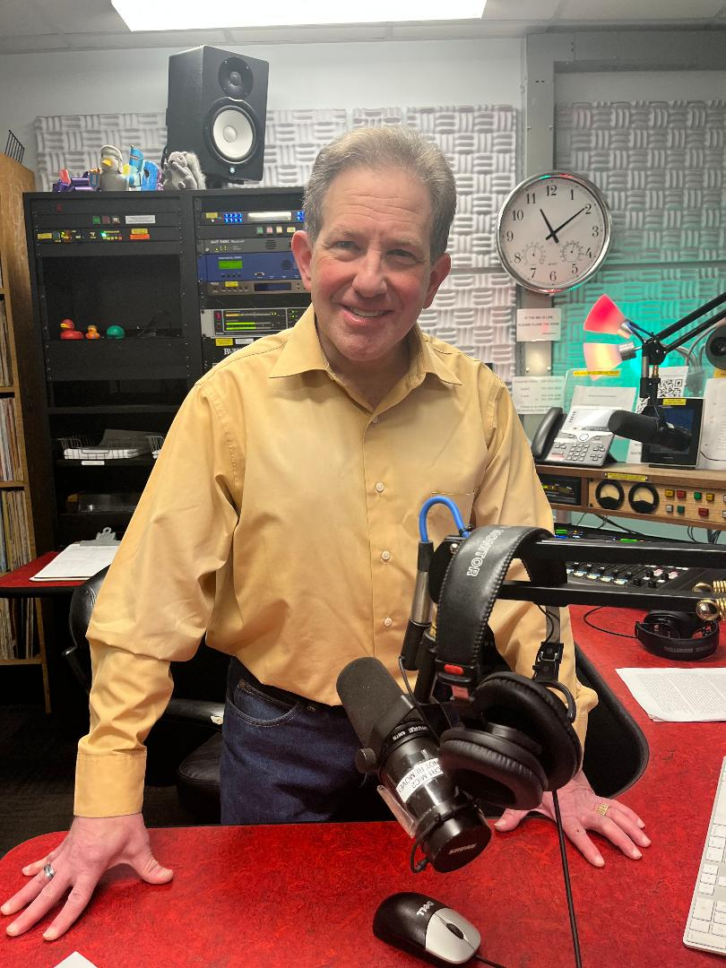
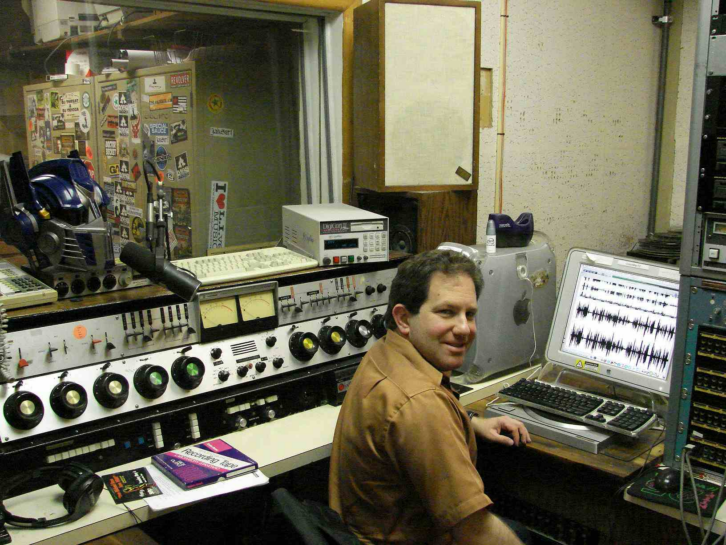
Howard Margolin this past January at WUSB’s studios. Credit: Dave Campfield
On Feb. 9, 1976, two Long Island, N.Y., elementary school kids, Howard Margolin and Steve Benzer, met, and eventually bonded over a shared love of radio.
Six years later, that friendship pulled them into a scene straight out of science fiction itself.
They discovered a backyard pirate FM station called WRAR, “Rebel Alliance Radio,” run by Preston Nichols. Its 400-watt signal, beamed from a shed in Nichols’ yard, carried music across the island.
Nichols, who died in 2018, would later gain notoriety for the Camp Hero conspiracy theories in his co-authored book, “The Montauk Project.”
The boys were so captivated they reached out to Nichols directly. He agreed to sell them a two-watt transmitter — but only after they proved themselves with an on-air shift at WRAR.
“We had to prove our worth,” Margolin recalled. They passed the test, and, on March 18, 1982, launched WOHM, “Resistance Radio,” from Benzer’s bedroom in East Northport.
“I think we had 250 albums between the two of us and Steve’s girlfriend loaned us some records,” Margolin said. The friends spun music, cracked jokes and played at being broadcasters. “We used to give the legal ID as ‘WOHM, Smithtown, New York.’ When I asked Steve why we were saying Smithtown, he replied, ‘because it’s not East Northport.'”
WOHM lasted only for five months, ending when Benzer’s family moved to Texas. He would later launch Expert Broadcast Electronics, currently providing engineering services to U.S. stations.
Margolin stayed behind on Long Island and enrolled at Stony Brook University as a biology major. Drawn to the campus station 90.1 WUSB(FM), he joined through the school’s “Science Fiction Forum” — the oldest student organization at Stony Brook.
Theater of the mind
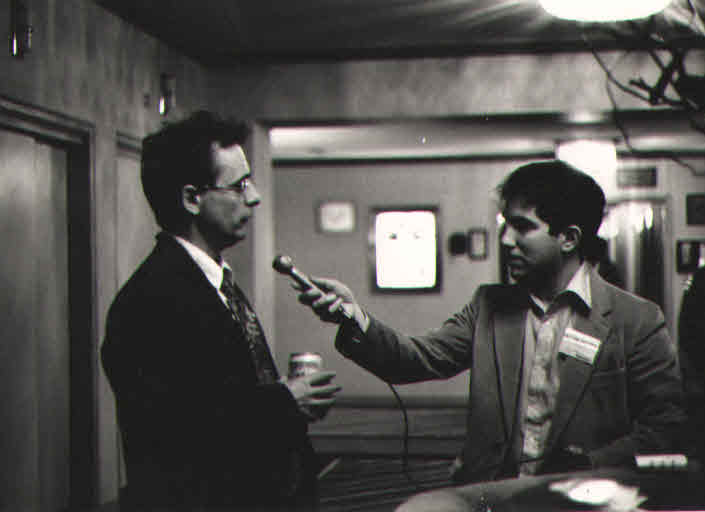
In 1988, Howard Margolin interviewed actor Sylvester McCoy for “Destinies.” Credit: Jon C. Manzo
A fellow student invited Margolin to read a short story on air — WUSB had been licensed at its 90.1 FM dial position for about seven years by then — and with a theater background, Margolin jumped at the chance.
He also carried memories of evenings spent listening to “Golden Age” radio dramas “The Shadow,” “The Green Hornet” and “The Lone Ranger” on 106.7 WRVR(FM), after his father told him about listening to those shows when he was a child in the 1930s and 1940s.
So when the opportunity came to perform science fiction on the radio, Margolin said, “it was a no-brainer.”
That spark grew into “Destinies — The Voice of Science Fiction.” Created by Gary Halada and Mike Botwin, and now approaching its 43rd year, it stands as one of radio’s longest-running science fiction programs.
In fact, as far as Margolin knows, Destinies is the second-longest running show of its kind in the world. The first is “Hour of the Wolf” on New York’s 99.5 WBAI(FM).
Margolin joined the cast in March 1984 and remains the producer and host to this day.
Vision by day, ears by night
After graduating Stony Brook, Margolin became a full-time optometrist, but Stony Brook allows both students and graduates to continue their WUSB shifts. For example, Jim Wiener, who has been with the station since 1969, back when it operated as an AM carrier current station, still hosts a show on the station.
“I think there’s a lot of people either that get bit by the bug and do it full-time, or the best of both worlds and do it as a little non-paying side-hustle,” Margolin said.
By the fall of 1985, Destinies would take the Friday at 11:30 p.m. slot, where it has been ever since.
Howard Margolin, in 2011, at WUSB(FM)’s studios at Stony Brook University.
A renovation of the Stony Brook student union building in 2017 forced WUSB to move its studios. To keep Destinies going, Margolin began producing the show on his home computer, employing newer technologies, like the Audacity editing software and a USB microphone.
“I bought a foam cover on eBay for 75 cents,” he remembered.
By the time COVID-19 pandemic hit in 2020, he had already pivoted to home production for three years, only going into the studio for live broadcasts. Ironically, more than 35 years after his pirate days, he was once again doing radio from a bedroom set-up.
Since 1984, he has worked with a film review team that helps him discuss the latest sci-fi flicks. Dave Campfield, an independent filmmaker, has been on the team since 2019, along with his producing partner, Justin Paul, who joined in 2022.
Audrey Dettmering has been with him since 2006. “Captain” Phil Merkel, who joined the review team in 2005, began archiving the show later that year.
Now, Merkel, who lives in West Coxsackie, N.Y., assists WUSB’s remote broadcasting setup, and he hosts two WUSB offerings of his own, “Captain Phil’s Planet” and “Friday Night Freeform.”
Intensive planning
Destinies regularly features segments such as “Dear Cthulhu,” a collaboration with author Patrick Thomas. Thomas writes a satirical advice column from the perspective of Cthulhu, the elder god from H.P. Lovecraft’s mythology.
Listeners “write in” with their problems — the letters are actually written by Thomas — some serious, some absurd, and Margolin reads the letters while Thomas provides answers as the “carnivorous elder god.”
Margolin gets to play a new character each month, from a five-year-old girl to a British woman whose boyfriend built a hydrogen dirigible in their backyard.
His optometry life usually stays separate from Destinies, but sometimes the link is too obvious. When his patient Christina M. Rau mentioned she wrote “science fiction feminist poetry,” she became a regular contributor.
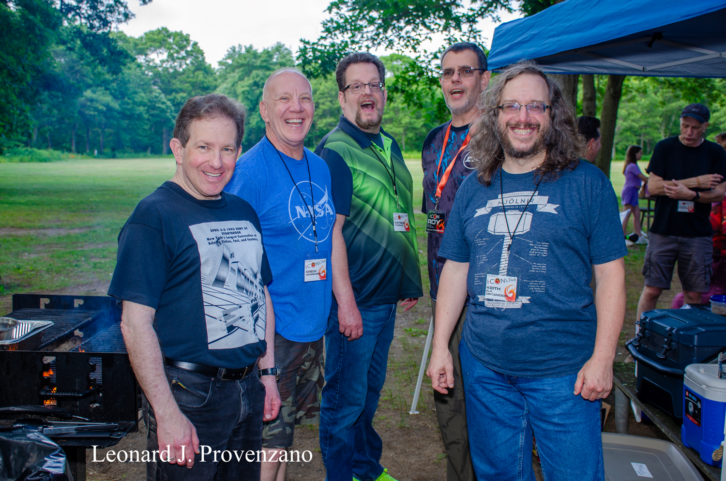
Howard Margolin and a reunion of some of his writer guests in 2023. Left to right: Drew Henriksen, Patrick Thomas, Roy Mauritsen and Keith R.A. DeCandido. Credit: Leonard J. Provenzano
Each month, for the past five years, he has taken one of Rau’s poems and mixed it with music to present on air.
Margolin’s preparation for each show is meticulous. “Everything I say is written out,” he said.
The show also includes memorials for those in the sci-fi genre who have recently passed and celebrations for milestones in film history.
Long Island sci-fi radio
Does science fiction translate to the radio?
In many ways, Margolin said, it’s the perfect medium. After all, it’s an oral art form.
The platform has allowed Margolin to interview the likes of Adam West and Stan Lee. When an author is on the show, he often has them read a passage from their book.
To make it more dynamic, Margolin will read the dialogue for a secondary character, creating a back-and-forth narrative rather than a single person narrating. “It’s much more interesting for the listener that way,” he said.
Perhaps his favorite subject was Julius Schwartz, editor of “Superman” comics from 1971–1986.
“I grew up reading his comics,” he said. They would end up becoming friends before Schwartz passed in 2004.
He recalled another opportunity in 2002 to talk with Richard Matheson, the author of “I Am Legend,” “The Shrinking Man” and “Somewhere in Time.”
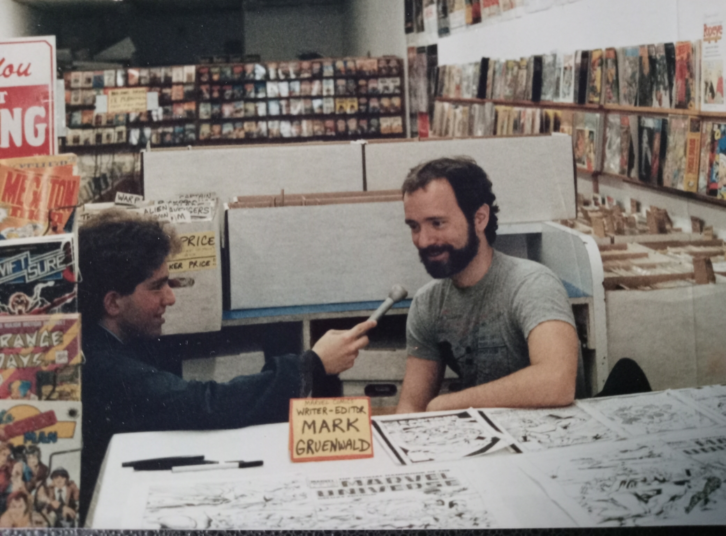
Howard Margolin interviews Marvel Comics’ Mark Gruenwald for “Destinies” in 1985.
Another legendary figure he spoke to, in 2000, was musical satirist Tom Lehrer, who recently passed at the age of 97.
College radio connection
As he approaches the 42nd anniversary of his involvement with Destinies on March 13, Margolin still has plenty of passion for his labor of love.
He’s seen many faces come and go. Today, the WUSB program that follows Destinies is hosted by two Stony Brook undergraduates born in 2004.
But, as is the beauty of college radio: Margolin explained they “speak the same language about film review” despite the generation gap. The two shows will often fill a “crossover” segment with back-and-forth banter.
It all goes back to those days when he and Steve ran WOHM out of a Long Island bedroom.
“It’s been 44 years since we ran our pirate station,” Margolin said. “He’s making a living out of it, and for me, it’s my creative outlet.”
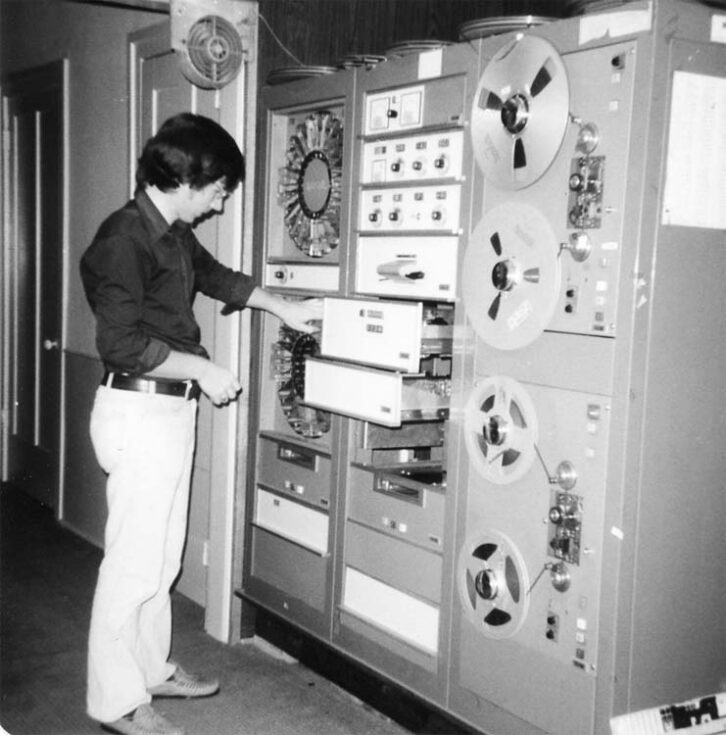
Author Criss Onan in 1974 with the IGM 500 system at WFLR.
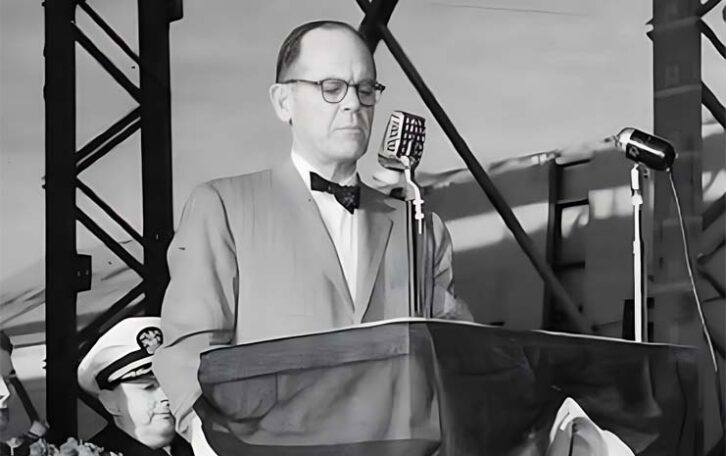
Radio automation pioneer Rogan Jones was remembered as an “idea man who spawned notions as fast as his aides could cope.” That was the description of him in a newsletter that later recounted the history of the company he founded: IGM.
Jones got into radio with the acquisition of KXRO in his hometown of Aberdeen, Wash., in 1928, settling the back-rent that was due to him and his brother for space in a building they owned. The station had been off the air after one of its owners — a police lieutenant — was convicted for using it to coordinate a fleet of rum-running speedboats!
The following year, Jones bought 100-watt KVOS in Bellingham, Wash., for $8,500, and purchased two other stations. He subsequently bought or started many West Coast FMs, including in Seattle, Portland, Los Angeles, San Francisco, San Diego and San Bernardino.
Although the stations were not financially successful — most listeners were still tuned to AM — Jones said the experience contributed to the development of his automation systems.
Because in 1959, Jones founded International Good Music to produce and sell taped music programs and automation equipment.
Simplimation
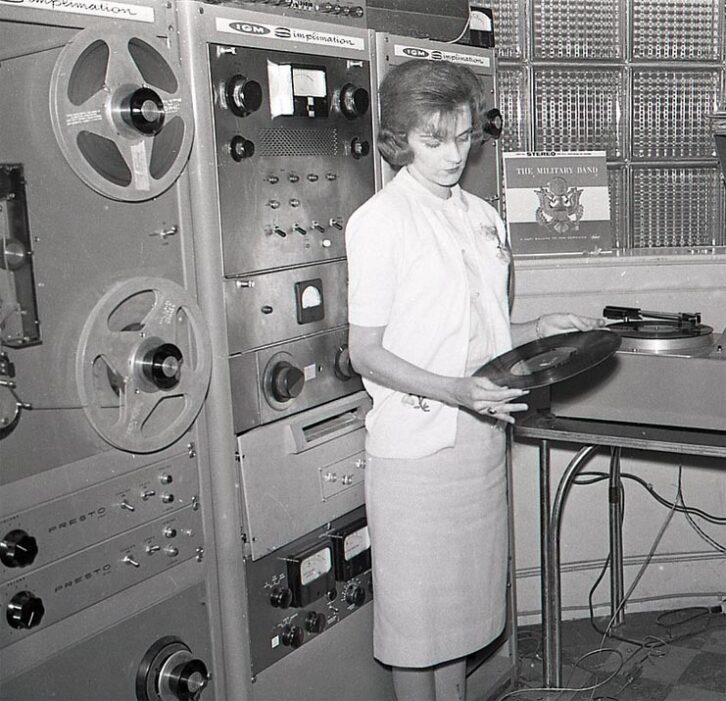
In 1961 IGM moved to a location on Home Road in Bellingham, where it would operate for the next 15 years. From that location came the “Simplimation” automation seen at the 1962 Seattle World’s Fair. It was on display for the public and provided background music.
Rogan Jones in 1958. Credit: Whatcom Museum
Early IGM automation sequencers, such as the 200 model introduced in 1961 and the 300 model soon after, were limited to a fixed number of playback sources. They were relay operated and used an “insertion” scheduling method.
Each non-music source, such as a single-play cart machine (or later an SCM Carousel) could be scheduled by an operator to play every 5 minutes, 7-1/2 minutes, 10 minutes etc.
When no more non-music sources were ready to play, music was played from reel-to-reel players until a non-music source was again ready.
A 300 system automation package cost $14,800, or about $155,000 in today’s dollars.
The model 500, displayed at the 1965 NAB show, was IGM’s first modular system and became the company’s most popular. Each non-music source was controlled by a plug-in card, allowing for expansion. Switching was done with small, inexpensive and readily available plug-in relays on the cards. A system started at $9,000.
In the late 1960s a large IGM van with a working 500 demonstration system sat parked behind my hometown radio station, WFLR(AM/FM) in Dundee, N.Y. The general manager was convinced after he saw and heard the system. He bought much of a 500 system that was being traded in by KFRC-FM in San Francisco, including an “Actan” music controller. An IGM technician once told a WFLR engineer that the Actan originally was designed to control traffic lights.
An IGM 200 “Simplimation” system is visible behind the woman holding an LP. This is at WDOD in Chattanooga, Tenn. in the early 1960s. Credit: Chattanooga Times Free Press
Thirty years later, KFRC Director of Engineering Phil Lerza told me he remembered wheeling each of those blue IGM 500 racks out of the station on a handcart when they switched to a new system.
The 600 IGM model introduced in 1965 was a 500 model with added program scheduling via an “automatic typewriter” and punch-card reader. Typical system price was $20,000, equivalent to $203,000 today!
IGM cart sources were usually single-play or Carousel multi-cart decks rebadged from competitor SMC. That changed in 1969.
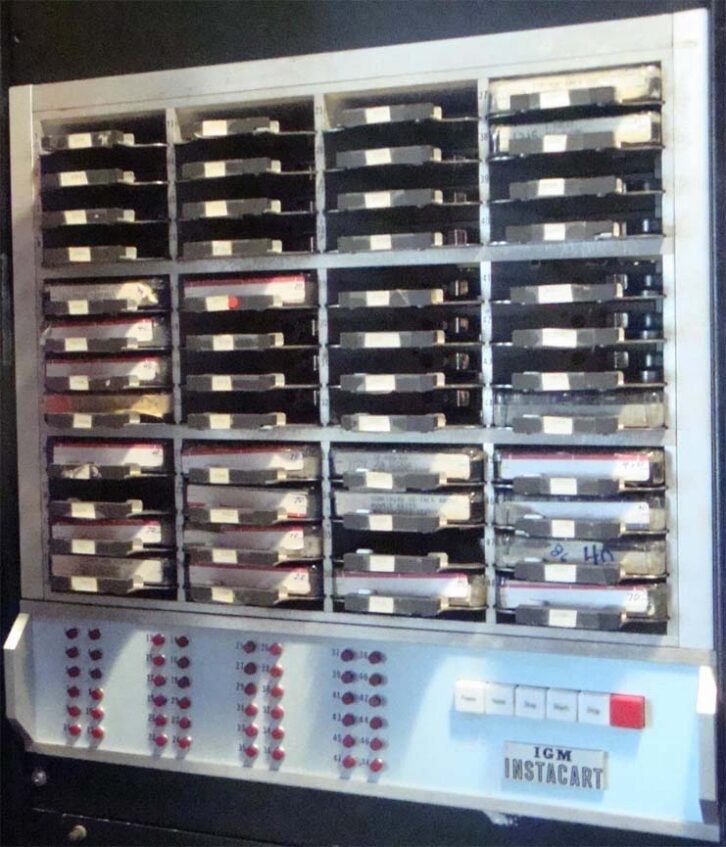
Ernie Burkhart, an aviation parts designer, had joined IGM in 1963 to build “bits, parts and pieces” in his words. One of the pieces he designed was the Instacart.
It held 12, 24 or 48 carts. Each cart was placed in a tray with a pinch roller and then inserted in an Instacart slot, where a solenoid would move the tray 1/16-inch in for playback.
IGM Instacart. Credit: Courtesy Robert Leftwich
Every slot had its own head, minimizing tape misalignment. Every column of trays had a common motor and capstan. For additional cost in 1979, each slot could have its own audio output.
The initial price for a 48-slot Instacart with the memory unit to allow a sequencer to access carts in desired order was $5,600.
IGM models changed from relay to solid-state sequencing beginning with the 400 model in 1971. The 700 family, introduced the following year, was a series of models — some controlled by DEC PDP-8 minicomputers — and a progression of punch card, paper tape, mag tape and ultimately disk drives as the boot and program loaders.
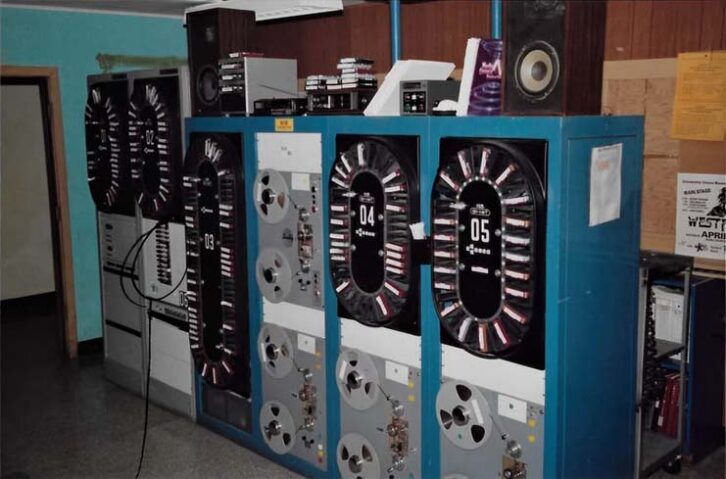
This photo shows equipment at WKAI(FM) in Macomb, Ill., in the early 1990s. There are four 42-tray IGM Go-Carts, one 78-tray Go-Cart and one 12-tray Instacart, numbered 01 through 06, along with other audio sources. Credit: Courtesy Rick Bulger
The quantity of events that could be scheduled became a horsepower race in the industry. IGM’s typically started at a minimum of 1,000 and could be expanded at additional cost. The quantity of input sources was expandable as well.
The IGM RAM model of 1975 was promoted for standalone use or as an add-on to a user’s existing system.
Succession
Following Rogan Jones’ death in 1972 and his son’s death in 1974, VP of Sales and Service Irv Law left to form Broadcast Supply West, and IGM split into three companies.
The local radio stations continued to be owned by the Jones family until sold to the Saga Radio Group in 1998.
IGM’s billing, traffic and accounting software systems was acquired by Sales Manager Joe Coons and President Lee Facto, with whom I would later work at RCS.
IGM’s music syndication division was sold to broadcaster Kemper Freeman Jr. of Bellevue and renamed Broadcast Programming International or BPI.
Some BPI formats included general “voicetracks” recorded with each song, creating the impression that the announcers were at the local station. A business owner once asked if the Jim French that he heard on WFLR “was one of the Frenches who lived over on Hollister Street.” French was actually at KVI in Seattle.
Ernie Burkhart bought the IGM automation side and designed a vertical Carousel-type multiple cart player called the Go-Cart, introduced in 1975. While less expensive than an Instacart, it improved on SMC’s Carousel product. Holding 24, 42 or 78 carts, the trays rotated bidirectionally under microprocessor control for fast access. A cart was removed from a tray and placed into a playback deck to minimize tape misalignment. The unit was hinged to swing open for maintenance. Pricing began at $4,045 for a 24-tray model.
By the late 1970s, about 500 stations were using IGM systems, roughly a third of the automation market.
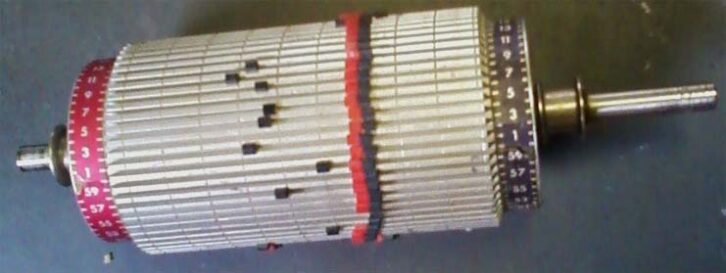
The IGM Actan was a drum rotated by a stepper relay with pegs and microswitches to control music playback from sources such as Scully 270 tape players. Credit: Courtesy Mike Smith
The MARC VII (for “Manual Assist Remote Control”) came out in 1976; it was an early IGM microprocessor product, using an 8748. It included a “TV” display and control keyboard. The Basic A & B models (1977) each used three 8085s. The model B had dual floppy drives. Both models used “plain English” control and display on a color CRT and printer.
IGM employed 105 people in 1969, but by 1980 the number had dropped to 33, and production halted temporarily. That year, following a heart attack, Ernie Burkhart sold a controlling interest in IGM to a local real estate developer. Later, IGM President Jim Wells bought the company. But by 1984, only 20 employees remained.
The SC model (for “Sophisticated Control”) was designed for PC control and came out in 1985, retailing for about $14,500. The EC (“Economical Control”) followed the next year for $4,975. These prices did not include the personal computer.
The MC, issued in 1990, was IGM’s last model. The company’s final mention in Radio World was a trade show exhibitor listing in the fall of 1991. IGM never made the jump to hard drive audio storage.
Sources for this article include Archives West, Bellingham Herald, Broadcast Engineering, Broadcast Management/Engineering, Broadcasting, Radio World and IGM documentation and staff interviews.
Hello Radio Enthusiasts!The latest issue of the SARC Communicator is officially live, and it’s one of our most diverse editions yet. Whether you are a history buff, a dedicated tinkerer, or a DX adventurer, there is something in here for you.Inside thi...
Big news — I’m proud to announce that the Second Edition of my book VHF, Summits, and More is now available. I’ve received tons of positive feedback on the first edition, published in 2019, and I decided it was time for an update. This new version is printed in color, which greatly enhances the photos and graphics. This book is Continue reading Second Edition of VHF, Summits, and More→
The SOTA Management Team launched a special challenge for 2026: a distance-based scoring challenge using CW and SSB on the 2m and 70cm bands. The announcement is here on the SOTA reflector. The basic idea is to encourage SOTA contacts using CW or SSB on these two bands. Because the scoring is based on distance, you need to enter the Continue reading SOTA Challenge: CW/SSB on 2m & 70cm→
The Communicator First Issue of 2026Happy New Year! This first issue of 2026 spans 110 pages and
offers a comprehensive exploration of amateur radio. Readers will find a
diverse mix of content, including technical projects, the latest operating
news, a...
Midnight struck! The calendar flipped,A brand-new baby boy born fully equipped. But this was no ordinary, cooing tyke, He burst out screaming... "CQ! Q-R-Z! gimme a mic!"His parents, both veteran 2-letter hams, were thrilled—not only by ...

 Connexion

 This weekend, there will be some old-fashioned record spinning on radio stations across the globe as part of