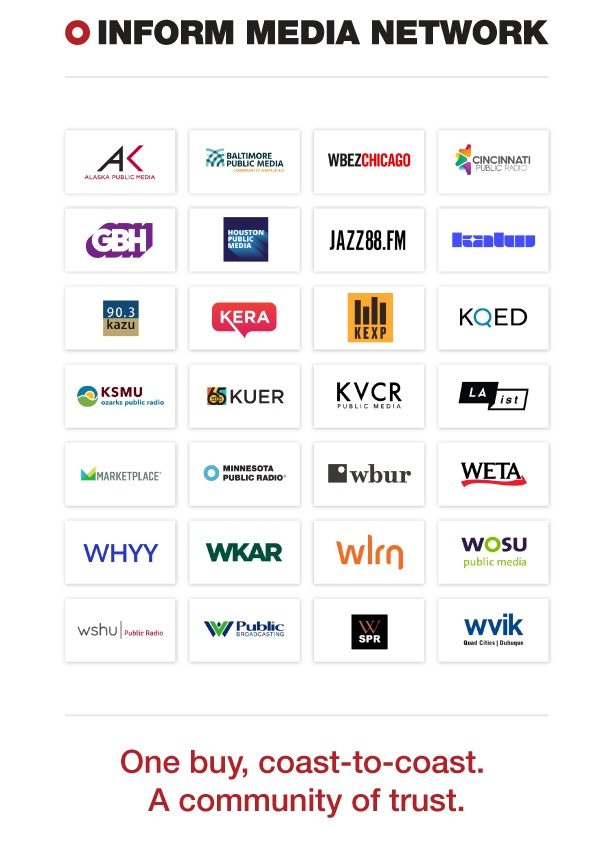
To help local public radio stations build revenue from digital underwriting, StreamGuys and American Public Media have launched a partnership called the Inform Media Network.
The organizations call IMN “a private underwriting and sponsorship marketplace purpose-built for public media” that provides local stations with a national sales team and network at no cost.
Approximately 30 organizations are participating. Among organizations taking part so far are familiar brands like KQED, WETA, Baltimore Public Media, WHYY, WBUR, Houston Public, WGBH, KEXP and others.
The companies said this network offers 55 million monthly impressions reaching over 6 million unique listeners through their podcasting and live streams.
The Inform Media Network is intended to help stations fill unsold digital inventory with “compliant, public radio-quality underwriting through APM’s centralized national sales reach.”
It said stations benefit from audience insights that support the local sales process and that it gives them a mechanism to sell local underwriting to local listeners of APM’s national podcasts, including podcasts from “Marketplace,” “This Old House Radio Hour” and “The Slowdown.”
StreamGuys will manage the technical infrastructure and deliver onboarding services and payment processing for publishers. Magellan AI is used for measurement “from listening to conversion.”
In the announcement, APM acknowledged the challenges of maximizing underwriting revenue for local and national organizations.
“Inform Media Network offers a solution to these challenges — to the benefit of the larger public radio ecosystem. The network is designed to simplify participation for stations while presenting advertisers with a single trusted point of entry into public media digital audio,” it said.
It quoted Justin Hach, director digital sales operations and products at APM and Minnesota public Radio, saying that impressions from listeners outside of a broadcast market may not be important to local sponsors but are a “fantastic” potential audience for national advertisers when connected across the public radio system.
StreamGuys said the network is “not an automated, algorithm-driven programmatic ad network” and that its underwriting will be FCC-compliant “and sound just like local underwriting sold by public radio stations.”
Local stations also will have the opportunity to sell APM’s national podcasts in their local region. Among organizations taking part so far are familiar brands like KQED, WETA, Baltimore Public Media, WHYY, WBUR, Houston Public, WGBH, KEXP and others.
We’re previewing the spring NAB Show in this series of articles. Here we consider challenges for radio sales departments.
Mike Hulvey is president and CEO of RAB and Dave Casper is its SVP, digital services. The RAB is a trade association that supports U.S. radio broadcasters in generating revenue.
Mike Hulvey
Radio World: As radio broadcast companies prepare to head to the convention, what do you consider the most important challenge facing their businesses?
Mike Hulvey: There’s a lot of uncertainty in the marketplace that we broadcasters cannot control. However, I tend to look at the challenge differently: Control what we can, and propel forward. With that, it’s critically important that broadcasters look ahead, innovate and plan for the future. And above all keep the eye on the ball, for our customers, listeners and our advertisers alike.
RW: You’ve recently published a report on the growing percentage of radio’s revenue that comes from digital sources. In the bigger picture, commercial U.S. radio revenue is down markedly from 15 or 20 years ago. What are the obstacles to radio companies returning to larger-scale growth in revenue?
Hulvey: In an increasingly fragmented media marketplace, radio continues to shine. All the collaboration that we’re embarking upon in ways that we’ve never done before, especially as it relates to measurement and addressing our advertisers’ needs under the “One Voice, Better Together” initiative, which addresses some of the obstacles to driving more revenue and increasing our share.
Above all, we must tell our story and ensure we’re responsible for the narrative.
RW: How will AI change how radio runs its businesses and workflows, beyond what we’ve seen to date so far?
Dave Casper: AI is transforming every corner of business and our economy. It will undoubtedly have a profound impact on how radio operates.
Dave Casper
As to how, like so many other companies, I think broadcasters are still working through this. Speaking from a sales standpoint, for the moment, it’s a workforce multiplier, allowing our sales teams to work faster and smarter, uncovering new sales opportunities and providing AEs with an unprecedented level of information they can use to help the local advertisers grow their business.
From copywriting and prospecting tools to enhanced CRM interactions and tools to help AEs plan and execute more effective audio and digital marketing strategies, AI is already helping AEs radio drive revenue.
However, I think this is just the beginning. Without a doubt, agentic AI will be the next big thing, as broadcasters start linking systems and information sources to drive further innovation and more effective solutions for our advertising clients.
RW: What sessions will you be participating in at the NAB Show, and what will you discuss?
Hulvey: We’re excited about RAB’s upcoming sessions, whether it’s our roundtable participation at the Small and Medium Market Radio Forum around RAB’s AI resources for broadcasters, or our two-session series on digital sales with Gordon Borrell highlighting our 14th annual benchmark report.
Lastly, the midterms are around the corner, so we’re going to have our good friend Steve Passwaiter join us for a session dedicated to political, and specifically how broadcasters can create more value and opportunities for local candidates.
RW: What other trends or technologies will you be watching for in the exhibits, the sessions or the hallways?
Casper: Isn’t that the exciting thing about NAB? Around every corner, there is something new to learn.
I’m excited to visit the Xperi booth and look in on DTS AutoStage. It’s such an exciting technology.
Getting back to AI, I’m also curious to see how broadcasting’s many vendors and partners are integrating AI into their product lines.
When you think about the intersection of broadcasting and AI, much of the heavy lifting will be done by the companies supporting our industry. How are they using AI to create smarter technology and tools. In turn, how can we leverage their work to drive the industry forward.
Howard Robertson is CEO/founder and his son Ryan Robertson is president of Spotset Media Network, a national audio media company reaching more than 12.5 million weekly listeners.
The face is covered by a sheet, but the eyes are wide open. The pulse is strong. The heart beats steadily. And that pathway to the soul we call hearing? Completely intact.
There is loud noise in the room, deafening yet clearly heard: about new directions, about who is in and who is out. But radio can hear every word of it.
Because radio is very much alive. Those who have written radio’s obituary and left it for dead need to stop, collaborate and listen.
This is how many in the radio industry feel right now. Maybe this is what happens when something gets labeled “seasoned.”
Ageism is foolish in any industry, but it is particularly absurd when the numbers refuse to cooperate. And before anyone mistakes this for a nostalgia argument, let’s be clear: Radio is not just AM/FM towers and dashboard dials.
Radio is streaming. Radio is apps. Radio is the audio companion people carry in their pockets and play through their earbuds, their smart speakers and their connected cars. Radio is digital, and it has been for years.
Nielsen tells us that radio reaches 93% of adults 18+ every single month, making it the top-reaching media platform in the United States. Not one of the top. Thetop.
If radio were a person, it would not be the one being eulogized. It would be the one running the room.
And yet, too many marketers rank radio near the bottom when assessing media effectiveness. The 2025 Nielsen Global Annual Marketing Report makes this gap almost impossible to explain with a straight face: Radio ranks last in perceived effectiveness among all major media vehicles, but simultaneously delivers some of the highest ROI of any medium globally.
Radio’s ROI outperforms video, display, podcasts, television, print, search and CTV. The medium that media buyers and marketers are least confident in is outperforming everything they are most confident in.
That is not a minor discrepancy … it’s a multi-billion-dollar blind spot sitting in plain sight.
There is a phrase that resurfaces every election cycle, attributed to the legendary House Speaker Tip O’Neill: “All politics is local.” The same principle applies here. All radio is local. And that matters enormously.
Broad awareness is easy to buy. What is genuinely difficult, and what actually moves people from exposure to action, is local relevance. Radio has always been built on exactly that.
That local action might be tapping a screen to place an order, walking into a quick-service restaurant or choosing one retail store over another on a Saturday afternoon. Local radio advertising is the most direct, human and immediate call-to-action available to marketers who want to influence what people actually do in their own communities. Not what they might do.
If music is the key to the soul, radio is the key to the community. Radio works, and the proof is well documented.
There is a meaningful difference between reach and connection, and smart media buyers know it. Impressive impression counts are easy to generate. What is far harder to manufacture is the moment when an audience actually trusts the voice delivering the message.
Radio has that. A listener who tunes in to the same station every morning on their commute has a relationship with that station. They know the hosts. They trust their recommendations. Algorithms can’t create years of earned loyalty, built one market and one community at a time.
The research is consistent: advertising that reaches but does not resonate becomes white noise. It registers without connecting. Major brands that chase scale at the expense of relevance often find their investment absorbed by audiences who have quietly learned to tune it out.
Radio’s intimacy, or the fact that it is local, live, and hosted by familiar human voices, is precisely what prevents that from happening. When a trusted local personality tells you about a restaurant, a deal or an event, it does not feel like advertising. It feels like a tip from someone you know.
For a media buyer building a case for investment, the question is never just “How many people will this reach?” The question that drives actual return is “How many people will this move?”
On that measure, radio’s combination of trusted local voices, habitual daily listening, and market-level precision is practically impossible.
Radio personalities were the original influencers long before that term ever existed. No other medium provides the marketing arsenal of local radio: live announcer reads with genuine personality, personal appearances, on-location remotes, promotional tie-ins and fully customized audio creative built around a specific market and community.
These are not features that can be templated or automated. They are fresh every day, never frozen, and the product of real relationships between real people, in real places.
So, radio is not just holding on. It is not just surviving. It is reaching nearly every adult in this country every month, speaking their language, in their market, through long-trusted voices.
The reports of its death are not just premature … they are just wrong. So, the next time someone tells you radio is dead, turn up the volume and drown them out, like the rest of the 93%.
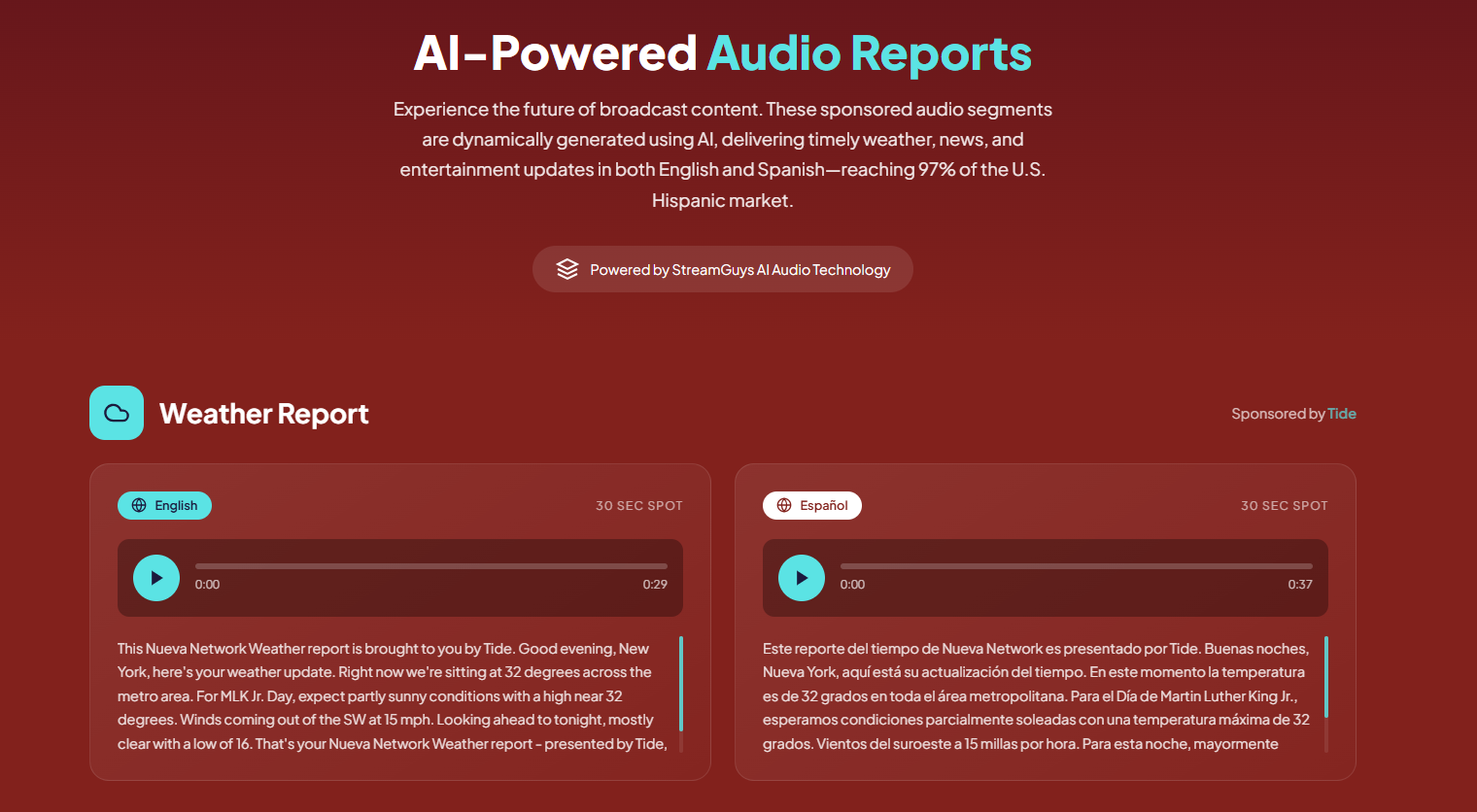
StreamGuys has launched an audio advertising service called SGcreative in partnership with Nueva Network.
They said this creates “a unique audio product combining national reach with local relevancy,” combining AI and ad-insertion technology.
Nueva Network serves the U.S. Latino market with audio on various platforms. StreamGuys said SGcreative helps Nueva Network “deliver real-time, location-specific sponsored content to Hispanic and multicultural audiences at scale.”
It said the partnership “helps publishers get access to national advertising campaigns that they otherwise might not participate in.”
The listener-facing content is branded by Nueva Network as “Que Onnda Today,” a format built around time-sensitive, geo-targeted audio segments.
StreamGuys said its platform turns real-time data into audio ads.
“It pulls in things like weather, traffic and local updates, then uses AI technology to quickly generate sponsored messages. Because SGcreative uses dynamic ad insertion, each listener hears ads tailored to their specific location.”
It provided an example that listeners in Los Angeles might hear a sponsored message followed by a local forecast or traffic story, while a person in Chicago hears the same type of message but with details for Chicago.
The ads are automatically updated in real time. Campaigns run across the StreamGuys Ad-Network in English and Spanish.
At the NAB Show, StreamGuys will be in the ENCO booth, C2116.
NBC Sports Radio is launching on the TuneIn platform.
TuneIn’s parent, the streaming media company Stingray, said TuneIn will stream NBC Sports audio simulcasts, including live daily studio shows from NBC Sports Now such as “Pro Football Talk Live,” “The Dan Patrick Show” and “Chris Simms Unbuttoned,” along with some live play-by-play events.
The announcement was made by Aileen Sokol, vice president of content partnership development at NBC Sports, and Kevin Straley, chief content officer at TuneIn.
Sokol said in the announcement that the partnership allows NBC Sports Radio to expand its distribution and audience.
Stingray said in the press release, “As sports content expands beyond traditional television and subscription platforms, streaming audio has emerged as a natural extension for live coverage. With sports being one of the few remaining appointment-driven categories in media, audio gives fans another way to stay connected to their favorite teams and athletes.”
Listeners can access TuneIn for free. The content will be available on its app, its website and on Sonos and other smart devices.
When it comes to the American radio dial, there’s are quite a bit of contemporary Christian music mixed in with a little fire-and-brimstone these days.
A new study from the Pew Research Center revealed that about one in four radio stations in the country air faith-based or religious music and content.
More than 4,000 religious stations, in total, operate nationwide.
The report, “Religious Radio Across America,” extrapolated data from approximately 440,000 hours of programming, conducted last July, and a survey in June of more than 5,000 U.S. adults.
Pew identified FCC-licensed terrestrial AM and FM religious radio stations in the U.S. using Radio-Locator.
The report’s most significant takeaway may be the vast reach of such stations, as it indicated that religious outlets serve every population center in the country, and their combined broadcast range covers most of the U.S. landmass.
Credit: Pew Research Center
In fact, nearly 98% of U.S. adults live within listening range of at least one religious radio station, according to Pew.
It found “most U.S. adults can tune into several different religious radio stations on the FM or AM dial from their home address.”
And in terms of denomination, an overwhelming majority of those are Christian stations, but not all.
Contemporary Christian leads the way
According to the report, about 45% of U.S. adults indicated “they ever listen to religious audio programming,” with about three-quarters of those at least occasionally tuning in on the radio.
Seven-in-ten listeners indicated they use podcasts and streaming services to access religious programming, and nearly all of the most popular radio shows are also available on these platforms.
Music accounted for roughly half of all airtime on religious radio in the U.S., according to the report. About 37% of Americans said they listen to religious music. The contemporary Christian music format, in particular, has seen significant growth, according to observers.
Religious radio programming addressed a wide range of topics through a religious lens, according to the Pew Report, with stations on average spending several hours per day discussing topics like lifestyle and personal development, family and parenting and health and wellness.
The Pew report classified a station as “religious” if its primary genre was listed as religious, Christian contemporary, gospel music or Spanish Christian. An overwhelming majority of U.S. religious radio stations are Christian, approximately 63%, though a smaller share are affiliated with other religious traditions.
Smaller shares of listening are tied to specific denominations such as Baptist or Pentecostal traditions at 10%, and about 8% Catholic.
Stations that air primarily secular content but occasionally include religious material in their programming — such as local church services on Sunday mornings — were not included in their definition of a religious radio station.
Ownership
The Pew report showed around three-in-ten religious radio stations in the U.S. are independently owned. The other 72% belong to multi-station ownership groups of varying sizes, according to an analysis of FCC licensing information.
The report doesn’t name any of the largest ownership groups, but Educational Media Foundation is a large owner of more than 1,000 religious radio signals in the country. EMF operates contemporary Christian radio networks K-Love and Air1.
Most often religious stations within the same ownership group, according to the Pew report, share a single online feed and broadcast the same content. Certain talk shows and music artists also blanket the religious radio airwaves. The research showed that several popular shows are syndicated on as many as half of all religious radio stations nationwide.
And while political commentary makes up only a modest share of all broadcast content on many religious radio stations, it’s still a major focus for some stations and for some listeners.
According to the report, “on average, religious radio stations across the U.S. devote about half their broadcast time to music — which includes everything from recorded songs to program theme music and advertising jingles — and half to spoken content.”
The report found that overall, 81% of spoken content is voiced by a male speaker.
Other key findings from the Pew Research report:
On average, U.S. religious radio stations air an even mix of music and talk, but that hides a lot of variation between individual stations, the report stated. About 37% primarily broadcast music, while 35% focus primarily on talk programming. Another 28% play an equal mix of the two.
Musically, a relatively small playlist of popular, established artists is generally featured: 16% of all the songs examined over the month of July were from just 10 individuals or bands.
Large majorities of white evangelical Protestants and Black Protestants reported listening to faith-based radio, while smaller shares of Catholics and non-evangelical Protestants said they listen to religious programming.
Rendering of the Los Angeles Memorial Coliseum on July 4, where America250 will host a concert anchoring a nationwide Fourth of July celebration.
Because no block party is complete without music, America250 has announced iHeartMedia as an official audio partner of the Semiquincentennial.
The nonpartisan organization charged by Congress with leading the celebration and commemoration of the 250th anniversary of the signing of the Declaration of Independence is organizing what it calls “America’s Block Party” events throughout the nation.
iHeartMedia said in a release that it will provide a national audio experience that connects America250 celebrations through one soundtrack on the iHeartRadio mobile app.
Block party events
You can attend the following America’s Block Party Events, or tune into the livestream on the iHeartRadio app from your own neighborhood gathering.
The festivities will start at 11:59 p.m. on July 3 at New York’s Times Square, where, for the first time in its 120-year history, the Times Square Ball will drop outside of New Year’s Eve.
On the Fourth, America250 will host a family-friendly concert at the Los Angeles Memorial Coliseum for a livestream audience. Headlining talent will be announced in the coming weeks.
In Milwaukee, Summerfest will serve as a block party location, featuring live music from acts such as Jelly Roll, Sam Barber, The Temper Trap and the BoDeans.
To the south, in Fort Campbell, Ky., the home of the 101st Airborne Division (Air Assault), the Fort Campbell Festival will celebrate military families, featuring The Legend of Charlie Daniels Tribute Concert. It is expected to draw approximately 100,000 attendees.
Finally, in Charleston, S.C., SC250 Charleston will host an Independence Day Celebration in Waterfront Park.
To mark the 100-day countdown, America250 also announced that Kool & The Gang will release a new version of their 1980 hit “Celebration.”
The Library of American Broadcasting Foundation has released the names of people who will be honored this fall as the 2026 Giants of Broadcasting and Electronic Arts.
Here’s the list, as described by the LABF:
Debra Oconnel — Chairman, ABC News Group and Disney Entertainment Networks, The Walt Disney Company
David Donovan — President and executive director, New York State Broadcasters Association, Inc.
Skip Finley — Broadcast owner, operator, advisor, and award-winning author
Jaime Jarrin — National Baseball Hall of Fame and legendary Spanish-language voice of the Los Angeles Dodgers
Deborah Norville — Two-time Emmy Award Winning veteran broadcaster and host of “The Perfect Line ”
Jane Pauley — Respected broadcast journalist and anchor of “CBS News Sunday Morning”
Debra Oconnell — Chairman, ABC News Group and Disney Entertainment Networks, The Walt Disney Company
Dave Santrella — Chief executive officer, Salem Media Group
Suzyn Waldman — Trailblazing sportscaster, award-winning journalist and longtime radio broadcaster for the New York Yankees
The honors will be given at an event in November in Gotham Hall in New York City. The emcee will be Juju Chang, a 2023 Giant honoree and co-anchor of ABC News “Nightline.”
The Museum of Broadcast and Communications will be honored with the LABF Excellence in Broadcast Preservation Award.
The Library of American Broadcasting has honored some 270 leaders in broadcasting since beginning the program in 2003. Net proceeds from the will support the preservation and expansion of the Library of American Broadcasting collection, curated at the University of Maryland.
Marking Mars’ first solo album release in a decade, the event was streamed live on TikTok and promoted across approximately 270 iHeartRadio stations. According to a release, 145 of those stations broadcast the launch event live.
The event resulted in approximately 36 million likes on TikTok and the highest viewership for a live album release within the last year.
“The iHeartMedia–TikTok album release format signals a broader shift: from passive distribution to an interactive cultural moment that delivered deeper engagement and set record-breaking results,” said Tom Poleman, chief programming officer for iHeartMedia.
“The Romantic” became Mars’ first album to debut at No. 1 on the Billboard 200.
Leading up to the release of his album “The Romantic,” Mars invited fans to submit love stories via TikTok and the iHeartRadio app’s Talkback feature for a chance to receive personal song dedications and advice. During the show, Mars debuted all nine songs from the album and also announced the release of a music video for “Risk It All,” the first track on the album.
iHeartMedia said that it extended the debut into a “multiweek celebration” across its stations.
iHeartMedia and TikTok followed up earlier this month with the announcement of “TikTok Radio from iHeart,” which is heard on the iHeartRadio app and approximately 28 of iHeartRadio’s stations.
As the first round of March Madness begins on Thursday, Cumulus Media’s Westwood One and the NCAA have entered into a multi-year renewal agreement for game broadcasts.
Westwood One retains exclusive broadcast radio and digital audio distribution and licensing rights for the NCAA Men’s and Women’s Basketball Tournaments, the NIT, WBIT and Men’s and Women’s College World Series.
The men’s basketball first round begins on Thursday while the women’s starts on Friday.
Westwood One’s broadcast crew of Kevin Kugler, Robbie Hummel and P.J. Carlesimo will call the action for the men’s Final Four and National Championship in English, a release said. Andy Katz will serve as courtside reporter, while Jason Horowitz and Nick Bahe host pregame, halftime and postgame coverage from Indianapolis.
Westwood One has broadcast the NCAA Men’s Basketball Tournament since 1982 and every game of NCAA March Madness on multiple platforms since 2005, according to a release.
All live coverage is available on Westwood One affiliates, Sirius/XM Satellite Radio, streamed online at Westwood One’s website, the Westwood One Sports app and on other platforms including NCAA March Madness Live.
A Virginia low-power FM must take steps to avoid violating the FCC’s underwriting announcement rules for noncommercial broadcasters. But it will keep its license.
This decision regarding WXRK(LP) in Charlottesville is one of a series that originally involved five LPFMs that participated in an unusual joint marketing arrangement.
Their “coop” prompted a license renewal challenge in 2019 from Saga Communications, which owns several stations in the region.
Saga asked the FCC to deny their license renewals based on several allegations, as we’ve reported, with the coop arrangement a central part of the case. Saga called it “an elaborate sham designed to give the appearance of compliance … while operating a commercial enterprise.”
Two of those stations are no longer active, with one having gone silent in 2020 in part because of the resulting financial strain, according to a local news report.
A third licensee agreed in 2024 to pay a $1,000 penalty and received a shortened license renewal. The fourth signed a consent decree last year without a financial penalty and won a full-term renewal.
Now comes the decision for the fifth.
Details
Blue Ridge Free Media is licensee of WXRK and operates on 92.3 MHz in Charlottesville. It broadcasts a rock format known as Rock Hits 92.3.
Saga Communications, through its Tidewater Communications subsidiary, alleged that the station was broadcasting commercials regularly. It also contended that WXRK was not conforming to its educational purpose and was part of an operating agreement that is prohibited by FCC rules.
Blue Ridge disputed the allegations and in turn claimed that Saga was abusing the commission’s processes in an attempt to eliminate competition.
As in the other cases, the FCC acknowledged that the LPFMs had entered into “highly unusual” agreements by forming the Virginia Radio Coop and using Experience Media and Experience Sales to sell underwriting announcements.
The FCC said it has reviewed these agreements to ensure that they do not create common ownership or control of any stations, which would violate LPFM license restrictions.
It noted that the LPFMs had formed the coop in part to share a transmitter site, antenna, studio and office facilities. The commission agreed that this was “unconventional” but it found that the coop was similar to a shared services agreement.
“The coop operating agreement itself does not contain any provisions that allow the coop to control the programming, personnel or finances of any station operated by its members that are commission licensees,” it found.
But as in the other cases, the FCC also expressed unease, saying such agreements created possible conflicts and that the case “identified issues” that it would look closely at should similar cases come up in future. “We remain troubled by this type of arrangement,” it wrote.
Blue Ridge did admit to airing announcements that failed to comply with the underwriting laws. It agrees to name a compliance officer, implement a compliance plan and file updates with the FCC. It avoided a financial penalty by showing that it did not have means to pay one.
The FCC did not accept other assertions by Saga or find that WXRK’s actions merited an end to its license. But it rejected Blue Ridge’s argument that Saga was misusing commission processes to eliminate competition to its stations.
Nick Langan’s reporting contributed to this article.
iHeart personality Ashlee Young will be among the regularly featured hosts on TikTok Radio.
The partnership between iHeartMedia and TikTok, announced last fall, is taking more solid form now with the launch of “TikTok Radio from iHeart.”
It goes live on Friday and will be heard on the iHeartRadio app and on 28 of iHeart’s radio stations.
The organizations also announced the first lineup of “creator-hosts” for the TikTok Podcast Network.
Their positioning: “The new station will blend TikTok’s discovery engine and cultural impact with iHeart’s programming expertise and trusted personalities to give fans a new way to listen to their favorite artists’ full tracks while diving deeper into the stories, trends and moments that turned them into a cultural phenomenon.”
They promise a mix of “today’s hottest music with real-time conversation, guiding listeners through what’s breaking now.”
The format launches Friday evening at SXSW, broadcasting from Austin.
The announcement was made by Dan Page, global head of media and licensing partnerships at TikTok, and Tom Poleman, chief programming officer at iHeartMedia.
Poleman described the overall concept in the announcement: “This station is built to feel like a living, breathing For You Feed, a place where creators, music fans and our on-air talent collide in real time to shape what’s next in culture.”
They also announced several podcasts that will launch soon to populate the TikTok Podcast Network; topics include sports, fashion and social media. Hosts include former jocks, “multihyphenates,” social media stars, fashion figures and “media personalities.” You can read the list here.
Over the last decade, the location of over-the-air AM/FM radio listening has fundamentally shifted, with the vehicle now accounting for a majority of all tuning. But it comes as its overall reach has declined during that same period.
According to the Q4 2025 “Share of Ear” survey from Edison Research, the shift to in-car listening is most evident among female listeners.
Pierre Bouvard, chief insights officer of the Cumulus Media/Westwood One Audio Active Group, highlighted in his analysis that AM/FM radio’s share of ad-supported audio in the car currently sits at 83%.
Bouvard characterizes the medium’s grip on the dashboard as “firm,” but the 83% figure does represent a multi-year decline from 90% in 2018 and 86% in 2024, according to the Q4 survey.
Even with that broader decline, radio remains a primary choice in the vehicle: Among the 18–34 demographic, for example, AM/FM radio still captures 77% of in-car ad-supported audio time.
The shift occurs as radio’s overall daily reach, or the percentage of persons who listen daily, among persons 18+ has fallen from 69% in 2017 to 54% in 2025, according to Edison. The reach of podcasts increased from 8% to 23% during that time.
The dashboard migration
Edison’s data tracks a long-term migration of the radio audience from the office to the vehicle. In 2015, car listening represented 42% of all over-the-air radio tuning; by late 2025, that proportion rose to 53%.
This concentration of listening in the car is most pronounced among younger age groups:
Ages 18–34: 63% of their over-the-air radio time now happens in the car.
Ages 25–54: 57% of their tuning occurs while driving.
Across all audio forms, among that 25–54 demographic, the proportion of all ad-supported audio listening occurring at work fell from 19% in the 2016-2019 period to 14% in late 2025.
But home listening for all ad-supported audio rose from 44% to 54% in that same timeframe — a shift largely driven by the persistence of working from home and the growth of podcasts and streaming, Edison said.
Demographic and vehicle trends
The reliance on the vehicle as a tuning hub is especially high among women.
Across every major demographic, the car represents a greater proportion of total radio listening for women than for men. Notably, for women aged 18–34 who listen to over-the-air radio, 72% of that time is spent in a vehicle.
This trend holds across various car brands. Among drivers of domestic models — Chevrolet, Dodge, Ford, GMC or Jeep — the vehicle’s share of total over-the-air radio time grew from 43% in 2016 to 53% in 2025. Drivers of popular imports saw a similar trend, with the in-car proportion moving from 50% to 55% in the same period.
Edison’s quarterly study, now in its 11th year, surveys approximately 4,000 U.S. listeners annually to track these shifts in audio consumption.
The industry also awaits the annual “Infinite Dial” report, scheduled for release on March 20.
Howard Margolin this past January at WUSB’s studios. Credit: Dave Campfield
On Feb. 9, 1976, two Long Island, N.Y., elementary school kids, Howard Margolin and Steve Benzer, met, and eventually bonded over a shared love of radio.
Six years later, that friendship pulled them into a scene straight out of science fiction itself.
They discovered a backyard pirate FM station called WRAR, “Rebel Alliance Radio,” run by Preston Nichols. Its 400-watt signal, beamed from a shed in Nichols’ yard, carried music across the island.
Nichols, who died in 2018, would later gain notoriety for the Camp Hero conspiracy theories in his co-authored book, “The Montauk Project.”
The boys were so captivated they reached out to Nichols directly. He agreed to sell them a two-watt transmitter — but only after they proved themselves with an on-air shift at WRAR.
“We had to prove our worth,” Margolin recalled. They passed the test, and, on March 18, 1982, launched WOHM, “Resistance Radio,” from Benzer’s bedroom in East Northport.
“I think we had 250 albums between the two of us and Steve’s girlfriend loaned us some records,” Margolin said. The friends spun music, cracked jokes and played at being broadcasters. “We used to give the legal ID as ‘WOHM, Smithtown, New York.’ When I asked Steve why we were saying Smithtown, he replied, ‘because it’s not East Northport.'”
WOHM lasted only for five months, ending when Benzer’s family moved to Texas. He would later launch Expert Broadcast Electronics, currently providing engineering services to U.S. stations.
Margolin stayed behind on Long Island and enrolled at Stony Brook University as a biology major. Drawn to the campus station 90.1 WUSB(FM), he joined through the school’s “Science Fiction Forum” — the oldest student organization at Stony Brook.
Theater of the mind
In 1988, Howard Margolin interviewed actor Sylvester McCoy for “Destinies.” Credit: Jon C. Manzo
A fellow student invited Margolin to read a short story on air — WUSB had been licensed at its 90.1 FM dial position for about seven years by then — and with a theater background, Margolin jumped at the chance.
He also carried memories of evenings spent listening to “Golden Age” radio dramas “The Shadow,” “The Green Hornet” and “The Lone Ranger” on 106.7 WRVR(FM), after his father told him about listening to those shows when he was a child in the 1930s and 1940s.
So when the opportunity came to perform science fiction on the radio, Margolin said, “it was a no-brainer.”
That spark grew into “Destinies — The Voice of Science Fiction.” Created by Gary Halada and Mike Botwin, and now approaching its 43rd year, it stands as one of radio’s longest-running science fiction programs.
In fact, as far as Margolin knows, Destinies is the second-longest running show of its kind in the world. The first is “Hour of the Wolf” on New York’s 99.5 WBAI(FM).
Margolin joined the cast in March 1984 and remains the producer and host to this day.
Vision by day, ears by night
After graduating Stony Brook, Margolin became a full-time optometrist, but Stony Brook allows both students and graduates to continue their WUSB shifts. For example, Jim Wiener, who has been with the station since 1969, back when it operated as an AM carrier current station, still hosts a show on the station.
“I think there’s a lot of people either that get bit by the bug and do it full-time, or the best of both worlds and do it as a little non-paying side-hustle,” Margolin said.
By the fall of 1985, Destinies would take the Friday at 11:30 p.m. slot, where it has been ever since.
Howard Margolin, in 2011, at WUSB(FM)’s studios at Stony Brook University.
A renovation of the Stony Brook student union building in 2017 forced WUSB to move its studios. To keep Destinies going, Margolin began producing the show on his home computer, employing newer technologies, like the Audacity editing software and a USB microphone.
“I bought a foam cover on eBay for 75 cents,” he remembered.
By the time COVID-19 pandemic hit in 2020, he had already pivoted to home production for three years, only going into the studio for live broadcasts. Ironically, more than 35 years after his pirate days, he was once again doing radio from a bedroom set-up.
Since 1984, he has worked with a film review team that helps him discuss the latest sci-fi flicks. Dave Campfield, an independent filmmaker, has been on the team since 2019, along with his producing partner, Justin Paul, who joined in 2022.
Audrey Dettmering has been with him since 2006. “Captain” Phil Merkel, who joined the review team in 2005, began archiving the show later that year.
Now, Merkel, who lives in West Coxsackie, N.Y., assists WUSB’s remote broadcasting setup, and he hosts two WUSB offerings of his own, “Captain Phil’s Planet” and “Friday Night Freeform.”
Intensive planning
Destinies regularly features segments such as “Dear Cthulhu,” a collaboration with author Patrick Thomas. Thomas writes a satirical advice column from the perspective of Cthulhu, the elder god from H.P. Lovecraft’s mythology.
Listeners “write in” with their problems — the letters are actually written by Thomas — some serious, some absurd, and Margolin reads the letters while Thomas provides answers as the “carnivorous elder god.”
Margolin gets to play a new character each month, from a five-year-old girl to a British woman whose boyfriend built a hydrogen dirigible in their backyard.
His optometry life usually stays separate from Destinies, but sometimes the link is too obvious. When his patient Christina M. Rau mentioned she wrote “science fiction feminist poetry,” she became a regular contributor.
Howard Margolin and a reunion of some of his writer guests in 2023. Left to right: Drew Henriksen, Patrick Thomas, Roy Mauritsen and Keith R.A. DeCandido. Credit: Leonard J. Provenzano
Each month, for the past five years, he has taken one of Rau’s poems and mixed it with music to present on air.
Margolin’s preparation for each show is meticulous. “Everything I say is written out,” he said.
The show also includes memorials for those in the sci-fi genre who have recently passed and celebrations for milestones in film history.
Long Island sci-fi radio
Does science fiction translate to the radio?
In many ways, Margolin said, it’s the perfect medium. After all, it’s an oral art form.
The platform has allowed Margolin to interview the likes of Adam West and Stan Lee. When an author is on the show, he often has them read a passage from their book.
To make it more dynamic, Margolin will read the dialogue for a secondary character, creating a back-and-forth narrative rather than a single person narrating. “It’s much more interesting for the listener that way,” he said.
Perhaps his favorite subject was Julius Schwartz, editor of “Superman” comics from 1971–1986.
“I grew up reading his comics,” he said. They would end up becoming friends before Schwartz passed in 2004.
He recalled another opportunity in 2002 to talk with Richard Matheson, the author of “I Am Legend,” “The Shrinking Man” and “Somewhere in Time.”
Howard Margolin interviews Marvel Comics’ Mark Gruenwald for “Destinies” in 1985.
Another legendary figure he spoke to, in 2000, was musical satirist Tom Lehrer, who recently passed at the age of 97.
College radio connection
As he approaches the 42nd anniversary of his involvement with Destinies on March 13, Margolin still has plenty of passion for his labor of love.
He’s seen many faces come and go. Today, the WUSB program that follows Destinies is hosted by two Stony Brook undergraduates born in 2004.
But, as is the beauty of college radio: Margolin explained they “speak the same language about film review” despite the generation gap. The two shows will often fill a “crossover” segment with back-and-forth banter.
It all goes back to those days when he and Steve ran WOHM out of a Long Island bedroom.
“It’s been 44 years since we ran our pirate station,” Margolin said. “He’s making a living out of it, and for me, it’s my creative outlet.”
An iPhone showing Apple CarPlay is seen in front of a Tesla Model 3 screen. Credit: Matteo Della Torre/NurPhoto via Getty Images
More than half of motorists rely on connections from their smartphones as their main in-car audio source.
That’s according to U.K.-based firm Futuresource Consulting, which has released the results from its Audio Tech Lifestyles 2025 survey. The study offers some interesting insights into how smartphones are shaping the future of in-car audio.
Respondents were also asked about their car audio preferences, and the survey concluded that motorists are not happy with radio being “buried” in menus.
The firm conducted the research last summer with a sample of approximately 10,000 respondents. The survey qualified only those respondents who owned a wireless speaker, smart speaker, soundbar, Hi-Fi system or separate headphones.
Its survey area included the U.S., U.K., Germany, Japan and China. The data was then filtered to include only people who travel by car.
Futuresource focused on the following listening choices: smartphone-tethered, radio — which includes AM/FM/DAB, online radio and SiriusXM, built-in streaming/native apps and CDs/other.
Approximately 51% of respondents use Bluetooth, Apple CarPlay or Android Auto as their main audio source.
Younger drivers lead this shift. Among Gen Z and Millennials — those aged 41 and under, according to the study — phone-based connections account for around 55% of listening, with CarPlay and Android Auto at 12–13%. For older drivers — those aged 58 and upward — mirroring is just 4%, with many still preferring simpler options, according to the study.
Radio remains second for in-car listening, used by approximately 26% of respondents. For those 58 and older, radio’s share climbs to around 40% of listening, while for younger drivers, it falls to around 10%.
The survey said preferences varied by nation. “In Germany and Japan, radio still dominates, though spoken word is gaining ground,” the survey said.
Music still leads at 58% of in-car streaming, but spoken-word formats are growing fast, Futuresource said. Both podcasts and audiobooks account for approximately 16% of listening.
Qualitative questions
Drivers are most satisfied when audio systems behave predictably, according to the study. “Audio should always resume in the right place after an interruption, with volume returning smoothly,” Futuresource said.
The firm said that levels should also stay consistent across music and speech to avoid sudden jumps.
Respondents expressed frustration from burying radio in deep menus, over-promising on app support or offering flashy sound modes that tire listeners on commutes.
“With regulators leaning toward physical controls for core functions, the case for tactile access to audio and climate controls is stronger than ever,” the study said.
Futuresource had specific instructions for automakers: Keep “radio fast and physical,” make voice primary in-drive with push-to-talk, and always show “continue listening” on the display when a car owner starts back up their vehicle.
Context
Across the past three ATL surveys, smartphone-tethered listening has grown from 48% in 2023 to the 51% this year. Radio declined from just below 30% to 25%. Built-in streaming edged up from slightly, while CDs continued their decline.
Futuresource Consulting said it has operated for approximately 35 years as a market research and consultancy firm.
The National Association of Broadcasters named the recipients of the 39th annual NAB Crystal Radio Awards:
KBHP(FM), Bemidji, Minn.
KGLK(FM), Houston, Texas
KNDE(FM), College Station, Texas
KXKT(FM), Omaha, Neb.
WCCO(AM), Minneapolis–St. Paul, Minn.
WEEI(FM), Boston, Mass.
WHJX(FM), Jacksonville, Fla.
WIYY(FM), Baltimore, Md.
WOKV-FM, Jacksonville, Fla.
WSB(AM), Atlanta, Ga.
These awards recognize radio stations for exceptional year-round commitment to community service. These were chosen from 50 previously announced finalists.
Winners were announced at the 2026 NAB State Leadership Conference in Washington.

 Connexion
 To help local public radio stations build revenue from digital underwriting, StreamGuys and American Public Media have launched a partnership called the Inform Media Network.