Vue lecture

Exhibitor Viewpoint: OBSBOT at NAB Show 2026
Liu Bo
Liu Bo


With the 2026 NAB Show approaching, we’re providing a series of previews with exhibitors about their plans and expectations.

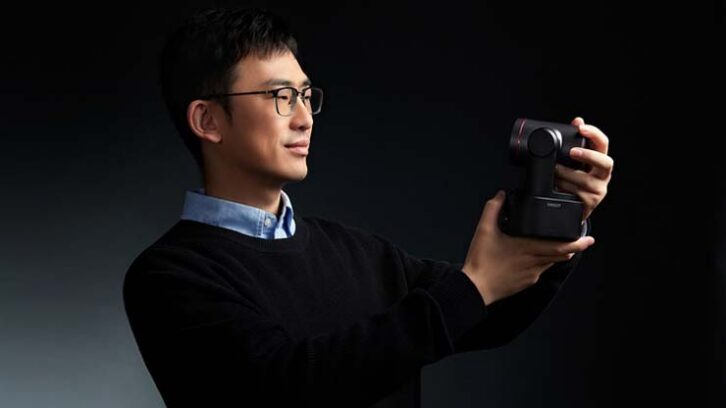
Liu Bo is CEO of AI camera company OBSBOT, featured here because of the growing role of video in the radio media ecosystem.

Radio World: What is OBSBOT and what types of products does it offer? 

Liu: OBSBOT is focused on AI-powered imaging solutions for live production, video creation and increasingly integrated AV workflows. Our mission is to make professional-grade video production more efficient, accessible and creatively powerful.

We offer a broad portfolio that includes flagship PTZR live production cameras such as Tail 2, compact live streaming cameras like Tail Air, AI-powered webcams across the Tiny and Meet series, as well as control hubs such as Talent.

We also provide a growing ecosystem of accessories and software, including microphones, remotes, filters, tripods and mounting solutions, to support a more complete production workflow.

The reason we exist is simple. Broadcasters, podcasters, streamers, educators, worship teams, enterprises and independent creators are all being asked to produce more high-quality video with smaller teams and tighter deadlines. Traditional setups are often too complicated and labor-intensive.

By combining smart AI automation with true production-grade imaging tools, we help teams dramatically reduce repetitive work, simplify operations and gain the freedom to create more dynamic and engaging content across many different formats and industries.

RW: What will you highlight for NAB Show attendees?

Liu: We are centering our presence on the OBSBOT Tail 2 and the core theme of AI-powered live production that is both professionally robust and highly accessible.

Tail 2 is the product that best represents where OBSBOT is headed today: bringing together production-ready image quality, intelligent automation and workflow flexibility in a single camera platform. It supports up to 4K@60fps, features AI Tracking 2.0 and native vertical 4K rotation and offers broad protocols and connectivity options, including NDI, FreeD, SDI, HDMI and Ethernet.

This makes it a camera that works equally well in traditional broadcast environments and in fast-moving creator workflows.

We are also excited to give attendees the first public look at our upcoming launch: the OBSBOT Talent 2, our next-generation all-in-one portable live production system, built around the philosophy “Aggregate. Automate. Amplify.”

Talent 2 integrates video switching, 4K encoding, recording, monitoring and multicamera control into a single compact device. It significantly streamlines professional multi-camera workflows by removing the need for laptops and complex setups, while serving as a powerful control hub to all OBSBOT cameras and further strengthening our end-to-end AI-powered ecosystem.

The core message is that advanced live production no longer has to be complicated or resource-heavy.

That’s why we’ve built a complete, hands-on experience at our booth. We’ve created a fully functional Podcast Studio where visitors can see the Tail 2 working together with the Tiny 3, Talent, and our full ecosystem in real-world situations. We’ll run daily themed sessions showing how to easily build multi-cam NDI setups, run smooth one-person productions, create visually compelling podcasts and put together perfect end-to-end AV solutions.

We’ve also set up a dedicated green-screen zone to demonstrate the Tiny 3’s virtual avatar capabilities with virtual voice, and to showcase Tail 2’s compatibility with FreeD technology for real-time virtual production.

Next door, in collaboration with 4DV.ai, we’re showing 60 Tail 2 cameras integrated with cutting-edge 4D Gaussian Splatting technology. Attendees will even be able to experience the immersive, volumetric video through VR headsets, which must be quite impressive.

RW: What is the most notable technology trend or recent change in streaming video?

Liu: The most significant trend is AI evolving from simple tracking and framing tools into a true, context-aware copilot for live production and streaming. This new generation of AI actively reduces crew requirements, enhances reliability and enables far more dynamic content with much lower operational overhead.

At the same time, we’re witnessing explosive growth in video-first podcasting and vodcasting. Industry reports project that global podcast and vodcast advertising revenue will approach $5 billion in 2026, with nearly 20% growth. On the viewer side, YouTube data shows that time spent watching video podcasts on connected TVs has nearly doubled year-over-year.

These shifts make one thing clear: Audiences now expect high-quality, polished video to accompany excellent audio. At OBSBOT, we design our products to meet this exact need, delivering professional AV experiences while dramatically simplifying the production process.

RW: What other business or technology trends will you be watching for?

Liu: First, the continued convergence of creator workflows and traditional broadcast environments. More and more, small teams are achieving the same multi-camera, low-latency quality that used to require big production crews.

We’re also paying close attention to advances in hybrid and remote IP production, especially tighter integration between AI and cloud technologies that bring greater scalability and efficiency.

Another exciting area is the rise of volumetric and 4D capture technologies, which are opening up truly immersive and interactive content experiences. We’ll also be looking at how spatial and immersive audio can be perfectly synchronized with AI-driven video tracking and virtual production.

Finally, there’s a strong and growing emphasis on sustainability and operational simplicity, with solutions that help reduce crew size, physical infrastructure and overall complexity while still delivering reliable, broadcast-grade performance for live events, sports, worship and podcasting.

RW: What else should we know?

Liu: What we would most like people to know is that OBSBOT is not just showing individual products at NAB Show 2026. Instead, we are showing how an AI-powered production ecosystem can work in real-world workflows. … At the end of the day, we don’t just build cameras. We create intelligent, creative partners that help you work smarter, faster and with much more creative freedom.

OBSBOT will be in booth C5144 and also a joint booth with 4DV.ai in C5249

[For more coverage of the convention see our NAB Show page.]

The post Exhibitor Viewpoint: OBSBOT at NAB Show 2026 appeared first on Radio World.
  •  

Connectivity in the SBE Ennes Spotlight

Dan Merwin
Dan Merwin

Telecom circuits and links are critical for today’s broadcast and media facilities. They’ll be the focus of a talk during the “Emerging Technology” track of the SBE Ennes Workshop at the NAB Show.

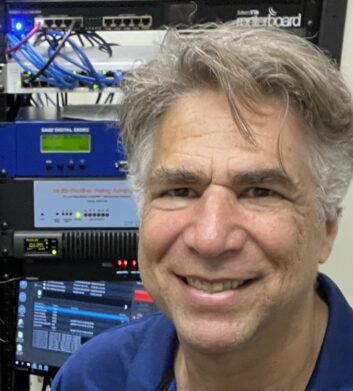
Dan Merwin is founder of Broadcast Telecom and a longtime telecom veteran; he also works part-time as a contract broadcast field engineer. 

Radio World: What is the most important trend in telecom links that we should know about?

Dan Merwin: Starlink will continue to evolve in all aspects, including probably eliminating the need for Carrier-Grade NAT (CGNAT). Space-based 5G and Amazon’s Project Kuiper low-earth-orbit constellation will also change the game in terms of ubiquity and performance. 

[Related: “Inside the SBE Ennes at NAB Show Emerging Technology Track”]

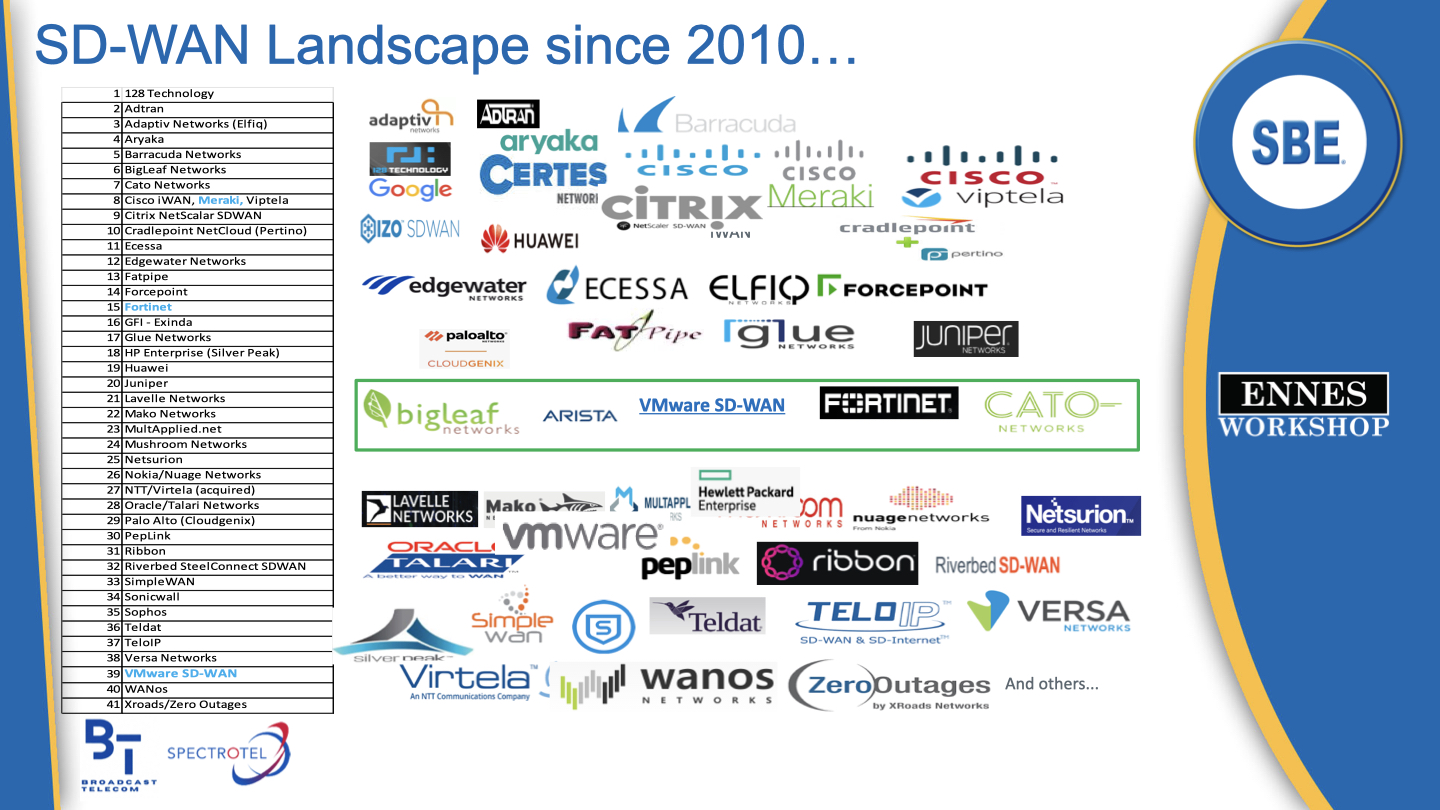
Also, with the use of SD-WAN technology, which by now is quite mature, the need for expensive private links such as MPLS, Metro Ethernet, satellite delivery and even 950 MHz STLs has been greatly reduced for broadcast and media facilities. And just the fact of usually no longer needing to have multi-year contractual obligations to ISPs with huge termination fees is key.

RW: How have platforms like Starlink, 5G and 5.8 GHz links changed the game?

Merwin: Starlink and 5G are at the forefront of the evolution of internet access in general in that it is vastly more useful to enterprises than in the past for a variety of reasons. It is more ubiquitous, higher-performing, more diverse, and far less expensive than 10 or 20 years ago.

There are many factors to take into account, though, when making network changes. With Starlink, there is apparently an outage of 3:19 every night when the satellites and/or terminals are reset. 

Regarding 5.8 GHz PtPs, yes, there are more options for wirelessly connecting sites and for extending the last mile, but the 5.8 GHz space has become crowded so people are often looking at instead utilizing licensed spectrum such as 6 GHz and 11 GHz. 

RW: How do SD-WAN technologies play into this discussion?

Merwin: It was inevitable that we’d see an explosion in cutting-edge technology that takes advantage of the changes in internet access. SD-WAN also addresses the fact that WANs have evolved from a datacenter-based topology to one that is based on the realities and necessities of distributed security, as well as applications that reside in the cloud and/or at any remote location.  

Quality of Service has been supplanted by Quality of Experience, which is AI-driven. For broadcasters, SD-WAN overlayed on top of two or three connections of various types provides a more cost-effective, reliable and manageable way to handle all of their applications, including audio, video, metadata, telemetry, etc. 

Given the evolving options, it’s a challenge to make decisions about which SD-WAN platform to purchase, not to mention which MSP/ISP to engage.
Given the evolving options, it’s a challenge to make decisions about which SD-WAN platform to purchase, not to mention which MSP/ISP to engage. Click to enlarge.

RW: Can you offer a few best practice tips?

Merwin: Engage a trusted advisor. With an SD-WAN deployment, what generally takes up the most time of the customer and the vendor(s) are the design, planning and configuration stages. That, and the fact that it often involves moving from a WAN made up of MPLS and/or Ethernet Private Lines, mean that salespeople and overlays (e.g. sales engineers) have to invest a significant amount of time, usually far more than in the past, in the pre-sales process, and are compensated relatively little. 

Not only that, but in the case where they are paid based on a customer’s spend, they are cannibalizing their revenue and thus their commissions. All this to say that they are mostly not motivated to try to move customers in that direction, and thus it is usually advisable to work with a consultant/agent who probably has more to gain and less to lose in order to help find the best fit. 

Just a few examples of factors to consider:

  • Some of the platforms redirect traffic on a per-packet basis, which facilitates seamless failover, whereas some just do it on a per-session basis, which will cause interruptions in case the primary link drops or bounces.
  • Fortinet, for example, can go deeper into the LAN because they make switches and access points, but there are capabilities that some of the vendors have that they don’t.
  • Is there a justifiable need to use a vendor that provides a “Middle Mile,” which enhances performance and security, such as Cato Networks?

Finally, when looking at moving to SD-WAN, it makes sense to do at least a cursory comparison of the benefits and potential drawbacks of self-deployed/managed, co-managed and fully managed SD-WAN, based on the IT resources available to the customer as well as the projected total cost of ownership, among other factors. 

Some providers will open tickets for you on any internet circuits (with a letter of authorization in place) as one example of the benefits of a managed service.

RW: What kinds of questions do you get from radio engineers?

Merwin: Naturally, they often want to know how well Starlink will work for their air chains and how reliable it is, although more and more engineers are becoming aware of its use in the industry. 

Cost is of course a common concern, so it’s nice to be able to talk to people about a technology change that will save them money in most cases. 

How troubleshooting is done with SD-WAN is another common concern. But most SD-WAN platforms make that a snap, with visibility and analytics even up to the application level.

RW: Are there misconceptions you would like to dispel? And what else should we know?

Merwin: It’s a little difficult for some people who have been involved with WANs for a long time to wrap their head around the idea that they might not need to have an expensive legacy private WAN anymore, and that low-cost, best-effort services such as cable internet can do the job perhaps even better when part of a redundant setup.

Meanwhile it’s estimated that there are still 7 to 8 million business POTS lines in the U.S. We have seen the prices go up for POTS as high as $1,500 per line! In addition, the copper infrastructure is no longer being maintained as it was in the past. 

POTS replacement has also become a mature and diverse offering, and it’s a managed service, so the days of a telco tech going out to install lines that are not installed where or how they need to be are pretty much gone.

The presentation “Telecom Circuits and Links for Broadcast and Media Facilities” is scheduled for 1:15 p.m. on Tuesday April 21 during the SBE Ennes Workshop.

[For more coverage of the convention see our NAB Show page.]

The post Connectivity in the SBE Ennes Spotlight appeared first on Radio World.

  •  

ENCO Takes aiTrack Into the Cloud

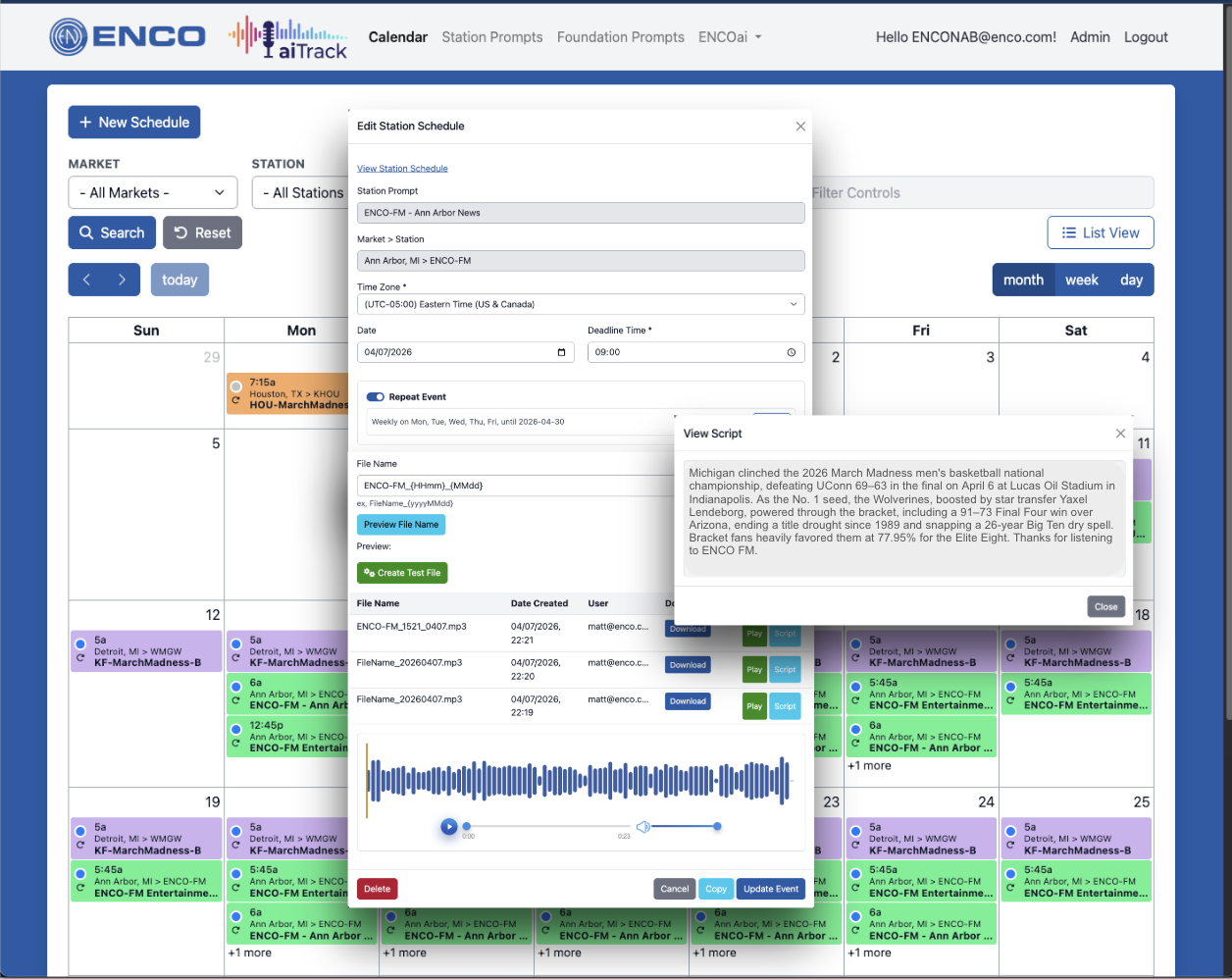
aiTrack user screen
aiTrack user screen (click to enlarge)

ENCO said its aiTrack workflow is now a fully cloud-native, automation-agnostic platform.

It will highlight this evolution at the NAB Show.

The system enables broadcasters to generate, customize and schedule AI-driven audio segments for live and automated programming. The company said cloud-native architecture now enables these benefits without the limitations of traditional infrastructure.

The tool is now accessible through any web browser. It allows on-air and production teams to create broadcast-ready content quickly using generative AI models and natural-sounding synthetic voices.

“From breaking news, entertainment, weather and sports updates to sponsored segments and localized content, the platform delivers seamless insertion into live broadcasts or scheduled playlists across terrestrial and streaming platforms.”

ENCO says its “foundation prompt” framework streamlines AI processes into intuitive templates. This lets users generate content by entering key variables such as location, format or sponsorship details.

aiTrack works with any broadcast automation system,  enabling delivery of its audio files into existing workflows from anywhere.

The company said the system now also offers more audio realism and flexibility, including multi-voice capabilities, language localization and voice cloning technology based on ENCO’s SPECai platform. “These enhancements bring AI-generated audio closer than ever to human performance,” it said.

NAB Show Booth: C2116

[Do you receive the free Radio World SmartBrief newsletter each weekday morning? Sign up here.]

The post ENCO Takes aiTrack Into the Cloud appeared first on Radio World.

  •  

Dielectric Highlights RingMaster at NAB Show

A 13-bay FM antenna with radomes lies on its side on the ground at a Dielectric factory event, as visitors walk past to inspect it
The antenna bound for Bonneville’s site in Utah is reviewed at a Dielectric factory event lin 2025.

Dielectric will feature its new RingMaster Series of high-efficiency FM antenna systems at the NAB Show.

It previewed these antennas last year and started shipping them last summer.

Dielectric will offer simulations and examples of installations in the United States and the Bahamas. Among them: Bonneville International is using a RingMaster antenna for a 13-station system at Farnsworth Peak, Utah. And Vertical Bridge installed a RingMaster auxiliary system at Cedar Hill, Texas, to transmit FM and HD Radio signals for 10 stations serving the Dallas-Fort Worth market.

The manufacturer says the new line combines the performance of its DCR Series with an architecture that provides an economical, efficient and adaptable solution for side-mounted FM systems. Dielectric says they use up to 1/3 fewer components.

“Integrating both full and half-wavelength spaced arrays, RingMaster allows broadcasters to achieve full FM bandwidth performance, something previously associated with half-wave spacing only,” it states.

It cites lightweight construction that helps with tower loading, structural concerns and installation complexities.

“The flexible design also introduces controlled elevation pattern shaping, providing customers flexibility and improved signal uniformity across the coverage area.”

NAB Show Booth: C1446


The post Dielectric Highlights RingMaster at NAB Show appeared first on Radio World.
  •  

Prism Red Is a Virtualized Broadcast Audio Receiver

Sample user screen in Prism Red

Adventure 33 will use the NAB Show to promote a new offering called Prism Red.

It describes this as the first fully virtualized broadcast audio receiver.

“For the first time ever, broadcasters can receive live programming, closure triggers and network feeds entirely in software, thus eliminating the need for dedicated hardware while preserving the reliability and performance expected of broadcast infrastructure,” the Canada-based company said.

It said Aiir’s PlayoutONE is the first automation platform to achieve “Prism Red Certified” status, which it will highlight at the convention. It said this is the first integration of Prism Red with a cloud-based/virtual playout system.

“Prism has already established itself as a true replacement for satellite distribution, delivering highly reliable audio over IP using multi-path, multi-vendor infrastructure,” it said in the announcement.

“With the introduction of Prism Red, that same proven solution is now available natively inside VM and cloud environments. This marks a fundamental shift: Broadcast reception is no longer tied to physical devices.” It said this enables faster and more affordable deployment and scaling, and more ambitious workflows.

[Related: “Prism Quattro Is a New Distribution Option”]

The post Prism Red Is a Virtualized Broadcast Audio Receiver appeared first on Radio World.
  •  

Exhibitor Viewpoint: Shure at the NAB Show

Sean Bowman of Shure
Sean Bowman

One in a series of previews asking exhibitors about their NAB Show plans and expectations. 

Sean Bowman is associate VP, sales North America at Shure Inc.

Radio World: The growth in the “creator economy” is an important theme throughout this year’s NAB Show. How are Shure’s products used in that part of the media ecosystem?

Sean Bowman: When we look at the creator economy, we see it as a broad, diverse spectrum rather than a single category. It includes everyone from individual podcasters and YouTubers to professional broadcasters, sports producers and live event teams.

Our focus is on supporting creators regardless of scale across that entire journey, starting with tools that deliver great results easily and growing with creators as their workflows become more advanced and specialized.

At the entry point, many creators are working alone or in small teams and need professional audio without a lot of technical set up. Our USB microphones and compact digital interfaces are designed to remove barriers by handling gain, processing and reliability behind the scenes, automatically. That allows creators to focus on storytelling and content while still producing audio that meets professional expectations.

As creators scale up, their needs change. They might move into live production, mobile broadcast and more complex environments where reliability, flexibility and speed matter. 

That is where our digital wireless systems, software tools and other innovative technologies come into play, helping creators manage more demanding workflows without starting over. The goal is continuity. We want creators to be able to start with Shure, stay with Shure and rely on familiar tools as their ambitions and audiences grow.

RW: Have Shure products found notable application in the exploding field of sports media? 

Bowman: Sports media has been a major area of focus for Shure and it is one where our products have been used for decades across sideline reporting, field of play capture and broadcast production. 

What has changed recently is the pace and complexity of those workflows. Sports broadcasts are faster, more immersive and more demanding than ever, which has pushed us to rethink how audio is captured, managed and delivered in those environments.

A good example of that evolution is the DCA901 Digital Array Microphone. Traditional approaches to sports audio have often required extensive manual setup and constant adjustment, especially when trying to follow unpredictable action on the field. With DCA901, engineers can digitally steer and calibrate the array in real time, saving significant setup time while gaining much more flexibility. 

It allows producers and engineers to capture exactly the sounds they want, follow the action as it moves and respond instantly as the production changes, which is critical in live sports environments.

We are also seeing that once engineers adopt these workflows in sports, they begin to recognize their value beyond a single use case. The ability to react quickly, manage uncertainty and maintain creative control has applications across other forms of broadcast and live production. 

Sports media has become a proving ground for these technologies and it continues to influence how we think about audio capture across the broader media ecosystem.

RW: What new products will you highlight?

Bowman: At NAB, we will be highlighting a mix of new hardware and software that reflects how broadcast workflows are evolving. One major focus will be SLXD+ digital wireless, which is designed for broadcast professionals who need reliable performance in crowded RF environments, whether they are working in studios, mobile broadcast setups or out in the field. We will also be showcasing our broader Axient Digital portfolio, including our latest updates and expanded features, to demonstrate how engineers can manage increasingly complex productions with greater confidence and efficiency.

Another key area of focus will be the DCA901 Digital Capture Array, which we will show in a simulated sports environment for the first time. DCA901 represents a shift in how audio can be captured in fast-paced productions by replacing traditional manual setup with digitally steerable, software-controlled workflows. 

Alongside that, we will be highlighting Action Isolator, a free software tool that helps broadcasters focus on the sounds they want to capture while reducing unwanted audio, reinforcing our broader strategy around software driven audio solutions.

We will also highlight products that reflect the growing overlap between broadcast and creator workflows. That includes portable and compact solutions like MV88 USBC and MVX2U Gen 2, as well as collaboration-focused technologies such as IntelliMix Bar Pro, built on Microsoft’s device ecosystem platform (MDEP) for modern AI powered workplaces.

Taken together, what we are showing at NAB is a portfolio designed to give customers flexibility, speed and consistency, regardless of where or how they are creating content.

RW: Has AI technology changed Shure’s products, behind the scenes or in how the products are deployed?

Bowman: Yes, AI has absolutely influenced how we think about our products, both behind the scenes in how we develop them and in how customers use and deploy them. 

In many cases, that shows up as intelligent processing that helps improve audio quality automatically, especially in less-than-ideal environments. Whether it is noise reduction, de-reverberation or sound isolation, the goal is to make it easier for users to get clean, usable audio without having to manually correct issues after the fact.

We are also seeing AI play a growing role in customer workflows that sit on top of the audio we capture. As more tools rely on speech recognition, transcription and content analysis, the quality of the audio input becomes critical. If those systems cannot clearly distinguish voices or understand what is being said, the productivity gains fall apart. That reinforces our focus on delivering consistent, high-quality audio capture, so customers can take full advantage of AI-driven tools with confidence and spend less time fixing mistakes and more time creating.

RW: What other business trends will you be watching for?

Bowman: One major trend we are watching closely is how venues and stadiums are evolving. There is a growing focus on how the in-person experience that fans hear and feel in the venue competes with versus what an audience experiences on the broadcast. 

That is driving new approaches to audio capture and distribution on both sides, especially in large, complex spaces where traditional methods no longer deliver the same impact.

We are also seeing increased interest in how technology can help create more inclusive and flexible experiences within those environments. That includes ideas like delivering consistent audio to premium seating areas, suites and hospitality spaces, as well as emerging applications such as translation and enhanced accessibility. 

As these experiences become more immersive and personalized, audio plays a critical role and we are excited to work with partners who are pushing the boundaries of what is possible in modern venues.

We’ll be discussing these topics in more detail at NAB’s Sports Summit series throughout the show.

NAB Show Booth: C4916

[For more coverage of the convention see our NAB Show page.]

The post Exhibitor Viewpoint: Shure at the NAB Show appeared first on Radio World.
  •  

Exhibitor Viewpoint: Fraunhofer IIS at the 2026 NAB Show

Mark Gayer of Fraunhofer IIS
Marc Gayer

With the 2026 NAB Show approaching, we’re providing you a series of previews asking exhibitors about their plans and expectations.

Marc Gayer is head of the Audio and Media Technologies’ Business Department at Fraunhofer IIS.

Radio World: Most attendees will have heard of Fraunhofer but may not realize its scale. Briefly, what is it and what is its core business?

Marc Gayer: Fraunhofer is Europe’s largest applied research organization, with 32,000 employees across 76 institutes, covering everything from communication systems and AI to health, mobility and media technologies. 

Fraunhofer IIS is one of the biggest institutes and home to the Audio and Media Technologies division — the people behind mp3, AAC, xHE‑AAC and today’s MPEG‑H and JPEG XS standards.

Our core mission is to develop technologies that turn scientific excellence into real‑world solutions such as efficient audio and video codecs and personalized, immersive sound. Our technologies are used for broadcast and streaming infrastructure as well as in advanced tools for content production and distribution. Continuous collaboration with global broadcasters, device manufacturers and standardization bodies ensures that our innovations reach audiences worldwide.

RW: What products or themes will you highlight at the NAB Show?

Gayer: Our focus will be on next-generation audio and professional media workflows, with major highlights from our audio and video technologies.

  • MPEG‑H Audio for broadcast and streaming — We’ll showcase new integrations of the MPEG‑H Renderer into Avid Pro Tools and Marquise Technologies’ MIST, enabling more creators to produce, QC and master immersive and personalized audio within existing workflows. We also present cloud‑based MPEG‑H Audio production and transmission workflows developed together with AWS and technology partners.
  • JPEG XS for ultra‑low‑latency, visually lossless video transport — Fraunhofer IIS will present the Emmy Award‑winning JPEG XS codec and its SDK, supporting ST 2110‑22, RTP, MXF and integration into CPU/GPU/FPGA/ASIC workflows — essential for IP‑based studio, cloud and live production environments.

RW: Fraunhofer codecs have played important roles in audio and radio broadcasting. What recent developments should we know about?

Gayer: Fraunhofer continues to advance the codecs that power today’s broadcast and streaming ecosystems. 

Recent developments include broader integration of MPEG-H Audio into cloud workflows as well as into even more professional production tools and consumer devices. 

In streaming, xHE-AAC remains a key technology for consistent, high-quality audio under variable network conditions, and adoption continues to grow across devices and platforms.

Beyond broadcast and streaming, our codec portfolio also advances next‑generation communication and immersive media, with IVAS and MPEG-I as emerging codecs enabling spatial experiences for phone calls and VR/XR applications. 

These efforts are complemented by innovations such as the integration of xHE‑AAC into modern messaging through its adoption in RCS ecosystems and LC3plus for low‑latency audio, which also has a lossless operation mode.

A particularly dynamic development is happening in Brazil, where the new DTV+ (TV 3.0) system uses MPEG‑H Audio as the mandatory audio codec. 

Consumer devices are now arriving on the market, including TVs with full MPEG‑H feature support, enabling Brazilian viewers to enjoy immersive and personalized audio at home. While Brazil leads the way, we also see growing interest from other markets in Latin America that watch this global media powerhouse closely. We expect many broadcasters to monitor the rollout of DTV+ and the viewer response during major events such as the upcoming World Cup — and some may explore similar audio innovations as Brazil’s ecosystem evolves.

RW: What have been the most important recent developments in AI for these areas?

Gayer: Within audio, the biggest shift has been the rapid move from classical signal processing to AI‑enhanced, context‑aware processing. 

For Fraunhofer IIS, this includes advances in AI‑based noise reduction, echo control, beamforming and dialogue enhancement — technologies that now adapt automatically to complex acoustic scenes in real time. 

At the same time, AI‑assisted tools are enabling more efficient broadcast and production workflows, from cloud‑based rendering to automated quality control, helping broadcasters scale modern, flexible production environments with less manual effort.

RW: What other trends will you be watching for at the convention?

Gayer: We expect strong momentum in cloud‑native and hybrid production workflows, particularly as more broadcasters adopt IP‑based infrastructures and seek interoperable, scalable audio tools. 

Personalized and accessible audio continues to gain importance, with viewers expecting adjustable dialogue levels, multiple commentary options, and mixes tailored to their listening environments. 

Additionally, the growing use of ultra‑low‑latency IP transport — supported by technologies like JPEG XS — is reshaping live production and enabling more distributed, collaborative workflows across studios and cloud platforms at the scale seen across NAB this year.

RW: What else should we know?

Gayer: Fraunhofer IIS develops technologies across the entire media chain and works with broadcasters, manufacturers and standards bodies to ensure real‑world deployment. Our goal is to make next-generation audio practical, accessible and ready for today’s workflows, a commitment reflected in the MPEG-H Audio and JPEG XS solutions we are showcasing at NAB, whether in immersive broadcasting, efficient streaming or the emerging world of personalized and interactive media experiences.

NAB Show Booth: W2343

[Read more interviews in this series.]

The post Exhibitor Viewpoint: Fraunhofer IIS at the 2026 NAB Show appeared first on Radio World.
  •  

Telos to Show New Flagship Processor at NAB

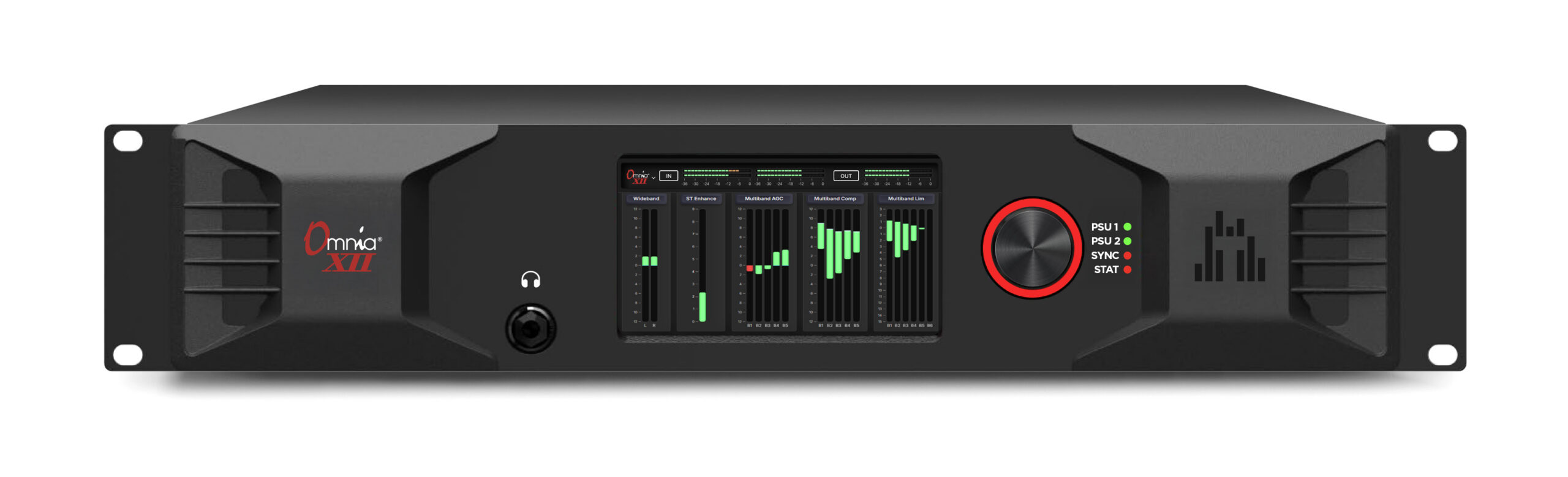
Omnia XII product image

A new flagship audio processor is coming from Omnia.

The Omnia XII for FM, HD Radio and DAB will debut at the NAB Show.

The company describes it as an all-new 2RU design, “built from the ground up by Frank Foti and his team to deliver maximum processing power, punch and performance on a flexible platform that can grow and evolve along with the needs of modern radio.”

Its design includes a wideband AGC; five-band multiband AGC and compressor; and a six-band multiband limiter, coupled with “smart” dynamic EQ and refined bass management tools.

Telos Alliance says the multiband section feeds a newly designed clipper developed through “intensive” research into delivering on-air loudness while eliminating distortion and listener fatigue that can come with aggressive processing. The clipper is called “Clemenza” after a character in “The Godfather.”

Omnia XII comes with a toolkit that includes a dynamic RDS encoder with optional UECP support, ratings watermark integration via SDKs from Nielsen, Kantar and Ipsos, and a dedicated insertion point that allows external devices such as the 25-Seven Voltair watermark processor to be introduced at the “sweet spot” in the airchain.

Features include ITU-R BS.1770 loudness and MPX power meters, a digital oscilloscope, an FM spectrum analyzer and Omnia QuickTweak controls. The company says these simplify processor tuning by adjusting multiple parameters simultaneously.

Connectivity includes analog, AES and composite MPX I/O. The processor supports Livewire+ AES67 AoIP, standard linear MPX over IP, optional µMPX encoding and an optional stream receiver supporting Super Hi-Fi’s HLS+ with metadata routing to RDS and up to 24 hours of backup playout capability.

Dual redundant internal power supplies and relay bypass on primary I/O paths provide resilience and switch-over to backup airchains. LWRP, Rest API and hardware GPIO facilitate remote triggering and control of events and parameters.

NAB Show Booth: C1819

Info: www.telosalliance.com

The post Telos to Show New Flagship Processor at NAB appeared first on Radio World.
  •  

Wheatstone Highlights Hitless Failover

Wheatstone is teasing more of its product highlights for the NAB Show.

It plans to demonstrate a new hitless switching option to assure zero downtime of critical components in a WheatNet IP audio network.

This technology was introduced last year as an option for Wheatstone’s Arcus IP audio console for television sound. Hitless failover redundancy is now an option for the Blade 4 I/O access units and mix engines for LXE and Strata consoles and surfaces.

“With this, WheatNet IP audio networked facilities can seamlessly switch to a backup I/O access unit and/or a console mix engine for continuous operation during an emergency,” it said.

“Unlike traditional failovers, which can often cause a slight pause while switching to a backup, hitless redundancy eliminates packet loss, making it ideal for live video (SMPTE-2022-7), audio (AES67) and critical network traffic.”

The technology features dual mix engines or I/O Blades synchronized in real time. Should a primary Blade 4 or Mix Engine fail, the backup Blade 4 or Mix Engine takes over for uninterrupted service.

“A high-frequency ‘heartbeat’ between primary and backup units enables automatic failover, ensuring rapid recovery in the event of a failure. Active and standby unit statuses are displayed in WheatNet IP Navigator management software, with manual failover options available for controlled transitions during upgrades or maintenance.”

Wheatstone also plans to show the Audioarts DMX 12 console for single or networked studios.

The DMX-12 console surface
DMX 12

“DMX 12 is ready for air and comes with a rackmount engine with audio, logic, I/O and expansion ports for just about any studio configuration,” it said. “Included is a five port Ethernet switch as well as WheatNet IP audio network connectivity.” The DMX line also is available in eight- and 16-channel configurations.

We noted earlier that at NAB the company will show the VMX mixing platform as well as the VML virtual mixing console.

NAB Show Booth: C1051

The post Wheatstone Highlights Hitless Failover appeared first on Radio World.
  •  

Suess on the Myriad Uses of AI in Media

Kyle Suess stands outside in front of shrubbery, wearing a sports jacket and open-collared shirt
Kyle Suess

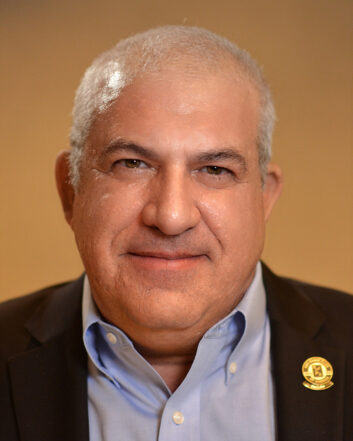
Kyle Suess is co-founder of Amira Labs. During the NAB Show he will give a talk as part of the SBE Ennes Workshop on April 21 about “Myriad Uses of AI in Media,” including for radio.

Radio World: What does your company do?

Kyle Suess: Amira Labs builds AI software for broadcast and media teams to detect, diagnose and help resolve content issues in real time before viewers notice. We automate audio/video QC, compliance and language/caption checks across live and VOD workflows. Our solutions are deployed on-prem or in the cloud, including fully air-gapped installations where models run locally with no third-party APIs required.

RW: What’s your background?

Suess: It is in building software products. I became drawn to a blend of tech and media starting in college in 2013 while working at a startup that was commercializing natural language processing research for multi-language translation and metadata tagging of videos from YouTube, news publishers and other online platforms.

That was the spark that led me to working at another startup, Grafiti, where my Amira Labs co-founder Stefan and I leveraged machine learning to catalog thousands of graphics and charts to make it easy for journalists and news media to weave them into stories.

These experiences brought out a motivation to get more involved in SMPTE, to learn from those who know more than me, and ramp up building useful tools for broadcasters. Our first Amira Labs-product designed for scalable, low-latency captioning, translation and language identification won NAB’s PILOT Innovation Challenge award.

RW: Broadly speaking, what are examples of how AI is being used in media now?

Suess: Captioning is the big one that many people have seen by now. There are a lot of captioning choices in the market, though be mindful of aspects like language support, latency and usage costs for captioning for long periods of time across many feeds.

Clipping highlights, content tagging and dubbing/AI voiceovers are other top examples. These applications of AI help with quickly generating highlights to post across social media, analyzing saved files to generate metadata for easier searching in media asset management (MAM) systems, and generating synthetic voices to narrate a script or speak in another language.

From a pragmatic sense, AI is widely being used in media as a service delivered through one of the “Big 3” providers of Google (Gemini), OpenAI (ChatGPT) and Anthropic (Claude) for typical everyday tasks like debugging networking issues, generating show rundowns, analyzing advertising data, etc.

This works at an individual level, but can be very expensive and limiting at scale, especially when actually involving content — audio streams, media streams, codecs, containers. For a lot of media companies, the last few years have involved “R&D science projects” relating to incorporating AI.

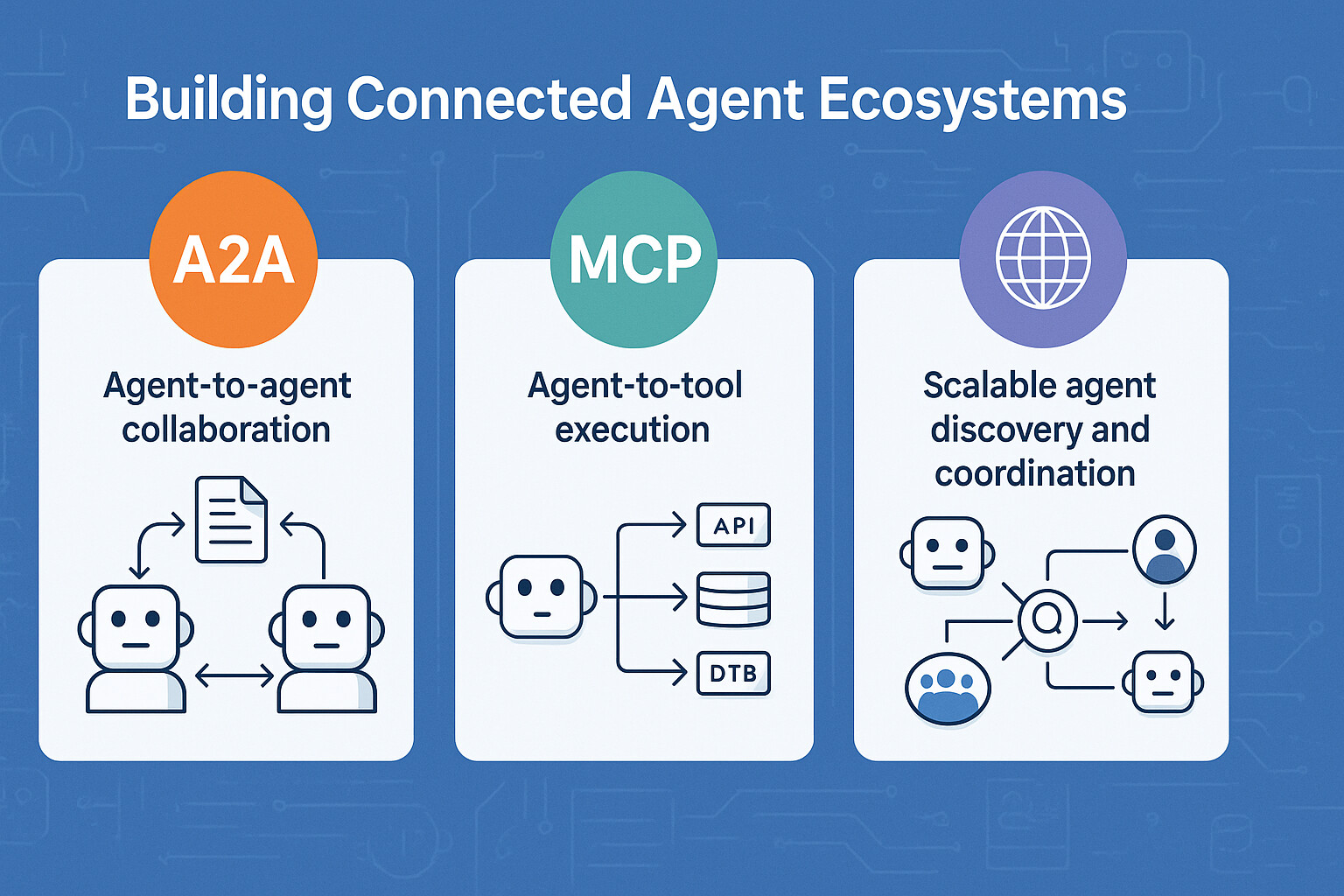
An infographic headlined "Building Connected Agent Ecosystems"
AI protocols that Suess will discuss for media uses cases.

What I will highlight is bringing an engineer’s mindset to strategically approaching AI and navigating how to build with it, beyond R&D. It’s important to be cognizant of the bigger picture and be calculated with assessing options when making AI decisions. There’s so much innovation happening nearly every week in the open-source world. I’ll highlight some of the most impactful and useful projects for media organizations.

RW: Specific to Radio World readers, what instances can you describe?

Suess: Translation of radio programs from English to other languages, done locally by uploading a script. The motivation for this use case is from working with a radio station in Kansas that wanted to reach more Spanish speakers and automatically translate their English programs, while still making it sound natural and not as robotic. This can go beyond Spanish to other languages catering to the community demographics of different radio markets, like Chinese in the Bay Area, Vietnamese in Orange County, Arabic in Detroit, etc.

Another use case is real-time content classification and segmentation of radio broadcasts.

Consider that a major U.S. radio broadcaster has multiple programs running simultaneously and they want to listen and classify different segments of the programs, or conversations if it’s like a podcast. This is where AI can be useful to easily save snippets of content that could be repurposed for a multitude of uses, without having to put in hours and hours of manual effort.

RW: Much of the attention around uses of AI focuses on negative impacts on human-based workflows. What’s your view?

Suess: First, I think it’s a valid concern and I wouldn’t dismiss it. We hear about the hype around the gold rush and efficiency multiplier aspects of AI in the news. Sometimes, it sounds like CEOs reimagining the 1960s “Twilight Zone” episode, where an enterprise can turn itself into a workforce of machines overnight.

I think AI is a greater enabler and augmenter to save time on the work we struggle with doing and don’t look forward to doing. However, I’m not sold that propositioning AI as a full replacer of humans is the next best move.

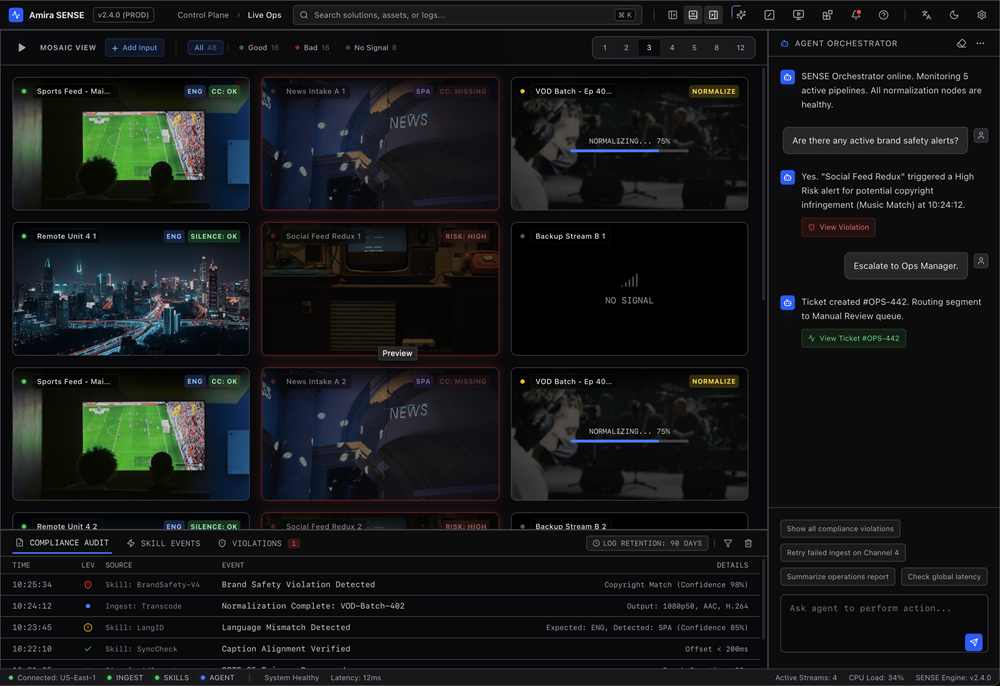
Screenshot of a multiviewer mosaic with an AI agent interface to obtain real-time understanding for user-requested live video feeds.

There’s a divergence between business aspirations and reality, and the reality of the situation is there’s still so much nuance, tribal knowledge and (let’s face it) chaos involved in making media happen that it seems short-sighted to sacrifice those built up in-house advantages.

I think the biggest gains will come from equipping employees with the AI tools that will bring the people and technology together to achieve those more productive outcomes desired.

In thinking about the impact of AI on jobs, there’s a great video from 1979 on YouTube of an interview about the impact of computers. If you replace “computer” with “AI,” the same thoughts we are grappling with today seem not so different than those of 47 years ago.

Perhaps looking back at the past will help offer informative moments of clarity for what we should really be doing with AI when going forward.

Amira Labs will be in booth W2217, sharing space with Open Broadcast Systems in W2219.

The post Suess on the Myriad Uses of AI in Media appeared first on Radio World.
  •  

“Control What We Can, and Propel Forward”

We’re previewing the spring NAB Show in this series of articles. Here we consider challenges for radio sales departments.

Mike Hulvey is president and CEO of RAB and Dave Casper is its SVP, digital services. The RAB is a trade association that supports U.S. radio broadcasters in generating revenue.

Mike Hulvey headshot
Mike Hulvey

Radio World: As radio broadcast companies prepare to head to the convention, what do you consider the most important challenge facing their businesses?

Mike Hulvey: There’s a lot of uncertainty in the marketplace that we broadcasters cannot control. However, I tend to look at the challenge differently: Control what we can, and propel forward. With that, it’s critically important that broadcasters look ahead, innovate and plan for the future. And above all keep the eye on the ball, for our customers, listeners and our advertisers alike.

RW: You’ve recently published a report on the growing percentage of radio’s revenue that comes from digital sources. In the bigger picture, commercial U.S. radio revenue is down markedly from 15 or 20 years ago. What are the obstacles to radio companies returning to larger-scale growth in revenue?

Hulvey: In an increasingly fragmented media marketplace, radio continues to shine. All the collaboration that we’re embarking upon in ways that we’ve never done before, especially as it relates to measurement and addressing our advertisers’ needs under the “One Voice, Better Together” initiative, which addresses some of the obstacles to driving more revenue and increasing our share.

Above all, we must tell our story and ensure we’re responsible for the narrative.

RW: How will AI change how radio runs its businesses and workflows, beyond what we’ve seen to date so far? 

Dave Casper: AI is transforming every corner of business and our economy. It will undoubtedly have a profound impact on how radio operates.

Dave Casper headshot
Dave Casper

As to how, like so many other companies, I think broadcasters are still working through this. Speaking from a sales standpoint, for the moment, it’s a workforce multiplier, allowing our sales teams to work faster and smarter, uncovering new sales opportunities and providing AEs with an unprecedented level of information they can use to help the local advertisers grow their business.

From copywriting and prospecting tools to enhanced CRM interactions and tools to help AEs plan and execute more effective audio and digital marketing strategies, AI is already helping AEs radio drive revenue.

However, I think this is just the beginning. Without a doubt, agentic AI will be the next big thing, as broadcasters start linking systems and information sources to drive further innovation and more effective solutions for our advertising clients.

RW: What sessions will you be participating in at the NAB Show, and what will you discuss?

Hulvey: We’re excited about RAB’s upcoming sessions, whether it’s our roundtable participation at the Small and Medium Market Radio Forum around RAB’s AI resources for broadcasters, or our two-session series on digital sales with Gordon Borrell highlighting our 14th annual benchmark report.

Lastly, the midterms are around the corner, so we’re going to have our good friend Steve Passwaiter join us for a session dedicated to political, and specifically how broadcasters can create more value and opportunities for local candidates.

RW: What other trends or technologies will you be watching for in the exhibits, the sessions or the hallways?

Casper: Isn’t that the exciting thing about NAB? Around every corner, there is something new to learn.

I’m excited to visit the Xperi booth and look in on DTS AutoStage. It’s such an exciting technology.

Getting back to AI, I’m also curious to see how broadcasting’s many vendors and partners are integrating AI into their product lines.

When you think about the intersection of broadcasting and AI, much of the heavy lifting will be done by the companies supporting our industry. How are they using AI to create smarter technology and tools. In turn, how can we leverage their work to drive the industry forward.

[Read more observations about current radio business trends in “Radio Managers Navigate the Rivers of Digital.”]

The post “Control What We Can, and Propel Forward” appeared first on Radio World.

  •  

Orban to Offer Quu as Integrated Option

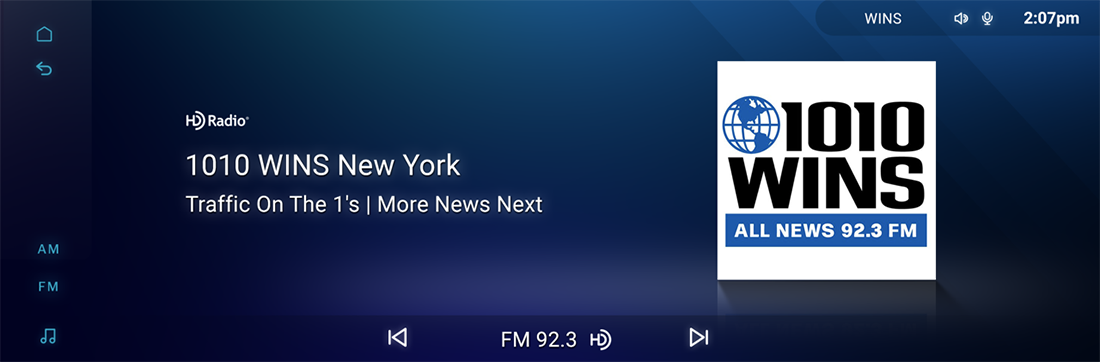
A sample Quu message for WINS on an HD Radio receiver

Orban Labs plans to offer the Quu360 Visual Radio platform as an integrated option for its Orban Optimod 5950 HD processor.

“This option for the 5950 HD eliminates the need for external PCs and simplifies the broadcast chain while improving a station’s presence on the dashboard,” they said in a release.

“Traditionally, radio stations have relied on separate systems for automation, metadata correction, visual messaging and RDS encoding, often requiring dedicated Windows-based PCs in the airchain.”

They said the embedded Quu360 option provides several benefits. It allows broadcasters to ingest metadata from cloud automation systems via HLS streams; normalize and correct artist/title data in real time; insert synchronized visual messaging for advertising and promotions; and deliver formatted metadata to the built-in RDS encoder. External Quu360 PCs are not needed.

“Broadcasters have the benefit of a consistent, high-quality display on the dashboard, with standardized song titles/artist data and support for synchronized advertiser messages,” the said.

The announcement was made by Orban President David Day and Quu VP of Technical Success Joe Marshall.

Marshall called the announcement “a major step forward in making synchronized metadata and advertising more scalable.”

Orban will be in booth C1259 at the NAB Show. Quu will be in meeting room C2658MR

[Going to NAB? Radio World readers are invited to attend a session on the show floor moderated by Editor in Chief Paul McLane called “Radio: The New Boutique Business?”]

The post Orban to Offer Quu as Integrated Option appeared first on Radio World.

  •  

Don’t Try This at Home

Alan Spindel is president of the Radio Club of America and senior electrical engineer for Ten-Tec/Alpha RF Systems. He develops hardware and firmware for amateur and professional radio systems.

He will moderate a Monday morning session at the NAB Show’s BEIT conference called “War Stories From the Front Lines of Broadcasting” featuring Bob Orban and Mike Pappas of Orban Labs, and William Harrison of WETA(FM) in Washington.

Alan Spindel
Alan Spindel

Radio World: How did this session come about?

Alan Spindel: The Radio Club of America honored Bob Orban with the Jack Poppele Award, which is named after broadcast pioneer and VOA director Jack Poppele, at the club’s 116th annual awards banquet. The award recognizes individuals who have made important, long-term contributions to radio broadcasting. 

Bob was unable to attend, so RCA Fellow Mike Pappas of Orban Labs accepted on his behalf. It is customary for recipients to give a talk at the technical symposium that accompanies the banquet; I asked Mike if he could share some practical field experience, as the symposium was heavy on theory this year. 

Mike gave a great presentation that included an exploding transfer switch blown to bits on security camera footage; screwdrivers jammed in to hold RF contactors closed; and the results of someone accidentally running full daytime power into a nighttime low-power tuning unit. 

A transfer switch explodes as seen on security video.

When NAB asked RCA as a partner organization to host a panel at the BEIT, I asked Mike if he could reprise his talk and bring in other panelists. He agreed on the condition that I add some of my own war stories, a few of which involved Mike. We agreed the format would be irreverent and lighthearted.

RW: Can you give a few more examples? 

Spindel: Mike has great stories and photos from a recent AM site renovation in Utah. Other tales include a six-figure hardline burnout caused by a 19-cent zener diode, and a DJ who panicked when the fire alarm annunciator panel caught fire in the control room and emptied an entire dry-chemical extinguisher into the on-air console and cart library.

A screwdriver has been used to hold RF contactors closed.

RW: What kind of practical knowledge are you looking to impart?

Spindel: There is a common misperception that young, up-and-coming broadcast engineers lack adequate RF knowledge or experience. I believe it is a misperception because if you lack RF knowledge, you will gain it quickly on the job. 

Much of the procedural and troubleshooting knowledge that exists in a modern broadcast plant is not in any textbook. These hard-won lessons must be passed down to each new generation. 

Our goal is that practitioners of all experience levels take away something useful to apply or pass along. The takeaway: You must survive and thrive where failure is not an option. The show must always go on. We hope every attendee will be both enlightened and entertained.

RW: What else should we know?

Spindel: A station GM, himself a former engineer, once asked me what I thought about a person he was considering hiring after meeting him for the first time.  I said, “He’s like us: someone who would never leave the transmitter site in the middle of the night while the station was still off the air.”

Broadcast engineering is a unique field with no formal academic path. It encompasses high power, RF, towers, generators, audio, video, microwaves, winches and four-wheel drives, to name a few disciplines. Knowledge is gained almost entirely through on-the-job experience. 

If this forum imparts even a small measure of that knowledge to the next generation through lessons learned, it will be a great success.

[Do you receive Radio World’s daily SmartBrief email every weekday morning? It’s free here.]

The post Don’t Try This at Home appeared first on Radio World.
  •  

ENCO to Demo Remote Cloud Captioning at PREC

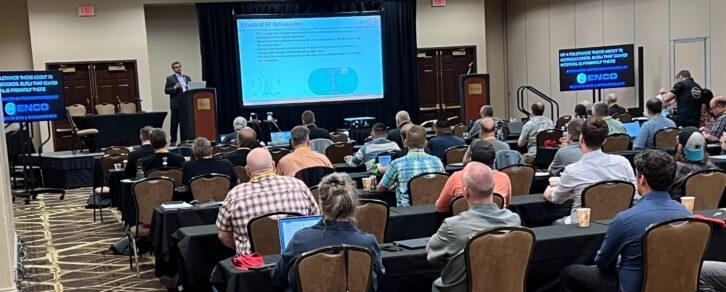
Attendees at a previous PREC event listen to a speaker.
Attendees at a past PREC. Captions from ENCO are visible on the displays to each side.

At the Public Radio Engineering Conference coming up, ENCO plans to showcase an application of its enCaption technology that also benefits attendees in the room.

The software company said it will highlight enCaption’s remote, cloud-based captioning workflow for live event presentations. As in the past it will generate real-time captions for PREC session displays, but now without needing on-premises hardware.

“Instead, ENCO will securely receive audio feeds from the conference, process captions through its cloud-based infrastructure and return live text in real time for display on-site via standard web browsers,” it said in a press release.

“The approach demonstrates a flexible, scalable alternative for live event captioning, particularly in environments where rapid deployment or minimal on-site resources are required.”

ENCO said this also enhances accessibility for engineers who won’t be in Vegas but attend virtually.

Scott Hanley, president of the Association of Public Radio Engineers, said, “The ability to caption in real time for both in-room attendees and remote participants — and even offer multiple languages — represents accessibility for the future.”

PREC takes place April 16–17 at the Tuscany Suites Hotel in Las Vegas. ENCO also will exhibit at NAB.

The post ENCO to Demo Remote Cloud Captioning at PREC appeared first on Radio World.
  •  

Beasley Station Will Demo WO Aurora at NAB Show

A Beasley Media Group station will broadcast live from the floor of the NAB Show to help demonstrate a new automation offering from WideOrbit.

KCYE(FM) 102.7 Coyote Country will use the WO Aurora platform to broadcast from the WideOrbit booth in the Central Hall on Monday and Tuesday April 20 and 21, from noon to 3 p.m. each day.

The software supplier said WO Aurora is a cloud-powered evolution of its WO Automation for Radio platform that provides hosting flexibility and several new options.

Shawn Stevens, KCYE program director and morning host, will use the new Web Studio browser-based interface, to control the station and its new Live Mic feature to broadcast live.

NAB Show Booth: C3038

The post Beasley Station Will Demo WO Aurora at NAB Show appeared first on Radio World.

  •  

JetPak Is a New Offering From Logitek

Logitek has launched JetPak, which it described as a compact, hardware-based USB audio interface intended to simplify how computers connect to Livewire AoIP networks.

It will be shown in the MaxxKonnect booth at the NAB Show. Logitek is partnering with MaxxKonnect on the product.

“Supporting up to four stereo inputs and 10 stereo outputs, along with integrated GPIO and logic control, JetPak provides a direct bridge between standard USB audio and Livewire environments, without the need for dedicated software drivers or additional licensing,” it said in the announcement.

JetPak can be held in the palm of a hand and can be moved from computer to computer.

“Configuration is stored within the device itself, allowing it to move easily between systems while retaining channel mapping and logic, making JetPak ideal for easy deployment and rapid disaster recovery.”

Logitek said JetPak combines “the ease of plug-and-play USB sound with the security of a physical hardware buffer,” minimizing direct network exposure from host computers.

JetPak will ship in Q2. It was announced by Logitek founder Tag Borland and MaxxKonnect President/CEO Josh Bohn.

NAB Show booth: C2038 (MaxxKonnect)

The post JetPak Is a New Offering From Logitek appeared first on Radio World.
  •  

BDI Rolls Out Control Platform for High-Power Systems

Broadcast Devices PCC-300

Broadcast Devices Inc. is offering the PCC-300 3 Switch Combiner Controller, which it describes as an SNMP-enabled control platform intended to simplify and safeguard RF switching in high-power dual-cabinet transmitter systems that use hybrid power combiners.

“Modern FM and television transmitters frequently combine the output of two final amplifier cabinets to achieve higher power levels,” it notes.

“In these systems, reliable and repeatable control of motorized RF switches or switchless combiners is critical when transitioning between combined operation and single-cabinet service modes.”

BDI said the PCC-300 addresses this by providing centralized control, interlock management and status monitoring for up to three motorized RF switches in a 1 RU chassis.

An optional redundant power configuration is available for mission-critical sites requiring increased system availability.

“The PCC-300 supports four standard operating modes commonly required in combiner installations: Transmitters A + B to Air; Transmitter A to Air with Transmitter B to Test Load; Transmitter B to Air with Transmitter A to Test Load; and Transmitters A + B to Test Load,” BDI said.

“Built-in interlock sequencing and dedicated ‘RF Safe’ inputs ensure switch movement occurs only under safe operating conditions, helping protect RF switches and transmission equipment during maintenance or fault conditions.”

It works with motorized RF transfer switches from major manufacturers and offers optional factory-fabricated control cables to simplify installation.

For control and monitoring, the unit includes Ethernet with SNMPv2 agent support, a supplied SNMP MIB and a free Windows graphical user interface. It provides GPIO and dry-contact interfaces for integration with legacy remote control systems and local panels.

It is available from BDI dealers.

NAB Show Booth: C2816 (Broadcasters General Store)

The post BDI Rolls Out Control Platform for High-Power Systems appeared first on Radio World.

  •  

Comrex Enhances FieldLink and ACCESS

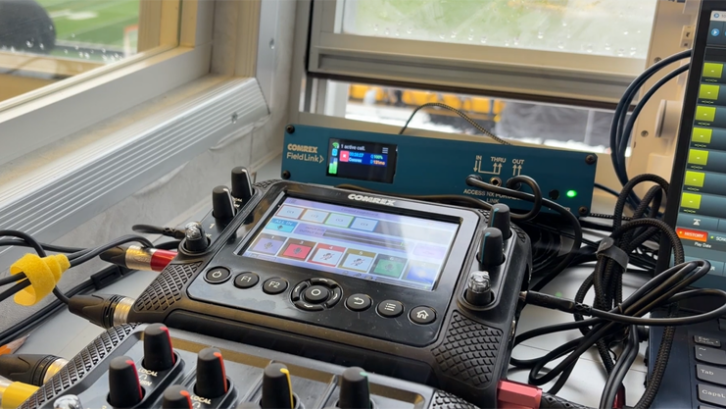
Comrex’s FieldLink unit
Comrex’s FieldLink

On the heels of last fall’s release of its FieldLink sideline reporter codec, Comrex will introduce FieldLink enhancements at the NAB Show. 

Comrex MIC-e (pronounced “Mikey”) is an XLR-to-USB-C microphone interface that the company has created for use with the free Comrex FieldTap app for iOS and Android. 

It offers dedicated input gain and headphone volume controls for return audio via the 3 mm output jack. 

“MIC-e also features side tone audio, which allows the talent to hear themselves while speaking, a feature lacking in other commercially available USB-C microphone interfaces,” the company stated.

A new Wi-Fi 7 Wireless access point for FieldLink also will be on display.

Comrex also promises major enhancements for the ACCESS NX Rackmount and ACCESS MultiRack, and ACCESS VM IP audio codecs such as Livewire integration for auto mix-minus and embedded GPIO to enhance the ACCESS line’s AES67 compatibility. 

“NAB attendees will also be able to get a first glimpse of some major Switchboard TS upgrades and improvements.”

Comrex will be in the Central Hall in booth C2243.

Info: www.comrex.com

[For News Like This See Our Show News Page]

The post Comrex Enhances FieldLink and ACCESS appeared first on Radio World.
  •  

How Boosters Can Help AM Stations

David Layer of NAB
David Layer

We’re previewing technical sessions and trends of the upcoming NAB Show.

NAB Vice President, Advanced Engineering David Layer will give talks about AM radio and hybrid platforms before and during the convention.

Radio World: What will your sessions be about?

David Layer: My presentation to the Public Radio Engineering Conference will focus solely on AM radio, and I plan to spend most of my time telling the audience about all the interesting AM radio-related work ongoing within the National Radio Systems Committee.

As it turns out, my colleague and good friend John Kean is presenting at the PREC as well, also about AM radio, so he and I will be coordinating our presentations as we work together on the NRSC projects.  It’s fair to say that John is the brains behind a lot of this work, and we’re fortunate that he is “on the job” here.

Also I’ll be speaking on the NAB Show floor on Tuesday, in the TV and Radio HQ Theater, about “Improving AM Coverage and the Future of Digital Radio Listening.” 

This talk will include some of the material I’m discussing at the PREC, in particular on the NRSC’s AM booster project, targeted to a different audience. I also plan to discuss my thoughts on the importance of broadcasters using digital radio signals and why digital plus hybrid — over-the-air plus internet — technology is the best combination to keep their stations “looking as good as they sound.”

RW: The NRSC has been conducting research about AM single-frequency networks. What is the status of that work?

Layer: AM broadcasters are disadvantaged compared to FM and TV broadcasters in that they are not authorized by the FCC to make use of on-channel booster stations.  

Also known as single-frequency networks or SFNs, main signal-booster signal combinations can help broadcasters reach listeners within a station’s service area that experience poor reception. Modern transmission technologies, including RF channel simulation tools that accurately model SFNs, and precise timing control between main and booster stations, are being used successfully in the support of SFNs in FM radio and broadcast TV services.

It stands to reason that AM broadcasters should also be able to employ these techniques and improve their coverage and service to listeners.

The NRSC is pursuing an AM booster project with the ultimate goal of developing a technical record to support adoption of a petition for rulemaking at the FCC that establishes rules for AM booster stations. 

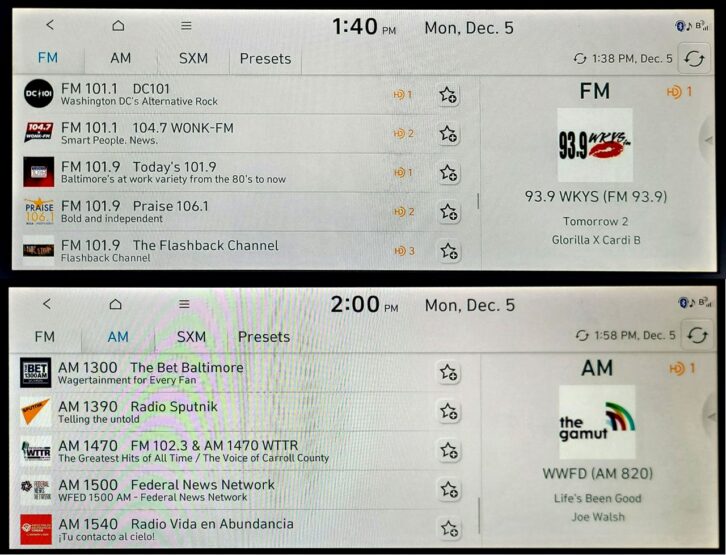
Station lists in a Hyundai Ioniq 5 with DTS AutoStage.

This project is expected to consist of a number of phases including laboratory testing of AM co-channel interference to develop parameters for booster station design; investigation into small antennas suitable for booster station operation; and ultimately construction and field testing of an AM radio SFN utilizing the learnings of the earlier work, under experimental authorization.

Our current challenge is identifying a full-service AM station that we can work with on booster experiments. We hope to identify a station in the Washington, D.C., area as that is where our testing resources are located. Once a plan is in place for conducting tests on a specific station, I expect the other parts of the project will move forward. 

RW: Hybrid radio systems like DTS AutoStage are becoming more prevalent in automobiles. What do they portend for the way radio uses metadata and its broader user experience?

Layer: I am a big fan of hybrid radio systems, and DTS AutoStage is clearly leading in this technology. Well-designed hybrid radio systems give the AM and FM radio bands a totally consistent user experience with respect to metadata, where all stations in the band look great with station logos and station information.

NAB recommends that all broadcasters participate in hybrid radio and make the necessary investments to provide great metadata to listeners. At the same time, many broadcasters should also be thinking about how they can support digital radio (i.e., HD Radio) technology and start broadcasting in digital.  

There are far more vehicles with HD Radio than with hybrid radio, and the radio “product” on the dash will look better and better as more broadcasters consistently transmit metadata using the HD Radio system. 

RW: The number of AM stations in the United States has been declining, slowly but consistently, for some time. What role do you see the band playing in American life in another few years?

Layer: AM radio continues to play a vital role in the emergency infrastructure of the U.S. as the backbone of the Emergency Alert System. This is a role not easily replaced by other technologies, and NAB has been a strong supporter of the AM Radio for Every Vehicle Act, which recognizes this and would keep AM radio in vehicles for the safety of all Americans.  

As an audio service, both AM and FM face challenges due to the increased competition that internet-delivered audio represents. I primarily focus on the technical aspect of these services in my role at NAB, and I expect NAB to continue to investigate and encourage use of technologies, like AM boosters and the use of digital radio, that help broadcasters to stand out in this ever more crowded field of choices.

[For more coverage of the convention see our NAB Show page.]

The post How Boosters Can Help AM Stations appeared first on Radio World.
  •  

Tieline Will Debut ViA Duo Codec

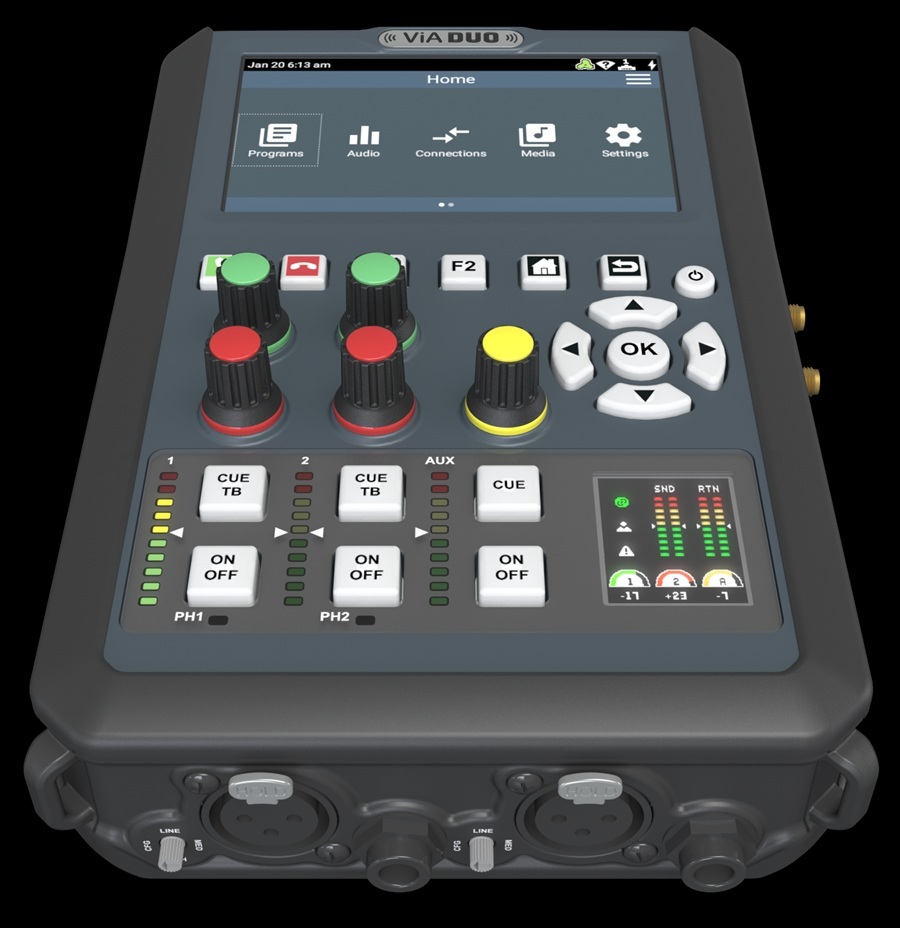
The ViA Duo portable codec
Tieline ViA Duo

Tieline will debut its ViA Duo codec at the NAB Show.

“ViA Duo is an ultra-portable broadcast platform that unifies IP workflows by delivering an all-in-one solution for remote broadcasts, commentary and off-tube broadcasting,” the manufacturer said in a release.

Charlie Gawley, VP Sales APAC/EMEA, said the ViA Duo bridges a gap between field reporting and commentary. It operates as an IP codec or AoIP commentary node, or facilitates off-tube broadcasting through support for audio and a video feed.

“ViA Duo supports HDMI video out, multiple AoIP protocols, plus IP streaming over multiple interfaces.”

Applications reporters with a guest; two commentators broadcasting sports events; announcers working from home; talk show and other radio show hosts on the road; off-tube commentary, or a sports commentary unit over AES67, ST2110-30, Livewire, Ravenna or Dante. An AoIP and Dante card is optional.

Tieline says the ViA Duo is lightweight and fits in the palm of a hand.

Features include two XLR mic/line inputs and headphone outputs. It can send bidirectional stereo or dual mono IP audio from a remote location to the studio using cellular, Wi-Fi or Ethernet connections, with no need for additional gear.

“Use ViA Duo as an AoIP node in stadium commentary booth and connect over a LAN to a remote truck, or over a WAN to a mixing console at a studio REMI hub. Off-tube commentary is also supported so your commentary team can receive a live video feed and call a game from wherever they are in the world.”

Remote control is provided using the embedded Toolbox Web-GUI or optional Cloud Codec Controller.

NAB Show Booth: C2246

The post Tieline Will Debut ViA Duo Codec appeared first on Radio World.

  •