The latest round in a back-and-forth surrounding interference complaints from a full-power station near the North Carolina/Virginia border has resulted in a Federal Communications Commission order for the translator in question to shut down for now.
We’ve covered the interference complaints that stem back to the fall of 2024 from Lakes Media, the owner of Class C3 98.3 WLUS(FM) in Clarksburg, Va. Its antenna is located just across the North Carolina state line in Granville County.
After Lakes Media’s first interference complaint, the FCC ordered same-channel W252EL(FM), a 150-watt “Rock FM” translator licensed to Cary, N.C., to go silent until it could implement a directional antenna pattern that avoided overlap with the WLUS 45 dBu contour.
The owner of the translator, Curtis Media, said it did so, and it returned to the air last September under program test authority. Curtis filed an application for a license to cover the new facility.
Lakes Media President Tom Birch quickly filed an opposition, arguing the application should be denied because WLUS was again suffering harmful interference.
The parties went back and forth some more. Curtis Media alleged that Birch repeatedly suggested paying $500,000 to settle the matter, “indicating that profit motives, not the interests of its listeners,” underpin Lakes’ interference allegations, according to the commission’s account.
Then in November, Birch and Lakes filed 10 listener complaints within WLUS’ protected 45 dBu contour, each plotted on a map, as well as signal strength data from each listener location.
“After enduring this three times since 2016, I am outraged that there are no FCC provisions for interference violators to be liable for reimbursing all of the expense incurred by the injured parties,” Birch told Radio World.
Birch ventured that Lakes Media spent “tens of thousands” of dollars in legal and technical expenses in trying to prove the interference.
Curtis argued that the latest exhibit was invalid because, among other reasons, nine of the listener complaints were clustered around the immediate neighborhood of Birch’s Raleigh-area residence.
“While the commission’s FM translator interference complaint process requires complaints to be from ‘separate receivers at separate locations,’ the commission surely did not envision ‘separate locations’ to mean more than a half-dozen houses in the same compact subdivision,” Curtis wrote.
The translator owner also argued those complaints should have been originally included in Birch’s 2024 filing. It further argued that its new antenna pattern, in terms of interference, was not being properly considered without the use of higher resolution terrain samples.
But the commission rejected Curtis’ argument about terrain accuracy and said that there is no rule or precedent supporting its claim “that listener complainants may not be clustered in a single neighborhood.”
All told, the Media Bureau found the latest evidence from WLUS compelling. While it cautioned Lakes and Birch against any possible abuse of process arising from financial settlement, it said that WLUS could not have collected the second round of listener complaints regarding the new pattern until it was actually on the air.
It found the complaints valid and, as a result, the Cary translator must shut down immediately. Curtis must first demonstrate, prior to any operation or processing of its new application, that it has resolved all listener complaints submitted by Lakes Media.
Radio World has also invited comment from Curtis Media.
With CBS News Radio about to sunset, a new operator will unveil a news network promising several technological advancements.
Live Channel USA is announcing the launch of the Radio Network News Service for U.S. stations. A bridge service will be available for affiliates beginning May 23 — one day after CBS News Radio is scheduled to shut down.
Dan Warren
While the network has roots in European broadcast technology and maintains a global hub in London, the rollout — which Live Channel calls the “Change Bulletin Supplier” initiative — is designed for the U.S. market, according to founder Dan Warren.
The network follows a traditional barter model, providing top-of-the-hour and half-hourly bulletins available in one-, three- or five-minute segments with a standard national commercial load.
Its primary differentiator, Warren says, is localization. RNN utilizes a cloud-based system to produce customized offerings designed to feel more like a regional partner.
“For example, a significant Florida story that might not make a national cut will still appear on our Florida affiliates’ bulletins but not in New York,” Warren said.
The full network will roll out on June 1. It is led by a veteran team with international broadcast experience from outlets such as Sky News, the BBC and CNN.
He managed to work nearly 65 years in the biggest city in the U.S., and in doing so, earned the admiration of his broadcast engineering peers.
Richard Ross, a longtime chief engineer in New York City, died on Feb. 12 at the age of 89. He is survived by his daughter Erica, who shared many details with us from his life.
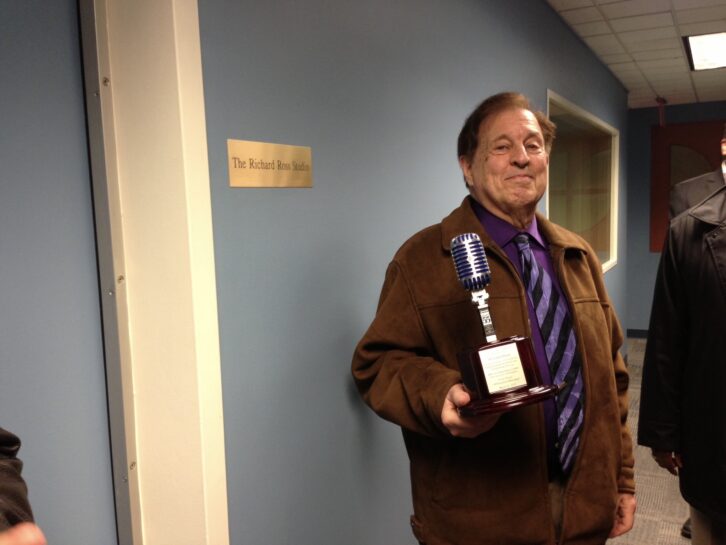
In March 2013, Ross received recognition of 50 years of service to WADO(AM). The Richard Ross Studio was named in his honor. Credit: Erica Ross
Ross joined 1280 WADO(AM) in the summer of 1972 as a relief engineer. By his count, he would withstand eight ownership changes until his retirement as chief engineer from Univision Radio in June 2020 at the age of 84.
Fellow engineers would call Ross frequently after his retirement, and for a time, he offered consulting services.
“He had a kind of Harry Potter-like knowledge of it all,” Erica said.
“Those who knew Richard lost a member of their family with his passing,” said Santos Lebron, engineering supervisor at Univision Radio New York.
Lebron’s relationship with Ross went back decades; they met when Lebron was hired as a relief engineer at WADO in 1977. He and others remembered Ross for being well-dressed and possessing a level-headedness, amicable toward all and harboring a bit of a mischievous side.
Ross knew of his fortune to work in the Big Apple for so many decades. “It is a rare occasion where one starts their career in any major city and they eventually work their way up the line to more important positions in major communications hubs,” he wrote in a piece for Storyworth.
Along with WADO, Ross spent many hours with the equipment above the Empire State Building when Heftel Broadcasting purchased 105.9 WNWK(FM). Univision’s radio footprint in New York would continue to grow with the addition of 92.7 WQBU(FM) in Garden City, followed by the trade of 105.9 with New York Public Radio for 96.3, then WQXR(FM), in 2009.
Early life
Ross was born to Helen and Edward Ross in May 1936 as an only child on Manhattan’s Upper West Side.
Erica recounted how he developed a knack for machines and tinkering early on. By age 10, Ross was already experimenting with his apartment building’s elevator controls — even figuring out how to send the doorman to the wrong floors.
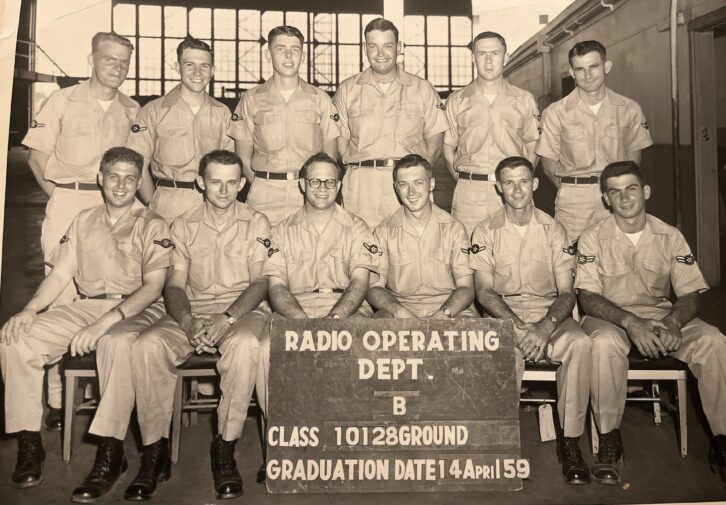
New York Air National Guard 1959 graduation for its radio operating department. Ross is at bottom left. Credit: Erica Ross
For several years, he attended a boarding school in western North Carolina near the Blue Ridge Mountains. The experience of navigating his way back to Manhattan via train sparked a lifelong fascination with locomotives.
He later attended Brooklyn Technical High School, where he joined the radio club and, according to Erica, officially “caught the bug.”
Ross studied at the University of Bridgeport, earning his associate’s degree in electrical engineering. He went on to serve three years in the communications division of the New York Air National Guard and completed basic training at Keesler Air Force Base in Biloxi, Miss.
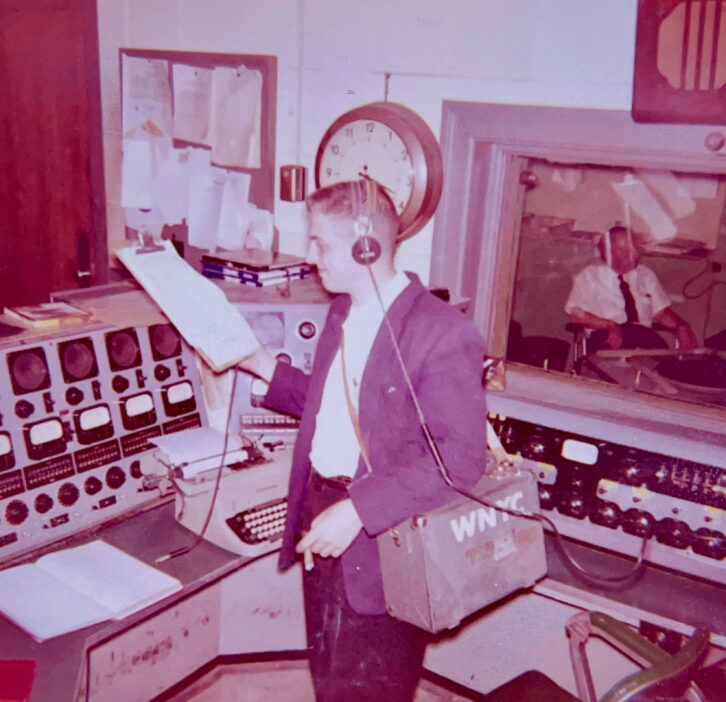
In 1958, he got his break into the radio business, joining Municipal Broadcasting System’s WNYC(AM/FM) as a provisional engineer.
Richard Ross at Municipal Broadcasting System’s WNYC(AM/FM) in 1958.
Ross aimed to become permanent pending a civil service exam. Passing the exam, however, didn’t guarantee a full-time position due to fierce competition from others. But WNYC’s chief engineer at the time, Hom Hong Wei, offered some reassuring advice, and Ross got the position.
He would credit Wei as being one of his most influential mentors. At WNYC, Ross found himself exploring hidden corners of the city.
“I got to go places that nobody else goes such as walking to the top of Washington Square Arch and yes, there is a locked stairway in the south leg of the arch,” Ross would recount.
Many decades at WADO
By the early 1970s, Ross transitioned to WADO as a summer relief engineer.
For a time, he found the energy to work at both WADO and WNYC, before becoming permanently entrenched at the Spanish-language AM station, where he’d work well into the 21st century.
He wondered how he had the stamina to manage it all.
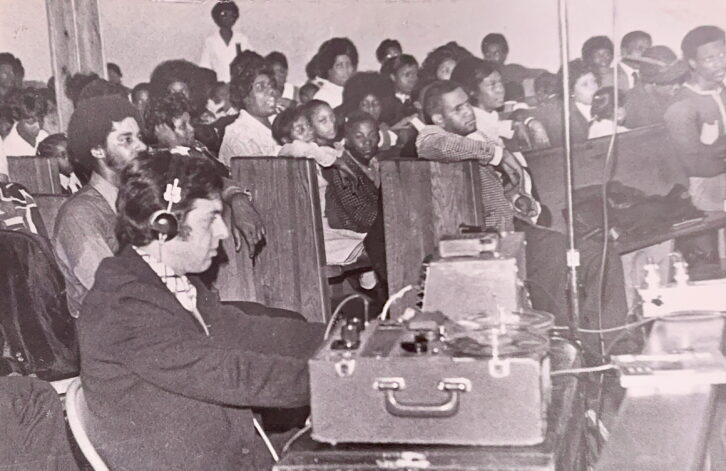
He’d go solely full-time at WADO, but Ross’ role went beyond its day-to-day. During the ’70s, the AM station would broadcast Black gospel music on Sundays, and it had brokered agreements with several churches in the south Bronx and Harlem.
Ross was tasked with recording the services, lugging RCA reel-to-reel machines to the locations. Others were known to turn down those assignments for one reason or another, but Ross happily obliged.
The Greater Hood Memorial AME Zion Church, December 1974, which is the oldest continuing church in Harlem. Ross operated as a “Gospel Technician.”
Even after WADO stopped airing the programming, he became entrenched with the churches, who would ultimately approach Ross to do separate recordings of the services. He would handle multiple recordings in a single day during the 1980s, and continued doing so through at least 2005.
They affectionately referred to him as “Brother Ross, our Gospel engineer,” viewing him as a part of their community. The services would be taped and sent to radio stations across the U.S. that aired Black gospel.
His spirit was evident in other ways. Ross became a member of the IBEW Local 1212, the labor union for broadcast engineers, in 1963.
He rose in its ranks, becoming part of the union’s executive board. Ross would stay even after he became WADO’s chief engineer in 1985, following the passing of his good friend Phil Greenstone.
With what would have been considered a management position, it was unusual for someone like Ross to remain in the union, both Erica and Lebron said. Ross wrote that he felt it was an honor.
“He was more than a colleague; he was a brother in every sense of the word,” IBEW 1212 wrote while remembering Ross on its website.
“All of us in this profession share the same situation,” Ross wrote in his Storyworth of his IBEW role. “We all know each other in New York City and once each month we meet to eat, drink and be merry and discuss our war stories.”
Ross was also a loyal member of the Society of Broadcast Engineers.
Meadowlands move
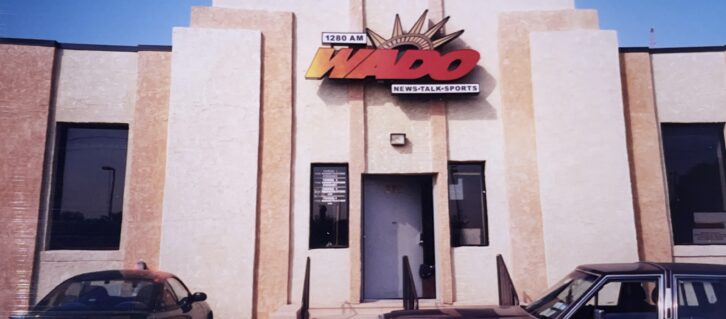
A mid-2010s photo of 1280 WADO(AM)’s studio, wth Ross’ prized 1989 burgundy Lincoln Town Car in front. By his count, Ross would withstand eight separate ownership changes until his retirement as chief engineer from Univision Radio in June 2020 at the age of 84.
As the broadcast landscape evolved, Lebron remembered Ross best for coordinating WADO’s transmitting power increase in the New Jersey Meadowlands at the end of 1999.
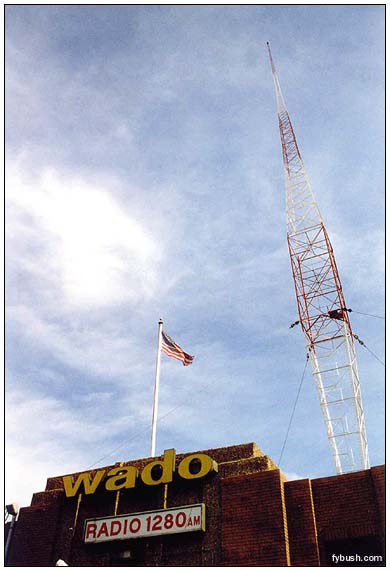
As recounted by Scott Fybush, WADO had used a Blaw-Knox diamond-shaped tower from its transmitter site on Paterson Plank Road in Carlstadt. It ran 5 kW day and night as part of a power restriction on regional channels like 1280.
But the FCC lifted that restriction in the early 1990s. WADO sought to upgrade to 50 kW by day and 7.2 kW at night, which required a new antenna system.
The former WADO(AM) Blaw-Knox tower dated back to 1934. This photo is from March 1998, courtesy of Scott Fybush.
The venerable Blaw-Knox tower came down, and three new towers were needed, along with a complete renovation of the 1930s-era building that housed its transmitters.
Then-owner Hispanic Broadcasting had filed for a construction permit, but most of the actual work did not commence until just prior to its expiration, which acted as a hard deadline.
As Ross wrote in his Storyworth, from October 1999 and for the next four months, he visited the Meadowlands site daily to complete the project under great stress and pressure.
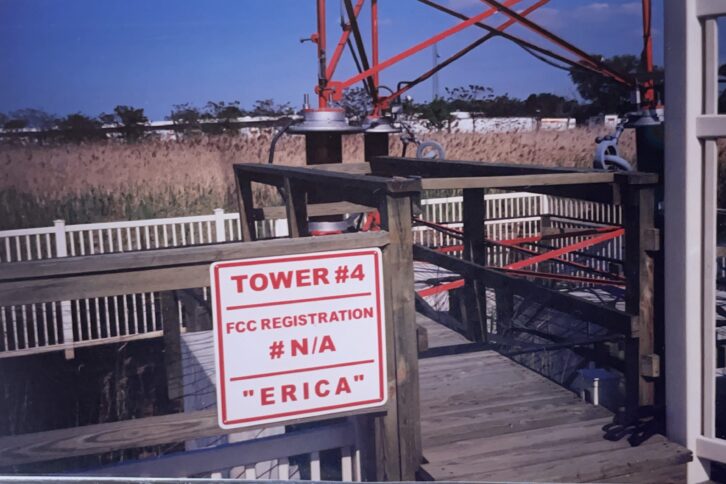
Ross named one of WADO’s three new towers in honor of his daughter. Ross said it was the “smallest but most powerful of the three.”
Construction took place on sensitive riparian land. It required a year of hearings costing over $1 million, involving the state of New Jersey, the Army Corps of Engineers and the U.S. Coast Guard.
Laying down and completely removing temporary wooden plank roads alone cost $675,000, according to Ross. Union dock workers were hired to build a 1,000-foot boardwalk to the towers, and a crane had to be rented from the Tappan Zee Bridge.
With the main transmitter building modified and the heat shut off, crews worked late into the winter nights, running copper straps between the four towers with only a porta-potty out back.
He recounted the moment of truth:
“On February 1, I invited David Lykes, Hispanic Broadcasting’s chief operating officer, to come up from Dallas to push the activate button at 6 p.m.,” Ross wrote. “My heart was in my throat, but the damn system worked.”
The antenna system was designed by Ron Rackley of du Treil, Lundin & Rackley, who consulted on the project and praised Ross for its execution.
True to form
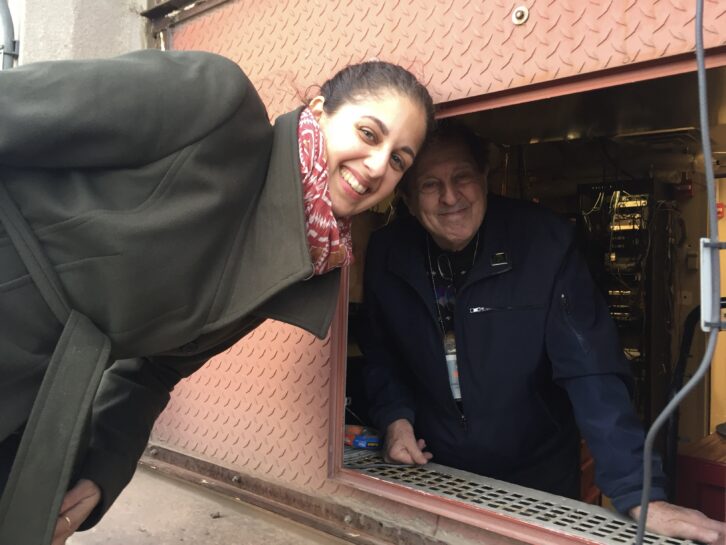
Ross offered daughter Erica one of his renowned tours of the Empire State Building broadcast facilities in November 2018.
There were many other, less high-profile wins as well, often accompanied by 2 a.m. phone calls.
Ross was also well-known for his thorough tours of the Empire State Building’s broadcast facilities — Erica said multiple people have told her that those tours were highlights of their careers.
Also an amateur radio operator (K2RNR), Ross had many interests outside of radio, including locomotives and nature.
He loved the city, but ever since his boarding school days in western North Carolina, he became infatuated with the peace of a mountainside setting. Since the late 1960s, Ross owned a property in Kunkletown, Pa., in the southern portion of the Pocono Mountain region.
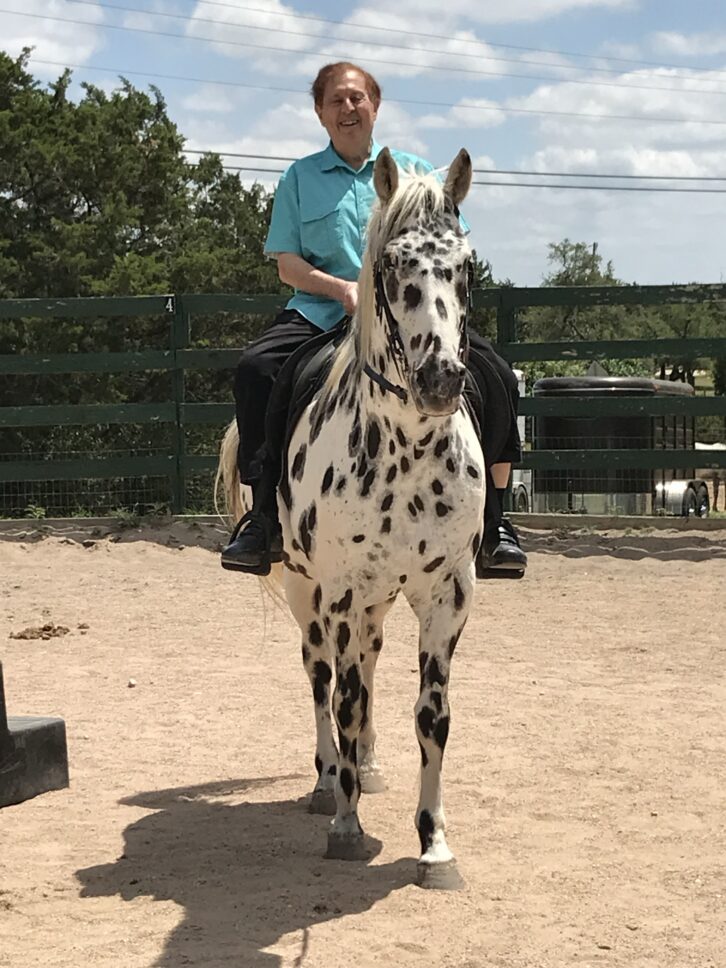
Ross, at age 83, on horseback while visiting Erica in Austin, Texas.
A lover of nature and an adamant conservationist, he viewed the country home as a sanctuary for wild animals. But he’d continue to call the Big Apple his main home and it was the only place he’d ever work.
In 2013, Univision honored his 50 years of broadcasting service by naming a studio after him.
True to his nature, he hated the attention and adamantly hoped people wouldn’t use the milestone to do the math on his age.
Ross passed away at home in his Hell’s Kitchen apartment — where he lived since 1964 — just shy of his 90th birthday.
Fittingly, the coroner described the lifelong engineer’s unforeseen cause of death as “an electrical short circuit of the heart.”
A memorial and celebration of life for Ross will be held Sunday, April 12, at the Masonic Lodge No. 72 in Secaucus, N.J.
FCC Chairman Brendan Carr chose a clear, blue-sky North Carolina spring day to travel to the top of a nearly 2,000-foot broadcast tower.
This was not the chair’s first rodeo — he also went to the top of the KELO(TV) tower in South Dakota last July and he has expressed his enjoyment of scaling such structures in the past. Carr used this latest opportunity, which included a live TV hit from the top of the eastern North Carolina broadcast site, to praise the efforts of America’s tower crews, including the one that aided him with his April ascent.
“It’s tower crews like this who maintain these structures; they are the reason why people receive these signals,” Carr told WCTI(TV). He said that there are roughly 20,000 tower climbers nationwide who support broadcast sites, along with towers for wireless communications and other services.
He shared a video on his X account:
Great day climbing with some of America’s talented tower workers. 🇺🇸
Carr utilized a hydraulic hoist for the majority of the ascent before climbing the final 100 feet by hand, according to WCTI. The round trip took several hours.
The tower, located just west of New Bern, stands approximately 1,966 feet tall. In addition to serving WCTI, WYDO(TV) and WUNM(TV), it is home to 95.1 WRNS(FM), a Class C, 100,000-watt station licensed to Kinston.
According to Wikipedia, the structure ranks among the tallest towers in the United States.
The climb comes while crews are in the middle of a major maintenance project to replace the guy wires that stabilize the tower, according to WCTI. As a result of the work, WRNS said on its Facebook page that the station was off the air for several hours on April 6.
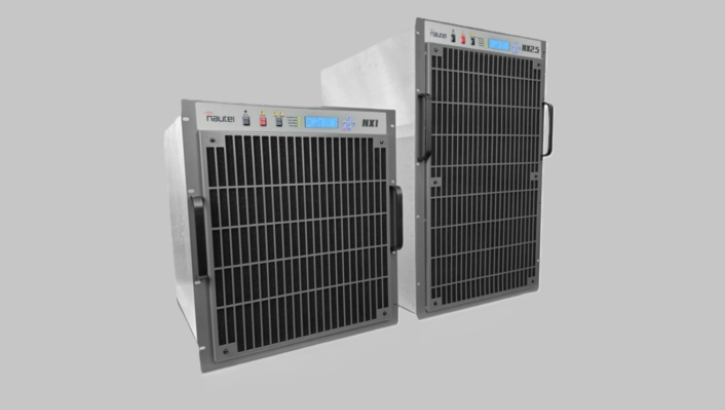
Nautel’s NX1 and NX2.5 AM transmitters will ship this fall.
Nautel will be expanding its NX series of AM transmitters into the low-power market, with two models that support both analog and digital broadcasting.
The additions are the 1 kW NX1 and the 2.5 kW NX2.5. Scheduled to ship in the fall, the transmitters will be exhibited at Nautel’s NAB Show booth.
“Low-power AM transmitters haven’t had these kinds of capabilities in the past,” said John Whyte, Nautel’s head of marketing and product strategy, in a release.
The transmitters are built on the company’s NX series architecture, which Nautel said accounts for approximately 40 MW of high-power AM deployments worldwide.
Both models contain a 250 W RF power module developed to bring the same performance in low-power configurations. The module includes ultra-linear modulation and digital precorrection.
The NX1 and NX2.5 support HD Radio, including MA3 all-digital operation, as well as current DRM modes. They also include Nautel’s digital modulation architecture for linearity and spectral cleanliness.
The models include front‑accessible, hot‑pluggable RF power modules that contribute the same to the final output. Nautel’s HTML‑based user interface provides local and remote monitoring, while built‑in RF instrumentation offers system visibility.
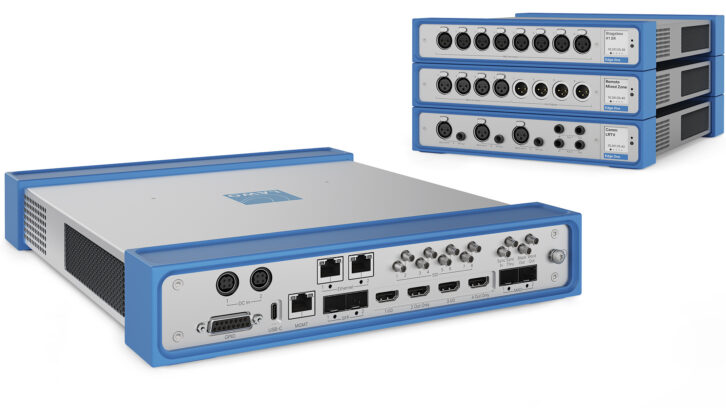
The Edge One is a stagebox suitable for pro AV and broadcast applications, Lawo said. It is available in three separate packages: audio, video and AV.
Built on Lawo’s HOME platform, it is a ST 2110 unit that supports NMOS. The Edge One provides analog, MADI and USB audio; video connectivity on micro HD-BNC and HDMI; as well as a 32 x 16 audio mixer with audio DSP. It is Lawo’s first stagebox to provide HDMI ports.
Suggested uses, according to Lawo, include use in remote production setups, combining video and audio while taking up 1U of flightcase rackspace.
When equipped with the commentary interface module and the Lawo HOME Commentary app, the unit is also suitable for up to three commentators, providing each with their own microphone input and headphone output.
It offers eight analog audio connectors (XLR), eight SDI connectors and four HDMI ports.
The stagebox also includes two MADI ports with sample rate conversion as standard, a USB-C port supporting four input and output audio channels, synchronization and reference connectors and two Ethernet and two SFP connectors for IP networks, with a maximum streaming bandwidth of 25Gbps.
It also supports PoE++.
Lawo will demonstrate the Edge One at its NAB Show booth.
It broadcasts from a tower site in Tasley that is also home to its sister AM station, the country-formatted 1330 WESR(AM), and its 105.7 FM translator. As of Wednesday, the three signals were off the air.
The Tasley Volunteer Fire Company arrived after receiving a call for a fire at the station’s tower site and reported the structure was fully involved, according to WBOC(TV).
According to station owner Charlie Russell, both the AM and FM can be heard again via their online streams, and Russell said that the station is working to secure a backup transmitter, with the hopes of returning to the air soon.
He expressed gratitude to the emergency services that arrived quickly on scene.
The AM signal goes back to 1958 from the Accomack County tower site, according to its FCC license record. The 103.3 FM signal signed on 10 years later.
According to the companies’ filing with the FCC, the purchase of the five stations and one associated FM translator was $3.75 million.
Usher Media is headed by the Grand Island-based Alan Usher. As a result of the deal, Usher and his wife, Joanna, divested their shares in Legacy Communications, an eight-station cluster also based in Grand Island.
NRG Media is an Iowa-based company headed by Mary Quass. NRG owns approximately 30 other radio stations across Iowa, Illinois, Nebraska and Wisconsin, but it has been divesting its radio properties, as Radio World has reported.
Kalil & Co., Inc. was the broker for this transaction.
The stations involved in the deal are listed below:
The event will take place Thursday, April 16, and Friday, April 17, at the Tuscany Suites and Casino, preceding the NAB Show.
This year’s speakers include engineers, representatives from product manufacturers and other recognizable industry names. PREC is public radio’s yearly gathering for broadcast engineers of all experience levels.
This year’s guiding theme is “what’s next.” While the content remains mostly technical, the dramatic changes in public media over the past year give the discussions a unique context.
According to APRE President Scott Hanley, the association board designed the event with that shifting landscape in mind. He also believes this is the one time of year such a large and diverse group of public radio technology experts can gather.
“We decided that our conference had become even more important than years past, as we face a future where effective, sustainable operation is at risk and important to our communities,” Hanley said.
Sample Thursday sessions include:
“Audio Processing: How to Tune It and Why It Matters,” by Leif Claesson of Claesson Edwards
David Layer of NAB presenting “AM Radio in the 21st Century”
“Transmission System Troubleshooting Techniques” by Steve Wilde of American Amplifier
“The Magic of LTSC and Other Ways to Make Legacy Tech Work,” by Scott Hanley, Darrell McCalla and William Harrison.
“The Data-Driven Dashboard: Leveraging AutoStage Analytics for Public Media” by Juan Galdamez of Xperi.
“Advances in FM Antenna Technology” by Cory Edwards of Dielectric
“NCE Translator Window and Other Legal Updates” by Derek Teslik of Gray Miller Persh
An update on NPR Distribution by NPR’s Badri Munipalla, Jon Cyphers and Mike Pilone
“Studios (Or No Studios At All): Some New Ways of Thinking” by Scott Fybush of Myriad broadcast software
“How Engineers Contribute to Public Radio Revenue Growth,” Jeff Soderberg of StreamGuys
The newly formed Public Media Infrastructure will also present on Friday; its speakers were pending at this writing.
Organizers have held the in-person conference price flat at $350 for members since 2024. They also offer a virtual attendance option for engineers unable to travel.
He also said APRE is expanding its financial aid footprint. The funds are designated both to assist attendees with financial needs and “to encourage the next generation of technical talent to get firmly engaged in the public media engineering community sooner rather than later,” according to Hanley.
The conference concludes on Friday evening with the annual APRE Awards Dinner at Lawry’s Prime Rib.
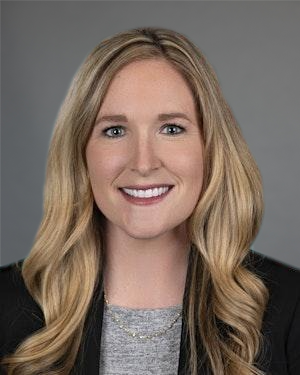
According to a release, Healey will serve as NAB’s primary spokesperson and media relations strategist to advance radio and TV policy priorities before Congress and the Federal Communications Commission.
Healey will report to Michelle Lehman, its chief of staff and executive vice president of public affairs, and she will lead its press team that includes Grace Whaley, NAB’s director of communications and social media, and Judianne Meredith, its communications coordinator.
Healey most recently served as a client engagement lead at PR firm Purple Strategies, where she developed communications strategies for advocacy and public affairs campaigns on behalf of clients across a range of issues.
She also brings media industry experience to NAB from her roles at AOL, The Grio and MS NOW — formerly MSNBC.
Meanwhile, for FM broadcast hobbyists like myself, there is the growing FMDX.org webserver project — a network I’m proud to participate in as a host.
If you’re new to the world of SDRs, however, the pace of development can be understandably dizzying. Where do you even begin?
We recently discovered a new mobile app that attempts to bridge this divide. Developed by Mark Garrison Jr., the Echo app brings four popular SDR platforms to your Apple iPhone or iPad. Garrison Jr.’s motivation for building the app is something I can appreciate and I’ve loved using it so far.
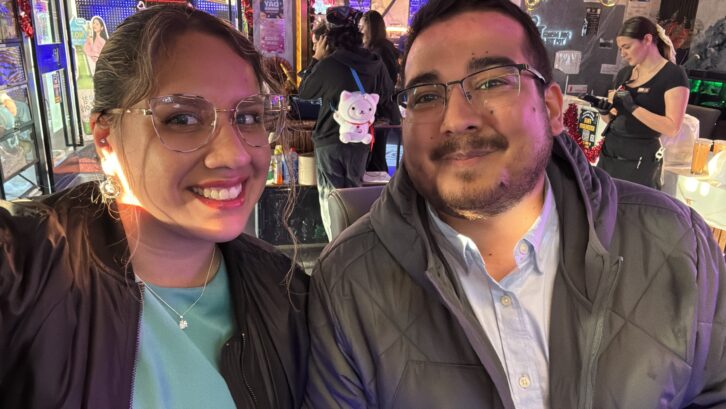
Garrison Jr. with his wife, Maricarmen. He said he dedicated the Echo app to her. “Her support was absolutely crucial while I was building this over the last several months,” he said.
Garrison Jr., a 27-year-old pharmacy technician in Texas, has been a radio hobbyist since childhood.
Despite being firmly in the Gen-Z demographic, he owned a walkie-talkie long before he had a cell phone. “I used to love helping my father test long-range reception with his homemade antennas, seeing if I could hear him all the way from the town grocery store,” Garrison Jr. told us.
That experience planted the seed, but as he grew older, his biggest hurdle was the barrier to entry created by the cost of traditional equipment.
Eventually, he and his father discovered SDRs. Garrison Jr. was amazed that a small laptop, a $25 USB dongle and a magnetic antenna with an application like SDRTrunk could replicate the performance of a $1,000 digital scanner.
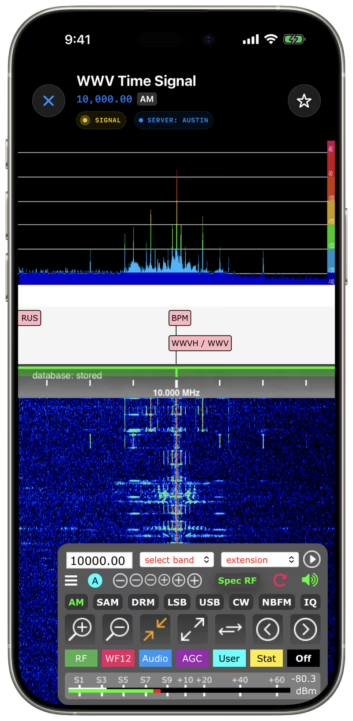
The Echo app uses a server in Austin to hear WWV’s signal on 10000 kHz.
It sparked a question: Could he harness the power of existing SDR networks and develop a mobile solution, something akin to many of the scanner apps that exist, but truly designed for a smartphone?
“I wanted something made for iOS that felt like ‘Apple quality’,” he said.
Garrison Jr. wrote Echo in Apple’s native Swift language to ensure a similar experience across iOS, iPadOS and macOS.
While development began last June as a personal project, he quickly realized there was a demand for a polished client that aggregated KiwiSDR, OpenWebRX, WebSDR and FMDX.org servers.
He was also careful to respect the community’s roots, speaking directly with KiwiSDR creator John Seamons and OpenWebRX developer Jakob Ketterl to ensure proper attribution.
The community’s response was, well, swift: A crowdfunding effort funded his Apple Developer license within ten minutes. After a two-month TestFlight beta with 200 users, Echo officially launched for iOS on March 31.
The iOS version is also available in the European Union. An Android version, he said, is also in development.
How it works
The beauty of Echo is that it doesn’t reinvent the wheel. There are so many SDR servers publicly available. A thoughtfully designed interface that can more easily bring them to you would go a long way. And that’s what I’ve found Echo is in my own use.
Echo can automatically match you with the nearest SDR server via location permissions or allow for manual selection.
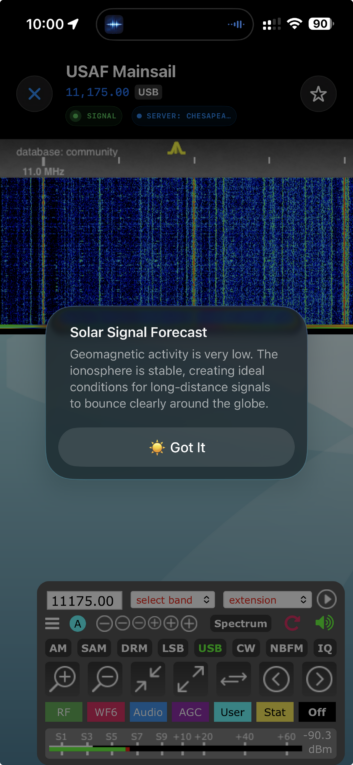
If you tap the “Signal” button while connected to a server in the Echo app, it fetches space weather from NOAA to display a solar signal forecast.
Depending on your target — such as an FM broadcast station — Echo switches you to the appropriate platform.
When I asked Garrison Jr. what sets Echo apart, he highlighted these five areas:
The “smart scan” experience: Located in the main station tab, the feature allows users to cycle through categories like amateur radio frequencies, public safety and military bands. He said that of the user feedback he’s garnered so far, military bands have been the most popular.
On-demand flexibility: While the scanner mode is a highlight, Garrison Jr. also wanted Echo to mimic a true tuner. At any point, users can break out of a scan to focus on a specific frequency. This includes access to a “hot list” of popular selections.
Interactive map: “Users can filter by SDR type, physical distance or signal-to-noise ratio to ensure the best audio quality,” Garrison Jr. explained, which includes whether you want to hear something locally or from another country.
A smart manual tuner: Echo detects kHz vs. MHz and routes FM requests to the nearest FMDX.org server. “I’m particularly proud of how it handles server complexities,” Garrison said. “If a server doesn’t support a specific frequency, the app helps the user find a server that does.”
Global database: Echo uses a categorized database of over 11,000 frequencies. The list is constantly growing, Garrison Jr. said, covering everything from standard FM and amateur radio to spy-thwarting “numbers stations.”
Echo has already seen quite a few user-fueled modifications. Garrison Jr. recently added Apple VoiceOver support for blind and low-vision users. The project has an active Discord community that he encourages new users to join.
What a time to be alive
I’ve said this before and the Echo app is a reminder — there’s never been a better time to engage in the hobby of radio, whether it’s long-distance (DX) signal hunting or scanning.
There are smart, young people like Garrison Jr. that are catching the bug and using software development skills to aid our endeavors!
For me, I can’t wait to use Echo to aid my DX this upcoming E-Skip and tropospheric ducting listening this season.
The Federal Communications Commission has sent a notice of unlicensed operation in the 11 GHz band to an internet service provider in the Sierra Nevada foothill region of California.
Conifer Communications is an ISP based in Groveland. The FCC said it was transmitting on 10.915 GHz for over a year after its license had expired.
That part of the radio spectrum is allocated by the commission for common carrier and fixed point-to-point microwave operations.
The San Francisco office of the FCC’s Enforcement Bureau said that it received a complaint of an unlicensed station operating atop Moccasin Peak.
Last September, according to the commission’s account, agents confirmed that Conifer Communications was transmitting with a license that expired in February 2024 and had not been renewed.
The Enforcement Bureau warned that operating radio transmitting equipment without authorization is a violation of federal law and could subject Conifer to monetary fines and seizure of the equipment.
Conifer Communications must discontinue operations immediately and must not resume. It also has 10 days from the date of the notice to respond with any evidence that it has authority to operate.
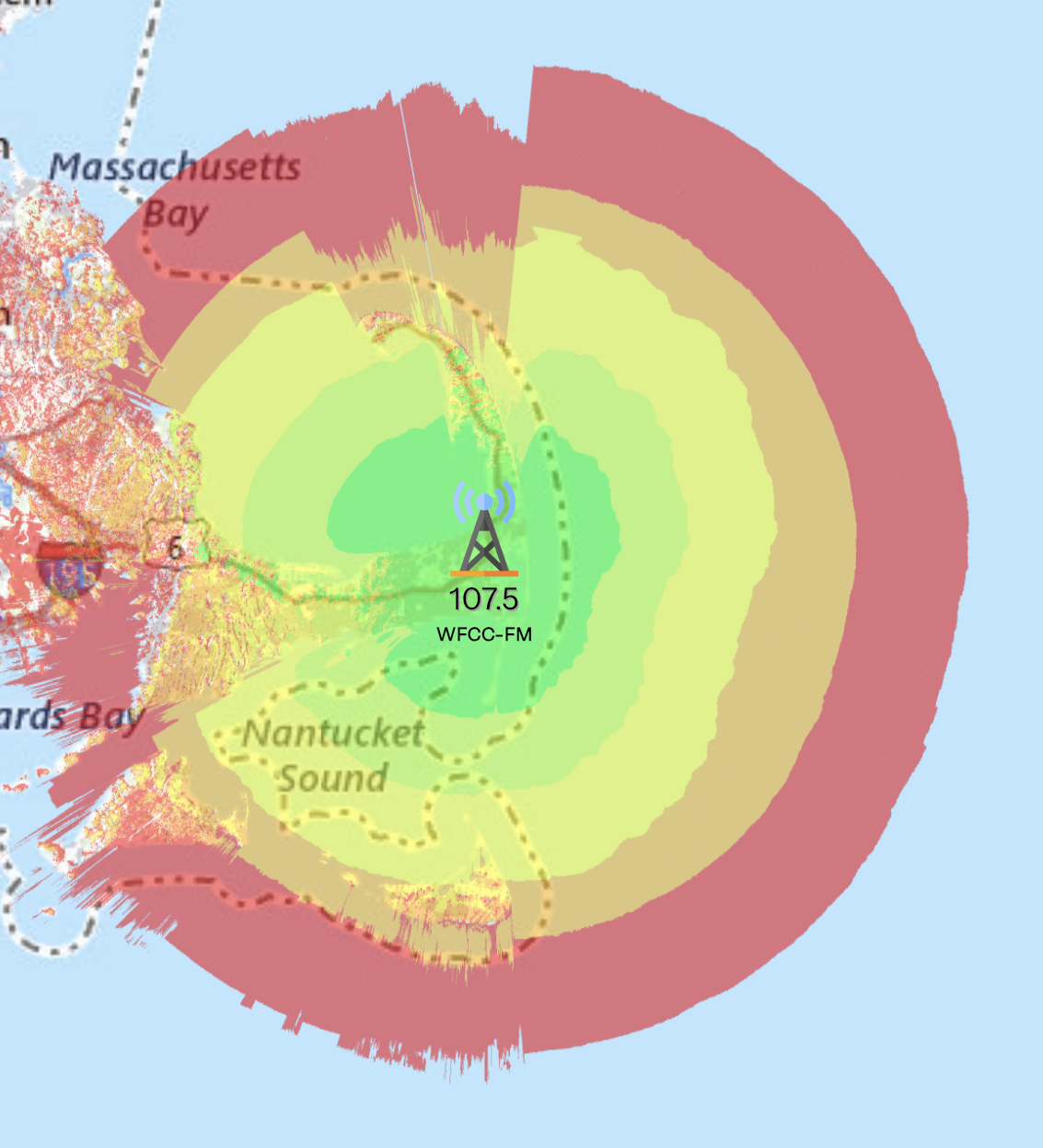
WFCC is owned by Cape Cod Broadcasting Media, also known as Sandab Communications, which also owns 99.9 WQRC(FM), 103.9 WKPE(FM) and 104.7 WOCN(FM) on the Cape.
Kitty Dukakis, the wife of Massachusetts governor and then-presidential candidate Michael Dukakis, threw on the switch for the signal for WFCC in March 1987, according to a Barnstable Patriot commentary by original owner Joseph Ryan.
WFCC operated under First Class Communications — hence the calls — and the station has prominently featured classical music since.
Sandab Communications purchased the signal from Charles River Broadcasting in 2007.
It marks K-Love’s first signal on Cape Cod. The network also owns and is heard on Class A 91.1 WTKL(FM) in New Bedford, Mass., to the west.
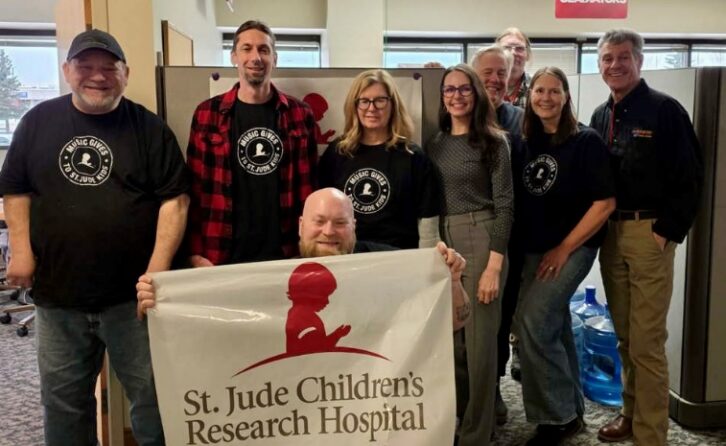
Left to right: Steve Franklin, Joe Campbell, Matt Collins (kneeling), Lara Bickford, Angie Kearns, Mike Ford, Steven Simmons, Carla Bales and Patrick Wright.
Two radio stations in the Last Frontier’s largest city helped raise more than $100,000 for St. Jude Children’s Research Hospital.
The “Music Cares for St. Jude Kids” radiothon, held March 19–20 on Connoisseur Media’s 104.1 KBRJ(FM) and 106.5 KWHL(FM), featured hosts from both Anchorage stations and plenty of on-air listener interaction.
104.1 “K-Bear” has been performing the radiothon annually dating back to 1997.
The stations relayed Alaska patient family experiences, according to a release. Local businesses also chipped in with contributions.
In all, the Anchorage FMs collected approximately $101,000 to help St. Jude advance research and treatment for pediatric catastrophic illnesses.
Connoisseur commended Anchorage listeners and said the radiothon was an example of the influence of local radio personalities and radio’s ability to drive audience engagement into action.
Before it grants the renewal of an AM station’s license in the Mississippi Delta, the FCC has entered into a consent decree with the owner of the station, which includes a voluntary contribution of U.S. $1,000 to the Department of Treasury, following several rules violations.
960 WABG(AM), “The Awesome AM,” in Greenwood runs 1 kW during the day from one tower and 500 watts at night from three towers. Bennie Wells is the station owner, listed officially under SPB LLC.
WABG filed for its license renewal in 2020. Following its application, one individual filed a petition to deny — which the FCC ultimately considered an informal objection — and another person also filed an objection.
The contentions centered on a transfer of control of the station back in 2015 that both parties argued WABG did not properly document with the commission.
After reviewing the case, the commission did find that an unauthorized transfer of control occurred when the interests of WABG’s two other members were acquired by Wells without prior approval.
It also found that WABG violated rules by failing to upload quarterly issues/programs lists in 2009, 2011, 2013, 2015 and 2017.
WABG also falsely certified on its renewal that it complied with public inspection file and biennial ownership reporting requirements, according to the commission.
As a result, the FCC and WABG have entered into a consent decree under which the station agrees to implement a compliance plan to ensure the station and staff follows the commission’s rules.
WABG will also make the voluntary contribution of $1,000 to the Department of the Treasury.
If the contribution is paid and the Media Bureau finds no other violations, the FCC said it will grant WABG’s license renewal.
WABG runs a Mississippi Delta blues and classic rock music format.
A release said that NBC Sports will make use of Triton’s hosting, monetization and audience measurement tools.
“Working alongside Triton Digital allows us to better understand our growing audiences and deliver reliable, consistent measurements to advertisers,” said Aileen Sokol, VP of content partnership development at NBC Sports.
As part of the collaboration, NBC Sports will use Triton’s Omny Studio for podcast hosting and distribution, Triton Ad Platform for audio advertising monetization and campaign management, Podcast Metrics for IAB-certified podcast measurement and analytics and Demos+ for demographic insights.
The release said that Triton’s technology will support NBC Sports’ podcast portfolio, allowing the company to distribute and monetize its sports podcasts.
After selling off quite a few of its midwest stations it acquired in the big deal with Alpha Media last year, Connoisseur Media announced Tuesday it is growing its presence in Nebraska’s capital city.
Connoisseur agreed to purchase NRG Media’s stations in Lincoln, Neb. The transaction is pending FCC approval and it is expected to close in the summer, according to a release.
The stations involved are 1400 KLIN(AM) and its 99.3 FM translator, 98.1 KFGE(FM), 105.3 KLNC(FM), 107.3 KBBK(FM) and its HD2 translator on 94.5 FM.
Connoisseur already owns four other full-power stations in the market, including 92.9 KTGL(FM), 96.9 KZKX(FM), 104.1 KIBZ(FM) and 106.3 KFRX(FM). Those stations came over in its Alpha Media deal that closed in September.
In a release, Connoisseur said the purchase is another step in its efforts to refine its portfolio by strengthening its presence in “priority markets.”
The ruling’s impact is unclear. The U.S. District Court for the District of Columbia noted that since Congress withdrew funding through last year’s Rescissions Act, and because the Corporation for Public Broadcasting has dissolved, no order can provide “meaningful relief” regarding that specific pool of money.
But Judge Randolph Moss repeatedly wrote in the Tuesday ruling that President Trump’s order crossed the line of the First Amendment. Moss was appointed to the D.C. district court in 2014 under President Obama’s administration.
Moss said that the order was issued without regard to nationwide interconnection systems, calling such distribution the “backbones” of public radio and TV.
Colorado Public Radio was a partner in the lawsuit challenging the executive order, along with NPR, Aspen Public Radio and KSUT. CPR said in a release that the ruling prevents the executive order from restricting CPR and other stations from using any federal funds for NPR content. In December, Radio World reported on the stations’ concerns.
NPR, according to its own reporting, said that it was not clear what the decision, which could be appealed by the Trump administration, would mean for the future of federal funding of public broadcasting. But the organization’s comments celebrated the decision.
“Today’s ruling is a decisive affirmation of the rights of a free and independent press — and a win for NPR, our network of stations and our tens of millions of listeners nationwide,” Katherine Maher, NPR’s president and CEO, said in a release.
White House spokesperson Abigail Jackson said in a statement: “This is a ridiculous ruling by an activist judge attempting to undermine the law.”
Representatives from the three Colorado public radio stations, according to a release, said the stations remain prepared to defend the ruling should the Trump administration appeal.
Timeline
The executive order issued by President Trump last May ultimately clawed back $1.1 billion in funding that Congress had set aside for public media outlets. Later last year, it led to a dispute between CPB and NPR over public radio distribution.
The D.C. court acknowledged in its order that while the federal government may impose limits on grants or fund its own speech to promote specific perspectives, “the First Amendment draws a line, which the government may not cross, at efforts to use government power — including the power of the purse — ‘to punish or suppress disfavored expression’ by others.”
Although CPB has been dissolved, the court clarified that this does not render the case moot because the executive order “sweeps beyond the CPB.”
The court is also issuing a permanent injunction to prevent federal agencies from enforcing the executive order.
In a statement, PBS, said it was “thrilled with today’s decision,” calling the president’s order a “textbook unconstitutional viewpoint discrimination and retaliation, in violation of longstanding First Amendment principles.”
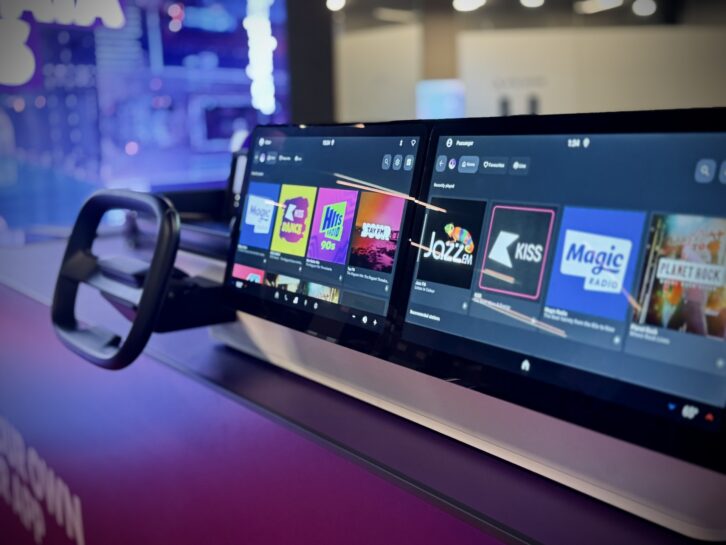
The Rayo app is now built-in to the Android Automotive operating system.
Bauer Media has released a new Android Automotive version of its Rayo app, available within connected car systems of BMW and Mini vehicles in the United Kingdom and Portugal.
The company seeks to use the new connected car integration to aid its plans to turn “broadcast scale into digital growth.” The app was built using Radioplayer’s white-label Android Automotive OS platform and is supported by distribution through the Appning Apps Market Solution.
Rayo is also available on iOS and Android, or online, according to Bauer Media. It offers live stations across the group’s audio portfolio, and Bauer Media said there are plans for on-demand audio and podcast features.
BMW Group joins the app launch as a partner OEM.
Android Automotive vs. Android Auto
Radioplayer’s Android Automotive technology allows stations to offer their streams into native in-car environments, while Appning supports distribution through its platform designed for in-car app marketplaces.
The distinction between Android Auto — which requires a smartphone to project content onto a vehicle display — is that Rayo runs natively on Android Automotive, making vocal controls and dashboard interfaces accessible to drivers, the company said.
Bauer Media operates approximately 104 radio stations across nine different countries in Europe.
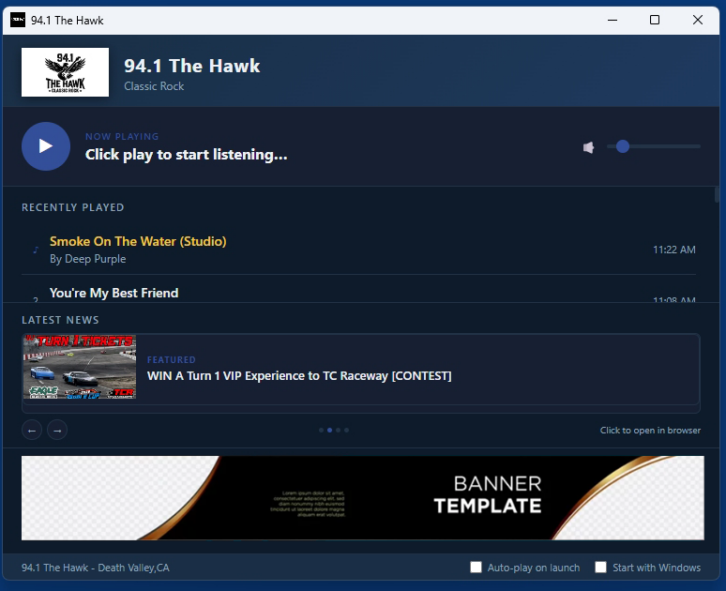
A look at the native Windows app, designed by Radioservers.
Radioservers has announced the release of a native Windows desktop radio application.
The company is positioning the product as an opportunity for stations that seek to recapture desktop listening hours lost to streaming services and browser-based players.
The Windows app gives stations a branded, installable desktop application that operates in the listener’s taskbar and Windows system tray.
It runs automatically at Windows startup, streams live audio and displays now playing information and song history. The app can also pull the station’s latest news from its WordPress RSS feed, it is capable of serving advertising from the station’s ad server and it can be distributed through direct download or the Microsoft Store, the company said.
Radioservers handles development, branding and distribution — including Microsoft Store submission.
Alongside the Windows launch, Radioservers also announced app development for three television streaming platforms: Roku, Google TV (Android TV) and Apple TV.
Each app is branded with the station’s logo and colors, supports live stream playback and now playing display and is submitted to the corresponding platform’s app store by the Radioservers team.
Radioservers said that it now offers native app development across five platforms, including iOS and Android.
 Connexion


 The
The