Editor’s note: In this morning’s newsletter, we misstated the number of new attendees at this year’s NAB Show. That figure should be 48% of the 58,000 attendees, not 48,000.
Engineering Achievement Award winners Harvey Arnold and Bert Goldman take center stage at the NAB Show “We Are Broadcasters” ceremony on Tuesday. Credit: NAB
According to the National Association of Broadcasters, there were about 58,000 registered attendees for the NAB Show this year.
Last year, it announced 55,000 for the event, and the post-COVID high has been 65K in 2023.
Approximately 48% of this year’s visitors attended the NAB Show for the first time, the association said in a release. Last year that number was 53%.
We spoke with some exhibitors at the show who worried about a downturn in international foot traffic around the show floor, but NAB said that visitors hailed from 146 countries. One in four participants traveled from outside the U.S., which compares similarly to the 26% figure NAB announced from last year.
But who those attendees are is changing. In terms of makeup, the number of registered attendees who are content creators increased 140% over 2025, NAB said.
Combined with sports and enterprise, the result is not just an evolving media landscape, but an evolving NAB Show, it said in a release.
About 13,000 attendees reported that they are corporate media professionals, which it said was nearly double the 2025 number.
The show itself featured 530 sessions and 899 speakers. There were around 1,100 exhibitors, including 132 for the first time.
NAB President and CEO Curtis LeGeyt, John Tesh and Chris Ornelas
Showing that he’s more than just the creative mind behind “Roundball Rock,” John Tesh has been inducted into the National Association of Broadcasters Hall of Fame as this year’s radio honoree.
His induction took place at the NAB Hall of Fame Awards Dinner on Tuesday. Actor Rob Lowe was also inducted as this year’s television honoree.
The honor recognizes individuals and programs that have earned a lasting place in broadcasting history.
“John Tesh’s work reflects a unique blend of creativity, risk-taking and reinvention across broadcasting,” said NAB President and CEO Curtis LeGeyt.
In 1999, Tesh launched his radio show alongside his wife Connie Sellecca and son and co-host Gib Gerard.
At the time, NAB explained, the concept was unique: a five-hour-long daily program featuring a combination of advice and personal development content on subjects important to listeners — surrounded by music.
“The John Tesh Radio Show,” as well as a spin-off, “Intelligence for Your Health with Connie Sellecca,” airs on approximately 350 stations and reaches around 7 million listeners each week.
“This special group of individuals and programs nominated for induction in 2026 epitomizes the wide spectrum of talented individuals our industry is fortunate to rely on and build large audiences around,” Kraig Kitchin, the Radio Hall of Fame’s co-chairman said.
Voting for inductees, conducted by approximately 1000 industry members, begins Friday and runs through May 8. The top six vote recipients will gain induction as part of the 2026 Radio Hall of Fame Induction class. The additional inductees that will make up the induction class will be selected by the Radio Hall of Fame Nominating Committee.
The 24 nominees were chosen by the Radio Hall of Fame Nominating Committee, with input from the radio industry and listeners.
This year’s Radio HOF nominees
Andie Summers
Big D & Bubba
Bob Stroud
Boomer Esiason
Charlie Van Dyke
Enrique Santos
Fred Winston
Funkmaster Flex
Helen Little
Joey Reynolds
John & Ken
Johnny Magic
Kevin Matthews
Kid Leo
Larry Elder
Lee Arnold
Monica May
Pat Hughes
Raul Brindis
Rickey Smiley
Ryan Cameron
Shotgun Tom Kelly
The Electrifying Mojo
Wait Wait… Don’t Tell Me!
This year’s inductees will be announced on Wed., May 20, and will be honored at the 2026 Radio Hall of Fame induction ceremony on Thu. Oct. 8 at the Fairmont Hotel in Chicago. Information on tickets for the event will be available soon.
The Radio Hall of Fame was founded by the Emerson Radio Corporation in 1988. The Museum of Broadcast Communications took over operations of the Hall in 1991.
Nick’s Signal Spot is a new feature in which Nick Langan explores RF signals, propagation, new equipment and related endeavors.
At Villanova University, I teach an undergraduate Computer Science course, Platform-Based Computing (CSC 2053).
It is a fun class and one I feel fortunate to be able to instruct. The first half covers web and mobile application development, which for at least many of the students is their first time building applications. The second half then takes my students through many of the cool things they can do with the Python programming language.
Python is well-known in the data science community for its adaptability to large datasets, breaking them down statistically and gathering potential trends, and then, in some cases, to make predictions.
My 16 students by now are probably good and tired of looking at radio station data — but I jumped at the chance to use real-world data that I’ve gathered for my RadioLand app project.
After a few weeks of using Python libraries to make some general observations on radio stations in a given state that they chose, I wanted to see if we could come up with a way to predict the signal strengths, or field strengths, of FM stations, numerically.
Machine learning is a way to train software, known as a model, to make predictions using data.
The data generated by the time-tested Longley-Rice propagation model, still relied upon by the FCC and many others and used within my RadioLand app, would work as the perfect training dataset for the class.
The study
A course on machine learning itself could easily span a whole semester. For me, I only had one two-and-a-half-hour class to explore it with the group and some of that time was devoted to their ongoing semester-long projects.
So, the most practical approach was to explore the use of a common first-time machine learning tactic: predicting through linear regression.
In its most basic form, linear regression is a technique that finds a relationship between statistical variables. In the context of our lab, we wanted to find which statistics have the strongest relationship to predict an FM station’s field strength.
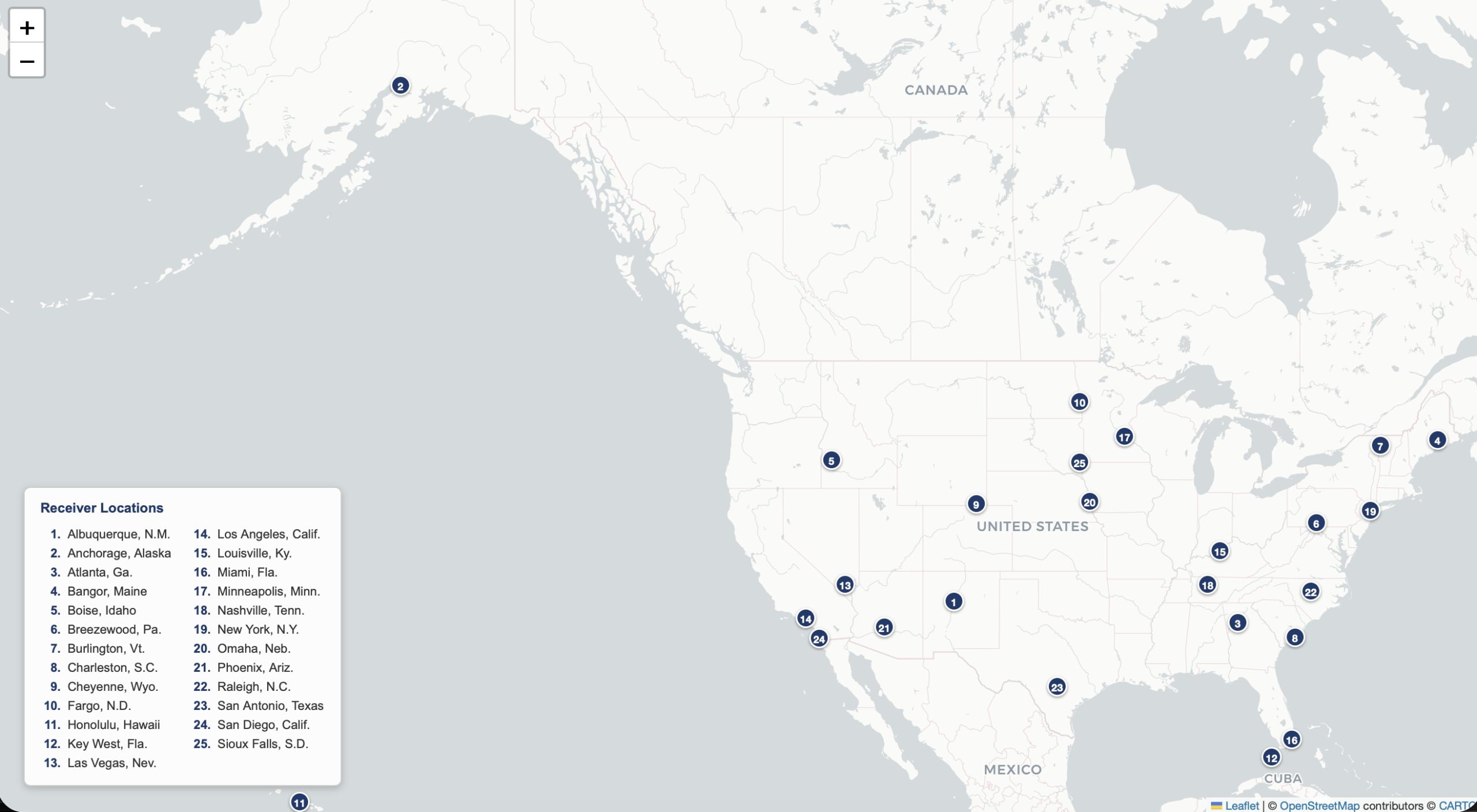
I extracted out of my RadioLand server pre-calculated Longley-Rice data for 25 random locations across the United States, with the signals measured in dBuV/m.
You can see a map of those locations below.
In the CSC 2053 lab, we used 25 random U.S. locations with previously generated Longley-Rice signal predictions. I used Python’s Folium library to generate the map you see above. Click to enlarge.
For each location, we had all FM stations available that Longley-Rice predicted to have field strengths of at least 40 dBuV/m. Then, we also had each station’s callsign, frequency, city, state, transmitting effective radiated power, antenna height above average terrain and the distance from our “receiver” location.
80/20 rule
First, I had the students run through typical machine learning techniques, which include splitting our 25-city data into “test” and “training” datasets.
The training data — or 80% of it — is used to train our linear regression model.
The test data — or the remaining 20% — is used to test the model to see how accurately it performs. The logic behind it is akin to knowing the answers to a test ahead of time.
That’s something my students can appreciate!
A model can perform well on the data it knows, but what happens when we throw it curveballs?
This all might sound complicated, but Python’s scikit-learn library has a linear regression model built right in. With programming syntax under our belt, it’s more a matter of feeding it the data and analyzing its performance.
Distance-first approach
With just a rudimentary understanding of signal propagation, you can probably discern that the most logical place to start for testing a feature’s relationship to predicting the strength of a radio signal is the distance from the transmitter.
The farther you are away from the source, the weaker it ought to be.
So that’s where we started. Could distance alone be a reliable predictor of a station’s field strength?
With our regression model, we use a metric called the R-squared score to understand its performance. Depending on the situation, it’s a quick and easy way to score the effectiveness of the relationship between our features and what we are trying to predict.
An R-squared score of 1 is a perfect score. A score of 0.5 would mean our feature explains half of the variance that is possible with our target. In some cases that might be OK.
But with field strength, we wanted to aim for something higher.
In our first go-around just using the distance, it resulted in an R-squared score of 0.48.
With linear regression, we want our model to plot as close to the line pictured. In this case, because the data is so scattered, it shows that distance from a transmitter alone does not predict a station’s field strength.
Scikit-learn also provides us with the root mean squared error, which gives us the average magnitude of error between the predicted and actual values in the exact same units we are trying to measure — dBuV/m. For our first regression model, it was about 16 dBuV/m.
That could be the difference between predicting a comfortably strong signal from a signal off the Empire State Building in New York City — at a level of 70 dBuV/m — and a fringe-type signal at around 55 dBuV/m.
To provide my students context, I gave them this rough guide for measuring the quality of an FM signal strength in dBuV/m.
While there is indeed a relationship between distance and field strength, it is not strong enough on its own.
With a model, we can combine the predictive features. What happened if we added a station’s transmitting power, antenna height and frequency to the mix?
Our R-squared score improved to 0.74.
Distance has the strongest correlation, but second is ERP. Antenna height above average terrain and the station’s frequency itself showed a very weak relationship.
Fitting a line
A comparison of our three linear regression model attempts, using r-squared score.
You do not have to be a mathematical maven to explore computer programming or machine learning. But in some cases, a little know-how helps.
Linear regression is based on how well your predictive data fits along a straight line.
To engineer a feature that accounts for this, we have to address the non-linear relationship. A common and highly effective tactic in machine learning to “fit” non-linear data around a straight line is to take the logarithmic value of a feature — in this case, distance.
We added the log of the distance as well as the log of ERP, as that feature also has a non-linear relationship with the field strength.
The result? An R-squared score of 0.89, or a mean error of 7.5 dBuV/m.
What’s missing?
Then I asked each of the students, in their lab workbook, to analyze two of the cities in the 25-city data set to see how our linear model worked in each location in isolation. First, they were given New York City and then they could choose one of the other 25 cities.
On a map, they could compare stations that the model under-predicted, over-predicted or placed within close proximity of Longley-Rice. A green dot here is good — that means the model came within 5 dBuV/m of Longley-Rice for the same station, such as the signals on the Empire State Building, for example.
The map plots the locations of each of the stations predicted by our linear regression model. A green dot, here, was good, meaning the model predicted within 5 dBuV/m of Longley Rice. An orange dot means the model’s prediction was more than 5 dBuV/m compared with Longley-Rice. A red dot means the model underpredicted Longley-Rice.
Sophomore student Anthony Dell’Avvocato pointed out that many of the over-predicted signals from a theoretical receiver in New York were in the direction of northern New Jersey.
Many of my students call New Jersey home, including Dell’Avvocato, and its geography has been a theme of some of our exercises all semester long.
“The model is struggling with urban canyons, terrain blocking and signal reflections, which aren’t captured by distance, power or height alone,” he wrote.
I finally asked each student if they were a broadcast engineer, would they find this model valuable?
Freshman Alan Uribe identified that although the Longley-Rice data it was trained on accounts for terrain, our linear model has no feature that does the same.
“It’s useful for early planning but not accurate enough for final decisions,” he said.
Sophomore Jack Behringer noted that for flatter areas, our regression model might prove useful. But in an area like California, he said, it would be thwarted by terrain.
“A real broadcast engineer knows the terrain and population of the area — this is overlooked by the model,” freshman Erin Campbell noted.
Takeaways
I don’t think anyone would comfortably rely on the model we came up with in one class to make real-world decisions. But the world of machine learning offers many more possibilities.
My research student, senior Minh Bigting, used a gradient boost model on similar data and has come up with promising results.
All in all, it was a fun way to show my group of students how FM signals travel and why there are a number of factors involved with hearing a station.
This weekend, there will be some old-fashioned record spinning on radio stations across the globe as part of this year’s Vinylthon.
Vinylthon 2026, happening April 18–19, is a fundraising event presented by the College Radio Foundation and designed to provide scholarships for future broadcasters.
Approximately 230 stations, from terrestrial to streaming, many at colleges and universities, are participating. There is still time to register, and your station is encouraged to spin vinyl all weekend long.
Meanwhile, you can stream the special WVYL pop-up station on Live365. The streaming outlet airs one-hours shows from college, community and commercial broadcasters, plus other programs that feature vinyl and other specialty content.
“When you support Vinylthon and WVYL, you are directly helping students who dream of working in radio take their next step into the industry,” said Tim Craig of the College Radio Foundation board.
This year also marks the debut of the Vinylthon Legend Award, which honors individuals who have made extraordinary contributions to radio.
The inaugural recipient is legendary top 40 radio personality John Records Landecker, whose career spans 50 years and is best known for his time on Chicago’s WLS(AM).
Landecker’s “trademark creativity and deep love of music have helped define the sound and spirit of top 40 and oldies radio for generations of listeners and broadcasters,” a Vinylthon release said.
Xperi, the parent of the DTS AutoStage technology, has announced a new premium tier of features for its broadcaster portal.
The company said that the DTS AutoStage Broadcaster Portal Premium gives subscribing stations access to station rankings by daypart, in near real-time, as well as expanded, exportable music charts.
The portal’s data is from DTS AutoStage, which is integrated into approximately 16 million vehicles globally. Per Xperi, this generates around 34 million hours of listening data per month in the U.S. across approximately 302 markets.
Pricing is structured for both commercial and non-commercial categories, determined by market size and BIA revenue market ranking.
Premium feature breakdown
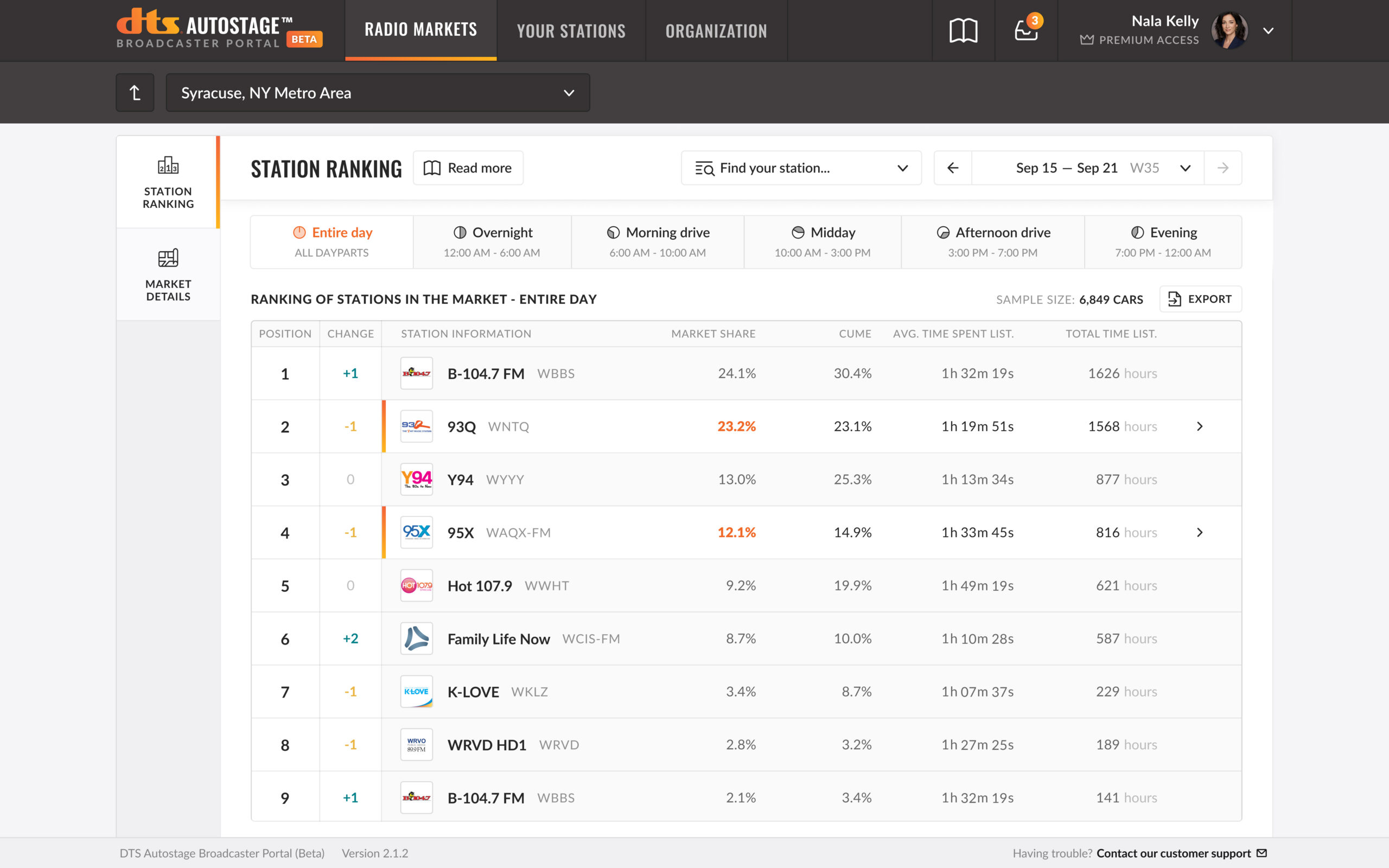
Station Ranking with Dayparts in the DTS AutoStage Broadcaster Portal Premium. Click to enlarge.
The features are now available and will be demonstrated at Xperi’s NAB Show booth, which include:
Station rankings with daypart granularity: Stations can see exactly where their station ranks in its local market and in adjacent markets, broken down by daypart: overnight, morning drive, midday, afternoon drive and evening.
Near real-time data — by day, week, month and quarter: Premium subscribers can watch patterns evolve and use them to inform their programming and promotions.
Top 100 songs: Premium subscribers gain access to weekly top 100 song rankings by total listening sessions, complete with spins, average sessions per spin and week-over-week chart movement.
Full data export: Every report in the premium tier — market share, daypart activity, music charts and ranking position — can be exported and downloaded for use in advertiser presentations and sales materials.
Enhanced combined listening heatmaps across expanded markets: Premium subscribers can view listening heatmaps with all broadcast frequencies — FM, HD Radio and translators — combined into one unified view, as well as weekly and monthly heatmap views.
Existing broadcaster portal features include quarterly listening data provided at the station level by time of day, market and geography in their core markets and surrounding markets. The portal also includes hourly flow, geographic heat maps and the number of vehicles used for listening reporting, with market sample sizes updated daily.
DTS AutoStage is now in 13 automotive brands, including Mercedes-Benz, Maybach, Hyundai, Genesis, Kia, BMW, MINI, Ford, Lincoln, Nissan, Infiniti, Tesla and Audi.
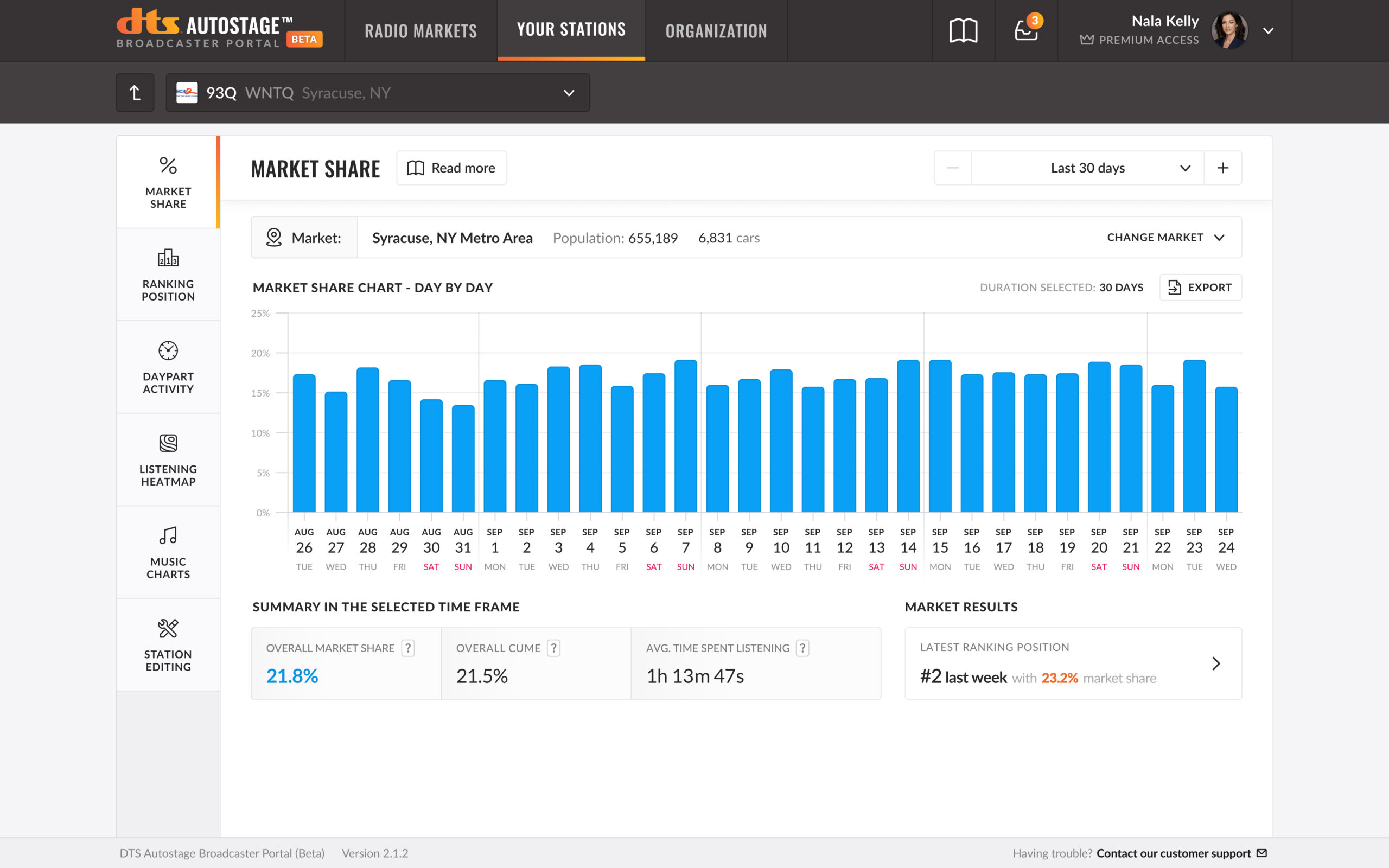
Market Share in the DTS AutoStage Broadcaster Portal Premium. Click to enlarge.
As of the beginning of April, vehicle coverage in New York City is 247,000; Cleveland is 46,312; Birmingham, Ala., is 19,211; Jackson, Miss., is 7,117; and market #302, Kokomo, Ind., is 1,464, Xperi said.
Joe D’Angelo, Xperi’s senior vice president of commercial strategy and partnerships, said that the premium tier was developed as a result of talking to station managers across the country. It allows broadcasters — from large market leaders to local community stations —to see where their stations rank at any hour of the day.
Earlier this week, we highlighted takeaways from Quu’s brand-new In-Vehicle Visuals Report, which looks at how radio station metadata is displayed in the top 100 new car models in the United States.
For instance, about three-quarters of the top 100 models now have HD Radio, and roughly one-quarter are equipped with DTS AutoStage. The report, which Quu makes available for free, is worth your time to review.
But one question might come to mind: Which car brands dominate the top 100?
According to Quu, its report now provides that information, sifting sales data from GoodCarBadCar.
Toyota, for instance, leads the way, accounting for 12% of the top 100, or 12 car models.
Ford is next with 10%, while Chevrolet, Honda and Nissan are locked in a three-way tie for third place at 8%.
By percentage, the leaders among top 100 market share, from the Quu report.
Note that some of the names on the chart are owned by a common parent. For instance Jeep and Dodge, listed separately, are both part of Stellantis.
You can view the top brands by percentage in the chart above, but Quu’s website allows you to drill down further to see specific models; for Toyota, these include the Tundra, Corolla, Camry, Prius and RAV4.
What is notable is that you can see whether each model has a dedicated radio button, as well as support for RDS and HD Radio displays.
Like all vehicles in the top 100, these Teslas do include an AM/FM radio. But as drilling down in the Quu report on Tesla models indicates, actually engaging with that radio might be a whole other matter altogether.
Beyond the audio industry, those researching automakers may also be interested in broader trends, such as the significant role of Japanese automakers in U.S. car sales.
Longtime engineer John Diamantis, who worked most recently in the Fredericksburg, Va., market and had deep ties to the Washington D.C. radio community, has died after an eight-year battle with cancer. He was 73.
Connoisseur VP and Market Manager Debbie Patten called Diamantis “the backbone of a radio station,” praising his consistency, skill and calm presence in a fast-moving business, according to DCRTV’s Dan Lane.
An author of “Tube Talk” Radio World columns in the 1990s, he also is remembered by many for building out many radio facilities, his knowledge of audio processing and his deft troubleshooting abilities.
Diamantis began his career on air but found his true calling in engineering, getting a taste at George Washington University’s carrier-current WRGW while studying there in the 1970s.
He most recently worked for the Connoisseur Media cluster of stations in Fredericksburg that were formerly owned by Alpha Media, which includes 93.3 WFLS(FM), 96.9 WWUZ(FM), 99.3 WVBX(FM) and 1350 WNTX(AM).
Before that, he had a 20-year run as chief engineer for Centennial Broadcasting’s 101.5 WBQB(FM) and 1230 WFVA(AM).
Prior to his time in Fredericksburg, he held engineering roles in the nation’s capital, including at the former Group W’s WCXR(FM) and WCPT(AM), and later at Colfax Broadcasting’s WBIG(FM), WGMS(FM) and WTEM(AM).
Before the sale of WCXR to Viacom, Diamantis oversaw a complete rebuild of the station’s studios, according to Lane.
Diamantis was a caring father and grandfather and he is survived by his partner, two daughters and grandchildren. He was also known for his love of poker.
Super Typhoon Sinlaku spins over the North Pacific Ocean on April 13, 2026. Credit: NASA Earth Observatory/Michala Garrison
The FCC has activated its Disaster Information Reporting System in response to Super Typhoon Sinlaku’s landfall in the Northern Mariana Islands.
In coordination with FEMA, the reporting system has been activated in the U.S commonwealth, which is located in the western Pacific Ocean, for its islands of Rota, Saipan and Tinian.
The FCC also activated the Mandatory Disaster Response Initiative for the same areas, which means that all facility-based mobile wireless providers must provide reasonable roaming services, mutual aid agreements with other providers, as well as service and restoration status updates to the public.
Super Typhoon Sinlaku, equivalent to a category 5 storm on the Saffir-Simpson wind scale, hit the Northern Mariana Islands for hours before daybreak local time Wednesday, slowing down to cause more damage across Saipan and Tinian, which are home to approximately 50,000 residents. Sinlaku peaked with winds of around 175 miles per hour.
According to NASA, meteorologists noted that the storm is one of only a handful of category 5 typhoons known to have occurred so early in the year.
President Donald Trump approved emergency disaster declarations ahead of the storm for Guam and the Mariana Islands. FEMA said it was coordinating support across multiple agencies, dispatching nearly 100 of its staff as well as other personnel, according to The Associated Press.
The FCC’s DIRS is a web-based system that communications providers, including wireless, wireline, broadcast, cable and VoIP providers, used to report communications infrastructure status and situational awareness information during times of crisis.
The candelabra tower on Baltimore’s TV Hill is on the left in this 2008 photo. Credit: Marylandstater/Wikipedia Commons
The Maryland attorney general and the state’s Department of the Environment have announced a settlement and consent decree with the owner of the Baltimore “candelabra” and its contractor over the spread of lead paint and chips debris from the broadcast tower into area neighborhoods.
Located on Baltimore’s “TV Hill,” the 997-foot tower is home to 97.9 WIYY(FM), 106.5 WWMX(FM), as well as FM translators on 97.5 for WLIF(HD4), 101.5 for WBAL(AM) and 106.1 for WLIF(HD2).
The agreement resolves a May 2023 lawsuit alleging that the tower’s owner, Television Tower, Inc., knew since 2012 that the tower contained lead-based paint, yet hired Skyline Tower Painting to repaint the structure. According to a release from the attorney general, Skyline was not accredited to provide lead paint abatement services in Maryland.
Television Tower is a joint venture of three television stations — WJZ(TV), WMAR(TV) and WBAL(TV) — which all have their antennas on the tower.
The complaint alleged that Skyline removed lead paint by scraping and forceful power washing without using controls or containment. The work, conducted in 2022, sent lead paint chips and debris into surrounding neighborhoods like Woodberry, as Radio World reported at the time.
State officials ordered TTI and Skyline to stop the project. While cleanup efforts were ongoing, residents found more paint flakes in the area. TTI has since replaced Skyline with a lead-accredited contractor and is using a specialized containment system to finish the job.
In December, Maryland Attorney General Anthony Brown had announced guilty pleas and a $100,000 fine against Skyline, according to The Baltimore Banner.
Under the $2.2 million settlement, TTI must complete all repainting using proper containment by June 30 and replace the elevator carriage by August 31. TTI is also required to conduct a final cleanup and inspection, followed by three months of monitoring community complaints.
As part of the decree, Skyline will permanently cease all lead abatement, painting and surface remediation work in Maryland.
Orban has announced software updates to its Optimod 5950 HD processor, including support for remote time management, expanded monitoring capabilities and security-related updates.
Existing users will be able to get the firmware for free in early May, Orban said. All new units, meanwhile, will ship with the updates.
Software improvements for the 5950 include customizable access control and front-panel security tools, remote date/time and NTP management, expanded monitoring and diagnostic tools, offline updates via USB, expanded HD Radio processing with transient enhance controls and increased headroom, and updates for increased security.
In addition to those updates, the manufacturer said that several optional features have been expanded.
The processor’s streaming option now allows dual-stream support, allowing an all-cloud-based input setup.
Its optional Nielsen encoder provides support for three simultaneous watermarking engines: FM, HD1 and HD2.
The processor’s optional HLS+metadata offers a metadata decoder with EAS chain triggers, and optional uMPX has added support for legacy encoders. A new optional feature, support for fallback file backup, is provided when other inputs are unavailable.
Orban will also be featuring the updated 5950 HD at its NAB Show booth.
Broadcast Supply Worldwide has announced the retirement of John Lynch, its director of business development, concluding a career that spanned more than five decades in broadcasting, 33 years of which were with BSW.
Lynch’s last day with BSW is April 30.
He joined the supplier in October 1992, according to a release, after two decades of radio and TV experience at nine stations. He became an integral part of the organization, known not only for his deep radio voice but for his connection to broadcasters across the country.
He was not formally trained as an engineer, but Lynch earned a reputation as a trusted advisor to both the technically minded and sportscasters alike. It earned him the affectionate title “The Sportscaster at BSW,” and later, as time is wont to do, it was amended to the “The Old Sportscaster.”
Supported by BSW to continue his broadcast endeavors, Lynch served as the voice of the Seattle Sea Dogs of the Continental Indoor Soccer League from 1995–1997, and later as the voice of the Unlimited Light Hydroplane Racing Association from 2001–2011.
BSW said that one of Lynch’s most notable contributions came in 1994, when he provided feedback to a visiting rep from Beyerdynamic. His suggestion — to offer broadcast headsets with factory-installed XLR and ¼” connectors — was adopted and led to a significant increase in product adoption across the industry.
John Lynch, in bobblehead form.
“John represents the very best of what BSW stands for — experience, a deep understanding of our customers and most of all, relationships,” said Bryan Seeley, president and CEO of BSW, in the release.
An Irish pursuit beckons
Lynch plans to spend more time traveling with his wife, visiting friends across the country and exploring a few states still left on his list — with hopes of someday visiting Galway, Ireland, where his family traces its roots.
He also plans to stay connected to broadcasting.
Before joining BSW, Lynch worked in sports broadcasting and served as a play-by-play announcer for football and basketball at Pacific Lutheran University near Tacoma, Wash. In retirement, he looks forward to the possibility of returning to the booth for select sports broadcasts should the opportunity arise.
Lynch will also be attending the NAB Show, where he looks forward to reconnecting with industry colleagues and customers. Attendees can find him with the BSW team at Booth C1459.
Justin Sasso speaks at the Colorado Broadcasters Association Awards of Excellence Gala.
The Colorado Broadcasters Association brought together approximately 400 industry professionals this past weekend for its Awards of Excellence Gala.
President and CEO Justin Sasso said the event, held at the Ritz Carlton Denver, highlighted the strongest work in Colorado radio and television.
The 2026 competition set a new high-water mark with 1,013 entries, including 546 from radio.
The program recognized standout performances across the state’s broadcast markets, with “Station of the Year” honors awarded based on cumulative points for first-place awards of excellence and second-place certificates of merit.
For radio, the state’s winners were:
Small Market: KBVC(FM) in Buena Vista
Medium Market: KYSL(FM) in Frisco
Major Market: KKMG(FM) in Colorado Springs
Metro Market: KCFR(FM) in Denver
In his remarks, Sasso said that trust is the industry’s defining asset, while pointing to recent advocacy outcomes, including blocking legislation that would have limited open records access in Colorado and the bipartisan support for the still-pending AM Radio for Every Vehicle Act.
The event also highlighted the next generation of broadcasters, recognizing students from Rampart High School and Colorado State University with future broadcaster awards.
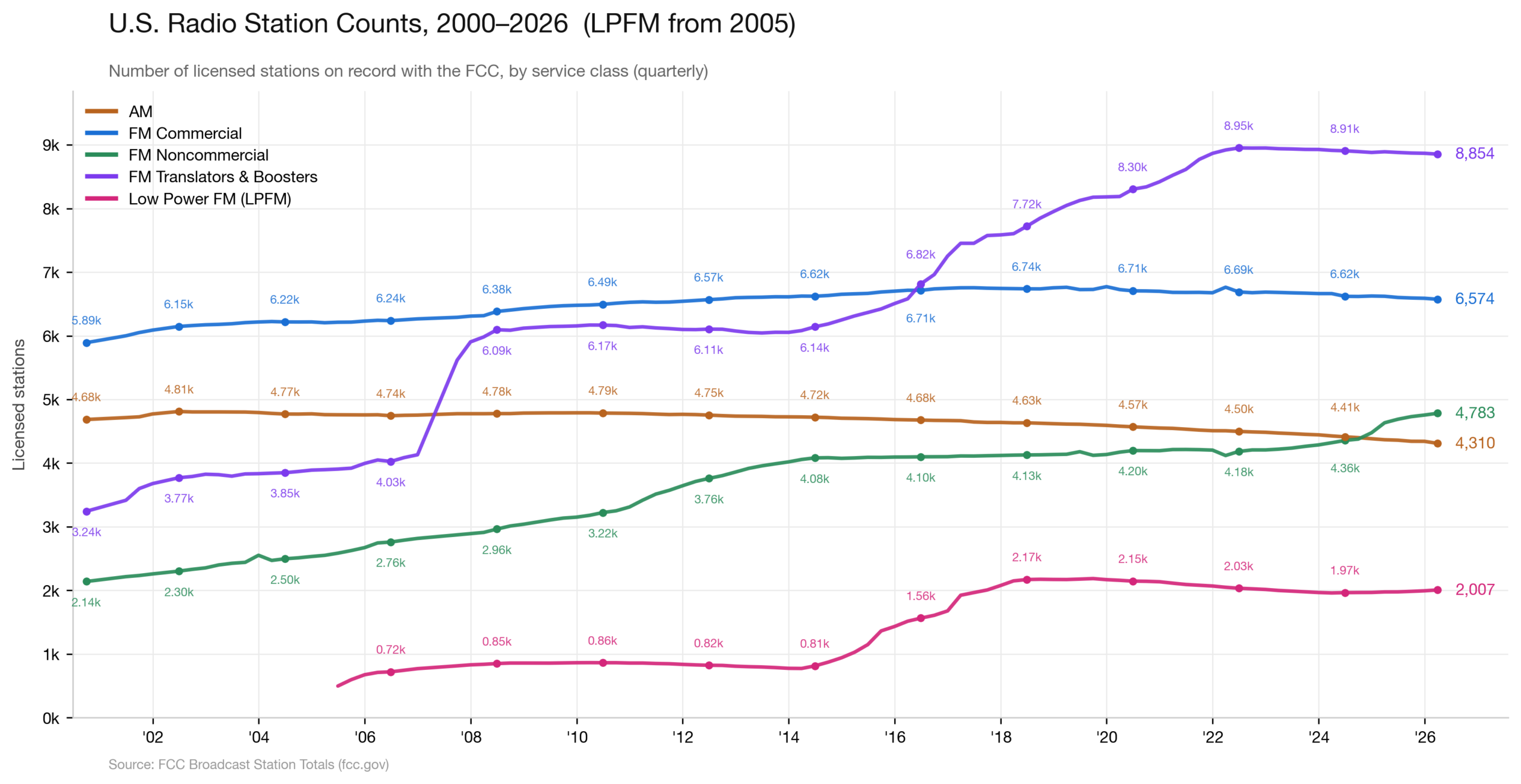
The FCC’s station counts for AM, FM commercial and noncommercial, FM translators and boosters and LPFMs since 2000. Click to enlarge.
In a time-series plot, let’s take a look at the latest station total report from the FCC, which reflects recent trends: Commercial AM and FM radio facilities are seeing gradual declines, while noncommercial FM totals continue to climb.
NCE FMs continue to set new highs. As of the commission’s March 31 report, there are 4,783 of these stations, which is up 28 stations from December. But as you can see from our 26-year chart, at turn of the century, there were only around 2,000 noncommercial FM stations.
Not all religious stations are noncommercial, of course, but many of them are, and the continued increase in noncom totals also reflects the prominence in the U.S. of such networks.
The NCE FM total once again outpaces the total number of AM stations in the U.S., which dropped by 32 since December to 4,310. That is the lowest the total yet for the senior band in the commission’s dataset, which tracks numbers dating back to September 1990. AM’s decline, as we can see, is gradual, but also continuous, since about 2010.
The drop in the number of AM stations is perhaps more publicized, but the number of commercial band FM stations has been in a decline, too. The total number of such stations fell by 12 from December to 6,574, which is down from an overall peak of 6,772 commercial FM stations reached in December 2019. Still, that’s quite a bit higher than the commercial FM total of 5,892 in 2000.
FM translators and boosters dipped slightly in March, falling from 8,867 to 8,854. These totals peaked at 8,951 in June 2022.
LPFMs, meanwhile, increased by 13 to 2,007. Our chart shows low-power FM totals peaking just before COVID-19 hit.
Broadcast Electronics will demonstrate its latest AudioVault automation user experience enhancement and a software-powered FM transmitter at the NAB Show.
“We are excited to bring new software and hardware products to NAB – our first under new local ownership – that enable stations to cost-effectively deliver content to their listeners,” said Rich Redmond, BE’s president and CEO, in a release.
A new look and feel
AudioVAault AV-xI software
With a redesigned look and feel, AudioVault AV-xI was released last fall and offers a layout framework with scalable docking positions. Users can drag and drop up to 18 AudioVault gadgets on a single screen.
BE said that the layout offers playback engines for streams, HD Radio channels or multiple stations on one workstation. Its built-in browser allows access to features such as news, weather or artist bios.
AV-xI also includes a revamped CloudVault, which supports centralized and distributed content and control, either on-premise or hosted. It provides integration with HLS streaming to a CDN or with an Orban 5950 processor.
CloudVault also includes a file distribution framework that provides real-time synchronization of content, commercials and logs between the cloud and edge playout devices.
BE said that the CloudVault solution is also suitable for disaster recovery, backup and off-premises operations.
AV-xI also features TRE+ integration, matching a station’s visual content with audio across RDS, HD Radio and streaming platforms.
Software-powered transmitter
The BE STX 1k transmitter will be demonstrated at the NAB Show.
The BE STX 1k FM transmitter is a new, 1 kW compact 2RU footprint model that includes LDMOS RF device and switching power supply technology. It uses BE’s TX direct-to-channel digital exciter.
There are optional upgrades available to transmit on digital HD Radio or DRM+ modes.
Control and monitoring can be done through an HTML5 GUI that supports SNMPv3 connectivity.
The STX 1k uses a software-defined processing engine, which integrates with BE tools such as its declipper, delossifier, advanced dynamics and a composite clipper that delivers audio quality and loudness for “even the most demanding markets,” according to BE.
The MicroMPX option allows for STL capability over IP networks, with error correction and transmission over multiple networks. Optional GPS synchronization coupled with single-frequency network software allows for operation in an SFN or on-channel booster.
Barix will unveil its latest Instreamer and Exstreamer devices for AoIP transport at the upcoming NAB Show.
The manufacturer is highlighting flexible configurations for its MultiCoder M400 and LX400 FLEXA codecs and its Reflector Evo cloud transport platform.
New for the NAB Show, Barix has added SRT and RIST support to the MultiCoder M400. The IP encoder can send audio streams to receive points in four formats, a feature intended for broadcast headends, media production centers and remote service providers.
The update follows the addition of SRT transport to LX400 codecs, which are designed for radio stations. The LX400 can be configured as either an encoder or decoder for use over traditional studio-to-transmitter IP connections, point-to-point SRT paths or multi-point enterprise Reflector Evo cloud networks.
The M400 integrates four internal encoding engines capable of simultaneous operation, each supporting low-latency RTP, BRTP, SRT and RIST protocols, Barix said. The hardware allows users to encode incoming analog audio into OPUS, AAC+, PCM and 320KB mp3. It can send multiple audio streams to receiving devices while maintaining quality on RTP, SRT or RIST.
The M400’s CPU capacity provides a foundation for ongoing customization and new applications, the company said. Like the LX400, it uses a Linux-based platform to provide security features, including HTTPS for device setup.
The LX400 codec includes features native to the Barix product line, including multiple contact closures, relays and a USB port for direct playout. It also offers end-to-end delay control for RTP streaming and stream redundancy modes for uninterrupted broadcasting. The device can be used in a standard STL configuration or within the Reflector EVO service.
The latter, offered through partner StreamGuys, provides full-duplex audio contribution and distribution in the cloud for enterprise broadcast applications.
The latest round in a back-and-forth surrounding interference complaints from a full-power station near the North Carolina/Virginia border has resulted in a Federal Communications Commission order for the translator in question to shut down for now.
We’ve covered the interference complaints that stem back to the fall of 2024 from Lakes Media, the owner of Class C3 98.3 WLUS(FM) in Clarksville, Va. Its antenna is located just across the North Carolina state line in Granville County.
After Lakes Media’s first interference complaint, the FCC ordered same-channel W252EL(FM), a 150-watt “Rock FM” translator licensed to Cary, N.C., to go silent until it could implement a directional antenna pattern that avoided overlap with the WLUS 45 dBu contour.
The owner of the translator, Curtis Media, said it did so, and it returned to the air last September under program test authority. Curtis filed an application for a license to cover the new facility.
Lakes Media President Tom Birch quickly filed an opposition, arguing the application should be denied because WLUS was again suffering harmful interference.
The parties went back and forth some more. Curtis Media alleged that Birch repeatedly suggested paying $500,000 to settle the matter, “indicating that profit motives, not the interests of its listeners,” underpin Lakes’ interference allegations, according to the commission’s account.
Then in November, Birch and Lakes filed 10 listener complaints within WLUS’ protected 45 dBu contour, each plotted on a map, as well as signal strength data from each listener location.
“After enduring this three times since 2016, I am outraged that there are no FCC provisions for interference violators to be liable for reimbursing all of the expense incurred by the injured parties,” Birch told Radio World.
Birch ventured that Lakes Media spent “tens of thousands” of dollars in legal and technical expenses in trying to prove the interference.
Curtis argued that the latest exhibit was invalid because, among other reasons, nine of the listener complaints were clustered around the immediate neighborhood of Birch’s Raleigh-area residence.
“While the commission’s FM translator interference complaint process requires complaints to be from ‘separate receivers at separate locations,’ the commission surely did not envision ‘separate locations’ to mean more than a half-dozen houses in the same compact subdivision,” Curtis wrote.
The translator owner also argued those complaints should have been originally included in Birch’s 2024 filing. It further argued that its new antenna pattern, in terms of interference, was not being properly considered without the use of higher resolution terrain samples.
But the commission rejected Curtis’ argument about terrain accuracy and said that there is no rule or precedent supporting its claim “that listener complainants may not be clustered in a single neighborhood.”
All told, the Media Bureau found the latest evidence from WLUS compelling. While it cautioned Lakes and Birch against any possible abuse of process arising from financial settlement, it said that WLUS could not have collected the second round of listener complaints regarding the new pattern until it was actually on the air.
It found the complaints valid and, as a result, the Cary translator must shut down immediately. Curtis must first demonstrate, prior to any operation or processing of its new application, that it has resolved all listener complaints submitted by Lakes Media.
Radio World has also invited comment from Curtis Media.
With CBS News Radio about to sunset, a new operator will unveil a news network promising several technological advancements.
Live Channel USA is announcing the launch of the Radio Network News Service for U.S. stations. A bridge service will be available for affiliates beginning May 23 — one day after CBS News Radio is scheduled to shut down.
Dan Warren
While the network has roots in European broadcast technology and maintains a global hub in London, the rollout — which Live Channel calls the “Change Bulletin Supplier” initiative — is designed for the U.S. market, according to founder Dan Warren.
The network follows a traditional barter model, providing top-of-the-hour and half-hourly bulletins available in one-, three- or five-minute segments with a standard national commercial load.
Its primary differentiator, Warren says, is localization. RNN utilizes a cloud-based system to produce customized offerings designed to feel more like a regional partner.
“For example, a significant Florida story that might not make a national cut will still appear on our Florida affiliates’ bulletins but not in New York,” Warren said.
The full network will roll out on June 1. It is led by a veteran team with international broadcast experience from outlets such as Sky News, the BBC and CNN.
He managed to work nearly 65 years in the biggest city in the U.S., and in doing so, earned the admiration of his broadcast engineering peers.
Richard Ross, a longtime chief engineer in New York City, died on Feb. 12 at the age of 89. He is survived by his daughter Erica, who shared many details with us from his life.
In March 2013, Ross received recognition of 50 years of service to WADO(AM). The Richard Ross Studio was named in his honor. Credit: Erica Ross
Ross joined 1280 WADO(AM) in the summer of 1972 as a relief engineer. By his count, he would withstand eight ownership changes until his retirement as chief engineer from Univision Radio in June 2020 at the age of 84.
Fellow engineers would call Ross frequently after his retirement, and for a time, he offered consulting services.
“He had a kind of Harry Potter-like knowledge of it all,” Erica said.
“Those who knew Richard lost a member of their family with his passing,” said Santos Lebron, engineering supervisor at Univision Radio New York.
Lebron’s relationship with Ross went back decades; they met when Lebron was hired as a relief engineer at WADO in 1977. He and others remembered Ross for being well-dressed and possessing a level-headedness, amicable toward all and harboring a bit of a mischievous side.
Ross knew of his fortune to work in the Big Apple for so many decades. “It is a rare occasion where one starts their career in any major city and they eventually work their way up the line to more important positions in major communications hubs,” he wrote in a piece for Storyworth.
Along with WADO, Ross spent many hours with the equipment above the Empire State Building when Heftel Broadcasting purchased 105.9 WNWK(FM). Univision’s radio footprint in New York would continue to grow with the addition of 92.7 WQBU(FM) in Garden City, followed by the trade of 105.9 with New York Public Radio for 96.3, then WQXR(FM), in 2009.
Early life
Ross was born to Helen and Edward Ross in May 1936 as an only child on Manhattan’s Upper West Side.
Erica recounted how he developed a knack for machines and tinkering early on. By age 10, Ross was already experimenting with his apartment building’s elevator controls — even figuring out how to send the doorman to the wrong floors.
New York Air National Guard 1959 graduation for its radio operating department. Ross is at bottom left. Credit: Erica Ross
For several years, he attended a boarding school in western North Carolina near the Blue Ridge Mountains. The experience of navigating his way back to Manhattan via train sparked a lifelong fascination with locomotives.
He later attended Brooklyn Technical High School, where he joined the radio club and, according to Erica, officially “caught the bug.”
Ross studied at the University of Bridgeport, earning his associate’s degree in electrical engineering. He went on to serve three years in the communications division of the New York Air National Guard and completed basic training at Keesler Air Force Base in Biloxi, Miss.
In 1958, he got his break into the radio business, joining Municipal Broadcasting System’s WNYC(AM/FM) as a provisional engineer.
Richard Ross at Municipal Broadcasting System’s WNYC(AM/FM) in 1958.
Ross aimed to become permanent pending a civil service exam. Passing the exam, however, didn’t guarantee a full-time position due to fierce competition from others. But WNYC’s chief engineer at the time, Hom Hong Wei, offered some reassuring advice, and Ross got the position.
He would credit Wei as being one of his most influential mentors. At WNYC, Ross found himself exploring hidden corners of the city.
“I got to go places that nobody else goes such as walking to the top of Washington Square Arch and yes, there is a locked stairway in the south leg of the arch,” Ross would recount.
Many decades at WADO
By the early 1970s, Ross transitioned to WADO as a summer relief engineer.
For a time, he found the energy to work at both WADO and WNYC, before becoming permanently entrenched at the Spanish-language AM station, where he’d work well into the 21st century.
He wondered how he had the stamina to manage it all.
He’d go solely full-time at WADO, but Ross’ role went beyond its day-to-day. During the ’70s, the AM station would broadcast Black gospel music on Sundays, and it had brokered agreements with several churches in the south Bronx and Harlem.
Ross was tasked with recording the services, lugging RCA reel-to-reel machines to the locations. Others were known to turn down those assignments for one reason or another, but Ross happily obliged.
The Greater Hood Memorial AME Zion Church, December 1974, which is the oldest continuing church in Harlem. Ross operated as a “Gospel Technician.”
Even after WADO stopped airing the programming, he became entrenched with the churches, who would ultimately approach Ross to do separate recordings of the services. He would handle multiple recordings in a single day during the 1980s, and continued doing so through at least 2005.
They affectionately referred to him as “Brother Ross, our Gospel engineer,” viewing him as a part of their community. The services would be taped and sent to radio stations across the U.S. that aired Black gospel.
His spirit was evident in other ways. Ross became a member of the IBEW Local 1212, the labor union for broadcast engineers, in 1963.
He rose in its ranks, becoming part of the union’s executive board. Ross would stay even after he became WADO’s chief engineer in 1985, following the passing of his good friend Phil Greenstone.
With what would have been considered a management position, it was unusual for someone like Ross to remain in the union, both Erica and Lebron said. Ross wrote that he felt it was an honor.
“He was more than a colleague; he was a brother in every sense of the word,” IBEW 1212 wrote while remembering Ross on its website.
“All of us in this profession share the same situation,” Ross wrote in his Storyworth of his IBEW role. “We all know each other in New York City and once each month we meet to eat, drink and be merry and discuss our war stories.”
Ross was also a loyal member of the Society of Broadcast Engineers.
Meadowlands move
A mid-2010s photo of 1280 WADO(AM)’s studio, wth Ross’ prized 1989 burgundy Lincoln Town Car in front. By his count, Ross would withstand eight separate ownership changes until his retirement as chief engineer from Univision Radio in June 2020 at the age of 84.
As the broadcast landscape evolved, Lebron remembered Ross best for coordinating WADO’s transmitting power increase in the New Jersey Meadowlands at the end of 1999.
As recounted by Scott Fybush, WADO had used a Blaw-Knox diamond-shaped tower from its transmitter site on Paterson Plank Road in Carlstadt. It ran 5 kW day and night as part of a power restriction on regional channels like 1280.
But the FCC lifted that restriction in the early 1990s. WADO sought to upgrade to 50 kW by day and 7.2 kW at night, which required a new antenna system.
The former WADO(AM) Blaw-Knox tower dated back to 1934. This photo is from March 1998, courtesy of Scott Fybush.
The venerable Blaw-Knox tower came down, and three new towers were needed, along with a complete renovation of the 1930s-era building that housed its transmitters.
Then-owner Hispanic Broadcasting had filed for a construction permit, but most of the actual work did not commence until just prior to its expiration, which acted as a hard deadline.
As Ross wrote in his Storyworth, from October 1999 and for the next four months, he visited the Meadowlands site daily to complete the project under great stress and pressure.
Ross named one of WADO’s three new towers in honor of his daughter. Ross said it was the “smallest but most powerful of the three.”
Construction took place on sensitive riparian land. It required a year of hearings costing over $1 million, involving the state of New Jersey, the Army Corps of Engineers and the U.S. Coast Guard.
Laying down and completely removing temporary wooden plank roads alone cost $675,000, according to Ross. Union dock workers were hired to build a 1,000-foot boardwalk to the towers, and a crane had to be rented from the Tappan Zee Bridge.
With the main transmitter building modified and the heat shut off, crews worked late into the winter nights, running copper straps between the four towers with only a porta-potty out back.
He recounted the moment of truth:
“On February 1, I invited David Lykes, Hispanic Broadcasting’s chief operating officer, to come up from Dallas to push the activate button at 6 p.m.,” Ross wrote. “My heart was in my throat, but the damn system worked.”
The antenna system was designed by Ron Rackley of du Treil, Lundin & Rackley, who consulted on the project and praised Ross for its execution.
True to form
Ross offered daughter Erica one of his renowned tours of the Empire State Building broadcast facilities in November 2018.
There were many other, less high-profile wins as well, often accompanied by 2 a.m. phone calls.
Ross was also well-known for his thorough tours of the Empire State Building’s broadcast facilities — Erica said multiple people have told her that those tours were highlights of their careers.
Also an amateur radio operator (K2RNR), Ross had many interests outside of radio, including locomotives and nature.
He loved the city, but ever since his boarding school days in western North Carolina, he became infatuated with the peace of a mountainside setting. Since the late 1960s, Ross owned a property in Kunkletown, Pa., in the southern portion of the Pocono Mountain region.
Ross, at age 83, on horseback while visiting Erica in Austin, Texas.
A lover of nature and an adamant conservationist, he viewed the country home as a sanctuary for wild animals. But he’d continue to call the Big Apple his main home and it was the only place he’d ever work.
In 2013, Univision honored his 50 years of broadcasting service by naming a studio after him.
True to his nature, he hated the attention and adamantly hoped people wouldn’t use the milestone to do the math on his age.
Ross passed away at home in his Hell’s Kitchen apartment — where he lived since 1964 — just shy of his 90th birthday.
Fittingly, the coroner described the lifelong engineer’s unforeseen cause of death as “an electrical short circuit of the heart.”
A memorial and celebration of life for Ross will be held Sunday, April 12, at the Masonic Lodge No. 72 in Secaucus, N.J.
FCC Chairman Brendan Carr chose a clear, blue-sky North Carolina spring day to travel to the top of a nearly 2,000-foot broadcast tower.
This was not the chair’s first rodeo — he also went to the top of the KELO(TV) tower in South Dakota last July and he has expressed his enjoyment of scaling such structures in the past. Carr used this latest opportunity, which included a live TV hit from the top of the eastern North Carolina broadcast site, to praise the efforts of America’s tower crews, including the one that aided him with his April ascent.
“It’s tower crews like this who maintain these structures; they are the reason why people receive these signals,” Carr told WCTI(TV). He said that there are roughly 20,000 tower climbers nationwide who support broadcast sites, along with towers for wireless communications and other services.
He shared a video on his X account:
Great day climbing with some of America’s talented tower workers. 🇺🇸
Carr utilized a hydraulic hoist for the majority of the ascent before climbing the final 100 feet by hand, according to WCTI. The round trip took several hours.
The tower, located just west of New Bern, stands approximately 1,966 feet tall. In addition to serving WCTI, WYDO(TV) and WUNM(TV), it is home to 95.1 WRNS(FM), a Class C, 100,000-watt station licensed to Kinston.
According to Wikipedia, the structure ranks among the tallest towers in the United States.
The climb comes while crews are in the middle of a major maintenance project to replace the guy wires that stabilize the tower, according to WCTI. As a result of the work, WRNS said on its Facebook page that the station was off the air for several hours on April 6.

 Connexion