Broadcast Radio will add Split Voice Tracking in the latest version of its Myriad Playout & Automation system
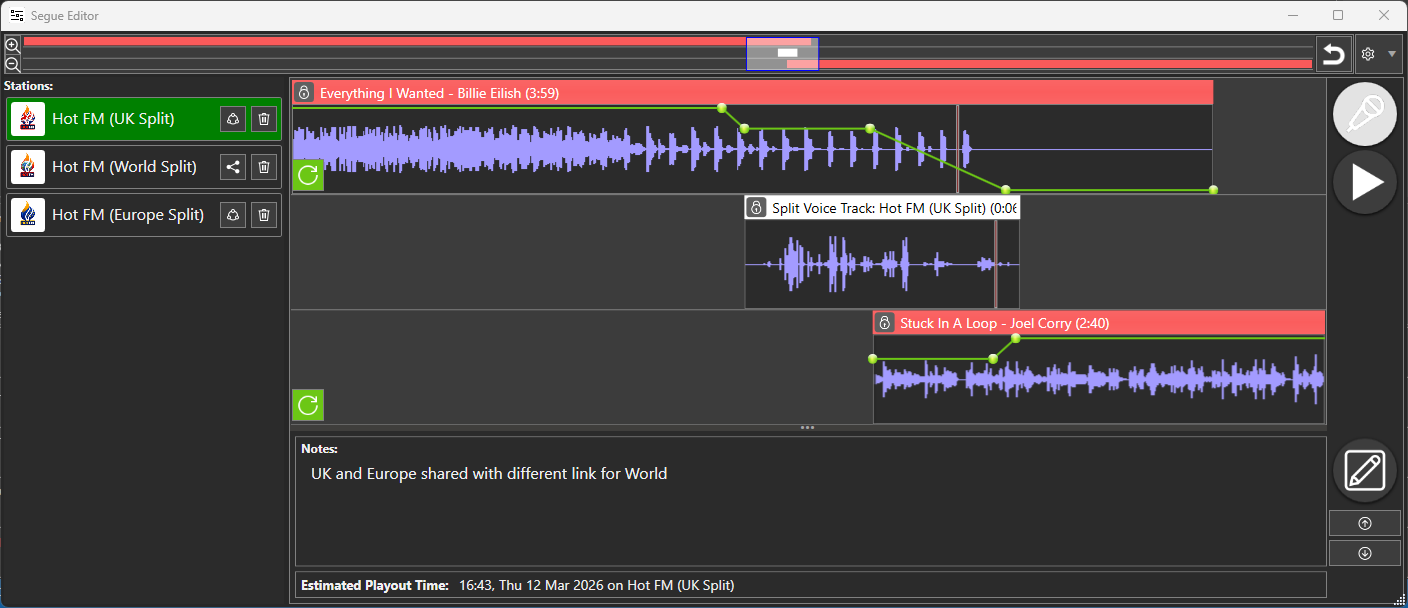
It will enable stations using split transmissions to record separate voice tracks for individual regions or platforms.
“The new capability allows presenters to create unique voice links for each split, or selectively share voice tracks across multiple splits, giving stations greater flexibility when producing localized content,” it said.
Split Voice Tracking introduces several tools.
Split VT Placeholders within the Log can contain notes or instructions for presenters, along with navigation tools that allow presenters to jump between Split Voice Track points in the Log.
The company said Split Voice Tracking also assists with maintaining consistent VT lengths between splits, helping ensure that region-specific voice tracks remain within similar durations so that split transmission paths remain synchronized.
“The feature works both in the studio using Myriad Playout and remotely via Myriad Anywhere, allowing presenters to produce split-specific links regardless of location.”
Split Voice Tracking enables stations to take advantage of split transmissions by adding more localized content, while keeping production efficient and cost- effective for live and automated shows. (See a short demo video.)
The company will highlight the feature at the NAB Show in booth C2230.
Dry chemical agent extinguishers form a crust to remove oxygen and keep it from spreading.
Water types absorb the heat, cool the burning material and remove oxygen.
Wet chemical types seal the fuel to prevent vapors from igniting and cool the fire.
Carbon dioxide types remove the oxygen and replace it with pressurized CO2 gas.
Halotron is a clean agent fire extinguisher that discharges a non-conductive rapidly evaporating liquid.
And foam types smother the fire by creating a barrier or film of foam.
According to the National Fire Protection Association, extinguishers carry a letter rating that corresponds to the type of fire a device can put out:
Class A are fires in ordinary combustible materials, such as wood, cloth, paper, rubber, and many plastics.
Class B are fires in flammable liquids, combustible liquids, petroleum greases, tars, oils, oil-based paints, solvents, lacquers, alcohols and flammable gases.
Class C fires involve energized electrical equipment.
Class Dare fires in combustible metals such as magnesium, titanium, zirconium, sodium, lithium and potassium.
And Class K are fires in cooking appliances that involve combustible cooking media like vegetable or animal oils and fats.
With all the equipment at a transmitter site, you certainly don’t want to use an extinguisher that will leave a residue that can ruin the electronics. To avoid damage, steer clear of Class A and B dry chemical extinguishers.
Engineer Blaine Wilson writes that Halotron, made by American Pacific, is a brand of “eco-friendly” halocarbon fire extinguishers that are non-conductive and leave no residue, suitable for Class A, B and C fires.
You should also consider an extinguisher’s rating and weight. The sites mentioned above have information to guide you.
What’s your experience? And have you ever had to use an extinguisher at your site? Email me.
Engineer Steve Michaels suggests you take this question to your local fire department.
This seems a good idea on several fronts. First, you will get the latest information. Second, many departments will offer a free fire inspection of the transmitter site. Third, it’s a nice excuse to build a relationship with your local emergency responders.
Tube rebuilding
With Microwave Power Products closing the former Econco facility, engineers will be looking for an alternative source for tube rebuilding.
Steve Tuzeneu writes that Massachusetts-based Kennetron rebuilds vacuum tubes, oscillator tubes, power grid tubes and electron valves used in broadcast and industrial applications. Do you have experience with the company to share?
Frank fixes a leak
Consultants Frank and Dave Hertel share a simple fix to a problem that you might encounter. It’s an emergency end cap for a 1-5/8-inch transmission line.
Perhaps you are on a job and the station’s “staff IT engineer” has an old transmission line adapter on a line that is leaking air excessively. His nitrogen tank is going “empty” once a day.
The flange adapter disassembled.
The nitrogen tankfeed for the 1-5/8-inch line unfortunately is in parallel with a 3-1/8-inch line. The leak occurred when the engineer removed the 1 kW FM transmitter in order to send it to the factory for repair.
Since he didn’t have a spare transmitter, he and management understood they would be off the air for some time. Fortunately, they also realized that their high-power transmitter should be protected by having nitrogen on its 3-1/8 line. The nitrogen feed is simultaneously on both the 3-1/8 and the 1-5/8 line so it would not take on any moisture.
Assembling the plug.
Lady Luck must have been with them because aprevious RF engineer had left a stockpile of parts and pieces. They found an old cut-off EIA 1-5/8 flange and converted it into an end cap. The flange caps the bottom run of the EIA flanged 1-5/8 coax while keeping pressure on both coax lines.
The finished adapter.
The photos show you how to correct the station’s linepressure requirement while awaiting a new, non-leaking adapter/connector for the 1-5/8-inch line and the return of the transmitter.
This can be used outside, if need be. It will withstand winter and summer conditions. The plug for the coax end is a 1-1/2-inch expandable freeze plug, also known as a welch plug, available from Amazon or an auto parts store.
Workbench submissions are encouraged and qualify for SBE re certification credit. Email johnpbisset@gmail.com.
Broadcast Supply Worldwide has announced the retirement of John Lynch, its director of business development, concluding a career that spanned more than five decades in broadcasting, 33 years of which were with BSW.
Lynch’s last day with BSW is April 30.
He joined the supplier in October 1992, according to a release, after two decades of radio and TV experience at nine stations. He became an integral part of the organization, known not only for his deep radio voice but for his connection to broadcasters across the country.
He was not formally trained as an engineer, but Lynch earned a reputation as a trusted advisor to both the technically minded and sportscasters alike. It earned him the affectionate title “The Sportscaster at BSW,” and later, as time is wont to do, it was amended to the “The Old Sportscaster.”
Supported by BSW to continue his broadcast endeavors, Lynch served as the voice of the Seattle Sea Dogs of the Continental Indoor Soccer League from 1995–1997, and later as the voice of the Unlimited Light Hydroplane Racing Association from 2001–2011.
BSW said that one of Lynch’s most notable contributions came in 1994, when he provided feedback to a visiting rep from Beyerdynamic. His suggestion — to offer broadcast headsets with factory-installed XLR and ¼” connectors — was adopted and led to a significant increase in product adoption across the industry.
John Lynch, in bobblehead form.
“John represents the very best of what BSW stands for — experience, a deep understanding of our customers and most of all, relationships,” said Bryan Seeley, president and CEO of BSW, in the release.
An Irish pursuit beckons
Lynch plans to spend more time traveling with his wife, visiting friends across the country and exploring a few states still left on his list — with hopes of someday visiting Galway, Ireland, where his family traces its roots.
He also plans to stay connected to broadcasting.
Before joining BSW, Lynch worked in sports broadcasting and served as a play-by-play announcer for football and basketball at Pacific Lutheran University near Tacoma, Wash. In retirement, he looks forward to the possibility of returning to the booth for select sports broadcasts should the opportunity arise.
Lynch will also be attending the NAB Show, where he looks forward to reconnecting with industry colleagues and customers. Attendees can find him with the BSW team at Booth C1459.
At the NAB Show, Tieline will introduce the Gateway Nexus.
The company describes it as a 32-channel, high-density AoIP codec that provides “deterministic, low-latency multichannel audio transport using dedicated and reliable hardware.”
The Gateway Nexus can be deployed in hosted and data center environments. It provides native support of AES67, ST2110-30, ST2022-7, Ravenna, Livewire, NMOS and Ember+ with optional Dante.
“It stands out as a powerful and cost-effective alternative to virtualized codec and server-based systems, providing seamless integration into IP-based audio networks,” the manufacturer states.
Remote control is provided using the Toolbox Web-GUI embedded in each unit, or the optional Cloud Codec.
Charlie Gawley, VP Sales APAC & EMEA, said the codec works in hosted environments to provide an opportunity to centralize infrastructure “without sacrificing performance or control, and delivering the confidence to transition to modern AoIP workflows.”
As broadcasting shifts towards centralized and remote production models for live applications, Tieline says, the codec’s DSP-based platform allows users to upscale infrastructure efficiently.
Screens are “everywhere” inside cars now — not just in the center stack of the dash, but directly in front of the driver, in front of the front-seat passenger and in front of folks in the back.
And this trend matters for radio.
That’s one finding from the latest In-Vehicle Visuals Report published by Quu Inc. It found that 68% of the 100 top new models sold in America now display information on not one but multiple screens.
Quu also found that every one of the top 100 cars still has FM and AM radio, though radio is getting harder to find in today’s multi-menu infotainment systems.
Once again the company sent a researcher to sit in those car models and log a set of parameters about how radio and metadata display. Then broadcast researcher Doug Hyde analyzed the data.
Key findings of the report are summarized in this chart:
CEO Steve Newberry said in the announcement, “In our third year, trendlines are emerging. Screens are everywhere in vehicles. Dashboards are getting smarter and more intuitive to use. Audio is now almost always paired with a visual.”
Newberry said that for radio, “the challenge isn’t availability — it’s discoverability. Ensuring sound is seen isn’t optional. It’s essential.”
The chart at right shows what percentage of the top 100 have certain features.
Click to enlarge
Almost 3/4 now have HD Radio and about 1/4 are equipped with DTS AutoStage. SiriusXM has seen a dip since last year. Android Audo and Apple CarPlay continue to be well supported.
But another notable finding: The number of models with streaming apps built right into the vehicle is now 53%, up from 20% just two years ago.
The data on all these models is available at QuuReport.com. The site provides searchable findings as well as photos of the dashboards.
Quu sells technology that helps radio stations schedule and publish programming and sales messages on screens.
Newberry will discuss the findings in a free webinar this Wednesday, including guests Fred and Paul Jacobs from Jacobs Media, Joe D’Angelo from Xperi and MikeMcVay of McVay Media Consulting.
Justin Sasso speaks at the Colorado Broadcasters Association Awards of Excellence Gala.
The Colorado Broadcasters Association brought together approximately 400 industry professionals this past weekend for its Awards of Excellence Gala.
President and CEO Justin Sasso said the event, held at the Ritz Carlton Denver, highlighted the strongest work in Colorado radio and television.
The 2026 competition set a new high-water mark with 1,013 entries, including 546 from radio.
The program recognized standout performances across the state’s broadcast markets, with “Station of the Year” honors awarded based on cumulative points for first-place awards of excellence and second-place certificates of merit.
For radio, the state’s winners were:
Small Market: KBVC(FM) in Buena Vista
Medium Market: KYSL(FM) in Frisco
Major Market: KKMG(FM) in Colorado Springs
Metro Market: KCFR(FM) in Denver
In his remarks, Sasso said that trust is the industry’s defining asset, while pointing to recent advocacy outcomes, including blocking legislation that would have limited open records access in Colorado and the bipartisan support for the still-pending AM Radio for Every Vehicle Act.
The event also highlighted the next generation of broadcasters, recognizing students from Rampart High School and Colorado State University with future broadcaster awards.
Representatives of the National Association of Broadcasters met with staff members of Commissioner Anna Gomez last week and reiterated their case for why the FCC should eliminate market caps on radio ownership, among other changes.
Gomez, a Democrat, has openly opposed further broadcast consolidation. She has said that when consolidation becomes the default solution, it often accelerates “the very decline it is supposed to address.”
FCC watchers assume that a vote to ease or remove caps would fall along party lines, with the two seated Republicans in favor. But the NAB appears not to have given up hope for a unanimous outcome.
The meeting on April 9 included NAB’s Senior VP and Deputy General Counsel Jerianne Timmerman and Chief Legal Officer Rick Kaplan. They met with Gomez’s Chief of Staff and legal advisor Deena Shetler and Policy Advisor and External Affairs Liaison Harsha Mudaliar.
The NAB representatives said local radio caps have not changed since the era before “satellite radio, streaming music services, podcasts, social media, giant digital advertising platforms, smart devices including phones, speakers and TVs, and automotive phone integration systems.”
They presented fresh data from Edison Research’s Share of Ear report, finding that AM/FM radio’s share of time that consumers spend listening to audio sources has fallen to 32 percent, even when counting the streamed versions of those stations.
“That’s a 40 percent decline from AM/FM’s 53 percent share of time spent listening reported by Edison in its first Share of Ear reports in 2014,” NAB says.
Competition from digital audio sources, they said, continues to erode terrestrial radio’s audience share. And revenue continues to fall for broadcasters, and NAB believes FCC rules are holding them back.
They cited research from Borrell Associates that shows total ad revenues (OTA plus digital) declined over 30 percent, without accounting for inflation, from $17.4 billion in 2007 to $12.17 billion (estimated) in 2025.
They said that according to the Borrell data, “Radio stations in mid-sized and small markets earn mere fractions of the revenues garnered by stations in the top 10 markets, and often struggle to cover their basic fixed operating costs, let alone invest in improved programming, retain talented staff or hire additional staff or update equipment.”
They made the case that increased common ownership will benefit consumers in the long run. Because owners would have incentive to program stations in a market differently rather than replicate formats, “common ownership leads to a greater variety of radio programming available to consumers in local markets.”
This is an argument that critics of media consolidation have ridiculed, saying that corporatization of radio has already led the medium in the opposite direction over the past 30 years.
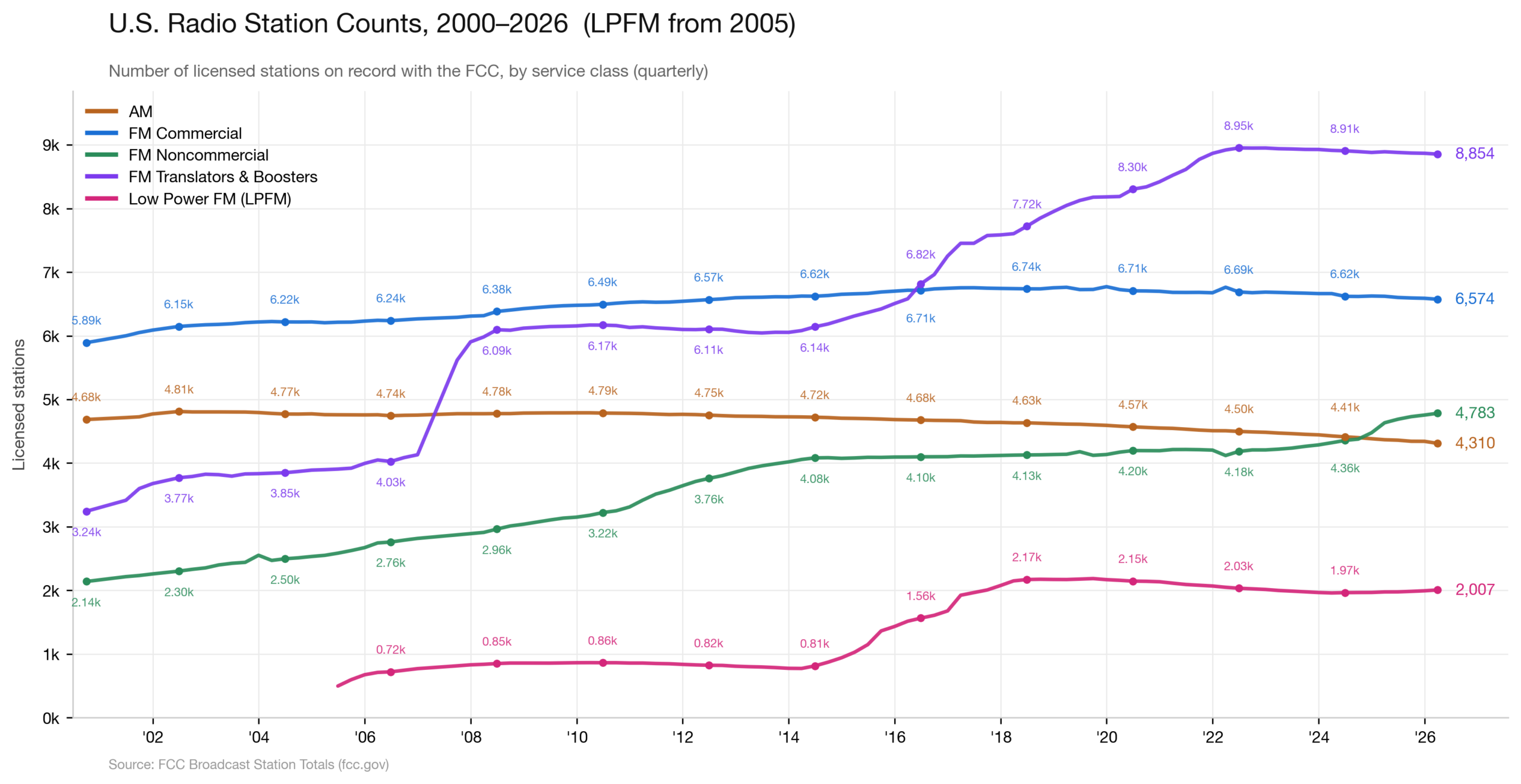
The FCC’s station counts for AM, FM commercial and noncommercial, FM translators and boosters and LPFMs since 2000. Click to enlarge.
In a time-series plot, let’s take a look at the latest station total report from the FCC, which reflects recent trends: Commercial AM and FM radio facilities are seeing gradual declines, while noncommercial FM totals continue to climb.
NCE FMs continue to set new highs. As of the commission’s March 31 report, there are 4,783 of these stations, which is up 28 stations from December. But as you can see from our 26-year chart, at turn of the century, there were only around 2,000 noncommercial FM stations.
Not all religious stations are noncommercial, of course, but many of them are, and the continued increase in noncom totals also reflects the prominence in the U.S. of such networks.
The NCE FM total once again outpaces the total number of AM stations in the U.S., which dropped by 32 since December to 4,310. That is the lowest the total yet for the senior band in the commission’s dataset, which tracks numbers dating back to September 1990. AM’s decline, as we can see, is gradual, but also continuous, since about 2010.
The drop in the number of AM stations is perhaps more publicized, but the number of commercial band FM stations has been in a decline, too. The total number of such stations fell by 12 from December to 6,574, which is down from an overall peak of 6,772 commercial FM stations reached in December 2019. Still, that’s quite a bit higher than the commercial FM total of 5,892 in 2000.
FM translators and boosters dipped slightly in March, falling from 8,867 to 8,854. These totals peaked at 8,951 in June 2022.
LPFMs, meanwhile, increased by 13 to 2,007. Our chart shows low-power FM totals peaking just before COVID-19 hit.
Broadcast Electronics will demonstrate its latest AudioVault automation user experience enhancement and a software-powered FM transmitter at the NAB Show.
“We are excited to bring new software and hardware products to NAB – our first under new local ownership – that enable stations to cost-effectively deliver content to their listeners,” said Rich Redmond, BE’s president and CEO, in a release.
A new look and feel
AudioVAault AV-xI software
With a redesigned look and feel, AudioVault AV-xI was released last fall and offers a layout framework with scalable docking positions. Users can drag and drop up to 18 AudioVault gadgets on a single screen.
BE said that the layout offers playback engines for streams, HD Radio channels or multiple stations on one workstation. Its built-in browser allows access to features such as news, weather or artist bios.
AV-xI also includes a revamped CloudVault, which supports centralized and distributed content and control, either on-premise or hosted. It provides integration with HLS streaming to a CDN or with an Orban 5950 processor.
CloudVault also includes a file distribution framework that provides real-time synchronization of content, commercials and logs between the cloud and edge playout devices.
BE said that the CloudVault solution is also suitable for disaster recovery, backup and off-premises operations.
AV-xI also features TRE+ integration, matching a station’s visual content with audio across RDS, HD Radio and streaming platforms.
Software-powered transmitter
The BE STX 1k transmitter will be demonstrated at the NAB Show.
The BE STX 1k FM transmitter is a new, 1 kW compact 2RU footprint model that includes LDMOS RF device and switching power supply technology. It uses BE’s TX direct-to-channel digital exciter.
There are optional upgrades available to transmit on digital HD Radio or DRM+ modes.
Control and monitoring can be done through an HTML5 GUI that supports SNMPv3 connectivity.
The STX 1k uses a software-defined processing engine, which integrates with BE tools such as its declipper, delossifier, advanced dynamics and a composite clipper that delivers audio quality and loudness for “even the most demanding markets,” according to BE.
The MicroMPX option allows for STL capability over IP networks, with error correction and transmission over multiple networks. Optional GPS synchronization coupled with single-frequency network software allows for operation in an SFN or on-channel booster.
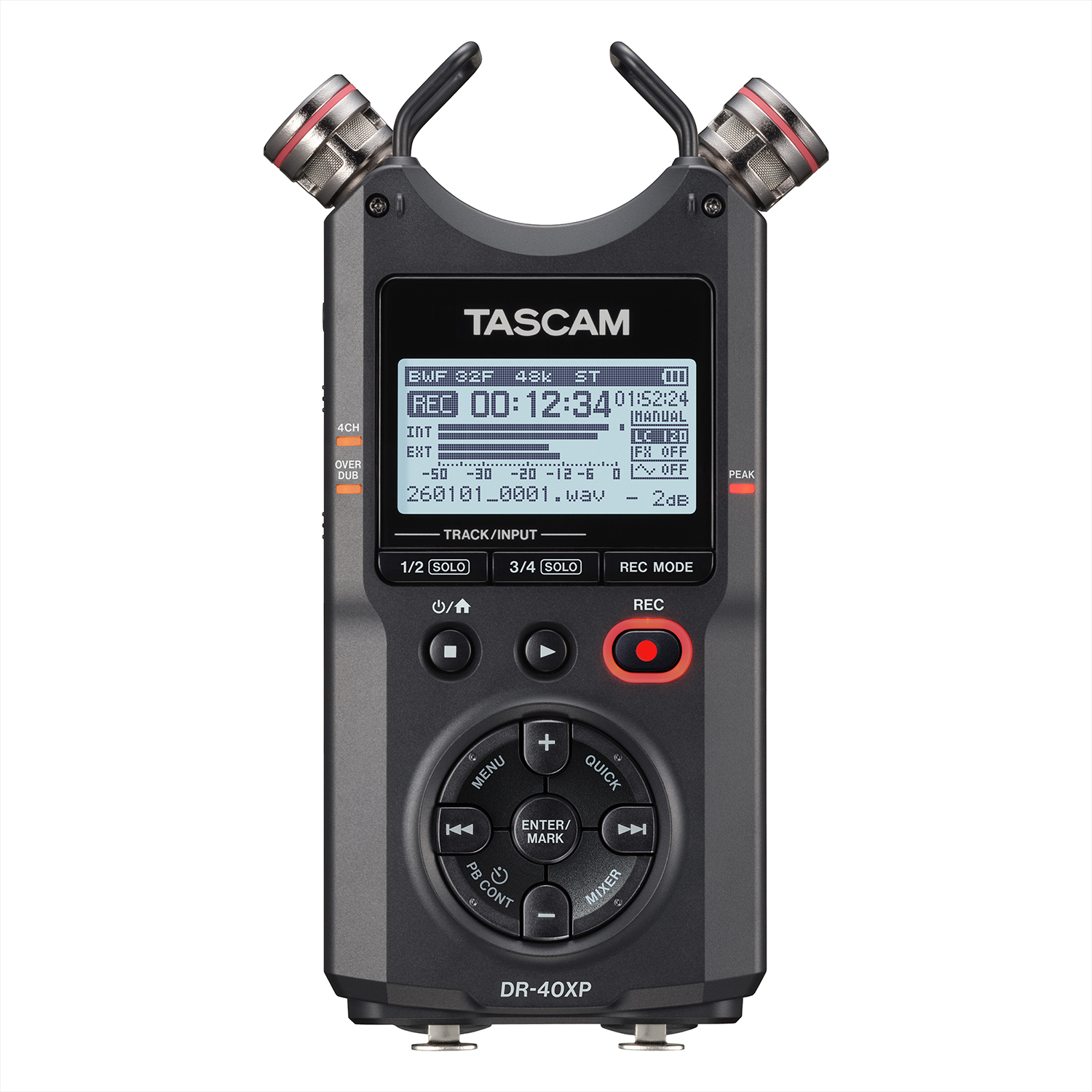
New from Tascam is the DR-40XP, a four-channel portable handheld recorder that adds USB-C connectivity and 32-bit floating point design to previous DR-40 models.
The company says it is suitable for professional-quality recordings for music, audio-for-video, meetings, dictation and other applications. Retail price is $259.
“The 32-bit float recording mode with up to a 96 kHz sample rate ensures low-noise, distortion-free recordings for a superior sound. With 32-bit float recording, users never have to worry about losing audio takes that were recorded too loudly or quietly.”
Features microSDXC card storage and support for up to 512 GB memory cards.
The unit has two unidirectional stereo condenser mics, adjustable from A/B to X/Y configurations. Two XLR/TRS inputs on the bottom can expand the system to capture four sources simultaneously. An input delay function mitigates phase incoherence between external and internal microphones.
“Combined with its USB-C audio interface, the recorder can function as a two-in/two-out audio interface capable of easily connecting to one’s computer or DAW on both Windows and Mac OS as well as iOS devices,” Tascam said in the announcement.
“Further, the DR-40XP can be connected to the aforementioned devices via USB-C for use as a USB microphone.”
The recorder includes a chromatic tuner for musicians, and an included reverb effect is useful for adding vocal and instrumental resonance.
Three low-cut filter options are available for reducing unwanted noise. For use with video, the DR-40XP has Auto Tone output functionality to make post-production sync a simple task. This recorder also can attach to a tripod mount.
A Sunday morning session in the NAB Show’s Broadcast Engineering & IT Conference will discuss “Successfully Launching Compelling Visual Radio Automation.” It will be by Fritz Golman, director of video systems and automation for RadioDNA.
Radio World: It feels like video has been part of radio operations for a while now. What will you talk about?
Fritz Golman:I’ll be presenting how we’ve successfully implemented a number of visual radio automation platforms. These case studies will highlight two projects of note, Houston Public Media’s KUHF, with two of their live flagship shows “Hello Houston” and “Houston Matters,” as well as Good Karma Brand’s WVMP/ESPN Radio Chicago and their 12-hour live broadcast day programming.
Fritz Golman
In this day of declining traditional listenership, not only alternative channels (EG, streaming) but enhanced presentation methods are needed to maintain and grow audience numbers — and of even more critical importance, especially for public radio, new opportunities for generating revenue.
RW: What would a typical station’s visual radio system consist of in 2026?
Golman: Although there is a temptation to utilize the least expensive components like low-cost webcams, the limitations they impose will be realized as soon as the operators of such systems when they want to “take it up a notch” with more sophisticated presentations.
Thus we only specify IP video systems using NDI and audio over IP, such as WheatNet, LiveWire or Dante. As these run on conventional network wiring, we eliminate the additional complexity of coax-based SDI cameras and dedicated digital video connections like HDMI.
The small additional upfront costs of these platforms yield long-term benefits of flexibility and interoperability. Then we integrate with a typical playout system like WideOrbit, RCS NexGen or RCS Zetta.
RW: Can you give examples of best practices?
Golman: Don’t scrimp on network wiring or backbone. The tiny additional cost of Cat-6 versus Cat-5 wiring can make a huge difference in the near future.
Pull another wire or two more than what is needed at the time, you’ll find that will come into play sooner or later.
Don’t be tempted to use hardware video switchers. They are limited in capability and locked into that configuration permanently.
Be willing to learn about the visual medium and collaborate with others, potentially from disciplines outside of one’s facility, to get the “look” that will attract and keep viewers.
The video network configuration at KUHF. RadioDNA was involved in all aspects of the build-out, not just the video side. The audio/Wheatstone environment is not detailed here.
RW: What else should we know?
Golman: We like to configure our solutions around proven, widely used products. Although there are a number of software packages that can do at least some of what we’re fielding, the operator should consider how many other users there are of that piece of kit.
I like to say that if you can only find one or two video clips showing the system in use or demonstrating features, it is probably not the package that has a lot of depth of support.
On the other hand, stay clear of open-source offerings. Even with the very tempting price (free), you will probably get what you paid for.
Barix will unveil its latest Instreamer and Exstreamer devices for AoIP transport at the upcoming NAB Show.
The manufacturer is highlighting flexible configurations for its MultiCoder M400 and LX400 FLEXA codecs and its Reflector Evo cloud transport platform.
New for the NAB Show, Barix has added SRT and RIST support to the MultiCoder M400. The IP encoder can send audio streams to receive points in four formats, a feature intended for broadcast headends, media production centers and remote service providers.
The update follows the addition of SRT transport to LX400 codecs, which are designed for radio stations. The LX400 can be configured as either an encoder or decoder for use over traditional studio-to-transmitter IP connections, point-to-point SRT paths or multi-point enterprise Reflector Evo cloud networks.
The M400 integrates four internal encoding engines capable of simultaneous operation, each supporting low-latency RTP, BRTP, SRT and RIST protocols, Barix said. The hardware allows users to encode incoming analog audio into OPUS, AAC+, PCM and 320KB mp3. It can send multiple audio streams to receiving devices while maintaining quality on RTP, SRT or RIST.
The M400’s CPU capacity provides a foundation for ongoing customization and new applications, the company said. Like the LX400, it uses a Linux-based platform to provide security features, including HTTPS for device setup.
The LX400 codec includes features native to the Barix product line, including multiple contact closures, relays and a USB port for direct playout. It also offers end-to-end delay control for RTP streaming and stream redundancy modes for uninterrupted broadcasting. The device can be used in a standard STL configuration or within the Reflector EVO service.
The latter, offered through partner StreamGuys, provides full-duplex audio contribution and distribution in the cloud for enterprise broadcast applications.
Today I was thinking about the remote control at my first radio job.
We used a 950 MHz STL to send audio and control information to the transmitter site and a 450 MHz TSL to return meter readings. We were reasonably happy to have forward and reflected power readings, the all-important ability to turn the transmitter on and off, raise and lower power, and, of course, a fail-safe wired to turn off the transmitter if the STL were to die.
Beyond that, however, we had to guess.
If the station went off, a lack of response from the remote control probably meant the utility power was off and the generator hadn’t started. But it also could mean the STL transmitter had failed, so we had to stop and look at the STL transmitter before driving to the transmitter site.
And because we knew so little, every time we were off air, we had to pack the truck with parts and tools to fix most anything that might be wrong.
Now we can look remotely at just about everything at the site, well beyond basic transmitter parameters … site temperature (inside and out), generator status, exact voltage from both utility and generator, not to mention live camera views of the transmitter, room and front door.
Depending on what I learn remotely, instead of driving to the site, I might be able to simply shut off and restart power to one rack component to get back on the air. The beauty of current technology is that emergency trips to the transmitter site are rare. Which, honestly, is the core purpose for a remote control system.
The problem with the now antiquated system at my first station is that I could know only a tiny fraction of the available information about the equipment. Fortunately, it’s no longer necessary to view my equipment through a pinhole.
AAT’s EmPower app prioritizes alarms to show the most important first.
In a time when staff and contractors are working harder and spreading their talents across multiple signals, having a basic remote control is now more expensive than upgrading. Making up for lack of information requires time, and unfortunately, it often means off-air time.
By necessity, most engineers can’t get to the transmitter site as often as they would like, feeling lucky to schedule a quarterly site check and cleaning. Therefore, having more detailed access to information about these critical systems becomes even more important, and allows the engineer to make good decisions about when visiting the site has become a critical priority — reducing the chance that the call to visit the site is an off-air alarm.
Through SNMP, equipment at most stations now provides a wealth of knowledge beyond voltages or GPIO, but not all remote control systems can take full advantage of it.
It’s important to look for systems that can fully leverage the information and control SNMP provides, such as AAT’s EmPower system. Far beyond being able to look at exciter readings, SNMP can provide information about specific devices within the transmitter, show audio input levels, and so on.
Remote control is only useful if the information and control are available where you are. For many years that meant walking (or running) to the remote control to find out what was going on. Now, products like EmPower put everything you need, literally, in your pocket.
Anywhere you have connectivity, you can receive alarms, evaluate readings and adjust parameters. It’s no longer necessary to drop everything to deal with a transmitter site problem — often a few seconds in the app will show what’s going on and allow on-the-fly adjustments.
Security is also an essential component of your remote-control system, as the last thing anyone needs is to give an unauthorized party control over the transmitter.
Security may involve careful implementation of firewalls or other protection options. EmPower uses a secure cloud service, making it easy to control who has what access. Now it’s possible to ask the board op or consultant to check readings or reset components, as desired, while keeping the bad guys out.
Reflected power readings used to be the only way to monitor the health of the antenna system.
For example, water entering the antenna system used to be invisible. It would silently creep in over weeks or months, and unless someone happened to notice a very tiny change in reflected power, no one had any idea. Then suddenly, the station is off the air with catastrophic damage to the inside of the coax, something that’s very hard to fix quickly.
Though AAT is happy to provide coax on short notice, it would be better to know about the problem before it was a disaster — knowledge that reflected power isn’t likely to provide.
Screenshot of AAT’s EmPower VNA in action showing faults 44 and 53 feet from the directional coupler. By comparing to the normal baseline, it’s possible trigger alarms based on changes within the antenna system — all while the station is on the air.
To help solve this blind spot, AAT can add vector network analysis to EmPower with its VNA option. The Empower VNA module can evaluate the health of the system in real time — while you’re on the air — and allow you to set alarms that will trigger whenever the antenna system changes from baseline measurements.
Thankfully, guessing what’s happening at the transmitter site is no longer a necessity because remote control technology has indeed come a long way.
Radio World Buyer’s Guide articles are testimonials intended to help readers understand why their colleagues chose products to solve various technical situations. This month’s focus is on-air audio processing.
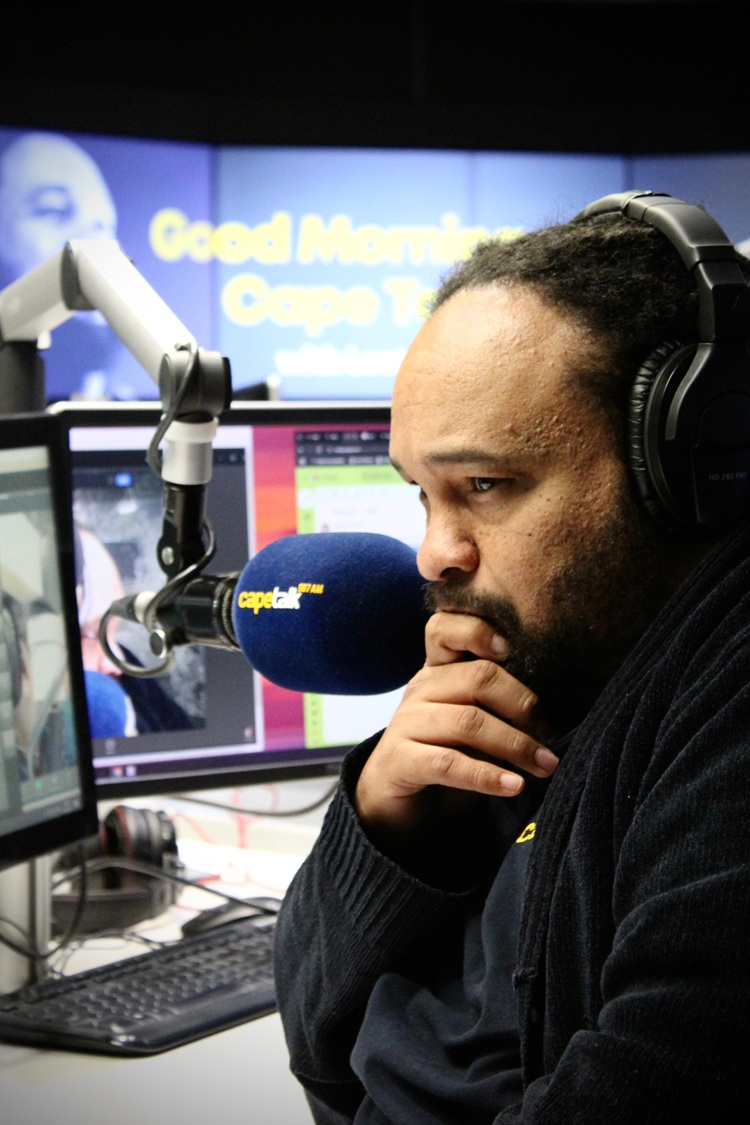
The author is a transmission specialist for Primedia Broadcasting. He is responsible for the transmission operations of 947/702 in Johannesburg and KFM/CapeTalk 567 in Cape Town, South Africa.
The word emoji owes its humble origins to the combination of two Japanese words for “picture” and “letter,” adding dimension to what otherwise would have been a “flat” or unemotive text message.
Primedia Broadcasting kicked off the year with a fun and modern out-of-home billboard campaign for CapeTalk 567, featuring today’s lingo.
Several examples of the social media campaign messages
While CapeTalk 567 prides itself on keeping things “real” with listeners through its programming content, there are technical systems that must work together to get the audio to its listeners as accurately and efficiently as possible.
CapeTalk 567 has been on the air for 28 years, primarily through its medium-wave footprint, serviced by a 25 kW transmitter on the outskirts of Cape Town operated by signal distribution service provider Sentech. It also streams its audio via the Primedia Plus app and as well as the DSTV Audio Bouquet (Channel 885).
Morning host Lester Kiewit.
For every commercial station on the radio “dial” (be they AM, FM or digital OTT platforms), there’s an ongoing conversation about how audio can be suitably “enhanced.” This is part of creating the sonic signature that adds to the listener’s experience when tuning into a particular station.
Broadcast audio processing over the years has remained a contentious topic for radio’s creative and engineering teams. Suffice it to say, the audio processor brings together the efforts of two diverse endeavours.
From an engineering perspective, the processor takes the lead in ensuring the transmission parameters (i.e. peak modulation) are always fully respected.
The “artistic” component considers how the audio is to be manipulated to create a particular sonic signature, through increasing perceived loudness along with achieving overall consistency of the program material.
There have been changes over the last 20 years or so that have affected audio quality on traditional transmission platforms.
In the world of medium-wave AM, it is both important and appropriate to maximize the density of the received audio, to ensure the audio remains intelligible.
External noise from devices such as LED lighting, laptops, computer power supplies and electric fences may impinge on a listener’s receiver, causing degradation in overall intelligibility. Studies have shown that this increase of external noise has been as much as 20 dB.
The only mitigation would be to increase audio density.
Years ago CapeTalk 567 had elected, via service provider Sentech, to use an Orban 9200 Optimod AM, which was installed at the transmitter site. This was at the time a departure from the traditional “analog” style of processing, as it made use of digital signal processing techniques.
Through investigation and listening tests, we found that the internal processing architecture of the 9200 presented some limitations for allowing a significant increase in audio density without degrading overall audio intelligibility.
It was clear that enhancing the audio quality of CapeTalk 567 now would require replacing the processor. I considered the options and elected Orban’s XPN-AM, purchased through Orban’s SA representative Prosound. They have been responsible for Orban’s South African sales and support since 1980.
The XPN-AM would be installed at Primedia’s Greenpoint studio facility. The 9200 would be retained as a backup at the transmitter site.
Having two independent audio processing paths within the XPN — one feeding the present AM signal and the other feeding both audio stream/DSTV platforms — provided us the maximum benefit for our signals, and the added benefit of being able to adjust the unit remotely rather than while standing in front of it.
The XPN’s processing enhancements have benefited CapeTalk 567’s on-air signals. Station Manager Tessa van Staden and Technical Operations Coordinator Brett Kannemeyer both have noted improvements in audio intelligibility, clarity and consistency across its broadcast platforms.
A further significant benefit is in the processor’s application to AM systems that permit the use of Modulation-Dependent Carrier Level technology, the dynamic reduction in carrier levels with the change in modulation levels.
MDCL can produce significant savings in transmitter energy consumption, an important consideration for AM radio stations. MDCL implementation is a priority for the Sentech-owned Nautel NX25 transmitter later this year.
Cumulus Media has released its 2025 financial results, and the data offers a better sense of the urgency surrounding its bankruptcy reorganization announcement in March.
Cumulus reported net revenue for the year of $742 million, a decrease of 10.3% from $827 million from 2024.
The media company’s net loss last year totaled $201 million.
A hearing to consider compliance with the bankruptcy code’s disclosure requirements, any objections and confirmation of the broadcaster’s plan will be held before U.S. Bankruptcy Judge Alfredo Perez in Houston on April 15.
Observers told us that the judge’s approval could come as early as May.
Cumulus President Mary Berner
“The company’s recently announced financial restructuring marks an important step toward meaningfully reducing the debt burden that has constrained the business,” Mary Berner, Cumulus’ president and CEO, said in a statement.
For the fourth quarter of 2025, Cumulus reported net revenue of $188 million, a decrease of 14% from the same three months the year prior, and a net loss of $135 million in in Q4 2025.
Revenue breakdown
Broadcast revenue dominated Cumulus’ totals for the year. It reported $339 million of spot revenue, down 13% from 2024, and $136 million from its Westwood One audio network operations for 2025.
Digital, which includes the Cumulus Podcast Network, totaled $151 million, which was down 2% YoY. Another $116 million in annual revenue was attributed to “other” revenue.
The Atlanta-based broadcaster finished the year with roughly $670 million of debt. Cumulus said in its bankruptcy filing that its debt had become unsustainable due to unrelenting challenges such as increasing competition from digital audio and streaming platforms, changes in the advertising market and recurring annual declines in its radio audiences.
“Looking ahead, we remain focused on building on the core strengths of the company to maximize value,” Berner said.
Cumulus, which has 393 owned-and-operated radio stations across 84 markets, did manage to shrink expenses in 2025. It said operating expenses last year were $880 million, which were down from just over a billion dollars in 2024. It reported having a total of 2,862 employees, 2,078 of whom were employed full-time.
The company’s most recent balance sheet reported capital expenditures of $20.2 million in 2025.
According to court documents, Cumulus recently reached agreements to retain its top leadership throughout the bankruptcy process and through the end of 2026. That includes the 66-year old Berner, and CFO Francisco Lopez-Balboa, age 65.
The media company remains embroiled in a lawsuit with Nielsen regarding the ratings company’s bundled ratings policy, though the case was paused by a federal judge after Cumulus filed for reorganization in March. U.S. District Judge Jeannette Vargas also issued a stay in the countersuit by Nielsen.
The latest round in a back-and-forth surrounding interference complaints from a full-power station near the North Carolina/Virginia border has resulted in a Federal Communications Commission order for the translator in question to shut down for now.
We’ve covered the interference complaints that stem back to the fall of 2024 from Lakes Media, the owner of Class C3 98.3 WLUS(FM) in Clarksville, Va. Its antenna is located just across the North Carolina state line in Granville County.
After Lakes Media’s first interference complaint, the FCC ordered same-channel W252EL(FM), a 150-watt “Rock FM” translator licensed to Cary, N.C., to go silent until it could implement a directional antenna pattern that avoided overlap with the WLUS 45 dBu contour.
The owner of the translator, Curtis Media, said it did so, and it returned to the air last September under program test authority. Curtis filed an application for a license to cover the new facility.
Lakes Media President Tom Birch quickly filed an opposition, arguing the application should be denied because WLUS was again suffering harmful interference.
The parties went back and forth some more. Curtis Media alleged that Birch repeatedly suggested paying $500,000 to settle the matter, “indicating that profit motives, not the interests of its listeners,” underpin Lakes’ interference allegations, according to the commission’s account.
Then in November, Birch and Lakes filed 10 listener complaints within WLUS’ protected 45 dBu contour, each plotted on a map, as well as signal strength data from each listener location.
“After enduring this three times since 2016, I am outraged that there are no FCC provisions for interference violators to be liable for reimbursing all of the expense incurred by the injured parties,” Birch told Radio World.
Birch ventured that Lakes Media spent “tens of thousands” of dollars in legal and technical expenses in trying to prove the interference.
Curtis argued that the latest exhibit was invalid because, among other reasons, nine of the listener complaints were clustered around the immediate neighborhood of Birch’s Raleigh-area residence.
“While the commission’s FM translator interference complaint process requires complaints to be from ‘separate receivers at separate locations,’ the commission surely did not envision ‘separate locations’ to mean more than a half-dozen houses in the same compact subdivision,” Curtis wrote.
The translator owner also argued those complaints should have been originally included in Birch’s 2024 filing. It further argued that its new antenna pattern, in terms of interference, was not being properly considered without the use of higher resolution terrain samples.
But the commission rejected Curtis’ argument about terrain accuracy and said that there is no rule or precedent supporting its claim “that listener complainants may not be clustered in a single neighborhood.”
All told, the Media Bureau found the latest evidence from WLUS compelling. While it cautioned Lakes and Birch against any possible abuse of process arising from financial settlement, it said that WLUS could not have collected the second round of listener complaints regarding the new pattern until it was actually on the air.
It found the complaints valid and, as a result, the Cary translator must shut down immediately. Curtis must first demonstrate, prior to any operation or processing of its new application, that it has resolved all listener complaints submitted by Lakes Media.
Radio World has also invited comment from Curtis Media.
With CBS News Radio about to sunset, a new operator will unveil a news network promising several technological advancements.
Live Channel USA is announcing the launch of the Radio Network News Service for U.S. stations. A bridge service will be available for affiliates beginning May 23 — one day after CBS News Radio is scheduled to shut down.
Dan Warren
While the network has roots in European broadcast technology and maintains a global hub in London, the rollout — which Live Channel calls the “Change Bulletin Supplier” initiative — is designed for the U.S. market, according to founder Dan Warren.
The network follows a traditional barter model, providing top-of-the-hour and half-hourly bulletins available in one-, three- or five-minute segments with a standard national commercial load.
Its primary differentiator, Warren says, is localization. RNN utilizes a cloud-based system to produce customized offerings designed to feel more like a regional partner.
“For example, a significant Florida story that might not make a national cut will still appear on our Florida affiliates’ bulletins but not in New York,” Warren said.
The full network will roll out on June 1. It is led by a veteran team with international broadcast experience from outlets such as Sky News, the BBC and CNN.
Three property owners in New York City have received “pirate radio letters” from the Federal Communications Commission.
The Notices of Illegal Pirate Radio Broadcasting inform the owners that unlicensed FM signals were detected coming from their respective properties and that they could be liable for significant financial penalties.
An LLC received a notice about an FM signal on 89.3 MHz coming from its property on West 189th Street of Manhattan last September.
David Duchatellier of the Jamaica neighborhood of Queens received a notice about a signal on 90.1 MHz last November.
And Thomas J. Chavannes and Beverley Dixon-Chavannes, also of Jamaica, got a letter about a signal this past January on 91.9.
New York is one of the markets in which the commission does regular pirate enforcement sweeps. The FCC said it looked into these cases after receiving complaints.
Each owner was given 10 days to respond “by providing evidence that you are no longer permitting pirate radio broadcasting to occur” and requesting them to identify the people engaged in the alleged pirate radio broadcasting on the property.
He managed to work nearly 65 years in the biggest city in the U.S., and in doing so, earned the admiration of his broadcast engineering peers.
Richard Ross, a longtime chief engineer in New York City, died on Feb. 12 at the age of 89. He is survived by his daughter Erica, who shared many details with us from his life.
In March 2013, Ross received recognition of 50 years of service to WADO(AM). The Richard Ross Studio was named in his honor. Credit: Erica Ross
Ross joined 1280 WADO(AM) in the summer of 1972 as a relief engineer. By his count, he would withstand eight ownership changes until his retirement as chief engineer from Univision Radio in June 2020 at the age of 84.
Fellow engineers would call Ross frequently after his retirement, and for a time, he offered consulting services.
“He had a kind of Harry Potter-like knowledge of it all,” Erica said.
“Those who knew Richard lost a member of their family with his passing,” said Santos Lebron, engineering supervisor at Univision Radio New York.
Lebron’s relationship with Ross went back decades; they met when Lebron was hired as a relief engineer at WADO in 1977. He and others remembered Ross for being well-dressed and possessing a level-headedness, amicable toward all and harboring a bit of a mischievous side.
Ross knew of his fortune to work in the Big Apple for so many decades. “It is a rare occasion where one starts their career in any major city and they eventually work their way up the line to more important positions in major communications hubs,” he wrote in a piece for Storyworth.
Along with WADO, Ross spent many hours with the equipment above the Empire State Building when Heftel Broadcasting purchased 105.9 WNWK(FM). Univision’s radio footprint in New York would continue to grow with the addition of 92.7 WQBU(FM) in Garden City, followed by the trade of 105.9 with New York Public Radio for 96.3, then WQXR(FM), in 2009.
Early life
Ross was born to Helen and Edward Ross in May 1936 as an only child on Manhattan’s Upper West Side.
Erica recounted how he developed a knack for machines and tinkering early on. By age 10, Ross was already experimenting with his apartment building’s elevator controls — even figuring out how to send the doorman to the wrong floors.
New York Air National Guard 1959 graduation for its radio operating department. Ross is at bottom left. Credit: Erica Ross
For several years, he attended a boarding school in western North Carolina near the Blue Ridge Mountains. The experience of navigating his way back to Manhattan via train sparked a lifelong fascination with locomotives.
He later attended Brooklyn Technical High School, where he joined the radio club and, according to Erica, officially “caught the bug.”
Ross studied at the University of Bridgeport, earning his associate’s degree in electrical engineering. He went on to serve three years in the communications division of the New York Air National Guard and completed basic training at Keesler Air Force Base in Biloxi, Miss.
In 1958, he got his break into the radio business, joining Municipal Broadcasting System’s WNYC(AM/FM) as a provisional engineer.
Richard Ross at Municipal Broadcasting System’s WNYC(AM/FM) in 1958.
Ross aimed to become permanent pending a civil service exam. Passing the exam, however, didn’t guarantee a full-time position due to fierce competition from others. But WNYC’s chief engineer at the time, Hom Hong Wei, offered some reassuring advice, and Ross got the position.
He would credit Wei as being one of his most influential mentors. At WNYC, Ross found himself exploring hidden corners of the city.
“I got to go places that nobody else goes such as walking to the top of Washington Square Arch and yes, there is a locked stairway in the south leg of the arch,” Ross would recount.
Many decades at WADO
By the early 1970s, Ross transitioned to WADO as a summer relief engineer.
For a time, he found the energy to work at both WADO and WNYC, before becoming permanently entrenched at the Spanish-language AM station, where he’d work well into the 21st century.
He wondered how he had the stamina to manage it all.
He’d go solely full-time at WADO, but Ross’ role went beyond its day-to-day. During the ’70s, the AM station would broadcast Black gospel music on Sundays, and it had brokered agreements with several churches in the south Bronx and Harlem.
Ross was tasked with recording the services, lugging RCA reel-to-reel machines to the locations. Others were known to turn down those assignments for one reason or another, but Ross happily obliged.
The Greater Hood Memorial AME Zion Church, December 1974, which is the oldest continuing church in Harlem. Ross operated as a “Gospel Technician.”
Even after WADO stopped airing the programming, he became entrenched with the churches, who would ultimately approach Ross to do separate recordings of the services. He would handle multiple recordings in a single day during the 1980s, and continued doing so through at least 2005.
They affectionately referred to him as “Brother Ross, our Gospel engineer,” viewing him as a part of their community. The services would be taped and sent to radio stations across the U.S. that aired Black gospel.
His spirit was evident in other ways. Ross became a member of the IBEW Local 1212, the labor union for broadcast engineers, in 1963.
He rose in its ranks, becoming part of the union’s executive board. Ross would stay even after he became WADO’s chief engineer in 1985, following the passing of his good friend Phil Greenstone.
With what would have been considered a management position, it was unusual for someone like Ross to remain in the union, both Erica and Lebron said. Ross wrote that he felt it was an honor.
“He was more than a colleague; he was a brother in every sense of the word,” IBEW 1212 wrote while remembering Ross on its website.
“All of us in this profession share the same situation,” Ross wrote in his Storyworth of his IBEW role. “We all know each other in New York City and once each month we meet to eat, drink and be merry and discuss our war stories.”
Ross was also a loyal member of the Society of Broadcast Engineers.
Meadowlands move
A mid-2010s photo of 1280 WADO(AM)’s studio, wth Ross’ prized 1989 burgundy Lincoln Town Car in front. By his count, Ross would withstand eight separate ownership changes until his retirement as chief engineer from Univision Radio in June 2020 at the age of 84.
As the broadcast landscape evolved, Lebron remembered Ross best for coordinating WADO’s transmitting power increase in the New Jersey Meadowlands at the end of 1999.
As recounted by Scott Fybush, WADO had used a Blaw-Knox diamond-shaped tower from its transmitter site on Paterson Plank Road in Carlstadt. It ran 5 kW day and night as part of a power restriction on regional channels like 1280.
But the FCC lifted that restriction in the early 1990s. WADO sought to upgrade to 50 kW by day and 7.2 kW at night, which required a new antenna system.
The former WADO(AM) Blaw-Knox tower dated back to 1934. This photo is from March 1998, courtesy of Scott Fybush.
The venerable Blaw-Knox tower came down, and three new towers were needed, along with a complete renovation of the 1930s-era building that housed its transmitters.
Then-owner Hispanic Broadcasting had filed for a construction permit, but most of the actual work did not commence until just prior to its expiration, which acted as a hard deadline.
As Ross wrote in his Storyworth, from October 1999 and for the next four months, he visited the Meadowlands site daily to complete the project under great stress and pressure.
Ross named one of WADO’s three new towers in honor of his daughter. Ross said it was the “smallest but most powerful of the three.”
Construction took place on sensitive riparian land. It required a year of hearings costing over $1 million, involving the state of New Jersey, the Army Corps of Engineers and the U.S. Coast Guard.
Laying down and completely removing temporary wooden plank roads alone cost $675,000, according to Ross. Union dock workers were hired to build a 1,000-foot boardwalk to the towers, and a crane had to be rented from the Tappan Zee Bridge.
With the main transmitter building modified and the heat shut off, crews worked late into the winter nights, running copper straps between the four towers with only a porta-potty out back.
He recounted the moment of truth:
“On February 1, I invited David Lykes, Hispanic Broadcasting’s chief operating officer, to come up from Dallas to push the activate button at 6 p.m.,” Ross wrote. “My heart was in my throat, but the damn system worked.”
The antenna system was designed by Ron Rackley of du Treil, Lundin & Rackley, who consulted on the project and praised Ross for its execution.
True to form
Ross offered daughter Erica one of his renowned tours of the Empire State Building broadcast facilities in November 2018.
There were many other, less high-profile wins as well, often accompanied by 2 a.m. phone calls.
Ross was also well-known for his thorough tours of the Empire State Building’s broadcast facilities — Erica said multiple people have told her that those tours were highlights of their careers.
Also an amateur radio operator (K2RNR), Ross had many interests outside of radio, including locomotives and nature.
He loved the city, but ever since his boarding school days in western North Carolina, he became infatuated with the peace of a mountainside setting. Since the late 1960s, Ross owned a property in Kunkletown, Pa., in the southern portion of the Pocono Mountain region.
Ross, at age 83, on horseback while visiting Erica in Austin, Texas.
A lover of nature and an adamant conservationist, he viewed the country home as a sanctuary for wild animals. But he’d continue to call the Big Apple his main home and it was the only place he’d ever work.
In 2013, Univision honored his 50 years of broadcasting service by naming a studio after him.
True to his nature, he hated the attention and adamantly hoped people wouldn’t use the milestone to do the math on his age.
Ross passed away at home in his Hell’s Kitchen apartment — where he lived since 1964 — just shy of his 90th birthday.
Fittingly, the coroner described the lifelong engineer’s unforeseen cause of death as “an electrical short circuit of the heart.”
A memorial and celebration of life for Ross will be held Sunday, April 12, at the Masonic Lodge No. 72 in Secaucus, N.J.
FCC Chairman Brendan Carr chose a clear, blue-sky North Carolina spring day to travel to the top of a nearly 2,000-foot broadcast tower.
This was not the chair’s first rodeo — he also went to the top of the KELO(TV) tower in South Dakota last July and he has expressed his enjoyment of scaling such structures in the past. Carr used this latest opportunity, which included a live TV hit from the top of the eastern North Carolina broadcast site, to praise the efforts of America’s tower crews, including the one that aided him with his April ascent.
“It’s tower crews like this who maintain these structures; they are the reason why people receive these signals,” Carr told WCTI(TV). He said that there are roughly 20,000 tower climbers nationwide who support broadcast sites, along with towers for wireless communications and other services.
He shared a video on his X account:
Great day climbing with some of America’s talented tower workers. 🇺🇸
Carr utilized a hydraulic hoist for the majority of the ascent before climbing the final 100 feet by hand, according to WCTI. The round trip took several hours.
The tower, located just west of New Bern, stands approximately 1,966 feet tall. In addition to serving WCTI, WYDO(TV) and WUNM(TV), it is home to 95.1 WRNS(FM), a Class C, 100,000-watt station licensed to Kinston.
According to Wikipedia, the structure ranks among the tallest towers in the United States.
The climb comes while crews are in the middle of a major maintenance project to replace the guy wires that stabilize the tower, according to WCTI. As a result of the work, WRNS said on its Facebook page that the station was off the air for several hours on April 6.

 Connexion