Vue lecture

For Cumulus, Financial Losses Were Mounting Before Its Chapter 11 Filing

Cumulus Media has released its 2025 financial results, and the data offers a better sense of the urgency surrounding its bankruptcy reorganization announcement in March.

Cumulus reported net revenue for the year of $742 million, a decrease of 10.3% from $827 million from 2024.

The media company’s net loss last year totaled $201 million.

As we have previously reported, Cumulus seeks to eliminate roughly $592 million in debt in a prepackaged reorganization with lenders in bankruptcy court. As part of the reorganization, Cumulus will become a private company.

A hearing to consider compliance with the bankruptcy code’s disclosure requirements, any objections and confirmation of the broadcaster’s plan will be held before U.S. Bankruptcy Judge Alfredo Perez in Houston on April 15.

Observers told us that the judge’s approval could come as early as May.
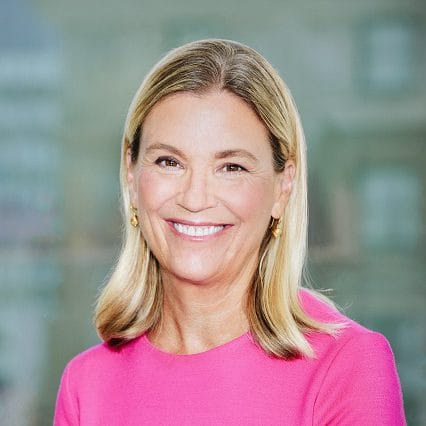
Cumulus President Mary Berner

“The company’s recently announced financial restructuring marks an important step toward meaningfully reducing the debt burden that has constrained the business,” Mary Berner, Cumulus’ president and CEO, said in a statement.

For the fourth quarter of 2025, Cumulus reported net revenue of $188 million, a decrease of 14% from the same three months the year prior, and a net loss of $135 million in in Q4 2025.

Revenue breakdown

Broadcast revenue dominated Cumulus’ totals for the year. It reported $339 million of spot revenue, down 13% from 2024, and $136 million from its Westwood One audio network operations for 2025.

Digital, which includes the Cumulus Podcast Network, totaled $151 million, which was down 2% YoY. Another $116 million in annual revenue was attributed to “other” revenue.   

The Atlanta-based broadcaster finished the year with roughly $670 million of debt. Cumulus said in its bankruptcy filing that its debt had become unsustainable due to unrelenting challenges such as increasing competition from digital audio and streaming platforms, changes in the advertising market and recurring annual declines in its radio audiences.

“Looking ahead, we remain focused on building on the core strengths of the company to maximize value,” Berner said.

Cumulus, which has 393 owned-and-operated radio stations across 84 markets, did manage to shrink expenses in 2025. It said operating expenses last year were $880 million, which were down from just over a billion dollars in 2024. It reported having a total of 2,862 employees, 2,078 of whom were employed full-time.

The company’s most recent balance sheet reported capital expenditures of $20.2 million in 2025.

According to court documents, Cumulus recently reached agreements to retain its top leadership throughout the bankruptcy process and through the end of 2026. That includes the 66-year old Berner, and CFO Francisco Lopez-Balboa, age 65.

The media company remains embroiled in a lawsuit with Nielsen regarding the ratings company’s bundled ratings policy, though the case was paused by a federal judge after Cumulus filed for reorganization in March. U.S. District Judge Jeannette Vargas also issued a stay in the countersuit by Nielsen.

(Read Cumulus Media’s 2025 earnings release.)

The post For Cumulus, Financial Losses Were Mounting Before Its Chapter 11 Filing appeared first on Radio World.
  •  

Study: Religious Radio Blankets Nearly All of America

When it comes to the American radio dial, there’s are quite a bit of contemporary Christian music mixed in with a little fire-and-brimstone these days.

A new study from the Pew Research Center revealed that about one in four radio stations in the country air faith-based or religious music and content.

More than 4,000 religious stations, in total, operate nationwide.

The report, “Religious Radio Across America,” extrapolated data from approximately 440,000 hours of programming, conducted last July, and a survey in June of more than 5,000 U.S. adults.

Pew identified FCC-licensed terrestrial AM and FM religious radio stations in the U.S. using Radio-Locator.

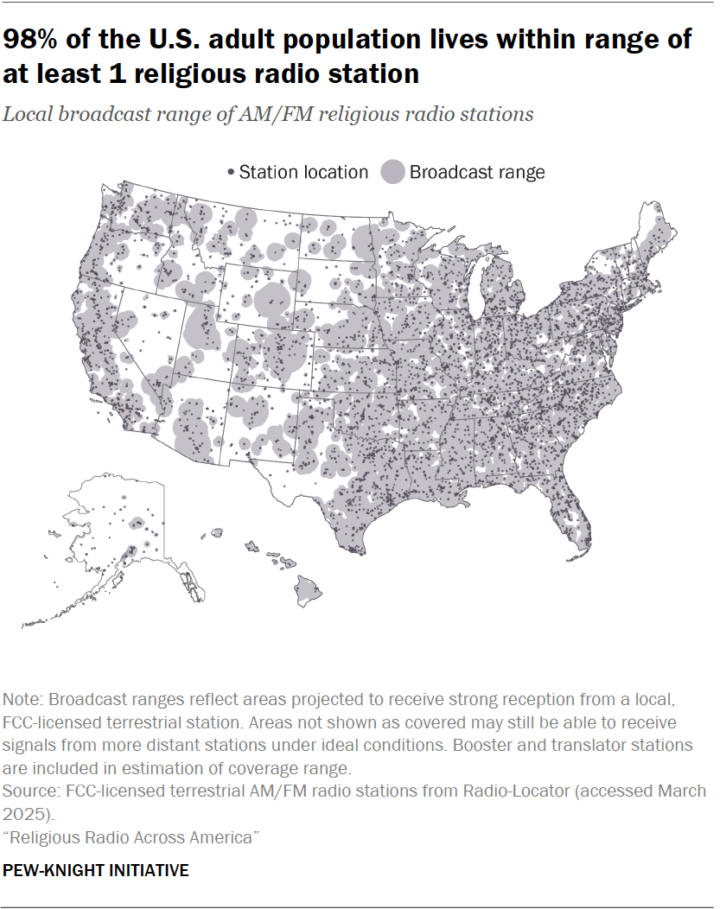
The report’s most significant takeaway may be the vast reach of such stations, as it indicated that religious outlets serve every population center in the country, and their combined broadcast range covers most of the U.S. landmass.

98% of the U.S. adult population lives within range of at least 1 religious radio station
Credit: Pew Research Center

In fact, nearly 98% of U.S. adults live within listening range of at least one religious radio station, according to Pew.

It found “most U.S. adults can tune into several different religious radio stations on the FM or AM dial from their home address.”

And in terms of denomination, an overwhelming majority of those are Christian stations, but not all.

Contemporary Christian leads the way

According to the report, about 45% of U.S. adults indicated “they ever listen to religious audio programming,” with about three-quarters of those at least occasionally tuning in on the radio.

Seven-in-ten listeners indicated they use podcasts and streaming services to access religious programming, and nearly all of the most popular radio shows are also available on these platforms.

Music accounted for roughly half of all airtime on religious radio in the U.S., according to the report. About 37% of Americans said they listen to religious music. The contemporary Christian music format, in particular, has seen significant growth, according to observers.

Religious radio programming addressed a wide range of topics through a religious lens, according to the Pew Report, with stations on average spending several hours per day discussing topics like lifestyle and personal development, family and parenting and health and wellness.

The Pew report classified a station as “religious” if its primary genre was listed as religious, Christian contemporary, gospel music or Spanish Christian. An overwhelming majority of U.S. religious radio stations are Christian, approximately 63%, though a smaller share are affiliated with other religious traditions.

Smaller shares of listening are tied to specific denominations such as Baptist or Pentecostal traditions at 10%, and about 8% Catholic.

Stations that air primarily secular content but occasionally include religious material in their programming — such as local church services on Sunday mornings — were not included in their definition of a religious radio station.

Ownership

The Pew report showed around three-in-ten religious radio stations in the U.S. are independently owned. The other 72% belong to multi-station ownership groups of varying sizes, according to an analysis of FCC licensing information.

The report doesn’t name any of the largest ownership groups, but Educational Media Foundation is a large owner of more than 1,000 religious radio signals in the country. EMF operates contemporary Christian radio networks K-Love and Air1.

Most often religious stations within the same ownership group, according to the Pew report, share a single online feed and broadcast the same content. Certain talk shows and music artists also blanket the religious radio airwaves. The research showed that several popular shows are syndicated on as many as half of all religious radio stations nationwide.

And while political commentary makes up only a modest share of all broadcast content on many religious radio stations, it’s still a major focus for some stations and for some listeners. 

According to the report, “on average, religious radio stations across the U.S. devote about half their broadcast time to music — which includes everything from recorded songs to program theme music and advertising jingles — and half to spoken content.”

The report found that overall, 81% of spoken content is voiced by a male speaker.

Other key findings from the Pew Research report:

  • On average, U.S. religious radio stations air an even mix of music and talk, but that hides a lot of variation between individual stations, the report stated. About 37% primarily broadcast music, while 35% focus primarily on talk programming. Another 28% play an equal mix of the two.
  • Musically, a relatively small playlist of popular, established artists is generally featured: 16% of all the songs examined over the month of July were from just 10 individuals or bands.
  • Large majorities of white evangelical Protestants and Black Protestants reported listening to faith-based radio, while smaller shares of Catholics and non-evangelical Protestants said they listen to religious programming.

You can read the full Pew Research Center report on religious radio here.

Pew Research Center is a nonpartisan, non-advocacy fact tank that informs the public about the issues, attitudes and trends shaping the world.

Comment on this or any article. Email radioworld@futurenet.com.

The post Study: Religious Radio Blankets Nearly All of America appeared first on Radio World.

  •  

FCC Moves Ahead With Revising 13 Broadcast Rules

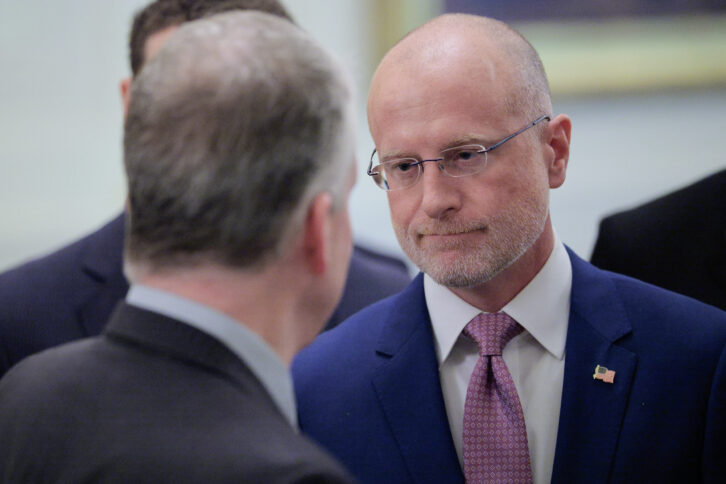
FCC Chairman Brendan Carr speaks with Sen. Dan Sullivan (R-Alaska) after attending the presentation of the Commander-in-Chief trophy in the East Room of the White House on March 20. Credit: Chip Somodevilla/Getty Images)

The Federal Communications Commission has made changes to its rules that ease some restrictions on broadcasters and eliminates others.

The revisions include removing the minimum AM power increase limit and extending technical special temporary authorities up to 180 days.

The 13 adopted changes at its March open meeting are the result of a notice of proposed rulemaking in December 2024 under former Chairwoman Jessica Rosenworcel.

The effort to ease regulatory burdens of broadcasters appears to fit neatly into current Chairman Brendan Carr’s “delete, delete, delete” initiative.

[Related: “FCC Approves Order to Accelerate High-Speed Network Rollouts”]

While Carr celebrated the removal of approximately 1,100 rules during his time as chair, he also indicated the commission is not nearly finished with its efforts.

“On deck for 2026 is licensing and permitting reform, eliminating unnecessary paperwork and smashing technological silos that have held back innovation for decades,” Carr said in a statement.

Of the three FCC commissioners, Carr and Commissioner Olivia Trusty unanimously approved the order.

Commissioner Anna Gomez concurred and dissented in part, stating, “as I have expressed before, I am sincerely concerned about the direct final rule process the commission has been using to eliminate rules.”

The changes also remove the ten-application cap adopted for the 2021 noncom educational FM new station application filing window; and codifies the definition of an authorized station, which LPFM applicants must protect, to include both licensed and granted construction permits.

You can read the report and order here.

Rule change specifics

The FCC voted to update its rules for AM station power increases to eliminate the requirement that stations request at least a 20% increase in nominal power; and update AM station classifications to conform to current classifications used in the Class B and Class D definitions.

The commission said that the National Association of Broadcasters supported the changes and agreed they would offer increased flexibility to AM stations, helping them achieve required community of license coverage.

The commission modified sections of its rules to state that an LPFM submitting an application a filing window for a new construction permit or modification of an existing LPFM authorization must protect FM, LPFM and FM translator applications filed prior to the release of the public notice announcing the filing procedures.

It also clarified that a public notice, which simply announces an upcoming filing window, would not terminate protection requirements for prior-filed applications.

In addition, the commission said it will remove language from its rules that limit an initial STA necessitated by technical or equipment problem to a 90-day window rather than the full 180-day period permitted for STAs for other reasons.

According to the order, NAB agreed that the change reduces burdens on both applicants and FCC staff. In addition, the comments of the licensees of 10 public broadcasters concurred that their stations would greatly benefit from the extension of this STA term. They also asserted that the period is more realistic given the time it takes to procure and replace technical equipment.

The order also stipulated that moving forward, the FCC will replace references to the bureau’s legacy CDBS electronic filing system with references to its new LMS electronic filing system. The commission said that it is making the change since it no longer updates CDBS, and users are instead required to use LMS to search for and file applications and pleadings.

Here is a summary of other rule changes adopted by the commission that affect broadcasters:

Change table of assignments/allotments references

The FCC adopted the proposal in the NPRM to update inconsistent terminology in rule references to the tables governing FM and TV allotments by changing references in certain sections to correspond with the standard language used in others.

The commission noted that in its comments, REC Networks considered the proposal noncontroversial.

Elimination of the NCE FM window application cap

The commission said it will eliminate language concerning the 10-application cap on the number of applications each applicant could submit in the 2021 NCE FM filing window. The FCC acknowledged that several applications remain pending from the 2021 NCE FM window.

It will delegate authority to the Media Bureau to effectuate this change and remove section the cap “upon resolution and finality of the remaining NCE FM applications.”

Revision of the signature rule

The FCC adopted the proposal to expand the definition of who may sign an application on behalf of a corporation, a partnership and an unincorporated association to include a “duly authorized employee.”

Additionally, in light of commenters’ requests, it will codify the term “duly authorized employee,” but the bureau to interpret the term “employee” broadly, as circumstances may require to take account of all types of employees.

Local public notice requirement after acceptance for filing

The order codified the established practice concerning when applicants for new NCE FM, NCE TV or LPFM construction permits must give local public notice of their applications.

It also clarified that the NPRM did not propose any new or additional local public notice obligations on parties.

The Media Bureau will be directed to update LMS to display the date an application is “accepted for filing.”

Redesignate renewal application petition to deny rule

The commission proposed to consolidate the rules for filing petitions to deny against license renewal applications into one rule section, and it adopted the measure finding that “moving all of the petition to deny rules into section will assist licensees and members of the public in complying with the rules.”

The FCC declined codify the existing interpretation of its rules that LPFM minor change applications received on the same day will be treated as simultaneously filed and, if mutually exclusive, directed to use engineering solutions and good-faith negotiation to resolve the mutual exclusivity. It said commenters gave conflicting responses to its benefits.

It also declined to make any changes to its informal objection rule. Currently informal objections are not required to be served upon the applicant, according to the FCC, which often leads to considerable inefficiencies in the resolution of contested proceedings.

Additionally, its current informal objection rule contains no restriction on the number or type of pleadings that can be filed in response to an informal objection, and provides no pleading deadlines.

However, the FCC said disagreement among commenters on how to proceed led the commission to decide to adopt any specific changes at this time.

Comment on this or any article. Email radioworld@futurenet.com.

The post FCC Moves Ahead With Revising 13 Broadcast Rules appeared first on Radio World.

  •  

Trusty: This Age of AI Calls for New “Routines”

FCC Commissioner Olivia Trusty conjured up her collegiate gymnastics experiences to describe the challenges AI presents and how the American workforce can respond to them.

She gave a speech to the National Urban League Empowerment Summit that focused squarely on AI and how workers can adapt to using technologies that are reshaping the job market.

Trusty, one of two Republicans on the FCC along with Chairman Brendan Carr, said there’s also work for government to do.

“Foundational” role

Trusty cited the Trump administration’s “worker-first AI agenda” for promoting the birth of new occupations, including “new-collar” jobs that prioritize skills and certifications over traditional degree pathways.

She said the FCC has a crucial role in connecting touchpoints of the technology. She said it is working to implement an agenda that expands the availability, affordability and quality of these critical information services.

“Our role is foundational. AI cannot function without connectivity,” she told the gathering in Washington.

As to what people in the workforce can do, Trusty drew a parallel to her time as a gymnast for the University of North Carolina at Chapel Hill in the early 2000s.

She described a rulebook called the “Code of Points” and said it would change over time, requiring new standards of excellence.

“To stay competitive, I had to learn new skills, more difficult tumbling passes, more complex combinations and sometimes routines that felt risky and uncomfortable at first. This required retraining, a commitment to continuous learning and an understanding that transformation was required to be competitive at the collegiate level,” she said.

It’s much the same with AI, she said. “AI represents an updated Code of Points, as intelligent technologies are reshaping the job market and the skills needed for workers to succeed.”

She said workers should take the initiative to develop AI literacy, investing time to understand how tools work and how to use them responsibly. “It also means strengthening the uniquely human skills that AI cannot easily replicate: critical thinking, creativity, emotional intelligence, ethical judgment and leadership.”

They also should seek early, hands-on experience through real-world situations like apprenticeships and on-the-job training. “To meet this moment, it is imperative that we embrace continuous learning. Skills cannot remain static in a dynamic economy. Just like in gymnastics, if the Code of Points changes, you train again. You evolve. You refine your routine.”

She said that for the workforce in particular, “access to high-speed broadband ultimately means access to education, to training, to entrepreneurship, to innovation and to the opportunity to participate in the AI economy. The FCC is actively working to implement an agenda that expands the availability, affordability and quality of these critical information services.”

She said the FCC’s work must include engaging with industry to support workforce development initiatives to prepare Americans for these careers. It can support AI literacy and skills development at every level, from K–12 exposure to workforce retraining, and help launch apprenticeship programs.

In many cases, AI will not replace workers, Trusty told the audience, but it will augment them. She said it will elevate productivity and efficiency, enhance decision-making and unlock new industries.

Trusty also cited the commission’s role in increasing broadband access to underserved and hard-to-reach communities. Universal connectivity, she said, will fuel the nation’s innovation capacity and ensure the development of an AI ecosystem open to all.

“Through our agency programs and regulatory authorities, the FCC is committed to closing the digital divide so that everyone can access AI-powered opportunities through high-speed connectivity,” she told the summit.

Trusty concluded by pointing to the importance of working with groups like the Urban League to move AI initiatives forward.

“The mission of the National Urban League has always been about ensuring that opportunity reaches every community. In the age of AI, that mission is more important than ever.”

The full text is available on the FCC website.

[Do you receive the Radio World SmartBrief newsletter each weekday morning?]

The post Trusty: This Age of AI Calls for New “Routines” appeared first on Radio World.

  •  

FCC Gathers Feedback on Noncom Translator Window

The FCC is hearing back about its plan to hold a translator filing window for the noncommercial band later this year.

The commission calls its plan a historic expansion and opportunity for educational and community broadcasters, though one advocacy group says it doesn’t do enough for low-power FM stations.

The plan would permit noncommercial FM, LPFM and noncommercial AM licensees to apply for FM translators operating in the reserved band, 88.1 to 91.9 MHz.

The FCC has said its proposal balances providing more access for noncommercial broadcasters with the need to guard against possible abuse. It proposes a cap of 10 applications per licensee.

Here’s a summary of three filed comments.

LPFM-AG

The Low Power FM Advocacy Group, headed by Dave Solomon, told the commission that the window is welcome but too restrictive.

“The proposed window is confined to Channels 201–220 only. That is the narrowest slice of the FM band and the portion reserved for noncommercial educational FM service,” Solomon wrote.

He said the window risks becoming a “paper opportunity for LPFM” since the commission proposes to leave in place a set of LPFM-specific translator limitations that are “unusually restrictive.” As a result he says the opportunity for LPFMs in this plan is “largely illusory.”

He identified technical barriers for LPFMs as well.

“Those limitations include the 60 dBu overlap requirement, the direct over-the-air input rule and the 10-mile/20-mile siting rule.”

Solomon also says the growth in the number of NCE stations in recent years reduces the number of channels available.

[Related: “Here’s How FCC Station Totals Have Changed in 10 Years”]

The FCC also proposed a cap of four applications for tribal applicants and two for LPFMs.

According to Solomon, “The better approach would be either to permit four applications for all LPFM applicants or to adopt a neutral standard under which additional LPFM applications may be justified by terrain, rurality, dispersed market geography, insular location, lack of usable reserved-band channels or service to underserved populations.”

He also recommends the FCC implement a one-year holding period on assignments and transfers to discourage “trafficking” of new authorizations.

(Read LPFM-AG’s filing.)

REC Networks

REC Networks, founded by Michelle Bradley, has taken an active interest in the plan.

According to an ex parte filing, Bradley met in January with several leaders of the Audio Division of the Media Bureau, including Division Chief Albert Shuldiner, to discuss it.

In her filed comments, Bradley told the FCC the national cap of 10 applications seems appropriate and is the same as prior noncommercial filing windows in 2007 and 2021.

However, Bradley warns of potential loopholes that could lead to manipulation of the filing system.

“Specifically, we are concerned that an applicant can intentionally file for a new FM translator to rebroadcast their own station and then immediately change the primary station to a different non-commonly owned station and eventually assign it to a different party based on a pre-planned arrangement,” she wrote.

“This vulnerability is very concerning to the integrity of the strict rules that are being put in place.”

Bradley would go further to prevent potential gamesmanship, proposing a condition that within the first four years of licensed translator operation, the primary station designation can only be changed to another broadcast facility that is commonly owned by the translator permittee/licensee.

(Read REC Networks’ filing.)

Cedar Grove

Meanwhile a full-service NCE licensee is urging the commission to expand the cap from 10 to 30 applications.

Cedar Cove Broadcasting says a smaller cap could force applicants to focus on large markets instead of rural areas.

“With the proposed 10-application limit to established NCE FM broadcasters, it will most likely limit potential new service to rural areas as NCE FM broadcasters will need to choose between filing applications for larger populated areas and these smaller areas,” the broadcaster told the FCC in a filing by President Victor A. Michael Jr.

Cedar Cove, licensee of eight full-power noncommercial stations and eight translators, says it has done preliminary potential channel availability studies for new NCE FM translator stations and has found available spectrum in most of the top 150 metro markets.

It also would reduce the planned cap for LPFM licensees from two applications to one, due to the limited number of opportunities in larger populated areas, which in turn would give established full-service NCE AM/FM stations a greater opportunity for these new potential NCE FM translators.

It said that even limiting LPFMs to one application could allow an existing LPFM station to potentially double its population coverage area, because those stations are limited to a maximum of 100 wats effective radiated power, whereas new NCE translators can operate with up to 250 watts ERP.

(Read Cedar Grove’s filing.)

The FCC also plans to limit eligibility in the window to existing licensees and permittees, which drew broad support from commenters.

No dates for the filing window have been announced.

Other filers include Ted Schober, Kyle Magrill, the Educational Information Corp. and Charles De Caro. You can review the filings at https://www.fcc.gov/ecfs/search/search-filings. Enter 26-20 in the “Proceeding” field.

Reply comments are due March 26.

The post FCC Gathers Feedback on Noncom Translator Window appeared first on Radio World.

  •  

LPFM Agrees That It Violated Underwriting Rules

logo of Rock Hits 92.3

A Virginia low-power FM must take steps to avoid violating the FCC’s underwriting announcement rules for noncommercial broadcasters. But it will keep its license.

This decision regarding WXRK(LP) in Charlottesville is one of a series that originally involved five LPFMs that participated in an unusual joint marketing arrangement.

Their “coop” prompted a license renewal challenge in 2019 from Saga Communications, which owns several stations in the region.

Saga asked the FCC to deny their license renewals based on several allegations, as we’ve reported, with the coop arrangement a central part of the case. Saga called it “an elaborate sham designed to give the appearance of compliance … while operating a commercial enterprise.”

Two of those stations are no longer active, with one having gone silent in 2020 in part because of the resulting financial strain, according to a local news report.

A third licensee agreed in 2024 to pay a $1,000 penalty and received a shortened license renewal. The fourth signed a consent decree last year without a financial penalty and won a full-term renewal.

Now comes the decision for the fifth.

Details

Blue Ridge Free Media is licensee of WXRK and operates on 92.3 MHz in Charlottesville. It broadcasts a rock format known as Rock Hits 92.3.

Saga Communications, through its Tidewater Communications subsidiary, alleged that the station was broadcasting commercials regularly. It also contended that WXRK was not conforming to its educational purpose and was part of an operating agreement that is prohibited by FCC rules.

Blue Ridge disputed the allegations and in turn claimed that Saga was abusing the commission’s processes in an attempt to eliminate competition.

As in the other cases, the FCC acknowledged that the LPFMs had entered into “highly unusual” agreements by forming the Virginia Radio Coop and using Experience Media and Experience Sales to sell underwriting announcements.

The FCC said it has reviewed these agreements to ensure that they do not create common ownership or control of any stations, which would violate LPFM license restrictions.

It noted that the LPFMs had formed the coop in part to share a transmitter site, antenna, studio and office facilities. The commission agreed that this was “unconventional” but it found that the coop was similar to a shared services agreement.

“The coop operating agreement itself does not contain any provisions that allow the coop to control the programming, personnel or finances of any station operated by its members that are commission licensees,” it found.

But as in the other cases, the FCC also expressed unease, saying such agreements created possible conflicts and that the case “identified issues” that it would look closely at should similar cases come up in future. “We remain troubled by this type of arrangement,” it wrote.

(Read the FCC’s summary of the latest case.)

Blue Ridge did admit to airing announcements that failed to comply with the underwriting laws. It agrees to name a compliance officer, implement a compliance plan and file updates with the FCC. It avoided a financial penalty by showing that it did not have means to pay one.

The FCC did not accept other assertions by Saga or find that WXRK’s actions merited an end to its license. But it rejected Blue Ridge’s argument that Saga was misusing commission processes to eliminate competition to its stations.

Nick Langan’s reporting contributed to this article.

The post LPFM Agrees That It Violated Underwriting Rules appeared first on Radio World.

  •  

iHeartMedia Says Revenue Grew Slightly in 2025

Lack of political advertising revenue stung iHeartMedia in 2025, but the media company still managed to grow its revenue last year, thanks to robust podcasting results.

iHeartMedia posted $1.13 billion in consolidated revenue for the fourth quarter of 2025, up 0.8% from Q4 2024. Excluding political revenue, the increase was 7.7%. Looking at the full year results, iHeartMedia recorded $3.86 billion in revenue, virtually flat versus 2024, but still up year-over-year 0.3% and 3.6% when excluding political.

The media company did lose money in the final quarter of 2025, reporting a Q4 net loss of just over $41 million. For full year 2025, iHeartMedia said it posted a net loss of $472 million.

For the fourth quarter, revenue from its Multiplatform Group, which includes approximately 860 radio stations and iHeart’s radio networks, was down $19.2 million, or 3% year-over-year, primarily due to lower political revenues, the company said. It posted $665 million in total revenue in the broadcast division in the quarter.

Specifically, broadcast radio revenue decreased $23.4 million, or 4.8% year-over-year, driven by lower spot revenue, according to the company’s filing with the U.S. Securities and Exchange Commission. Networks increased $4.9 million, or 4.4% year-over-year.

For the year, the broadcast group was down 4%, but only 2% when excluding political. The company said it had $80 million in political advertising in the fourth quarter 2024.

(View the iHeartMedia Q4 2025 investor slidedeck.)

Shining star comes in to view

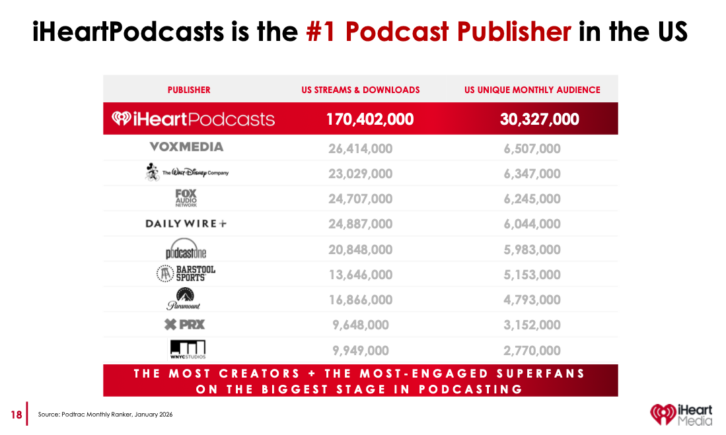
iHeartMedia’s shining star again was revenue from the Digital Audio Group. It increased $47.7 million, or 14.1% YoY, driven by podcast revenue, which increased $34.1 million, or 24.5% YoY in Q4, to $173.7 million.

Digital was up 14% and podcast revenue up a whopping 26% for the full year 2025, according to the company.

From iHeartMedia's Fourth Quarter 2025 Investor Presentation
Podcast growth, per Podtrac Monthly Ranker, taken from iHeartMedia’s Fourth Quarter 2025 investor presentation.

Broadcast still brings in the majority of iHeartMedia’s revenue, but the gap is closing. The Multiplatform Group generated $2.3 billion in revenue for the year, while the Digital Audio group had revenue of $1.3 billion. In 2024, broadcast generated approximately $1.2 billion more in revenue than digital.

iHeartMedia Chairman and CEO Bob Pittman connected recent announcements, such as its partnership with Netflix and TikTok, as a testament to the power of broadcast radio.

[Related: “iHeartMedia Launches TikTok Podcast Network & Radio Format”]

“We are now premiering new music with TikTok and radio, including last week’s preview of Bruno Mars’ new album,” Pittman said.

Turning to the Audio and Media Services Group, which includes Katz Media Group and RCS, revenue was $79 million for the fourth quarter, down 19.3% year-over-year. Again, most of that was attributable to the loss of political dollars. That division was down 16.7% for the year.

Programmatic buying

The company continues to invest in broadcast programmatic efforts. On a Monday call with investors, Pittman highlighted new partnership agreements with Amazon DSP, Yahoo DSP, and others to include broadcast radio inventory in their programmatic platforms. The company also announced a partnership with StackAdapt in November.

“In the case of Amazon, we expect our broadcast radio inventory to be included in their programmatic platform in the second half of the year,” Pittman said.

Pittman admits “broadcast radio is obviously the harder one to get in programmatic because the programmatic systems have really been built for digital inventory.”

iHeartMedia says it expects total programmatic revenue to be approximately $200 million in 2026, up 50% from the total in 2025, according to its SEC filing.

In 2025, iHeartMedia “outperformed the radio industry revenue performance by 500 basis points, according to Miller Kaplan,” Pittman said.

Pittman reiterated the fact that the media company has the largest “local sales force in audio.”

The company’s Q4 and year-end presentation on Monday further highlighted the company’s continuing digital and podcast growth.

 “Our podcast momentum continues, growing 24.5% compared to prior year, above our guidance of ‘up in the mid-teens,’ and we have the number one audience in podcasting as measured by both Podtrac and Triton,” Pittman said.

A new round of cost savings

The company announced it is currently implementing another $50 million in cost savings, which will commence starting in Q2 2026. That is the same amount of cost reductions the company announced for the current Q1 2026 period.

“As a reminder, we achieved a previously announced $150 million of net cost savings in 2025, and we continue to work on the efficiency of our operating structure, including using technologies like AI-powered tools and services,” said Rich Bressler, president and COO of iHeartMedia.

Neither Bressler nor Pittman offered specifics as far as what the cost savings might entail.

[Related: “Reports Mount of Cuts in Staff at iHeartMedia”]

In the fourth quarter, the company’s free cash flow was $138 million, Bressler said, or $158 million when including the proceeds from real estate asset sales.

At year’s end, the company’s net debt was approximately $4.5 billion, according to Bressler. There’s been no change in that figure since last year, as it reported the same amount.

Debt management brings expense, he said, such as interest expense of approximately $440 million this year.

Capital expenditures for the year were $81.7 million compared to $97.6 million in 2024. Cap ex spending in 2026 is expected to be approximately $90 million.

Guidance

Bressler said iHeartMedia expects consolidated revenue to be up high single digits in 2026 compared to last year.

Our January revenue was up approximately 1% year-over-year. We expect the Digital Audio Group’s revenue to be up mid-teens year-over-year, with podcast revenue expected to grow in the low twenties. We expect the Multiplatform Group’s revenue to be up mid-single digits year-over-year,” Bressler said.

Much of that growth is supported by a return of political advertising in 2026, company officials said.

[Do you receive the Radio World SmartBrief newsletter each weekday morning? We invite you to sign up here.]

The post iHeartMedia Says Revenue Grew Slightly in 2025 appeared first on Radio World.

  •