
 Connexion
Connectivity in the SBE Ennes Spotlight
Telecom circuits and links are critical for today’s broadcast and media facilities. They’ll be the focus of a talk during the “Emerging Technology” track of the SBE Ennes Workshop at the NAB Show.
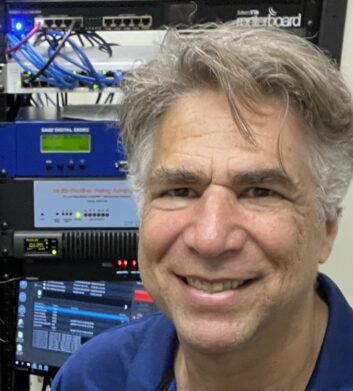
Dan Merwin is founder of Broadcast Telecom and a longtime telecom veteran; he also works part-time as a contract broadcast field engineer.
Radio World: What is the most important trend in telecom links that we should know about?
Dan Merwin: Starlink will continue to evolve in all aspects, including probably eliminating the need for Carrier-Grade NAT (CGNAT). Space-based 5G and Amazon’s Project Kuiper low-earth-orbit constellation will also change the game in terms of ubiquity and performance.
[Related: “Inside the SBE Ennes at NAB Show Emerging Technology Track”]
Also, with the use of SD-WAN technology, which by now is quite mature, the need for expensive private links such as MPLS, Metro Ethernet, satellite delivery and even 950 MHz STLs has been greatly reduced for broadcast and media facilities. And just the fact of usually no longer needing to have multi-year contractual obligations to ISPs with huge termination fees is key.
RW: How have platforms like Starlink, 5G and 5.8 GHz links changed the game?
Merwin: Starlink and 5G are at the forefront of the evolution of internet access in general in that it is vastly more useful to enterprises than in the past for a variety of reasons. It is more ubiquitous, higher-performing, more diverse, and far less expensive than 10 or 20 years ago.
There are many factors to take into account, though, when making network changes. With Starlink, there is apparently an outage of 3:19 every night when the satellites and/or terminals are reset.
Regarding 5.8 GHz PtPs, yes, there are more options for wirelessly connecting sites and for extending the last mile, but the 5.8 GHz space has become crowded so people are often looking at instead utilizing licensed spectrum such as 6 GHz and 11 GHz.
RW: How do SD-WAN technologies play into this discussion?
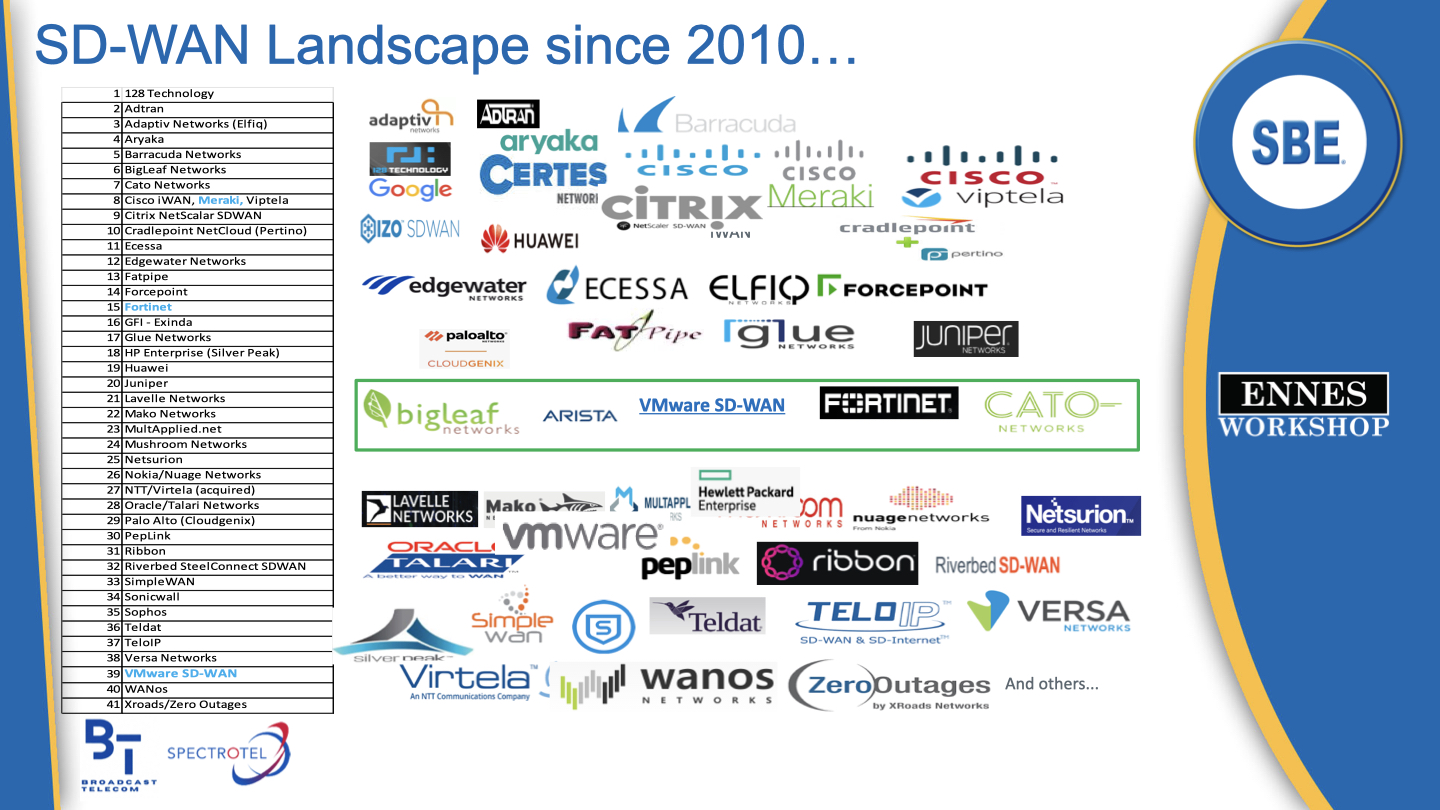
Merwin: It was inevitable that we’d see an explosion in cutting-edge technology that takes advantage of the changes in internet access. SD-WAN also addresses the fact that WANs have evolved from a datacenter-based topology to one that is based on the realities and necessities of distributed security, as well as applications that reside in the cloud and/or at any remote location.
Quality of Service has been supplanted by Quality of Experience, which is AI-driven. For broadcasters, SD-WAN overlayed on top of two or three connections of various types provides a more cost-effective, reliable and manageable way to handle all of their applications, including audio, video, metadata, telemetry, etc.
RW: Can you offer a few best practice tips?
Merwin: Engage a trusted advisor. With an SD-WAN deployment, what generally takes up the most time of the customer and the vendor(s) are the design, planning and configuration stages. That, and the fact that it often involves moving from a WAN made up of MPLS and/or Ethernet Private Lines, mean that salespeople and overlays (e.g. sales engineers) have to invest a significant amount of time, usually far more than in the past, in the pre-sales process, and are compensated relatively little.
Not only that, but in the case where they are paid based on a customer’s spend, they are cannibalizing their revenue and thus their commissions. All this to say that they are mostly not motivated to try to move customers in that direction, and thus it is usually advisable to work with a consultant/agent who probably has more to gain and less to lose in order to help find the best fit.
Just a few examples of factors to consider:
- Some of the platforms redirect traffic on a per-packet basis, which facilitates seamless failover, whereas some just do it on a per-session basis, which will cause interruptions in case the primary link drops or bounces.
- Fortinet, for example, can go deeper into the LAN because they make switches and access points, but there are capabilities that some of the vendors have that they don’t.
- Is there a justifiable need to use a vendor that provides a “Middle Mile,” which enhances performance and security, such as Cato Networks?
Finally, when looking at moving to SD-WAN, it makes sense to do at least a cursory comparison of the benefits and potential drawbacks of self-deployed/managed, co-managed and fully managed SD-WAN, based on the IT resources available to the customer as well as the projected total cost of ownership, among other factors.
Some providers will open tickets for you on any internet circuits (with a letter of authorization in place) as one example of the benefits of a managed service.
RW: What kinds of questions do you get from radio engineers?
Merwin: Naturally, they often want to know how well Starlink will work for their air chains and how reliable it is, although more and more engineers are becoming aware of its use in the industry.
Cost is of course a common concern, so it’s nice to be able to talk to people about a technology change that will save them money in most cases.
How troubleshooting is done with SD-WAN is another common concern. But most SD-WAN platforms make that a snap, with visibility and analytics even up to the application level.
RW: Are there misconceptions you would like to dispel? And what else should we know?
Merwin: It’s a little difficult for some people who have been involved with WANs for a long time to wrap their head around the idea that they might not need to have an expensive legacy private WAN anymore, and that low-cost, best-effort services such as cable internet can do the job perhaps even better when part of a redundant setup.
Meanwhile it’s estimated that there are still 7 to 8 million business POTS lines in the U.S. We have seen the prices go up for POTS as high as $1,500 per line! In addition, the copper infrastructure is no longer being maintained as it was in the past.
POTS replacement has also become a mature and diverse offering, and it’s a managed service, so the days of a telco tech going out to install lines that are not installed where or how they need to be are pretty much gone.
The presentation “Telecom Circuits and Links for Broadcast and Media Facilities” is scheduled for 1:15 p.m. on Tuesday April 21 during the SBE Ennes Workshop.
[For more coverage of the convention see our NAB Show page.]
The post Connectivity in the SBE Ennes Spotlight appeared first on Radio World.