Vue lecture

An Ode to an Antenna Behemoth

Nick Langan's APS-13 antenna
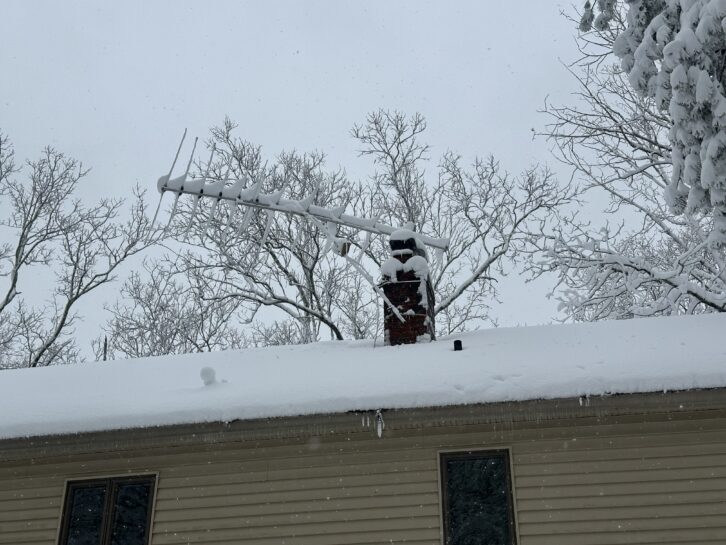
Heavy wet snow drapes off the sideways APS-13 on Nick’s roof Monday.

Nick’s Signal Spot is a new feature in which Nick Langan explores RF signals, propagation, new equipment and related endeavors. 

On Monday, we were without power for approximately 12 hours at my house in southern New Jersey, following the nor’easter that dumped approximately 15″ of snow where we live. My brother, Bobby, had gone outside to start the digging-out process.

Then he came back in and uttered: “Your antenna is hanging downward.”

My response, as any deep radio enthusiast can relate to, was: “Which one?”

But then he said it was the antenna on our roof, and I knew it was the APS-13 FM Yagi. My heart immediately leapt into my throat.

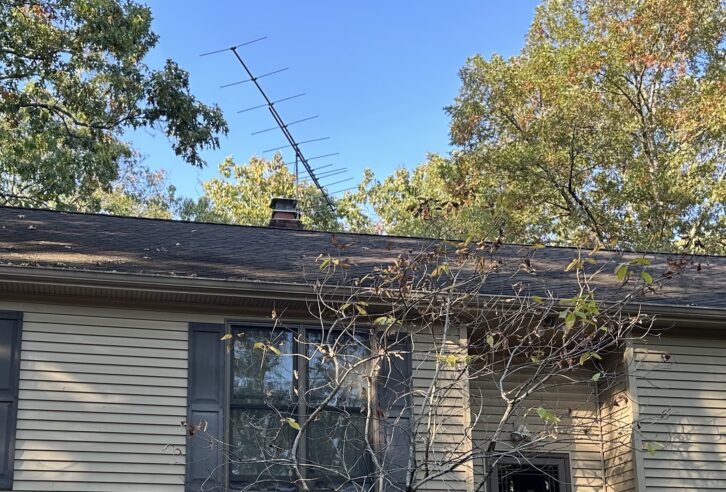
The Antenna Performance Specialties APS-13, with the number 13 referring to its number of antenna elements, is a specimen. At approximately 200 inches in boom length, it takes a large area to mount. It was developed by Ed Hanlon sometime around the turn of the century.

Hanlon stopped building them around 2008. Its sister model, the smaller, nine-element APS-9B, is also still reliably used by several hobbyists, and there was an even larger, 14-element APS-14.

But the APS-13 achieved legendary status, particularly around the time it was invented. Brian Beezley (K6STI)’s modeling of the antenna demonstrates its quality.

Prior to the APS-13, for a consumer-grade product, the best receiving antenna around that time was the Channel Master Probe-9.

My longtime good friend and fellow long-distance FM radio DXer, Michael Temme-Soifer, purchased an APS-13 and told me of the feats he could accomplish from Atlantic County, N.J., with the Yagi, some 20 years ago now.

With no tropospheric enhancement, he could hear as far as WIKS(FM) in New Bern, N.C., and WOMP(FM) in Bellaire, Ohio — both well over 300 miles away — on a daily basis.

I’m an easy sell, and that was enough for me. In April 2005, I ordered mine and I had it installed.

For DXers in pursuit of a sharp antenna that could find nulls in local signals, the directionality of the APS-13 was unprecedented, and in my usage, it still is.

It’s harder today, what with so many signals on the air. But even so, particularly during summertime tropospheric enhancement, the APS-13 remains a champion.

The APS-13 antenna atop my home in Tabernacle, N.J. It's about 20 feet above the ground. What if it were about 800 feet higher?
The APS-13 antenna atop my home in Tabernacle, N.J., in better times.

One example is a null I always have on 100.1 WJRZ(FM) from Manahawkin, about 25 miles away. Whenever there is enhancement to the north, I can reliably hear 100.1 WDST(FM), from Woodstock, N.Y., 150 miles to the north.

The Yagi has survived a move to my current location in Tabernacle, Burlington County, and numerous nor’easters and wind events in between.

So, what’s its current status? It’s perilous. But somehow, despite the heavy, wet snow compromising the mast held by my chimney mount, the antenna itself looks intact.

The countdown is on for me to find someone, anyone, willing to scale my roof in the next few days.

I’ll keep you posted on how it unfolds!

[Read the Signal Spot from Nick Langan for More DX-Related Stories]

The post An Ode to an Antenna Behemoth appeared first on Radio World.

  •  

What Can You Hear From the Top of a Tower?

Nick’s Signal Spot is a new feature in which Nick Langan explores RF signals, propagation, new equipment and related endeavors. 

Where I live in New Jersey, there are just so many FM signals around.

As a result, for the best long-distance signal monitoring results, I’ve learned over the years that sometimes, height isn’t always might. My FM Yagi antennas at approximately 10 feet above the ground will hear weak signals that my time-trusted APS-13 Yagi, mounted to my roof at about 20 feet above the ground, will not.

I attribute it to higher noise floor levels up above the ground.

But outside the eastern megalopolis? Well, that’s a different story. I’ve always wondered the kinds of things you could hear with a receiver connected to an antenna on a high tower!

Another fellow FM long-distance enthusiast, Jeff Lehmann (A1JL), shared with me a video engineer Roman Porterfield took earlier in February from North Dakota.

Porterfield is the single full-time engineer for i3G Media in Jamestown, N.D.

The tower site in the video, located in Eckelson, N.D., had lost power. Taking advantage of the silence, he plugged his Airspy HF+ software-defined radio into the site’s auxiliary antenna — which was pointed east from the site toward Valley City — and he started tuning around.

It is a fascinating look at what can be heard from about 640 feet above the ground.

At about the 12-minute mark, Porterfield switches reception to the main antenna, pointed westward toward Jamestown. Toward the end of the video, there is a fascinating look at the range of stations he is able to hear on 104.5 FM, a clear channel in that region.

First, 104.5 KCCR from Blunt, S.D., serving Pierre, comes in steady at about 205 miles. Then, it is replaced by 104.5 KBUN from Blackduck, Minn., arriving from the opposite direction at a distance of 171 miles.

The modern receiver

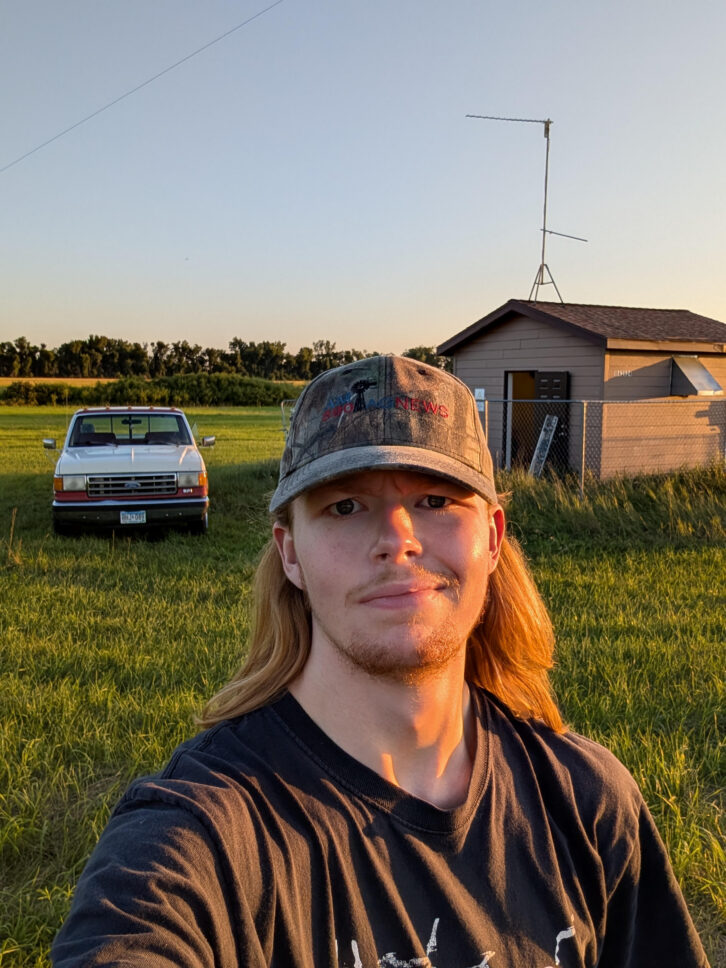
Roman Porterfield in front of KQLX(AM) in summer 2025.
Roman Porterfield at the KQLX(AM) Lisbon, N.D., transmitter site in summer 2025.

Porterfield, 22, told me he always had an interest in radio, but “The Modern Rogue” YouTube channel featured an episode on SDRs and he became even more intrigued. He bought his first SDR while he was still in high school, about 25 minutes outside of Minneapolis.

Now in North Dakota, Porterfield uses SDR IQ file recordings to archive sections of the FM band, particularly during road trips.

“Think radio tapes but instead of audio, it’s the full IQ of the recording,” he said.

I’ve always had trouble myself with managing SDR IQ file storage. IQ files are .WAV files, and recording several hours can encompass terabytes of data.

But Porterfield also writes software, and he pushed out to his GitHub repository a tool that allows you to chop IQ files into smaller, labeled segments and output them as FLAC-compressed files. It’s something I want to try out very soon.

In a database, Porterfield said he has nearly 23,000 clips, dating back to June 2020, many of which are of stations that no longer exist.

Porterfield told me he’s also working on metadata middleware software for RDS, stream data and HD Radio. He hopes that it will be a free, open-source, modular RDS middleware that treats metadata like a flow graph with logic inputs from Axia for aspects like simulcasting and advanced routing.

SDRs, I believe, are the future, and might be the link to engaging smart young folks like Porterfield again in the medium!

Ski and scan

Unless you can seek out high towers to plug into, most of us just need to travel to find those open dial locations.

Radio World contributor and long-distance signal enthusiast Karl Zuk nominated two sites — Yosemite Valley, Calif., and Lake Louise, Alberta — for our “Quiet FM Dial” locations list, noting they are phenomenal places to listen for meteor scatter.

Regarding the Canadian location, Zuk writes:

“Lake Louise now has two CBC transmitters nearby. When I first went up there in the 1980s, the only thing on FM was an aural TV transmitter on 87.75. At Lake Louise, just pick any frequency and sit for a while.

“Guaranteed to hear meteor scatter,” Zuk said.

“You really should go there. Phenomenal skiing and Rocky Mountain majesties.”

Is your transmitter alright?

Meanwhile, the discussion on long-distance signals, including the story I wrote on summer and fall tropospheric enhancement sparked a memory from longtime reader Bob Gonsett in southern California.

He recalls a moment circa 1980 when he received a call from a frustrated general manager of a well-known Mt. Wilson FM station in Los Angeles. The GM was upset that an adjacent-channel station in San Diego was causing temporary interference to his signal.

Gonsett shared the details of that memorable conversation:

“[The GM] assured me that the interference affected not only his station but other Wilson signals as well. He went on to explain his rationalization of the situation: There were certain summer days and times when all of the San Diego FM stations secretly agreed to greatly increase their transmitter output powers.

“My explanation of temperature inversion layer ducting — as we called it at the time — seemed to fall on deaf ears, unfortunately,” Gonsett explained.

[Read the Signal Spot from Nick Langan for More DX-Related Stories]

The post What Can You Hear From the Top of a Tower? appeared first on Radio World.

  •  

Supercharged Ionosphere Delivers Rare Winter DX

Nick’s Signal Spot is a new feature in which Nick Langan explores RF signals, propagation, new equipment and related endeavors. 

For VHF FM radio and TV long-distance signal reception enthusiasts, or DXers, the wintertime doldrums are often real.

Cold temperatures and dry air masses, as we’ve covered previously, often do not support tropospheric propagation. In the northern hemisphere, there is a winter E-Skip cycle, and there was some associated activity with it across North America earlier in January, but it’s much less intense compared to the summer. Typically, by late January, chances for skip dry up.

From here on out, unless you live in a spot particularly hospitable for meteor scatter, it’s possible you might not see another DXable opportunity until April or May.

[Related: “Radio Magic on a Cold Winter’s Night”]

But for some DXers, the evening of Jan. 20 proved particularly special.

On that day, there was a strong geomagnetic storm — as our sister site Space.com chronicled, a class G4 Aurora event. While an Auroral event itself is known to produce “hashy” propagation on VHF frequencies, typically involving signals from the north, the exact impact on broadcast bands can be unpredictable.

Jim Thomas, now 70, told us he has been DXing the band since he was 15. Today, Thomas lives in Springfield, Mo., and is an avid FM and TV DXer and member of the Worldwide TV & FM DXing Association.

He began the evening of the 20th with his antennas aimed north, seeking Auroral signals. He sought a beacon such as CITO(TV) in Timmins, Ontario, on 65.76 MHz. But Thomas found no indicators of Auroral propagation on his band.

Meanwhile, Bill Hepburn, located in southwestern Ontario, reported receiving low-VHF TV signals from the far distant south — counterintuitive to standard Auroral DX.

First, Hepburn confirmed TV Venezuela signals on Channel 3, and then RCN Colombia signals on Channel 2 — both at distances over 2,200 miles. Later, he would receive signals from Nicaragua on Channels 2, 3 and 4.

He posted the logs to the WTFDA’s WLogger propagation bulletin board. Based on the direction — south — and the style of signals observed, more stable than typical E-Skip, posters began to suspect it was F2-based propagation. Hepburn noted a similar event in 2001, the last time he observed F2 in the TV bands.

Thomas, meanwhile, was using SDR Console software to watch the band. At about 10:15 p.m. Central Time, he observed a weak carrier on the SDR’s spectrum view on 65.75 MHz, the audio carrier for TV Channel 3. He listened with earbuds and could tell the audio was in Spanish. Soon after, he noted the same on Channels 2 and 4.

(Listen to Jim Thomas’ analog Channel TV 2 audio, determined to be an RCN Colombia affiliate.)

At first, Thomas suspected Cuba, which is a frequent E-Skip-based reception area. But checking Cubavision’s schedule, it showed a drama, whereas Thomas was hearing opera-style music.

Thomas recorded the audio and sent it to Raymie Humbert, a bilingual DXer considered an authority on DX from Mexico and Latin America. Humbert confirmed the identification of the RCN Colombia network.

“This is the first time I have ever experienced F2 TV DX,” Thomas told us. “It was really strange to hear, but also exciting.”

DXer Andrew Knafel (K8EL), near Akron, Ohio, also posted excellent clips to his X account of the signals he captured on his TV set. Here is how RCN from Colombia looked on TV Channel 2 for Knafel:

Wow, this is the first F2 propagation I’ve seen on TV. Currently I’m receiving the RCN TV network from Colombia 🇨🇴 on channel 2 here in Ohio. That’s about 2100 miles. pic.twitter.com/31Ng0KRx2c

— Andrew 📻📶🇺🇸 (@StaticVoyager) January 21, 2026

Higher up in the band, on Channel 4, is a signal he captured from Managua, Nicaragua, at about 2,000 miles.

Here is another video from the aurora-enhanced disturbed E-layer propagation on Wednesday. This is channel 4 (66-72 MHz). The MUF was high enough for video but not quite for audio. This is Managua Nicaragua at about 2000 miles received in Ohio. pic.twitter.com/RKIqjiN1vu

— Andrew 📻📶🇺🇸 (@StaticVoyager) January 24, 2026

What is F2, anyway?

How does a DXer aiming for Canada end up catching Colombia during a geomagnetic storm?

We aren’t 100% certain. It is not a given this was standard F2; it is still possible this was Auroral-influenced E-Skip set off by the geomagnetic storm. However, the stability and distance point toward F2.

First, a short primer on F2 reception. An article by J.R. Kennedy (K6MIO) describes F2 as the “holy grail” of VHF DXing. It relies on the ionosphere’s highest layer to reflect signals over long distances. It is highly dependent on the solar cycle — and we are in a maximum right now. There is also a peculiarity in the F2 layer not found in the other layers, Kennedy notes, called the “winter anomaly.”

“The central message in all of this is that, on average, F2 propagation between points on the same side of the equator will be much better in the local winter and near solar maximum,” Kennedy wrote.

Under normal conditions, Trans-Equatorial Propagation (TEP) allows signals to cross the equator. This is quite rare, particularly for DXers at Hepburn and Knafel’s latitudes.

But some research, including a study by Elvira Astafyeva and five other authors presented at the American Geophysical Union Conference in 2024, indicates that during severe geomagnetic storms, such as the one on Jan. 20, a phenomenon called the “Super Fountain” occurs. The study describes it as an “uplift” of the crests that sit north and south of the magnetic equator, much farther poleward than usual.

Astafyeva linked the observations to a large coronal mass ejection that arrived at Earth on May 10, 2024.

“We note that, while the dayside ionospheric effects at low and mid-latitudes during the May 2024 storm are impressive, they yet seem to be more modest than that observed during the October 2003 geomagnetic superstorm,” the authors wrote.

Incidentally, during that October 2003 event, according to the WTFDA VUD archives, two DXers in Texas and Louisiana tentatively had a program match to KHON(TV) in Honolulu, while DXer Mike Cherry in British Columbia confirmed KHON, the first time in then 35 years of DXing that Cherry had logged Honolulu outside of the summer E-Skip season.

South Korea in SoCal

One of the most prolific F2 DXers was the late Gordon Simkin.

He penned multiple columns for the WTFDA’s VHF/UHF Digest back in 2003 and 2004 regarding his experiences with F2 propagation in the 1950s.

Writing about his time as a research assistant at Loma Linda University in California in 1957, he recounted using a Heathkit FM-3A tuner with a converter to tune the 40–60 MHz band. South Korea was using the 42–48 MHz band for FM broadcasts in those days.

While recording a station, he captured an ID in English. “It was quite a delight to discover that I was receiving Seoul, South Korea!” Simkin wrote. He believed its call letters were HLKA, and it was around 45 MHz.

This may be the most distant FM broadcast signal ever logged at approximately 5,000 miles.

He had several receptions of BBC audio from Loma Linda, reaching frequencies as high as 52.4 MHz in what he described as the “most extreme day for F2” he ever experienced — likely Nov. 20, 1959. Glenn Hauser wrote of this in his DX Listening Digest in 2002.

“Legendary DXer Gordon Simkin who lived in Loma Linda, Calif., managed to catch MUF as high as 53.75 MHz to the BBC in UK — rather phenomenal, as well as a French station operating with a video carrier frequency of 52.4 MHz (at that time),” Hauser wrote.

In general, the maximum usable frequency in F2 events is limited typically to about the six-meter amateur radio band (50–54 MHz), making the Channel 4 reports from Jan. 20 highly unusual.

Was it the Auroral link?

For DXers like Thomas, Hepburn and Knafel, it made for a very mysterious and memorable event, regardless.

[Read the Signal Spot from Nick Langan for More DX-Related Stories]

The post Supercharged Ionosphere Delivers Rare Winter DX appeared first on Radio World.

  •