Vue lecture

Information Station Specialists Preps New AM Broadcast Antenna

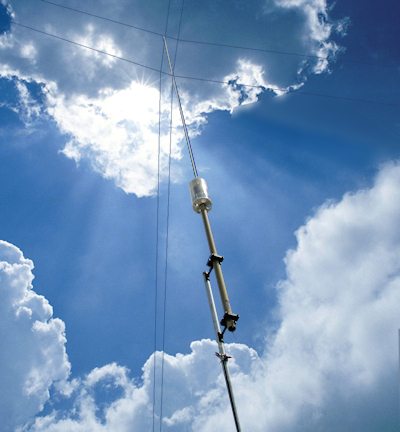
Information Station Specialists' Magnum K1 antenna.
Information Station Specialists’ Magnum K1 antenna.

Engineered in the U.S. heartland, the pending Magnum k1 antenna, Information Station Specialists said, will offer AM station operators a path for an affordable antenna with a “fly under the radar” footprint.

The Michigan-based company said the model is pending the completion of full-power tests. The FCC granted an AM station the authority to test the antenna at 1 kW on Jan. 12, according to Bill Baker of Information Station Specialists. The company anticipates it will begin taking orders in the spring.

But Baker told us that the antenna is designed to specifically support up to 1,000 watts of power on middle and upper AM frequencies.

He has heard from interested station owners early and often who crave an antenna that can reduce their land footprint — or better yet, be installed on a building roof.

“It can absolutely save an AM license when a broadcaster is forced to move their antenna because of a land sale, loss of lease or the sudden requirement for a tower replacement,” Baker said.

The Magnum k1 stands less than 50 feet tall and only a modest, flat area of ground or rooftop is required, Information Station Specialists said. It recommends a 100 ft. x 100 ft. flat installation surface with the antenna and its supporting mast installed in the center.

“Testing thus far proves it has the efficiency to be a full-time antenna for many Class B, C and D stations that operate on frequencies 900 kHz and above,” Baker told us.

The Magnum k1 package includes the antenna itself, as well as mounts, a support mast and pole, guy lines, hardware and electronics in a weatherproof cabinet.

“Because the antenna’s design is series-resonant with a matching network, an antenna tuning unit is not needed,” he said.

The idea was hatched about seven years ago. The company’s HPR.0990 AM antenna for travelers’ information station broadcasters could handle more wattage than the standard 10 watts of TIS power in an emergency under a special temporary authority with the FCC.

AM stations began to use the model for STAs and even full-time applications for power levels under 300 watts.

Baker pointed to Emmis’ 1070 WFNI(AM), which has been operating with the  HPR.0990 from a downtown Indianapolis rooftop site with around 200 watts while the company seeks to find a prospective purchaser, according to WFNI’s STA. (WFNI filed for a silent STA this past December.)

One station in Connecticut is also using the HPR.0990 and hopes to move back to its licensed 1 kW with the Magnum k1.

“We are being real careful to get this product right,” Baker said. Upcoming field tests to prove its power worthiness, he believes, will prove that.

Additional options, including a preassembled ground plane, roof installation kit, tuning analyzer and engineering support, will also be available.

Operators can request an estimate of signal performance with the Magnum k1, Baker said, and also whether the antenna is likely to be efficient enough for commission approval on their frequency from any site in the U.S., prior to purchase.

The Magnum k1 joins other antenna and tuners offerings from Information Station Specialists, including “The Lowdown”, a 630-meter amateur radio antenna, “The Range Extender,” a Part 15 antenna and tuner and the Matchbox impedance matching network.

[Do you receive the Radio World SmartBrief newsletter each weekday morning? We invite you to sign up here.]

The post Information Station Specialists Preps New AM Broadcast Antenna appeared first on Radio World.

  •  

AM Broadcasters Ask for More Translator Flexibility

A coalition of broadcasters in the United States would like the FCC to give AM stations a fresh opportunity to acquire and move FM translators.

The group of 19 AM operators has asked the FCC to reopen its 2016 filing window that allowed AMs to acquire and relocate translators as part of its “AM revitalization” initiative.

Class C and Class D AM broadcasters dominate the coalition. They believe their proposal “will allow for substantial FM translator transmitter site and channel moves, enabling additional FM translators to rebroadcast AM stations.”

In addition, they would like the FCC to allow each AM to move up to three translators. They also hope the commission will allow the acquisition of translators that are farther away. And they would like this AM translator “window” to be made permanent.

The proposal does not call for the creation of new FM translator licenses; it deals with rules for how AM stations can acquire and move them.

Proven approach

Although the FCC recently has been closing dormant dockets, the AM revitalization docket remains open.

The window a decade ago permitted an AM broadcaster to acquire an FM translator and relocate it on any available frequency for local service using the rebroadcast of the AM station programming. Another window the next year allowed additional AMs to apply.

The group filing the petition is headed by Press Communications under President Robert McAllan. It includes names familiar at the FCC for their advocacy on behalf of smaller AM broadcasters, including Bud Walters, Matthew Wesolowski and Larry Fuss. (The full list is at the bottom of this story.)

They told the FCC that FM translators have saved hundreds of AMs from going off the air. They said stations have seen increases in listenership, advertising revenue and community engagement.

But they said the challenges facing the AM band have only intensified. Those include ever-increasing noise floor levels, continued degradation of audio receiver quality, variable (if any) nighttime service, and digital technological change in the marketplace.

They said AM stations “continue to experience a disproportionate decline in listenership.” They cited Nielsen data indicating that AM listenership represents less than a third of broadcast radio station audiences with FM picking up the balance, and that younger demographics rarely use AM.

They believe more than one-third of AM stations still lack at least one companion FM translator.

A reopening, they said, would benefit small, often minority-owned AM stations, many in rural areas. They said such owners often lack the capital or market conditions to launch digital services or may not have the financial capability or spectrum availability to obtain a full-service FM license.

More flexibility

They told the FCC that the greatest accomplishment of the revitalization initiative was giving AMs the ability to substantially move FM translators to locations where they could more effectively rebroadcast programming.

In 2016, the translators could only be moved from within a 250-mile radius of the subject station’s transmitter site and must be located within 25 miles of its transmitter.

A reinstatement would not require a “totally new major rulemaking infrastructure,” the broadcasters believe.

As before, they ask that the FCC provide an initial time period of perhaps 120 days in which only Class C and Class D AM stations could file.

But they also requested “minor enhancements.”

They would like the FCC to offer stations, “especially those with daytime-only operation or low-power and critical nighttime patterns,” the opportunity to obtain up to three FM translators to run within the 25-mile limit. In the previous window AMs could move only one.

“In many areas of the nation, and particularly in Zone 1, largely higher-power second-adjacent channels severely limit translator power levels,” they wrote. “Thus, the need for multiple translators to better emulate the daytime coverage of many Class D and Class C AM stations.”

They suggest a cap of three so that no AM is forced out of the market for translators by a large entity acquiring dozens of signals for a particular AM station, or by a competing AM “usurping” the FM translator spectrum in a market.

They also advocate broadening the purchasing reach from 250 to 500 miles, primarily to assist stations on the east and west coasts, the borders with Canada or Mexico, and the Gulf. (Apparently sensitive to politics, the filing simply used the name “the Gulf.”)

“This change is important as AM stations located near coastal or border areas were hampered in under the 2016 filing windows by having many fewer potential FM translators to acquire due to not having a full circumference of 250 miles dues to a truncation by such borders or the coast.”

Additionally, the broadcasters asked that their proposed “window” be made permanent.

“Rather than further limiting for the future the availability and the number of translators for purchase to eligible AM stations, a permanent change to the FCC’s rules to allow for moving FM translators to serve AM stations going forward will avoid spectrum warehousing and gamesmanship which often occurs upon the opening of a time-limited window,” they wrote.

[Read the petition here.]

Example

A footnote in the filing provides a case study of how this might benefit a broadcaster.

“Press Communications LLC is the licensee of WHTG(AM), a Class D 500-watt daytime-only station licensed to Eatontown, N.J.,” it states.

“The station currently has one companion FM translator W264DH, which only reaches about 20% of the AM’s daytime coverage. Adding one or more translators would greatly enhance WHTG’s ability to better serve its existing listening audience, and more importantly, develop new audience.”

It noted that Press also has a construction permit on file to move W264DH to another location within 25 miles of WHTG’s transmitter site.

“But without an additional translator, that move is a zero-sum game, as some listeners will lose FM service without a second translator to replace W264DH at the existing site.”

Conclusion

The petitioners noted AM radio’s role in public alerting. They cited the perceived desire of FCC Chairman Brendan Carr to help make sure that all broadcasters remain competitive well into the future.

“AM broadcasting technology is now over 100 years old, which is eons in a world that went from 56k digital dialup modems to gigabit speeds in a little over a quarter of that time. The laws of physics tell us there is little we can do to overcome the technical limitations inherent in AM service,” they wrote.

“Indeed, reinstating the 2016 AM Radio Revitalization translator modification filing windows for FM translators will help ensure AM broadcasters’ high level of service well into the future.”

The groups that filed the petition are SSR Communications, Simmons Broadcasting, Kaspar Broadcasting, Mountain Top Media, Priority Communications, Virden Broadcasting, South Seas Broadcasting, Delta Radio Network, Hancock Communications, WYCQ, The Cromwell Group, R & F Communications, Eureka Broadcasting, O-N Radio, Viper Communications, Mentor Partners, Genesee Media, Dakota Broadcasting and Community First Broadcasting.

[Related: Read comments by REC Networks in reaction to this petition.]

The post AM Broadcasters Ask for More Translator Flexibility appeared first on Radio World.

  •  

The Communicator: January – February 2026

The Communicator First Issue of 2026Happy New Year! This first issue of 2026 spans 110 pages and offers a comprehensive exploration of amateur radio. Readers will find a diverse mix of content, including technical projects, the latest operating news, a...

💾

  •  

Future in Focus: Justin Sasso of the Colorado Broadcasters Association

In this “Future in Focus” series, we’re asking industry thought leaders, executives and engineers to comment on top trends of the past year and what they expect for radio in 2026.

Justin Sasso is the president and CEO of the Colorado Broadcasters Association

Radio World: What do you think is the most important thing that happened in the world of radio in 2025?

Justin Sasso: I think the defining moment in 2025 was the way the industry rallied around the AM Radio for Every Vehicle Act. For me, that fight has never been just about AM, it was about whether free, local radio keeps its place in the dashboard. Honestly, it probably should’ve been called the “Free Local Radio in Every Vehicle Act.”

What really struck me was the unity. You had big market, mom-and-pop, public broadcasters, everyone pulling in the same direction. In Colorado, it lit a fire under broadcast operators. It reminded lawmakers that this medium is still the heartbeat of every Colorado community.

When a local station warns you about a wildfire, connects you to your neighbors or just keeps a lonely highway from feeling quite so empty, that’s not a relic. That’s essential.

Justin Sasso at the Bonneville Denver studios

RW: What technology/business/regulatory trend do you think is going to have the greatest impact on radio in 2026?

Sasso: AI, without a doubt. But not in the “replace everybody with robots” way people like to dramatize it.

Where I get excited is using AI to take the grind out of the job. Broadcasters spend a huge amount of time digging for relevant stories, pulling research and trying to figure out where their audience is hanging out online. AI can do the heavy lifting there, scraping, sorting and organizing so real people have more time to do what radio does best: be human and local.

I see AI clearing the runway so talent, newsrooms and sellers have more room to be creative, perform better research and deepen customer relationships. The broadcasters that treat AI as a force multiplier, not a shortcut, are the ones that will pull ahead in 2026.

RW: What will be your main professional goal or project in the coming 12 months?

Sasso: The big push for me is evolving our organization from a pure “broadcasters” association into a broader media association. Our members haven’t been purely “broadcasters” in a long time. They’re creating digital news, podcasts, streaming, social video, newsletters, events and embracing the whole media ecosystem.

My focus is building an organization that matches what’s happening on the ground. That means inviting more of those adjacent local media players into the tent and designing benefits and advocacy that reflect their reality.

We’re not walking away from radio or TV; that’s our foundation. We’re adding more cement to the foundation, so it can support where local media is heading. If we get that right, we’ll be in a much stronger position to protect and grow local media in Colorado.

RW: How do you think our industry will be different in 10 years?

Sasso: I think the metro–rural divide is going to become much more pronounced. In big markets, radio will be one of many players in a crowded space. To win there, stations will have to be hyper-local and very intentional about why they exist. Stations will have to get creative and find a niche that listeners can’t get from a playlist or a syndicated program.

In rural Colorado and similar places, radio’s role is going to be even more critical. You’ve got communities losing their newspapers, struggling with broadband access and still facing wildfires, floods and blizzards. Radio becomes the connective tissue, even more so, for news, information and public safety.

Ten years from now, I don’t think, “Is radio still here?” is the right question. The better question is, “Which stations leaned into their local superpowers and took that to every platform, and which ones tried to out-Spotify Spotify?” The former have a future.

RW: Anything else we should know?

Sasso: Yeah! Don’t underestimate your state broadcast association.

Even if you never go to an event, even if you don’t read every newsletter, your association is out there every day in front of lawmakers, regulators and other industries that would love to steal your spectrum, your ad dollars and your audience. Commercial, non-comm, LPFM, religious, music, sports, talk, everybody is in that conversation whether they realize it or not.

When that advocacy voice goes quiet, the policy decisions don’t stop. They just start tilting in favor of whoever did show up in the room. So, my message is simple: stay connected.

Support your association however you can because, at the end of the day, we’re fighting for the future of free, local media.

Radio World welcomes comments on this or any story. Email radioworld@futurenet.com with “Letter to the Editor” in the subject field.

Read more stories like this in our News Makers section.

The post Future in Focus: Justin Sasso of the Colorado Broadcasters Association appeared first on Radio World.

  •  

Get That Beat Out of Your Head!

The AM Improvement Working Group of the National Radio Systems Committee has been working on characterizing AM radio performance and on solutions to improve AM radio reception.

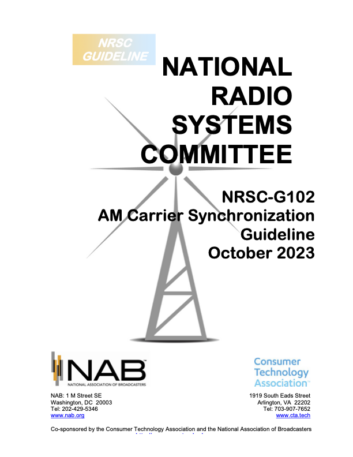
The cover of the NRSC guideline described in the text.

The NRSC is cosponsored by the National Association of Broadcasters and the Consumer Technology Association. It is a group of scientists and broadcast engineers pooling their talents to find solutions to broadcast transmission problems.

An NRSC guideline describes technology that can aid AM stations with their coverage and improve listener experience.

The problem

You have heard it many times: a beat note between co-channel AM stations in fringe reception areas. Stations on the same frequency as the one you’re listening to can create an annoying low-frequency hum or beat in received audio. It is distracting and can cause listeners to tune away.

According to FCC rules, the AM transmitter carrier frequency tolerance is +/– 20 Hz. That means two transmitters could be as much as 40 Hz apart and still be legal.

An audio beat of that kind between two stations can be quite annoying. The most common example happens when listeners are driving out of a station’s protected contour and are continuing to listen to a popular program. Interference from another station, on the same frequency, causes listener fatigue and tuneout.

A worse case is when stations are about 1 Hz apart. Listeners hear a station’s audio rise and fall every second. It is common when a station is pounding in via skywave during critical hours. That is often when advertisers are paying to get impressions to listeners during drive time. Ouch!

The solution

For years, a handful of AM stations with on-channel AM boosters have successfully synchronized their transmitter frequencies to minimize interference to listeners.

That same idea can be applied to co-channel AM stations everywhere. It has been shown that a 3 dB or more improvement in listener audio signal-to-noise ratio (SNR) can be achieved with carrier synchronization. That is the equivalent of doubling transmitter power!

Think of this as extended coverage. The greatest benefit is to co-channel stations that know they are interfering with each other but have had no option to remedy the problem until now.

Technology

Hardware is readily available to discipline the carrier frequency of an AM station to its exact licensed frequency. GPS satellites can be used as frequency references to do the work. A typical cost of $1,000 for hardware with installation can get almost any AM station synched up, so to speak.

Most AM transmitters today have 10 MHz reference oscillators, which are divided down to the station’s operating frequency. The transmitter then amplifies it up to licensed power. That 10 MHz oscillator can be replaced by an external source, usually via a jumper change within the transmitter. Some older transmitters might want an external RF input to be on the carrier frequency, but that is doable too.

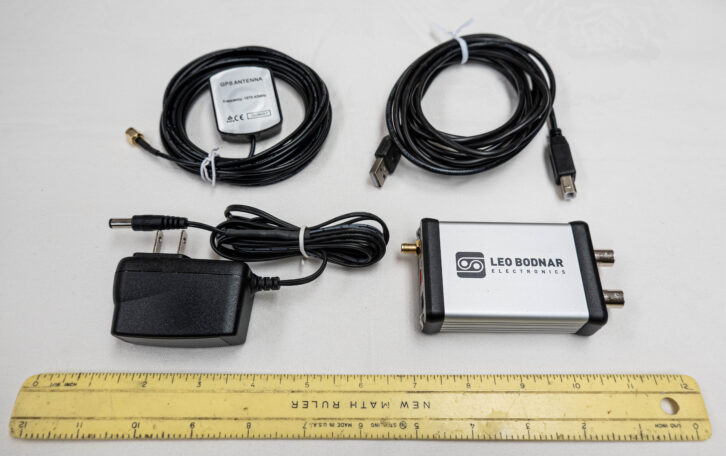
Fig. 1: A Leo Bodnar clock.

Almost any GPS synchronized time base could work. The unit I tested, shown in Fig. 1, was a Leo Bodnar Precision GPS Reference Clock. It comes with a small GPS antenna and 16-foot cable for $233.95. They also have GPS antennas for outdoor use, which have 33- and 98-foot cables. This might be required in many situations.

This particular unit can be programmed to generate any frequency between 450 Hz and 800 MHz. It will continue working if GPS signals are lost due to antenna problems or whatever. The RF output will be very close to correct and will move back to the exact frequency when the GPS input it restored.

Listening

In listener tests between two synchronized stations, it is amazing to hear how reception cleans up. Audio from the weaker station may be heard in the background, but the annoying beat note between carriers is gone.

Note that this is voluntary. All stations should be synchronized to get the greatest benefit on the frequency to be synchronized. All stations on all frequencies could and should synchronize.

Regarding local Class C channels, this will likely benefit the daytime. But with dozens of stations heard at night, there will be more audio than carrier. Therefore, there is no guarantee that this technology will work for every station in every situation.

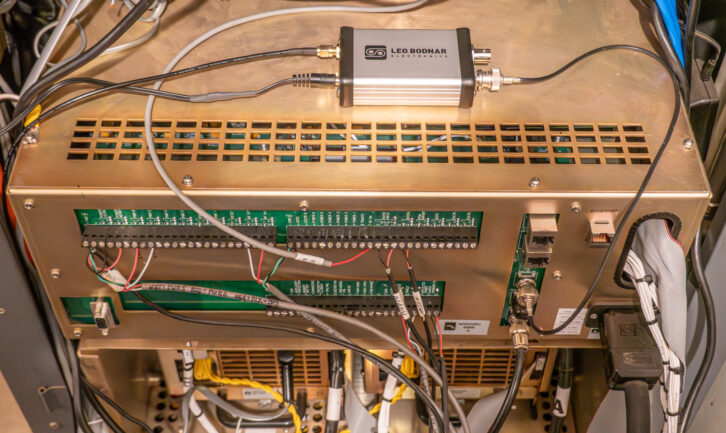
Fig. 2: A Leo Bodnar unit on a Nautel J1000 Transmitter

Fig. 2 shows a typical installation on a Nautel J1000, a 1 kW AM transmitter. A Leo Bodnar Precision GPS Reference Clock is fed into a BNC jack on the back of the transmitter, replacing the transmitter’s RF oscillator. A small GPS receive antenna mounts outside the transmitter building.

There is no harm in AM broadcasters synchronizing their carriers. No FCC paperwork is required, although it would be best to confirm all is well during an annual NRSC occupied bandwidth and RF harmonic test.

(Read the full text of the G102 document.)

Comment on this or any article. Write to radioworld@futurenet.com.

The post Get That Beat Out of Your Head! appeared first on Radio World.

  •  

CQ Worked All Zones

I always have an operating goal in sight to motivate me to get on the air. On the HF bands, I followed the typical progression of getting Worked All States (WAS), Worked All Continents (WAC), and DX Century Club (DXCC). It seems that DXCC receives all the glory and attention, with many DXers pursuing the goals of working all countries, Continue reading CQ Worked All Zones

The post CQ Worked All Zones appeared first on The KØNR Radio Site.

  •  

Top Five K0NR Blog Posts for 2025

Closing out 2025, here are the top five blog posts at k0nr.com during the year. Some people may see this as a lazy way to create one more blog post this year without much effort, and they would be right. These posts are the top five most viewed this year, but may have been written earlier. Top Five Blog Posts Continue reading Top Five K0NR Blog Posts for 2025

The post Top Five K0NR Blog Posts for 2025 appeared first on The KØNR Radio Site.

  •