We’re big believers in the power of college radio here at Radio World, so it’s cool to share a promotion being run right now by Telos Alliance.
The manufacturer is partnering with the non-profit College Radio Foundation to give away a flagship Omnia.11 FM+HD audio processor to a U.S. college station. That’s a prize with a retail price of about ten grand.
“The contest is easy to enter,” Telos says in its announcement.
“Students, faculty and staff at college radio stations in the USA can submit their entry online; all that’s needed is a quick paragraph explaining why their college station needs a new Omnia.11.”
Entries will be open through April 10 at the company website. The winning entry will be chosen by the College Radio Foundation, led by Rob Quicke, whose work on behalf of college radio, including the annual College Radio Day, is familiar to Radio World readers.
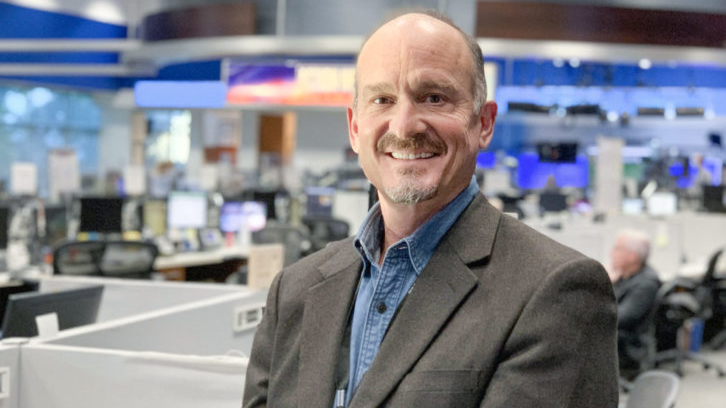
Telos Audio Production Senior Director of Sales Jim Armstrong was quoted saying, “College radio has always held a special place in our hearts because so many of us got our start in the industry at a college station. We’ve got former on-air personalities, chief engineers and radio station staff at every level of our company who credit college radio with igniting their love for the medium.”
That’s certainly true of me as well. I still remember walking into WXDR at the University of Delaware for the first time. The experiences of those first few years have shaped my lifetime. And my Radio World colleague Nick Langan works as a faculty advisor for 89.1 WXVU(FM) in Philadelphia.
But all of us also have read news stories about this or that school deciding it no longer needs a radio station, overlooking the power and appeal that working in media still hold over young people.
So I’m all in with anything that gives a college station a boost up.
Penta Laboratories Director of Business Development Steve Sanett
Supply Side is a series of occasional articles about companies in the supplier marketplace.
Steve Sanett is director of business development for Penta Laboratories in Newbury Park, Calif.
Radio World: What is Penta Labs and what range of products does it offer?
Steve Sanett:Penta Labs is a manufacturer originally located in Santa Barbara, Calif. It commenced production of electron tubes in 1951, mostly supplying the U.S. government with power grid triodes, tetrodes and pentodes of various power output, ranging from 500 watts to 250 kW. It was a division of Raytheon for 15 years, acquiring an expanded range of expertise.
Penta has now expanded into the vacuum capacitor product line with both fixed and variable capacitors.
RW: What broadcast bands and power levels do your products support?
Sanett: We manufacture a complete line of tubes originally made by Eimac, Amperex, Thomson CSF, Burle and Penta.
Our most popular tube types are 4CX7500A, 4CX7500A, 4CX15,000A, 4CX20,000 A, C, D, E. We manufacture about 75 different types including non-broadcasting types such as magnetrons and thyratrons.
Penta Labs manufactures about 75 different types of tubes.
RW: The shutdown of the former Econco facility, known for rebuilding vacuum tubes for transmitters, has drawn attention in the radio broadcasting industry. What services does your company offer in this area?
Sanett: We have been working diligently reducing costs of tube production so we could convert users from re-built tubes to new current product tubes at equal or lower pricing and warranty. We prefer to start with new materials that have not been subjected to multiple rebuilds and shipping back and forth of used and old burnt tube cores, usually in bad condition.
RW: What else should we know?
Sanett: Penta has been around for 75 years. We have high-quality customer service and great turnaround for any issues that may arise.
We are currently the largest supplier in the world of ham radio type tubes, with a large presence on the internet. We stock most of the tubes that are used in the broadcast industry and can ship the same day that we receive the order.
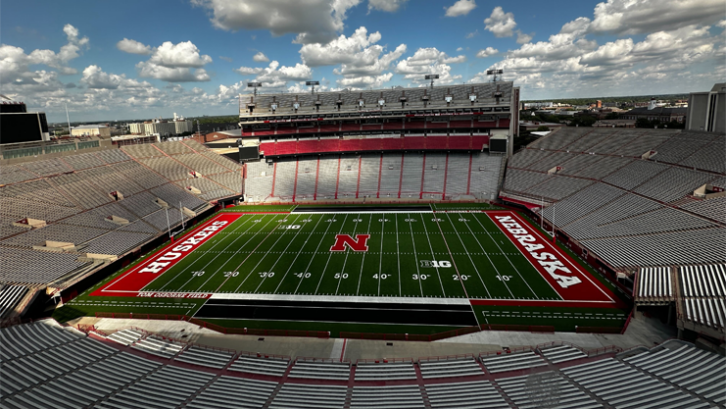
Huskers Radio Network, part of the University of Nebraska, feeds more than 30 affiliate stations with sports coverage that includes its nationally known football program, basketball and volleyball, plus associated shows. The school is in the Big Ten Conference and competes in NCAA Division I.
The athletics department moved its entire multimedia department at Memorial Stadium to a renovated second floor, creating a 25,200-square-foot facility. It includes a variety of media including HuskerVision, designed and built by Beck TV, as well as the new Huskers Radio Network (HRN) facility built by Inrush Broadcast Services.
Memorial Stadium at the University of Nebraska.
For HRN this wasn’t a revolution in technology but a location change, a refresh in hardware and cabling, and cleanup of documentation.
The project also shored up the important Barix distribution network that feeds every affiliate and added new custom WheatNet Screenbuilder virtual control panels to ease daily management of the distribution network.
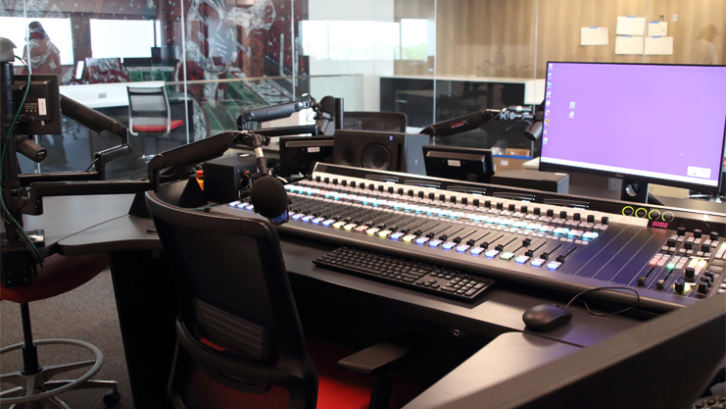
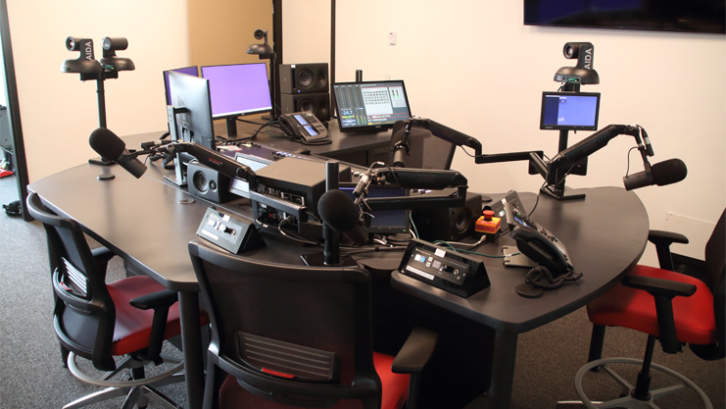
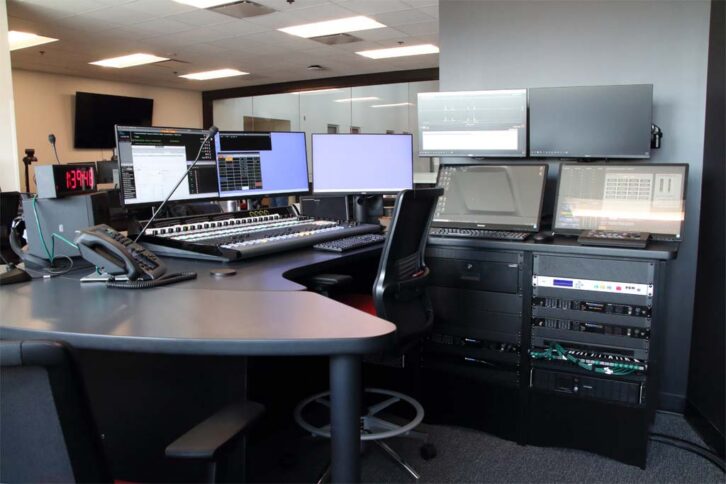
The HRN studios include a video studio, a control room studio and two production studios, all in an open floorplan.
A radio showcase studio.
The furniture and Wheatstone gear, including LXE surfaces and various varieties of blades, had been installed previously; these were documented, moved and freshened. The RCS Zetta system also got a hardware refresh and a database and audio move.
The overall facility construction began in 2020 and was open to integrators in April 2025. The HRN integration was completed by the end of July.
HRN was integrated into the overall multimedia Technical Operations Center over two visits in June and July. The studios were moved and upgraded to the new facility over the July 4 holiday.
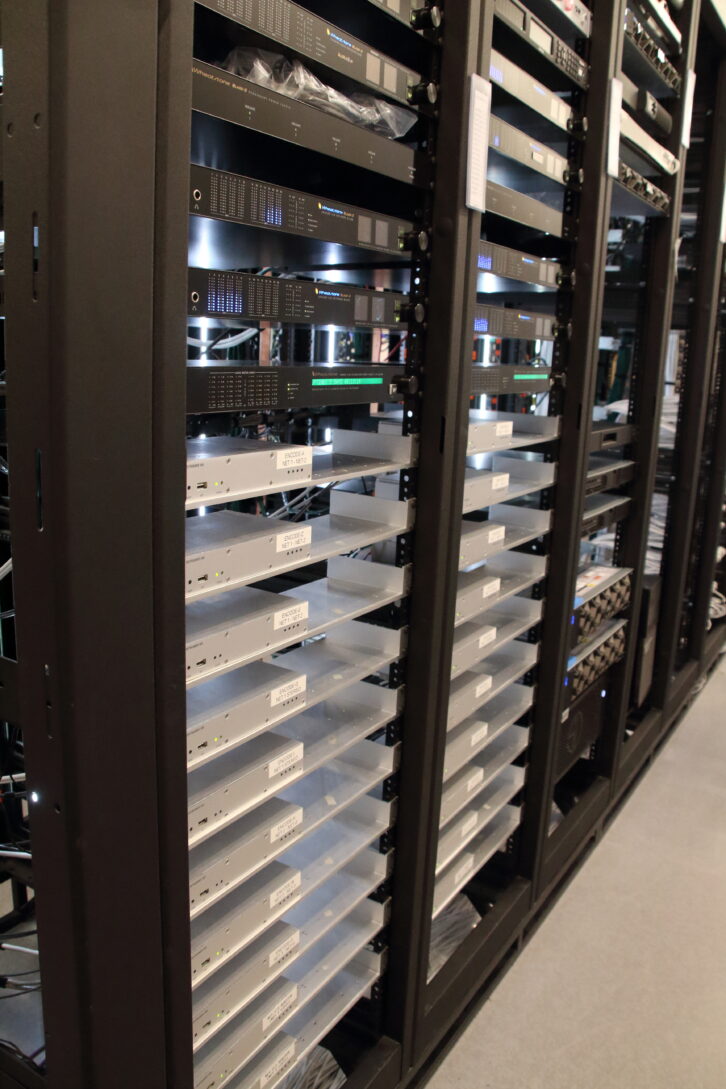
Redesigning the head-end equipment for HRN enabled the team to reduce TOC footprint, as HRN was leaving its own dedicated rack room and joining the combined multimedia TOC.
Radio studio equipped with video in mind.
Key technical components included the Wheatstone AoIP infrastructure, RCS Zetta automation and Barix affiliate distribution system. BSW supplied new radio equipment. Inrush Voice provides phone service to HRN’s Telos VX talk show system.
The work leaders included Brandon Meier, project manager for HRN and HuskerVision; Scott Guthrie, chief engineer of HRN; Garett Hill, technical expert at HRN and HuskerVision; Josh Hilkemann from Playfly, which runs day-to-day operations of the HRN; Alex Bonello from HDVmixer; Tom Lawler from RCS; and the Inrush integration team. BeckTV was the integrator for the HuskerVision side.
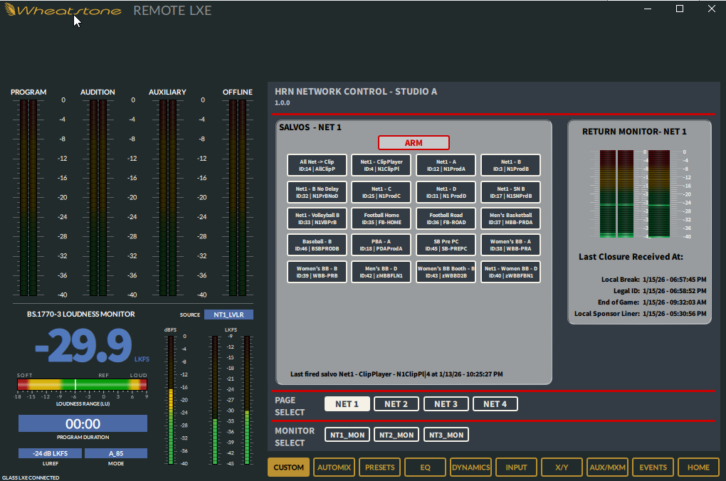
Network Control Room supported by Wheatstone Screenbuilder.
“This is a complex production and distribution facility entirely owned by a university athletics department and run by production and network sales partner Playfly,” said Rob Bertrand, partner at Inrush.
“It utilizes a unique implementation of Barix distribution hardware in a design and network methodology that was implemented by a prior engineer.
Racks in the TOC including Barix distribution infrastructure.
“Combined with RCS Zetta macros for affiliate network closures, it’s incredibly effective as a cost-effective owned distribution network. But it took some coordination to discover all the nuances of the prior engineer’s design as well as shifting ownership of certain web components from one entity to another.”
In addition, Inrush provided custom Wheatstone scripts to create a quick and effective GUI to trigger salvos for each of the four networks, change network audio monitoring and track/confirm closures are being fired to all affiliates.
“Previously, HRN struggled to track which source was feeding each network and it was difficult and opaque to confirm that affiliate closures had been properly sent. Now, any of the four LXE studio positions can perform these actions from their touch screens, which are attached to the LXE engine.”
Any of the four LXE studio positions can perform actions from their touchscreens, attached to the LXE engine.
Bertrand said that while there are no project components residing in the cloud, the virtualized technology offered by WheatNet Screenbuilder enables complex switching and logic arrays to be built and the operation monitored easily by operators.
“Creating such an environment before the AoIP world would have involved custom boxes filled with relays, back walls adorned with numerous 66 blocks and cross-connects, and even then it would have been nearly impossible to provide the logging and confirmation now available via the virtualized WheatNet Screenbuilder functionality that Inrush delivered to HRN.”
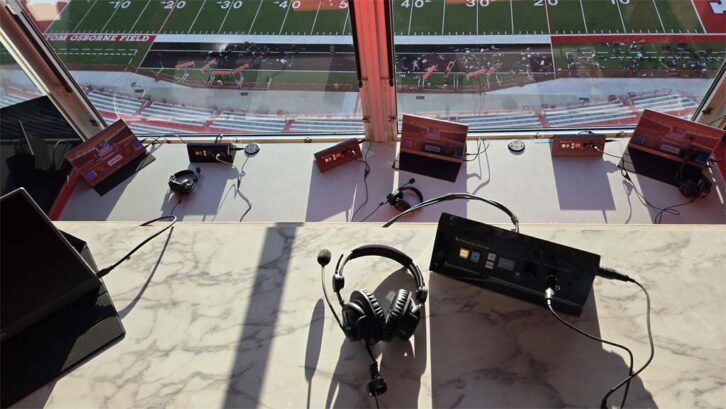
The play-by-play booth in the stadium also was rebuilt and connected to the WheatNet infrastructure.
Cameron Boswell, Inrush SVP of integration services, said, “We were substantially impressed with what Huskers had already achieved using Barix hardware. We cleaned it up and standardized its logic and audio implementation, but we were really building on what was there.
“Their Barix distribution network is cost-effective and extraordinarily effective in meeting the IP-based distribution needs for the four disparate channels of the Huskers Radio Network, including matching backup encoders.”
The Huskers Media team brought Inrush back for subsequent visit to rebuild the play-by-play booth in the stadium.
Xperi saw a decline in overall revenue last year, from $493.7 million in 2024 to $448.1 million in 2025. Its net loss grew from $14 million in 2024 to $56.3 million in 2025.
The technology company, which is the parent of DTS, HD Radio and TiVo, has released its Q4 and full-year results.
In Q4, revenue fell from $122.4 million a year earlier to $116.5 million in 2025. But Xperi cut its quarterly net loss from $46.2 million a year earlier to $17.1 million in Q4 2025.
CEO Jon Kirchner was upbeat in his summary of the year. He said Xperi has achieved 5.3 million monthly active users on its TiVo One ad platform. He said the DTS AutoStage footprint increased 40 percent to reach 14 million vehicles. And he said Xperi expects to double media platform revenue and achieve positive free cash flow this year.
He said the company saw “meaningful year-over-year improvement in adjusted EBITDA and operating cash flow in 2025.”
“[W]e achieved key milestones which clearly demonstrate the significant progress we have made toward our growth goals,” Kirchner said.
“We believe our success in growing our large and unique global footprint over the past few years has positioned us to accelerate our monetization efforts through advertising and data solutions.”
Of specific interest to the radio industry, the company says it has had “continued strong growth in the Connected Car platform footprint as well as new automotive OEM programs that are expected to enable acceleration in long-term monetization.”
It noted that it recently Mercedes Benz to launch DTS AutoStage video service, “making Mercedes the first car brand to offer all four of Xperi’s connected car solutions: HD Radio, DTS:X immersive sound, AutoStage audio and video powered by TiVo.”
It said the expansion of DTS AutoStage continues, “achieving over 14 million vehicles on the platform by year-end and reaching important scale to enable in-car monetization trials.”
It launched HD Radio in several new models from manufacturers including Toyota, Honda and Audi, and signed a multi-year program for HD Radio with an unnamed large U.S.-based Tier 1 supplier.
And it said it has signed a multi-year DTS audio deal with “a large Asian Tier 1 supplier, which is expected to secure the DTS decoder technology in a number of future car programs.”
FCC Chairman Brendan Carr is calling on broadcasters to air “patriotic, pro-America programming” connected with the 250th anniversary of the nation.
He hopes broadcasters will “pledge to provide programming that promotes civic education, national pride and our shared history.” His ideas include airing the pledge of allegiance and playing music by John Philip Sousa.
In the current political climate, Carr’s announcement and accompanying comments are likely to draw yet more attention to the chairman’s interactions with broadcasters.
Commissioner Anna Gomez, the only Democrat on the FCC, reacted immediately on X: “Nothing is more American than defending our constitutional rights against those who would erode our civil liberties. If broadcasters choose to participate in this FCC campaign, they can do so by defending their First Amendment rights and refusing government interference.”
One Radio World reader, an engineer, emailed us: “If [Carr] wants to be a program director, maybe he should be applying at a radio station.”
Sample programming
Carr wrote that “civics education is in rapid decline” and lamented that “classic programming such as ‘Schoolhouse Rock!’ is now only found in online archives.”
He said that broadcasters “are uniquely positioned to help address these concerning developments by providing programming that celebrates the remarkable story of American Independence while also tailoring it to the specific needs of their local communities, in furtherance of their public interest obligations.”
The chairman published a list of possible content that includes news content, PSAs and starting each broadcast day with the “Star Spangled Banner.”
His list of examples, in his words:
Running PSAs, short segments or full specials specifically promoting civic education, inspiring local stories, and American history.
Including segments during regular news programming that highlight local sites that are significant to American and regional history, such as National Park Service sites.
Starting each broadcast day with the “Star Spangled Banner” or Pledge of Allegiance.
Airing music by America’s greatest composers, such as John Philip Sousa, Aaron Copland, Duke Ellington or George Gershwin.
Providing daily “Today in American History” announcements highlighting significant events that took place on that day in history.
Partnering with community organizations and other groups that are already working hard to bring America’s stories of unity, perseverance and triumph to light.
It is unusual for a chairman to call on broadcasters to provide any kind of specific programming. The announcement does not require this programming, though the chairman used the phrases “taking the pledge” and “fulfilling their public interest mandate” in the same sentence.
Carr called it an invitation. He wrote that the Pledge America Campaign “enables broadcasters to lend their voices in support of Task Force 250 and the celebration of America’s 250th birthday by airing patriotic, pro-America content that celebrates the American journey and inspires its citizens by highlighting the historic accomplishments of this great nation from our founding through the Trump Administration today.”
Radio World asked for comment from the National Association of Broadcasters. Spokeswoman Grace Whaley replied by email:
“NAB, alongside our thousands of local radio and television stations, looks forward to continuing our work to celebrate America 250 by telling the stories, highlighting the service and celebrating the traditions that define our nation in communities across the country. We appreciate the FCC’s recognition of the unique role free and local broadcasters play in bringing Americans together. At NAB’s upcoming State Leadership Conference, we will roll out new spots and tools for stations that choose to participate, building on the work already underway to inform, engage and serve audiences across the country in celebrating this momentous milestone for our country.”
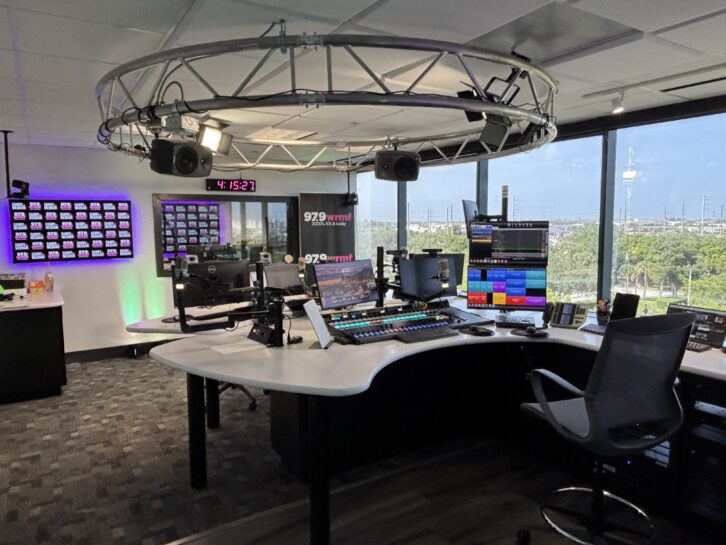
When lightning struck Hubbard Radio’s WRMF(FM), part of a six-station cluster in the West Palm Beach market, it damaged their old Harris Vistamax router beyond repair.
“We had an existing WheatNet infrastructure for our WideOrbit network, so the decision was made to start the slow studio migration to it,” said Chief Engineer David Brown.
“The No. 1 station in the market is our WRMF signal, with ‘The KVJ Show’ leading, so it was logical to start there.”
The old studio, he said, was small, dark and cramped.
“We’ve been in this building for over 20 years. We are located in the Northpoint Executive building on the fifth floor with a view towards the coast and downtown West Palm,” he continued.
“I wanted to maximize that view. I wanted big, bright and roomy. We took one small production studio at the end of our ‘studio row’ and two offices next to it to create one large studio and one smaller producer’s studio. In total we have 11 studios, including production, on air and a voicetrack/podcast room.”
The project was completed in mid-2025.
Brown led the work and did the studio layout and design. Integration services were provided by RadioDNA, with cabinetry by Studio Technology. Wheatstone was the primary provider of consoles and studio hardware.
“I’ve slowly been swapping out our hodgepodge of microphones in the overall facility to Neumann BCM 705s, so we continued with that process,” he said.
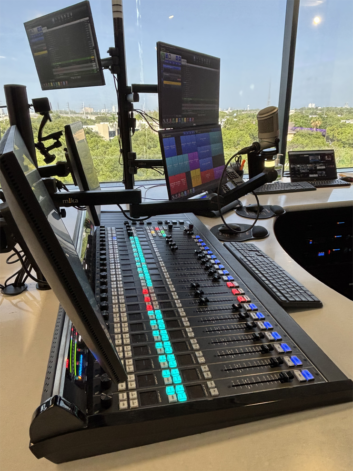
Multiple monitors near at hand and easily movable.
Support equipment was provided by SCMS and Broadcasters General Store. Insoft supplied and installed an HDVMixer video system.
WRMF’s transmission facilities and a secondary site are located in Wellington, Fla., with a tertiary site in Lake Park. All sites use Harris CD Link or Moseley SL9003s for over-the-air STL, Intraplex units for dedicated fiber and Comrex BRICs for the redundancy.
“We use a variety of transmitters: GatesAir FAX40s, a couple of Nautel NX Series, a GatesAir Flexiva 3DX50 and our newest, a Nautel GV2 40 kW on our WMBX signal,” he said.
Live and local
Brown said that “live and local” matters to Hubbard. “This project reflects that, a studio for real-time use and for real people, lots of space, countertops and storage.”
The cabinetry includes a guest microphone location just to the left of the main console, where someone can simply walk in the door and “have a chat” quickly and easily, with no need to go to one of the more “formal” mic positions.
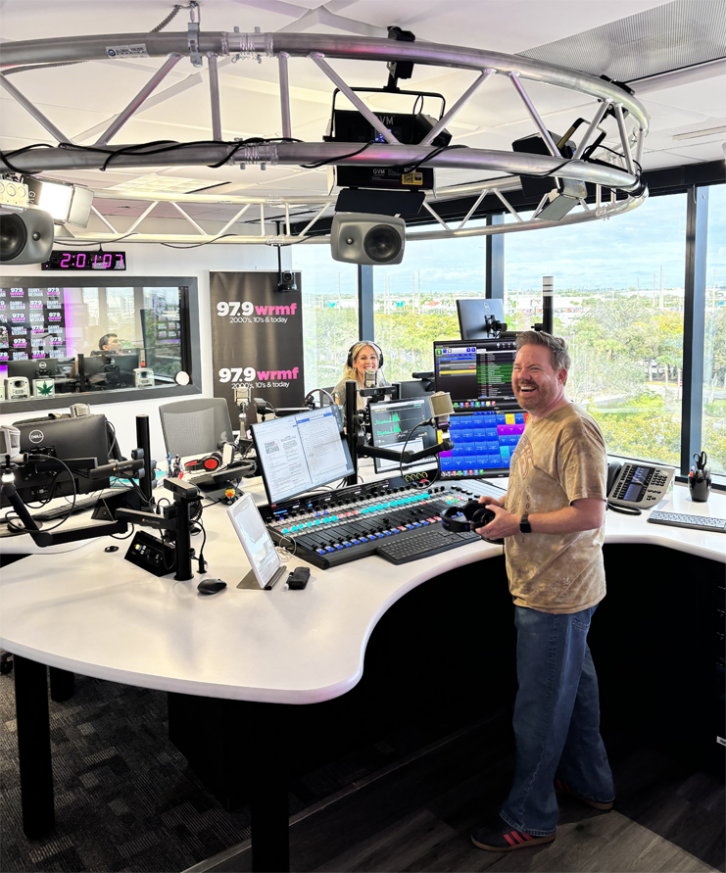
Danny Meyers, right, and Meghan Lane work an afternoon shift in the new room.
Studio flexibility is enhanced by digital branding using Amazon Signage sticks. “We can reconfigure the studio to brand any of our products quickly.”
Asked what made the job stand out, Brown replied, “It was special to me to be allowed a blank slate, no predefined layout, console format or equipment list. We built what our local people wanted, needed and envisioned without any corporate demands or input.”
He added, “It’s interesting to note that how much the video portion of the product affected the studio construction. With numerous fixed shot and closeup HD cameras, the lighting and camera shot angles became a consideration.”
A noncom FM station in central California has lost its license for sitting silent for more than a year and/or for operating from the wrong location.
The FCC Media Bureau has sent the notification of cancellation to Peace and Justice Network of San Joaquin County, licensee of KVSJ-FM in Tracy, Calif., led by Richard Blackston.
“[T]he Media Bureau gave [the] licensee several opportunities to demonstrate that the station operated with authorized parameters and without gaps of 12 months or longer, but licensee failed to do so,” the bureau wrote. It also dismissed an application to renew the license and another for minor modification.
Timetable
The circumstances of this case date back nine years.
According to the FCC’s account, Class A station KVSJ lost its licensed transmitter site in 2017, after which it filed a series of requests for special temporary authority to operate at reduced power from temporary locations.
Most recently, in 2020, it had an STA to operate from the grounds of a local nursery. It also held a construction permit to build permanent facilities there.
But the station went silent in May of 2021, according to the FCC, and the STA and CP had both expired by late 2022 without the station filing for a covering license to reflect completion of construction.
In October 2021, the licensee did file a minor modification application that specified the same transmitter site as the 2019 permit, and it requested an additional STA to operate from the site of the 2020 STA. But both eventually were dismissed.
Meanwhile after a year had elapsed since the station went silent, the FCC sent a letter of inquiry, but it said the station gave only a partial response and did not provide enough information to demonstrate that it had resumed operation with authorized facilities.
Then in March 2023, the station filed an issues/programs list in its online public inspection file in which it wrote that it “continued broadcasts under pending temporary authorization after completing major construction and program tests” under the 2019 CP.
Soon after that, the Enforcement Bureau observed a signal on the station’s 89.5 frequency from the grounds of the nursery.
In another communication in early 2024, the station told the FCC it had been operating almost continuously since November 2021. In a subsequent online public file document, it stated that it was airing broadcasts of automated programming on a regular basis.
In December 2024 the station applied for a license to cover the expired CP; it said then that it was operating under program test authority. The next month it uploaded more issues/programs lists in which it indicated that it had been broadcasting since October 2021, though at reduced power.
The Enforcement Bureau monitored the station again in February 2025 and found that the station was transmitting an unmodulated carrier signal.
In May of 2025 the Media Bureau sent another letter of inquiry. It asked for explanations and documents to determine dates of operation and silence, the use of authorized/unauthorized parameters and other information. It warned that failure to respond would result in loss of the license.
The station replied in writing, but according to the commission it did not answer the questions.
“Licensee appears to be arguing that, but for bureau delays in taking action on the 2021 STA request and its request to withdraw that minor modification application, the station’s operation from a location at the nursery would have been authorized either pursuant to STA, program test authority or a license such that the station would not have been silent or operating from an unauthorized location for 12 consecutive months at any time after that date,” the commission wrote.
The Media Bureau gave the station more time to compile and submit documentation but hasn’t heard anything since August of 2025.
Outcome
Now the Media Bureau has ruled that the station has been silent and/or operating from an unauthorized location for more than 12 consecutive months, which means its license has died.
“We have enough information before us to determine that the station was either silent or operating from an unauthorized location for years and thus its license terminated.” It added that equipment tests or “dead air” is equivalent to silence.
The bureau also rejected claims putting the onus on FCC staff for delayed processing of the minor mod and a later STA.
“Staff delays or inaction do not bear on licensee’s failure to operate without authorization. … That those applications were pending for an extended period of time does not change the fact that licensee operated from an unauthorized location for years.”
And the bureau said that even if the license had not expired for the reasons above, it would have dismissed the renewal because the licensee failed to respond properly to two letters of inquiry. The FCC said those “brief responses are patently inadequate, failing to provide any of the requested documentation and ignoring almost all of the inquiries.”
Two FCC orders issued this month provide some insight into how broadcasters should communicate with the commission if they want to take EAS equipment offline to move it.
Section 11.35 of the rules requires EAS participants to ensure that their equipment is “installed so that the monitoring and transmitting functions are available during the times the stations and systems are in operation.”
In the first order, the FCC’s Public Safety and Homeland Security Bureau granted a waiver to Fort Myers Broadcasting in Florida for three radio stations that FMBC is relocating.
FMBC told the FCC that it would need to “to uninstall, pack, move and reinstall the EAS equipment” and that the stations would not be in compliance for up to two hours.
It said its new location “is better protected from flood risk” and said a limited EAS outage to move the equipment was unavoidable. It said the harm would be minimal because no other stations rely on its EAS signal; relocation would not occur during a scheduled test; and the company would not proceed if there appeared to be any risk of an emergency event.
Then in a separate but related order, the FCC granted a similar waiver to Sun Broadcasting Inc. to allow it to move EAS equipment for four of its own stations from the same location.
Sun operates under a shared services agreement with FMBC in which Sun rents space and FMBC maintains Sun’s EAS gear. The FCC said OK to those four stations but declined a waiver for two more because Sun didn’t supply enough information. It said Sun could resubmit. (You can read that order here.)
As a side note: FMBC and Sun both pointed out that EAS participants are allowed to operate without alerting equipment for up to 60 days pending repair or replacement of defective equipment. But in its orders the FCC emphasized that the exemption does not apply to the relocation of functioning EAS equipment. “Simply disconnecting EAS equipment from operation does not make it defective,” the bureau wrote.
The FCC staff also noted that Sun filed only three business days before the date of its requested relief. “While the bureau appreciates that Sun sought to conform its conduct with the rules and encourages similarly situated EAS participants to seek a waiver if circumstances require, the bureau urges parties to do so as far as possible in advance of their expected need for relief to afford the commission sufficient time to consider such requests.”
In late 2023, the boards of directors of Rhode Island PBS and The Public’s Radio (formerly Rhode Island Public Radio) officially voted to merge their operations. In July 2025 the unified organization changed its name to Ocean State Media.
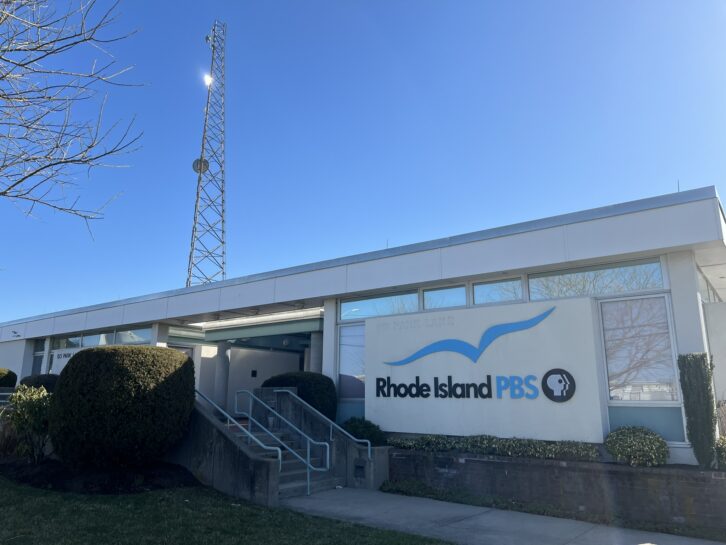
As part of the merger, the radio operation moved from historic Union Station in downtown Providence, where it leased space, and relocated to the Rhode Island PBS studios about four miles away.
Exterior of the TV production facility, including STL tower, prior to the Ocean State Media rebrand.
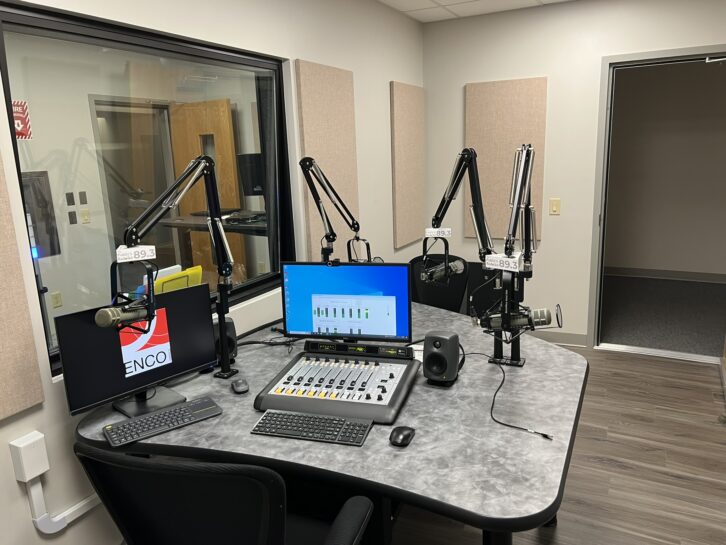
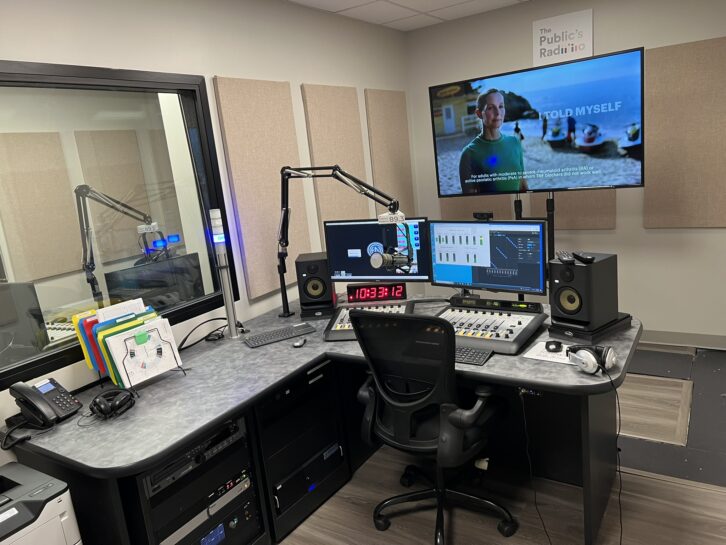
The work entailed construction of a new main studio and a multipurpose room for backup, editing and talk. It would involve turning two purpose-built 1990s TV audio production suites into effective radio studios.
The project also involved the installation of TOC and air chain equipment in the active RIPBS Master Control as well as new paths for the STLs, integration of ENCO software, hardware upgrades and the construction of new networks.
Karl Voelker, recently retired CTO of WBUR in Boston, was retained by RIPBS on contract as the project manager. He was instrumental in organizing the construction, the network building and STL reconfiguration and hiring contractors to complete the project.
“Aesthetics were not a major consideration in this rebuild,” said Rob Bertrand, partner at Inrush.
“The heart of this story is not about a fancy new facility or exceptional new features. It is a modern AoIP facility that, within a compact pair of studios, provides the flexibility to support a well-respected regional radio news and talk service. It used existing real estate not only for the studios, but also for the TOC.”
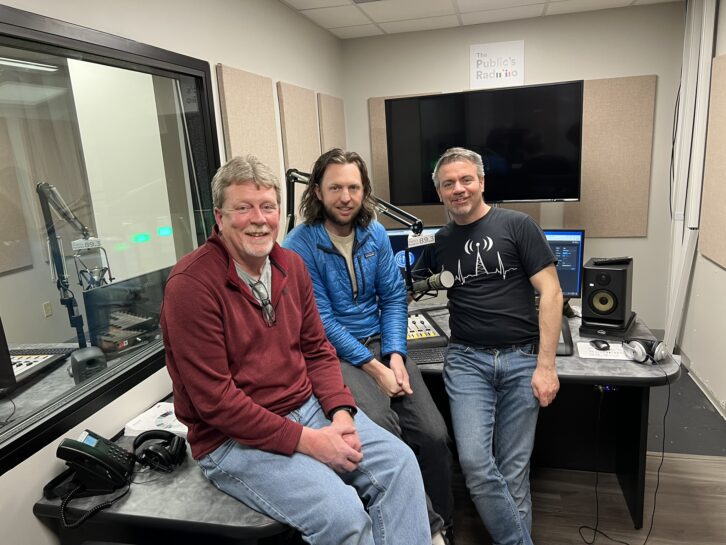
Project Manager Karl Voelker, Inrush SVP Cameron Boswell and Inrush CEO Rob Bertrand pose just after bringing the new facility to air.
He said time, cost and available space were key drivers. The studio integration work was done on a tight three-week turnaround, preceded by a period of planning and light renovations.
“Many organizations wait for the stars to align perfectly before committing to a merger like Ocean State Media accomplished. However, even before the pressures of 2025 with the CPB funding rescission were known, the folks at OSM were focused on getting the Rhode Island PBS and The Public’s Radio teams all under the same roof as soon as reasonably possible.”
He said Ocean State Media worked to balance form and functionality as well as the aggressive timetable.
The specifics
The radio network is built on a Telos Livewire system and includes Axia StudioCore engines, IQ consoles, xNodes, Pathfinder controller and iPort multi-codec gateways. The compact studio build benefits from virtualized technologies such as switching mechanisms that exist within Axia Pathfinder and an airchain facilitated by full management by AoIP architecture. The project included the introduction ofan easy-to-use graphical studio switching mechanism to meet the needs of less-technical users.
Ocean State Media’s multipurpose radio production studio.
Its equipment complement includes EV RE20 mics, Yellowtec Mika arms and lights, OC White arms, Comrex codecs, APT WorldCast STL gear and Inovonics tuners. Studio Technology provided the cabinetry.
Project Manager Karl Voelker oversaw some upgrades to the walls, doors, floors and windows of these spaces. However, the physical footprint of the rooms did not change.
Because automation audio can be easily routed away from the local consoles, freeing up both studios, either room can be used for any purpose during pre-recorded or network programming.
“This approach is becoming much more common where the budget or the space doesn’t allow for separate voice tracking booths, edit rooms and talk/podcast studios,” said Cameron Boswell, the Inrush SVP of Integration and Systems Engineering.
“This requires intentional furniture design choices and special attention to tabletop layout. You need to have visible screens for your automation or editing software while maintaining open sightlines and comfort for interviews etc,” said Boswell.
The new Ocean State Media radio studio occupies what had been a TV audio editing room.
There is also accommodation for future video installations.
Behind the scenes, Bertrand said OSM was able to reuse surplus rack space in its TOC, space left vacant after the HD transition years ago. This also meant that there was ample HVAC capacity and an appropriate environment for the air chains, network and IT equipment, as well as backup power from an existing generator.
They were also able to utilize the existing TV STL tower onsite. A small, cost-effective second master UPS was added.
Up the hill
To reach the transmitter of flagship station WNPN in Newport, the radio studio’s output is hopped first to the Omni Providence Hotel downtown via 5 GHz Ubiquiti Litebeams and then to the transmitter site via a licensed 11 GHz shot utilizing SAF Tehnika radios.
Engineering consultant Aaron Read of L&R Broadcast Services erected the initial link during his tenure with Rhode Island Public Radio and assisted the project team with a new first hop from the Rhode Island PBS studios in place of the link from the former downtown location.
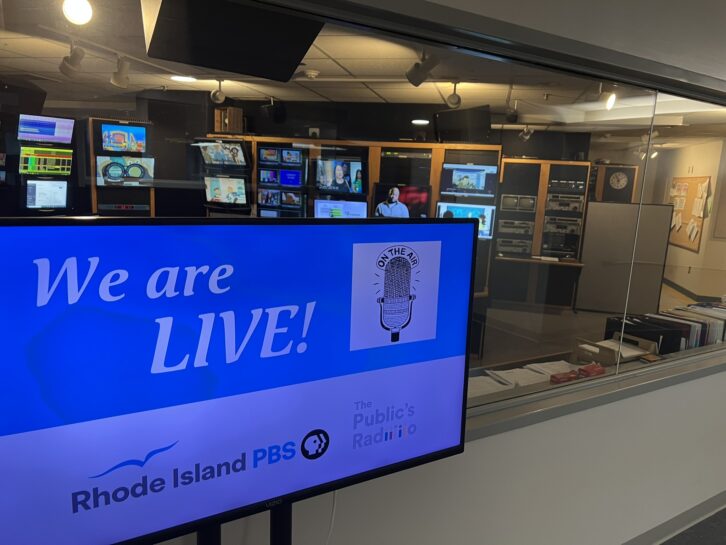
A view from outside of TV master control. The monitor proclaims that operation of the merged Rhode Island PBS and The Public’s Radio is now live from the production facility.
Audio traverses these IP links via WorldCast APT codecs, while backup is provided via Comrex Bric-Links and terrestrial ISP connections.
Station WNPE(FM) in Narragansett Pier is fed via ISP with WorldCast APT codecs. The transmitter for WPVD(AM) in Providence is fed via the Telos iPort. The latter site also provides a backup satellite downlink, which had been the primary satellite downlink until last summer.
OSM’s FM translator sites are fed via Inovonics Aaron FM rebroadcast receivers.
Extra benefit
As part of the overall merger, an abandoned TV satellite downlink dish at the studios was repurposed to become the new main downlink for NPR content.
Prior to that, the downlink was at the AM site and the station used a pair of Telos iPorts to traverse the public internet to deliver the content to the studios. While this was workable, it made sense to move the downlink to provide walk-away simplicity without the need to consider the impact of firewall updates or other network changes.
OSM CEO Pam Johnston is interviewed by morning host Luis Hernandez in the multipurpose production studio on the first day at the consolidated facility.
Bertrand added that given the short remaining lifespan for satellite delivery by the public radio satellite system, no one was advocating a substantial investment in a new dish and related hardware.
“Being able to repurpose an existing dish that hadn’t been used in over 20 years was a big win, an unexpected bonus of the radio station moving in with the TV station.”
OSM’s new Director of Engineering RZ Mall hails from a TV background and is responsible for the overall operation of the combined TV and radio stations. To assist RZ with this broad set of responsibilities, Inrush is providing 24/7 remote support of radio technical operations.
“As public media grapples more and more with its future post-CPB, it is likely that more PBS and NPR member stations will choose to merge or at least move in together,” Bertrand believes. “The folks at Ocean State Media were among the first to prove that with some creativity and flexibility, it’s possible to achieve substantial savings in ongoing operating costs without compromising quality of content, which means more budget can be put toward the mission of audience service. We’re proud to have played a small part in helping them to achieve their vision.”
Public Media Infrastructure, the new entity that hopes to play a growing role in supporting the infrastructure of public media stations, has named its board of trustees.
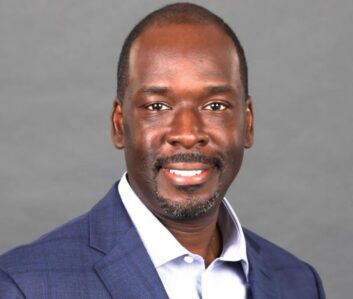
Its chair will be LaFontaine Oliver, executive chair of New York Public Radio.
As we’ve reported, PMI was launched in November by American Public Media Group, PRX, New York Public Radio, Station Resource Group and the National Federation of Community Broadcasters.
It received a five-year, $57 million grant from the Corporation for Public Broadcasting, one of CPB’s final acts.
“Each of these organizations already provides services that stations depend on today,” PRI explains on its website, “including PRX’s Dovetail and Exchange; APMG’s state and national services; NFCB’s direct support to community and Tribal stations; SRG’s research and convenings; and NYPR’s national programs and distribution network.
“PMI brings these capacities together under one roof so that stations can count on reliable, universal and affordable distribution services while benefiting from a coordinated roadmap for adoption, innovation and sustainability.”
Among other things PMI has said it plans to unify the existing help desks of PRX, NFCB and APMG into “a coordinated support pathway.”
The board’s first members are Anni Caporuscio, general manager of KKCR Community Radio in Kauai, Hawaii; Mariana Robertson, general manager of KCAW Raven Radio in Sitka, Alaska; José Martínez-Saldaña, co-executive director of Radio Bilingüe in Fresno and Oakland, Calif.; Vijay Singh, CEO of Vermont Public in Colchester, Vt.; and Kenya Young, president and CEO of Louisville Public Media in Kentucky.
More board members will be seated later this year. PMI is being led for now by Interim Executive Director Bob Kempf.
In the board announcement, PMI said its broad purpose is “to strengthen and sustain the essential public services local stations provide to their communities by modernizing and providing shared technology, distribution platforms and data analytics systems powering the U.S. public radio network … PMI exists to ensure every station — large and small, urban and rural — can reliably and efficiently deliver content, reach audiences on every platform and thrive in a rapidly changing media environment.”
As part of Radio World’s latest ebook about trends in codecs, we asked a sampling of industry engineers and users for their perspectives on the evolution of codec designs and applications, from remote broadcasts to sophisticated distribution applications.
Some opted to focus on specifics of their favorite codec brands, others spoke more generally, but all gave insight into the many ways these solutions are serving radio today. Their comments are below, and you can read much more on this topic in the ebook itself.
“A trend that continues and is not a fad is the integration of transport codecs within the broadcast infrastructure via hardware or software that includes associated data, control and timing signals,” said Roz Clark, executive director of radio engineering at Cox Media Group.
“The traditional infrastructure of a broadcast facility continues to evolve, and the ability to add process-intensive capabilities such as PPM, audio processing and other functions to devices that once were designed for a single purpose is moving forward.”
A key requirement of this, Clark said, is to transport all associated signals — not just audio — on time, securely and reliably.
“Interoperability between the various systems and vendors is key to long-term success and to allow incremental upgrades within the broadcast plant to take advantage of capabilities and efficiencies.”
He said this topic is being addressed in the IEEE-BTSC Aggregated Content Delivery Link standard work currently underway. “The ACDL standard will formalize these requirements and others to ensure interoperability and an international standard to reference.”
How do today’s codecs avoid problems with dropped packets?
Roz Clark
“The use of multiple disparate network connections that can use the connections simultaneously to deliver the content is an important feature,” Clark said.
“Ensuring the last-mile connections on each end of the circuit uses different physical delivery is important. Network connections that only use physical media that are delivered over a cable or fiber fall victim to backhoe fade, while last-mile connections that are over-the-air such as 4G or satellite can fail for other reasons.”
By mixing these types at a location, risk can be minimized, and service is likely to survive complete outages.
At Cox, he said: “The use of IPL technology from GatesAir in links between studios and transmitters has opened up opportunities for us to enhance our operational resiliency. This technology takes the traditional point-to-point dedicated nature of an STL to a scenario where it becomes a multipoint-to-multipoint network of content distribution.”
That opens the possibility of flexibly feeding a tower site from alternate locations on demand as part of a BCP program. “If properly configured, the alternate site can maintain normal operations for the station for internal customers, as well as external customers including streaming audio, metadata etc.”
“It is no longer so necessary for a user to physically touch the box to make adjustments. You plug in power, network and maybe some local I/O in the field, browse in and go.”
The “box,” he noted, can be anywhere.
“All of the tech you need is built in, including AoIP and the latest public network protocols. Several popular brands have multiple codecs in one box, all accessed via a network for connection, control and audio — doing more with less, faster, better, cheaper, a better ROI for the expense of the device.”
Ed Bukont
Given that more functions in the air chain are now in software, how has this affected workflows?
“Air chains are generally static except for EAS and backup situations,” Bukont replied.
“By and large, software has made this harder for the installer but easier on the user. A faceless box can have multiple network ports, allowing secure connections to multiple sites while being controlled securely on a management port.
“Software, and how it integrates at different levels of the OSI model, can allow multiple users and vendors to interact on a common platform from the console, through processing, program delay, EAS, watermarking, STL, all the way into the transmitter, while maintaining a diverse set of reliable paths that may be divergent between content and control.”
Bukont said codecs and a variety of IP connection technologies are making it possible to merge studios while keeping a local presence that was not practical for many even 10 years ago.
“I am less concerned with minute improvements in audio quality that may be masked by background noise of an event. The real advances are in accommodating a diversity of paths via various technologies to create reliable connections with an acceptable fail-over.”
Links to data centers
Lamar Smith, VP and director of corporate engineering at Beasley Media Group, notes that the expansion in use of codecs in radio feels exponential.
“With the COVID pandemic we scrambled to get as many codec units as possible, from any flavor possible, to allow our staff to remotely work from home,” he said.
“They all served their purpose during that time, but surprisingly, they have continued to be a vital part of what we do daily.”
He said some have changed their purpose a little, but the remote connectivity has continued to be a vital part to all the company’s operations.
“We are finding the current trend being the use for STL replacements in place of our historical traditional 950 MHz gear and as a way of linking our studies to our data centers, transmitter sites and remote staff contributing to our programming.”
Smith said radio’s familiar tower industry faces a crisis. “It has become too expensive as a way to distribute our content. The delivery of audio to a transmitter site via ISP is a way of limiting the needs on towers for STL antennas.”
Lamar Smith
He said the use of data centers to distribute content to transmitter sites plays into this. “We may have a data center on the East Coast but feed content to transmitter sites on the West Coast.”
The need to create more and more multi-channel audio paths means software-based devices must be able to handle a number of paths versus an individual piece of hardware for each codec path.
“While the hardware handling a single audio codec path is still needed, with all the downsizing we have been going through, the data centers have demanded that we have server-based solutions that can handle a lot of traffic in a small footprint,” Smith said.
“That traffic is everything from the traditional algorithms — linear or ACC — as well as using SIP technology to accomplish the needs.”
Given advances in audio coding, DSP and wireless IP over recent decades, what improvements can still be made in the quality of audio delivered by codecs?
“Reliability and robustness are critical to the operation of our codec systems, and these areas need to be the focus of the manufacturers,” he replied.
“While we have seen massive improvements in reliability from our ISPs, inherent issues of the public internet cause short temporary interruptions as well as jitter and latency.”
The use of multiple ISPs to overcome these issues has proven to be effective, he said.
“But it’s my opinion that this is an area where we should and will see improvements as manufacturers continue to adapt to the needs of the industry and push for quality audio at near-real time delivery while overcoming public internet obstacles.”
Smith said that in one market, Beasley recently needed to move quickly out of a building that housed its offices and studios because the building was being sold.
“We quickly implemented a data center implementation that allowed the studios and offices to move within 60 days. Using ISP codecs as a way of linking the audio between temporary studios and to the transmitter sites was critical and made the move viable.
“While we have used the GatesAir IPlinks for years now, we have started implementing stream-splicing on our links that feed the transmitter sites across the public internet. We have done this using dual ISP connections such as a fiber provider and Starlink, for example,” he said.
“Sometimes getting dual ‘good’ ISP connections at the transmitter site is difficult, so we have even found success in implementing on the same provider with enough latency on the second path to overcome the failures of the provider. While this adds to the delay of audio going from ‘live’ to ‘on-air,’ we’ve all moved on from expecting real-time audio on the air years ago.”
Diverse connections
Randy Williams is chief engineer of media and technology company Learfield, which specializes in college athletics. Learfield deploys numerous Comrex codecs.
“The use of CrossLock or some type of SD-WAN technology within the codec allows two or more diverse IP connections to be installed,” he said.
“The codec unit will monitor the incoming connections and ‘switch/bounce’ to the IP source that has the best reliability and lowest amount of packet loss. This ensures connectivity without sacrificing missing audio bits or downtime.” (By default, the IP codecs aggregate all data connections, but Redundant Transmission mode can be selected.)
He said the codecs do well at avoiding dropped packets.
“By using CrossLock, the codec is placed into a VPN connection where it is managing two different network IP connections, similar to SD-WAN. While a connection is established and running, Comrex employs several error protection and concealment techniques and Automatic Repeat Request, which instructs the codec software to send redundant data, allowing the codecs to reconstruct or resend lost packets. These features are running simultaneously in live streams to reduce audio loss.”
David Tukesbrey
Learfield also has begun a systematic migration to a Wheatstone AoIP platform. “There are processing, compression and level adjustments inside the WheatNet blades or software applications. This is drastically reducing the amount of physical audio cabling that would traverse our building and also is replacing external hardware devices that used to perform the same or similar processes.”
He said Learfield’s Comrex IP rack codecs offer various algorithms for broadcast audio connections with AES digital audio inputs and outputs.
Also useful is the multi-stream feature available in Comrex codecs.
“By configuring a primary ‘main’ unit in multi-stream mode as the ‘encoder’ unit, as many as 10 other codecs can connect to the ‘encoder,’ providing the same quality audio and relay closures. Learfield has made up to 25 different codec connections in multi-stream mode if only using AAC-Mono as the common algorithm profile.”
Williams is looking forward to a recently introduced product called FieldLink. “Once it is proven in larger Division 1 football and NFL stadiums it will be a game-changer for Learfield. It is a dynamic WiFi Access Point codec that allows roaming field reports to connect via smartphone application and deliver high-quality, full-duplex audio to the producer in the press box or studio. This would eliminate the wireless microphone and IFB systems in use during large-scale sporting event productions.”
When it comes to doing remote broadcasts, field users tend to focus on the practical aspects.
David Tukesbrey is sports director at Hub City Radio, a group of FM, AM and HD multicast stations in Aberdeen, S.D. He uses Tieline gear in his play-by-play work.
After audio quality, he said, “The most important thing for being user-friendly is a tad bigger screen, so I can get connected to the station. I also like that fact that the codec is versatile in terms of size and weight. It doesn’t take up a lot of space on game day on the desk or table that I use.”
For Tukesbrey, a codec fills many needs.
“I do all my coaches interviews on it, with an SD card for storage, and it’s so versatile. I’ve worked at radio stations where audio quality isn’t prioritized. When I’m calling play-by-play or listening on the radio to a game, I want to hear and feel like I’m there. The codec provides that. And you click a few buttons and you’re connected. Getting connected via Ethernet is simple, and even via Wi-Fi is easy.”
“As more broadcasters move to using the internet for audio delivery, it is critical to consider codecs that can effectively handle multiple IP paths, using diverse NICs, and integrate stream-splicing,” he said. “This will minimize glitching and occasional dropouts that are inevitable on shared services, especially on wireless/cellular and satellite internet connections.
Jeremy Preece
“It is also helpful to choose a unit that can provide detailed stream performance and alarm reporting via SNMP, etc., as unrecovered packet losses and similar problems can affect listener experience while going unnoticed on standard audio monitoring hardware.”
Audio codecs have been available as software for some time, he noted, so the technology is well tested in that format.
“Using software codecs can greatly simplify distribution from a studio to multiple tower sites and your station’s website and mobile apps. Codecs can also run in the cloud, reducing on-prem hardware and reducing failure points.”
Preece said hardware codecs still have a place, but software models should not be overlooked if redundancy and scalability is a consideration.
Given advances in audio coding, DSP and wireless IP over recent decades, what improvements can still be made in the quality of audio delivered by codecs?
“While it is possible to deliver decent audio at lower bitrates than ever before, broadcasters should budget for the bandwidth to use the highest bitrates possible,” he continued.
“For primary audio paths, choose a codec that can use modern algorithms — AAC+ etc., never MP3 — and whenever possible use 192k or higher. Even better, use microMPX, which provides exceptional audio quality, with stereo pilot and RDS, at bitrates comfortably as low as 384k.
“If your link budget allows, consider going linear/uncompressed to maximize quality. For emergency or cellular modem backups, that’s a good place to sacrifice quality for reliability and cost-efficiency.” And when he’s in the market for a codec, Preece bases the purchasing decision on the project goal.
“A platform for a multi-booster FM+HD SFN system will involve a lot more complexity than a basic IP-STL,” he noted.
“The first step is to accurately identify your needs: Are you sending analog L/R audio, AES, AES192 or MPX? What about metadata, E2X or other IP data services? Consider IP redundancy: Do you need a second or third built-in NIC or will one suffice?
“If HD Radio content is in play, give careful consideration to the delivery method and where the HD equipment is placed. In some cases, sending I2E or E2X from the studio to a tower site may be more cumbersome than simply encoding three or four AES audio streams with a separate IP link for PAD. If you’re not sure what the best solution is, reach out to a sales rep or dealer and ask them to walk you through options. There may be five ways to do it, but only one that is truly the best for your scenario.”
Comment on this or any story. Email radioworld@futurenet.com with “Letter to the Editor” in the subject field.
Read more expert comments about codec designs in the free ebook.
The report takes heart from the trend line for digital. Its findings are against a backdrop of revenue totals that are much smaller than 10 or 20 years ago.
The report finds that radio’s digital advertising reached a record in 2025 of $2.3 billion. It also states that digital sales accounted for 24.4% of total revenue nationwide.
That would put overall revenue of the U.S. commercial radio industry last year at $9.4 billion.
For context, in 2005 the radio industry’s revenue was $21.5 billion, according to Radio World’s reporting of RAB data at the time. In 2016, the year RAB said digital ad revenue first surpassed $1 billion, radio’s total that year was about $17.4 billion. (Those were not Borrell-based numbers but give a sense of how the radio revenue picture has shrunk.)
“Borrell forecasts digital revenue will grow slightly faster this year — 9.5% versus 7.8% in 2025 — reaching $2.5 billion,” RAB states in the new release.
“The average station generated $511,873 in digital revenue in 2025, and the average market cluster made $2,263,431.”
RAB President/CEO Mike Hulvey was quoted saying, “Advertisers are recognizing the digital services and products that exist as part of broadcast radio’s marketing toolbox and are taking advantage of it.”
According to RAB, the report finds that “strong and sustained digital growth has largely offset declines in core radio advertising. Since 2022, digital revenue has grown at a compound annual rate of 8.3%, while core radio advertising has declined 2.2%.”
It quoted Borrell Associates CEO Gordon Borrell pointing out that three-fourths of radio buyers are not yet taking advantage of radio’s digital products.
Marketron CEO Jimshade Chaudhari said, “Digital is now the primary driver of revenue stability and growth in radio.”
Another finding: Local advertisers value radio’s “branding power and return on investment,” but many view it as difficult to measure.
“As a result, budgets are flowing toward media that combine radio’s branding with accountability, particularly streaming audio, streaming video and digitally measurable campaigns,” RAB stated.
The report also found rapid adoption of artificial intelligence tools in radio sales organizations but said many managers express concern that AI-driven media recommendations may not favor radio “unless stations strengthen their digital positioning and measurement capabilities.”
The report, which is available to RAB members, is based on ad revenue data from approximately 3,800 radio stations; surveys of advertisers, agencies and radio managers; and market-level digital revenue estimates in 513 U.S. markets.
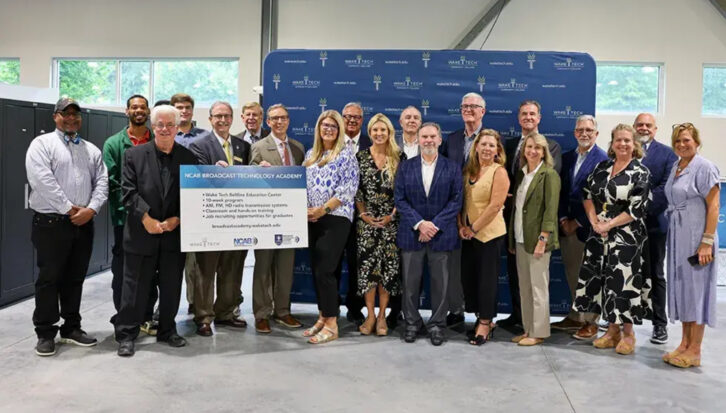
Participating students pose with representatives of Wake Tech and the North Carolina Association of Broadcasters.
“There is an immediate need for radio frequency engineers throughout our state. The Broadcast Technology Academy is providing a direct pipeline of talented and well-trained individuals to fill that need.”
Those are the words of Mark Mendenhall, president of the North Carolina Association of Broadcasters, as reported on the website of Wake Tech Community College.
The NCAB partnered with Wake Tech to develop the 10-week academy “to prepare individuals who are technically minded, mechanically inclined or electrically inclined for careers as broadcast technicians.”
Tuition, fees and books are covered by the state association. Additional funds are available to help with living expenses and transportation.
The program provides 240 hours of instruction and bench work, eight hours per day, three days a week, for 10 weeks. The school has a lab equipped with modern Nautel solid-state AM and FM transmitters, as well as legacy CCA and Harris radio gear. TV equipment is planned.
The syllabus was written by retired engineer Jerry Brown, using the SBE Engineering Handbook as the course’s textbook; and as the program took shape, Brown also emerged as the instructor and ambassador for the academy. Guest lecturers complemented his teaching.
Students learn about AM, FM and HD radio transmission systems, including transmitters, antennas, transmission lines, remote control systems and program delivery systems.
Thirteen recently completed the program and subsequently passed the Society of Broadcast Engineers Certified Broadcast Technologist exam. They now should be able to troubleshoot and repair legacy and modern transmission systems.
I asked Jerry Brown if he had encountered any surprises during this first session.
“We found out early on that you need to do a refresher on basic physics and advanced math, such as linear algebra, geometry and an overview of calculus — foundational things when you get into antennas and electromagnetism and those sorts of things,” he said.
“We were able to adjust quickly and we’re addressing this in the course rework.”
Brown said that the program seems to be a good fit for today’s technically minded young people.
“STEM students find a field that allows them to do everything: computer science, IT, engineering, electrical, mechanical.”
And what a great model this is. I hope more state broadcast associations and technically oriented educators will emulate it.
The next academy at Wake Tech is planned for next summer. More info is at the school’s website.
Other schools on the list, according to the SBE website, are Bates Technical College in Tacoma, Wash.; Cayuga Community College in Auburn, N.Y.; and the AFRTS Technical Training Program at the Defense Information School in Fort Meade, Md.
The society is on the lookout for other schools to join its Certified School list, and it has a school sample curriculum to assist schools in creating a broadcast engineering degree program.
Radio World welcomes letters to the editor on this or any story. Email radioworld@futurenet.com.
Station WKXM-FM in Winfield, Ala., was hit with a cyberattack on its transmitter on Thursday, according to the Alabama Broadcasters Association’s Engineering Services arm.
“Someone gained access to their transmitter, which had RBDS as part of the transmitter software,” according to an email from ABA.
“The intruders took over the data and displayed some very offensive wording.” The attack did not affect program audio itself.
“The station engineer was able to gain access into the transmitter and turned off the RBDS data transmission. It appears the intruder gained access using the factory installed login information and changed the displayed data and the login. The station is working with the transmitter manufacturer to correct the factory login information.”
ABA Director of Engineering Services Larry Wilkins concluded: “This is another warning that stations should be using secure firewall protection in front of all their equipment even the transmitter itself!”
Text has been updated with additional information.
Would you like your station call letters to be WKRP?
That famous call sign currently is held by a low-power FM station in Raleigh, N.C. And while the station isn’t planning to give it up, it would be willing to share if the price is right.
The licensee issued this announcement:
“Oak City Media, a non-profit organization that’s operated a real WKRP for over a decade, is announcing a process by which certain other broadcast stations can share this nostalgic call sign in accordance with FCC regulations, allowing simultaneous use by one AM radio station, a full-power FM station (as ‘WKRP-FM’), full-power television station (with the suffixes ‘-TV’ or ‘-DT’) and one low-power TV station (using the suffixes ‘-CD’ or ‘-LD’).”
Executive Director D.P. McIntire wrote: “For five years, ‘WKRP in Cincinnati’ was the fictional, often dysfunctional setting behind one of the most popular situation comedies in the United States. Originally airing on the CBS television network, immediately after its network run it became a syndication staple for stations, and episodes can still be found on the air in many markets; as can episodes of a revival of the series in the early 1990s.”
He invited broadcast licensees to email him for an info packet “explaining the process, timelines and requirements.”
“At the end of this process, one station in each of these categories will receive authorization to use the WKRP call sign along with Oak City Media,” according to the release.
“The organization meanwhile intends to use proceeds generated through the process to help a number of newer non-profit groups build the ‘third generation’ of LPFM radio stations.”
FCC rules allow applicants to request call signs of their choice if the combination is available.
They state: “Where a requested call sign, without the ‘-FM,’ ‘-TV,’ ‘-CA,’ ‘-DT,’ or ‘-LP’ suffix, would conform to the call sign of any other non-commonly owned station(s) operating in a different service, an applicant utilizing the online reservation and authorization system will be required to certify that consent to use the secondary call sign has been obtained from the holder of the primary call sign.”
McIntire told Radio World that Oak City Media receives several approaches each year from parties interested in obtaining or sharing the call letters.
“We do not want Oak City Media’s involvement in this process to violate either FCC regulations or IRS rules governing 501(c)(3) organizations,” he said, so they’ve created a 501(c)(3) non-profit called IBC Inc., short for Independent Broadcast Consultants.
“Oak City Media will conduct the selection process for whom shares the WKRP call sign,” McIntire said.
“Those who ‘win’ will donate funds to IBC, which in turn will oversee the funds and disburse them to ‘third-generation’ LPFM stations in need until we’ve exhausted what we generate.”
He said the effort has no stated goal amount, “simply to get the most we can so as to provide the biggest ‘pay it forward’ we’re able.”
(See a list of historical uses of WKRP at FCCInfo.com.)
Do you ever find yourself feeling a little blue about the radio industry? Spend a few minutes reading Dave Sturgeon, especially if you work on the commercial side of our biz.
“Radio is the only medium that still respectfully assumes you’re busy,” Dave wrote recently in a LinkedIn post.
“Every other medium today demands your attention: Watch this. Click that. Don’t skip. Stay till the end.”
Radio, Dave wrote, does the opposite.
“Radio assumes you’re living your life: Driving. Working. Making dinner. Running a business. Thinking.”
And instead of interrupting you, he wrote, it shows up alongside you.
“That’s not a weakness. That’s radio’s superpower. Because the people with the least time are usually the people with the most responsibility. Decision-makers don’t sit still. They move.
“Radio meets them in motion. It doesn’t fight for attention — it earns trust through repetition, familiarity and presence. Day after day. Week after week.”
In a world obsessed with “engagement,” Dave concluded, radio still understands something fundamental: Busy people buy things.
“That’s why radio doesn’t need to be flashy. It needs to be consistent. Clear. Human. The more demanding media becomes, the more valuable a medium is that respects your time and attention.
“Radio doesn’t nag. It accompanies. If your advertising only works when someone stops what they’re doing, it’s built to interrupt — not influence.”
I liked that post and asked for his permission to share it with you.
Dave is the founder of Radio TV Agents; he has spent more than four decades as a morning show host, market vice president, director of sales, trainer and public speaker.
He describes himself as “a Canadian by birth and Californian by residence” who “still believes in coffee-fueled morning shows, a great jingle, and the magic of live, local radio.”
I asked him to share a few more of radio’s superpowers with us for this column. He sent this list:
Radio is free
Radio ads are unskippable
Radio doesn’t watch you back or follow you around, it respects your privacy
Radio is word-of-mouth advertising on steroids
Radio is the original platform for social media influencers (personality endorsements)
Radio audio entertainment and advertising is “crowd-delivered” — thus radio’s ultra-affordable CPM
Audio triggers emotions: Emotions make memories and branding stick
Digital is delivered one-to-one. Radio’s crowd delivery makes all digital advertising work better
Radio isn’t just music, it’s companionship — music discovery on radio is random and exciting
When disaster strikes, cable, Wi-Fi, phone service and all other utilities stop working, radio is the last remaining medium that keeps people connected.
Radio is the soundtrack to your daily journey — the most used in-car medium where people are on their way to spend money
I love Dave’s boulder-smashing energy. You can follow him on LinkedIn. His book is sold on Amazon, and he has a podcast called “The Truth About Radio.” You can also hear an interview with him on The SoundOff Podcast at www.soundoffpodcast.com/dave-sturgeon.
No burning decisions specifically about radio broadcasting appeared on the FCC’s January meeting agenda today, but the commission took several actions of interest.
It unanimously adopted an order to enhance unlicensed use in the 6 GHz band for a new product category called “geofenced variable power” or GVP devices that can operate both indoors and outdoors at higher power than previously authorized devices.
“This action enables consumers to benefit from supercharged Wi-Fi and a new generation of wireless devices, from AR/VR and IoT to a range of innovative smart devices,” it said.
We reported on this pending action earlier this month. The proposal has been pushed by tech companies Apple, Broadcom, Google, Intel, Meta, Microsoft and Qualcomm. In 2024 the Consumer Technology Association told the FCC it supported the idea.
Chairman Brendan Carr said that at the recent CES show, “America’s tech industry debuted Wi-Fi 8 routers and chips for launch as soon as this year. This next generation of Wi-Fi will offer blazing fast speeds and massive bandwidth with more efficient power, higher throughput and better client-to-client communications.”
He noted that in 2020 the FCC opened 1,200 MHz in the 6 GHz band for unlicensed use. With this action he said the FCC brings more unlicensed spectrum to the marketplace “and [will] allow innovators to supercharge existing unlicensed bands. … With higher power and outdoor mobility, expect more compelling AR/VR, short‑range hotspots, automation and navigation.”
Gary Shapiro, the executive chair and CEO of the Consumer Technology Association, issued an enthusiastic statement: “Unlicensed spectrum is the foundation for transformative technologies like Wi-Fi, and opening more of the 6 GHz band will supercharge the next wave of innovation, including augmented reality, virtual reality and other game-changing applications.”
Foreign ownership
Separately and unanimously the FCC also codified foreign ownership review requirements.
It said the goal was to maintain strong national security review processes while providing clarity for foreign investment.
“The agency’s longstanding foreign ownership review has helped protect against national security risks when reviewing increasingly complex ownership structures for FCC license holders, namely broadcast, common carrier wireless, and aeronautical licensees,” it said in a statement.
“Today’s action codifies many of those processes to ensure its foreign ownership requirements are clear and consistent, and to streamline the review process.”
The rules codify the policies and practices that it says the FCC has developed over the last decade to review complicated ownership structures under its Section 310(b) rules.
Foreign ownership reviews for broadcast licenses are led by the Media Bureau.
Foreign adversaries
The commission also established new rules intended to create transparency about the control of licensed entities by foreign adversaries. Again the FCC was unanimous.
“Foreign adversaries have made clear their intent to probe and penetrate vulnerabilities across our communications ecosystem,” said Carr.
“We have seen this through cyberattacks like Salt Typhoon. We have seen it in the equipment pipeline, where foreign adversary‑controlled labs could attempt to influence the testing and approval of devices bound for the U.S. marketplace.
“We have seen it in the online marketplace, where millions of prohibited devices linked to foreign adversaries were being sold to American consumers. And we have seen it at the carrier level, where entities with concerning ties to foreign governments have sought to operate in U.S. networks despite clear national‑security risks.”
Carr said the vote “sets up a clear, risk-based reporting structure that requires entities to attest to whether they are owned by, controlled by, or subject to the direction of a foreign adversary.” He called it an agency-wide effort that “builds on a year’s worth of national security initiatives and establishes a uniform system for identifying foreign adversary control across all FCC licensees and authorization holders.”
The order places each license, permit or authorization into a series of schedules, based on a variety of factors including national security risk of foreign adversary control and reporting burdens, and it imposes reporting requirements about equity and controlling interests.
The FCC said, “Today’s action, as well as those spearheaded by the commission over the past year, including establishing the Council on National Security, will strengthen the security of U.S. communications networks by tracking many of the ideas laid out in the pending bipartisan Foreign Adversary Communications Transparency (FACT) Act led by Senator Deb Fischer and moving swiftly to protect national security.”
We will watch for announcements about the paperwork impact of these foreign ownership and foreign adversary rules on broadcasters.
We have more details about the FCC’s plan to invite applications for new FM translator construction permits for noncom educational stations in the reserved band, 88.1 to 91.9 MHz.
We reported yesterday that Chairman Carr had mentioned a planned vote in a blog post. The commission subsequently released the draft of the notice on which it will vote on Feb. 18.
The notice will direct the Media Bureau to begin work to open the filing window, the first of its kind for stations in the reserved band. Specific dates would come later.
Under the plan, an applicant would have to be the licensee or permittee of an existing NCE FM or noncommercial AM radio broadcast station or LPFM that the proposed translator would rebroadcast. The FCC does not plan to accept major modifications to existing NCE reserved band translators.
The commission also is proposing a limit of 10 applications nationally for each applicant (but four for tribal LPFMs and two for other LPFMs). But it also is asking for public comment on its proposed eligibility restrictions and caps.
“The commission has employed application caps or eligibility restrictions in prior reserved band full-service NCE FM windows and non-reserved band FM translator windows to promote efficiency, curb speculative applications and expedite the processing of applications and expansion of new service while preserving spectrum and future licensing opportunities,” it wrote in a summary sheet.
“For example, in both 2007 and 2021, before the NCE FM station filing windows opened, the commission sought comment on an application cap and subsequently established a limit of 10 NCE FM new station applications filed by an applicant during each filing window.”
It said the application limit was an effective safeguard and helped restrict the number of MX applications, prevented mass filings and allowed the FCC to process and grant thousands of new NCE FM applications. It noted that it also has imposed such restrictions in prior translator filing windows.
And as noted above, the FCC said that it will not accept applications for major mods to existing NCE reserved band translators. “An applicant seeking a major modification to an existing NCE reserved band FM translator station authorization may apply for a new station and, subsequent to commencement of operations with its newly authorized facilities, surrender its old station license.”
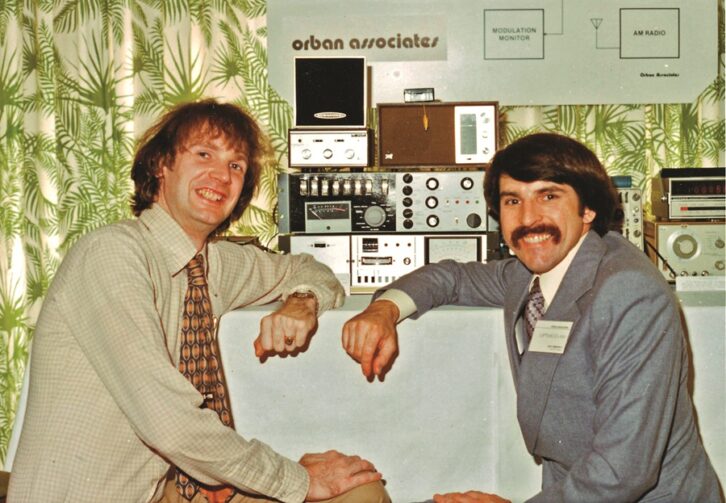
Bob Orban and John Delantoni pose with a new product in their NAB Show booth in 1977.
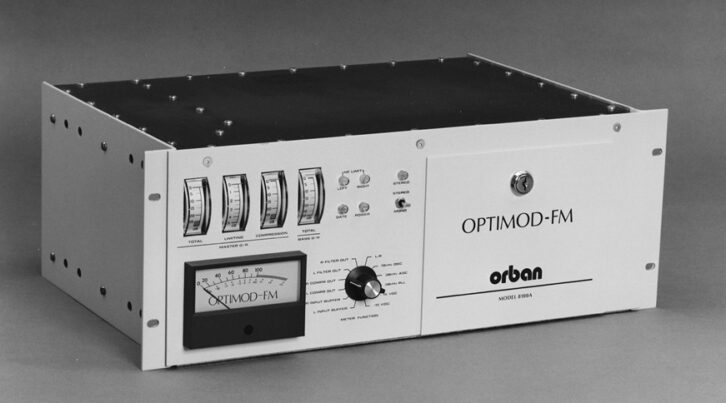
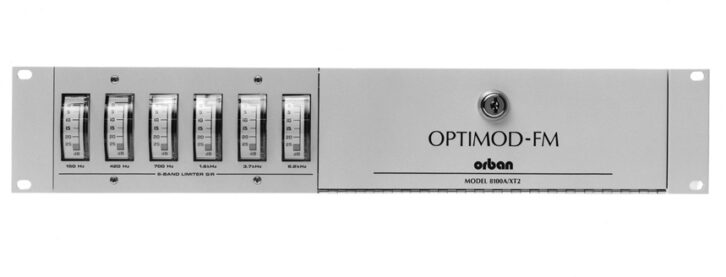
Orban’s first audio processor for FM broadcasting, the Optimod 8000, has turned 50. To mark the anniversary, Orban is sponsoring this series of interviews of Bob Orban in conversation with Radio World Editor in Chief Paul McLane. This is Part 3. (Read the earlier parts starting here.)
Paul McLane: When we spoke last, you talked about building on the success of the FM 8000 processor and getting into AM with the Optimod 9000. The early 1980s must have been a time of significant growth.
BobOrban: The 8000 had caused us to grow rapidly and gave us the luxury of being able to take our time in terms of product development. There was plenty of money coming in, and we didn’t have shareholders other than John Delantoni and me, so we didn’t have quarterly reports to answer to.
McLane: Tell me about the design process — was it basically you sitting down and thinking? Was there a team effort?
Orban: I did the engineering design work at the time, and we had a PCB layout guy. John Delantoni, who had worked in electronic manufacturing, was responsible for production design. I didn’t do PC board layout, I didn’t do mechanical design. I did the electrical design, and what today you might call the algorithm design — although, back then, that was synonymous with the circuit design of the product.
McLane: This is all before tabletop computing, surface-mount technology and DSP took off, right?
Orban: I was a very early user of computers. I learned programming in college, first Fortran and later Algol, so I had familiarity with the concepts even in the ’60s.
My first one really was a programmable calculator, the HP 9100, around 1969. Then in 1975 we were able to afford a Tektronix 4051, one of the first devices you might call a personal computer. It used a Motorola 6800 microprocessor and a Tektronix storage tube as the display. It was programmed in BASIC. So even though desktop computing really came on the scene with the IBM PC and Apple II, I’d been doing it since 1975 with this Tektronix device.
One thing that distinguished Orban from its competitors was the formal mathematical design process we applied to our products.
For example, we started serious “design for manufacturability” by doing sensitivity analysis. That’s where you do circuit analysis and determine the effect of component tolerances on the final behavior of the circuit.
If you look back at those old Orban analog products, you’ll see components with various tolerances. That wasn’t driven by cost, as you might think. It was driven by mathematical analysis of the circuit to determine which components were the most sensitive and required the tightest tolerances.
McLane: Was that unique among processing manufacturers of the time?
Orban: I can’t speak for others. CBS Laboratories had a very good technical team and I’m sure they had access to computing facilities, but I don’t think they were thinking of processing in the same sophistication that I was at the time, particularly regarding the filter design. They were thinking of gated compressors and peak limiters embedded in other parts of a conventional transmission chain.
McLane: Now tell me about the genesis of the Optimod-FM 8100A.
Orban: Well, I knew that we could do better.
Dave Hershberger, who was working for Harris, had come up with a clever overshoot compensation scheme for a new generation of Harris stereo generators, so I needed to do something to respond to that. At the same time, my invention of distortion cancel clipping, first used in the 9000, opened up a new opportunity for FM processing.
The big weakness of the 9000’s distortion cancellation was that it required analog bucket brigade delay lines. Those were fine for AM in terms of their noise and distortion performance, but they weren’t quite good enough for FM.
So one day I had the idea that instead of using these analog delay chips, I could use the main 15 kHz low-pass filter already in the FM processor as a delay line if I applied group delay correction to it.
That was another result of computer-aided design, designing the matched filters between the 15 kHz main low-pass filter and side-chain low-pass filter for cancellation. They had to be matched in magnitude and phase over the 0 to 2 kHz region. That’s something that could not have been done without the computational resources I had at the time. I wrote programs to do that.
Now we had distortion cancellation with high basic audio quality, a very clean signal path. That allowed me to do much more aggressive clipping than the 8000 had done, to rely much more on the clipper for high-frequency control, which allowed the 8100 to be substantially brighter.
Another influence was Mike Dorrough and the Discriminate Audio Processor, the DAP 310. There were also home-brew multiband processors out there.
The problem I had with a simple multiband processor was that if you were doing purist processing for, say, a classical or a jazz format, you wouldn’t necessarily want all this automatic re-equalization that happens with the multiband compressors of the time.
I came up with the idea of variable coupling between the main part of the compressor, which was above 200 Hertz, and then a base compressor that was below 200. To avoid bringing up high frequencies unnecessarily, the basic 8100 was not a three-band like the Dorrough, it was a two-band. Then the high-frequency limiter was separate, designed to control high-frequency overload due to the FM preemphasis curve, instead of just doing automatic re-equalization.
Then I came up with the frequency contour side-chain overshoot corrector, which was my response to Dave Hershberger’s clever design. But unlike his, it did not increase clipping distortion in the frequency range below about 5 kHz.
I applied for patents on a number of these things. Patents were an important part of our business strategy, to protect our intellectual property.
An amusing anecdote: I was testing a prototype of the 8100 on KSOL in San Francisco. The late Bill Sacks was responsible for one of the other Bay Area stations. Later, when the cat came out of the bag, Bill was quite ticked off. He said, “Boy I chased that thing. I could just never quite get there. So now you’re telling me that that’s what you were doing!”
Optimod-FM 8100A
McLane: How did the market launch go?
Orban: We subscribe to the IBM philosophy, which is that when you announce a product, you need to be able to deliver it pretty much the next day, otherwise it’s going to cannibalize your existing sales.
People tested them and that that the 8100As were sufficiently better than their 8000s that upgrade was warranted. The product was a very big success for us, in fact it’s the best-selling Orban processor in the company’s history.
We eventually sold something like 10,000 units over the years, and it stayed in production for I think 10 years.
McLane: For 8000 users, this was not a modification, it was a full replacement.
Orban: It was a replacement. You also now had a built-in stereo generator. And it had the same barrier strips on the back — you could basically disconnect the wires from your 8000, put the 8100 in the rack and reconnect the wires, and you’re in business.
McLane: Were you positioning it as a processor for all formats?
Orban: It was designed so that you could go to the purest end if you wanted to, but you could also speed up the release time and reduce the coupling between the master and base bands. It was also a very competitive rock and roll, pop music, urban processor.
McLane: Are we getting into the era of presets?
Orban: This was entirely analog, so it didn’t support presets. We suggested setups in the manual, but you had to go inside the box and adjust the knobs to the manual’s recommended settings.
There were a lot of consultants who had their own secret sauce; and because the peak limiting and distortion cancel clipping systems were so strong, people started putting processing in front of it again, as had happened with the 8000. One of the biggest successes was Glen Clark’s Texar Prisms. There were also Circuit Research Labs boxes, and a number of lesser players in terms of the popularity including the Pacific Recorders Multimax.
McLane: Did it annoy you that people were putting boxes in front of yours?
Orban: As long as their checks were good in buying the 8100, that was the main thing that I was concerned with!
By this time I had learned an important lesson for anybody doing processing: Don’t confuse your own preference with the preference of the wider audience. Different people have different preferences, and that’s okay, that’s part of life.
You can either go along and help them achieve those preferences the best they can, or you can be resistant. And being resistant is just foolish.
McLane: In 1984 you introduced the 8100A/XT 6-Band Accessory Chassis. Why was that necessary?
Orban: We saw that Texar was having a big success with the Prisms. We realized that there was an opportunity not only to make a much more multiband processor but to do it in a novel way that embedded itself into the circuitry of the 8100 and that exploited its existing distortion-cancelling filters, which of course, you couldn’t do with an external product.
I came up with the idea of multiband distortion cancel clipping, where each band has its own independent distortion cancelling. It occurred to me that, because everything but the clippers are linear, you can use the single distortion-cancelling filter for all of the bands, which greatly simplifies things.
I’d had experience with six-band compressors in the 9000 and the 9100 so we knew how to do it. We came up with a hybrid that plugged into the 8100A with an umbilical cord into a connector in the back, and you moved a few jumpers on the 8100’s printed circuit boards.
8100A units could be field upgraded to 8100A/1 status via the Orban RET-27 upgrade kit. It required soldering to the backplane and replacement of several PC cards. According to the XT2 manual, the upgrade could be expected to take about an hour, and the XT2 manual contains installation instructions for the kit.
When we got the 8100A/XT out on the market, some people pushed back against the tuning, so I did more work on that. I also discovered that it seemed to work better when the top-band compressor was controlled by the side chain of the band below the top band.
Those two modifications, along with additional tuning controls, became the 8100A/XT2, and it seemed to be exactly what the market was looking for. Again it stayed in production for a number of years.
Optimod-FM 8100A/XT2
McLane: What does the success of these products tell us about the radio marketplace of the time?
Orban: They wanted it louder, they wanted it brighter, they wanted it cleaner.
Those three requirements require tradeoffs. Usually when you push one, you get less of the other. Our goal was to offer a toolkit that allowed you to push that as hard as you possibly could, with the best compromise depending on your preference.
It was not up to me to dictate user or program director preferences. They knew more about programming than I did, and they did focus groups, they watched the ratings. I just provided them with the tools to realize what they wanted to do.
We wanted to serve any format, from the BBC doing classical music all the way to an aggressive rocker in the New York City market.
McLane: Meanwhile you were introducing products on the TV side.
Orban: The Optimod-TV 8180A, introduced in 1981, was basically an 8100 without a stereo generator.
Around the same time, CBS Technology Center, the successor to CBS Labs, had come out with their second-generation CBS loudness meter and an associated loudness controller.
There had been an FCC docket on loud commercials. I saw an opportunity to address the FCC’s concerns and introduce a good-sounding processor that could be tuned appropriately for television. It was based on the 8100, which is a highly tunable processor.
We licensed the loudness controller and loudness meter technology from CBS Technology Center — we never brought out a commercial version of the meter, it was just too expensive with analog components.
I did some mathematical transformation of the original filters in the CBS IP package to reduce the cost, but even so, it would have been very expensive. When we finally introduced the free Orban loudness meter in DSP in 2008, one of the goals was to finally make the CBS loudness meter available to the wider public after a gap of many, many years.
So in 1983 we introduced the 8182 version, which added Hilbert-Transform clippers and a CBS Loudness Controller to the original 8180A.
Hilbert-Transform was based on the work of the mathematician David Hilbert, which in turn was based on work by Michael Gerzon, who was active in the Audio Engineering Society and a published author. He figured out how to do an RF clipper without using RF modulation by doing a model.
I borrowed his work and combined it with distortion-cancelling ideas of mine. That turned into the Hilbert-Transform clipper, first used in the 8182 Optimod TV but later also in the Optimod-HF 9105 for international shortwave.
McLane: How did the TV side of the industry respond to your products, how were sales?
Orban: Slow but steady. TV stations did not think of their revenue in terms of loudness wars, for very good reasons, but they were under pressure from the FCC for the loud commercial issue.
We offered them a package tied up with a bow that would solve their loud commercial problem and provide a comfortably listenable audio stream. People could just relax and enjoy and not even think about it. Dialogue was intelligible. Commercials weren’t too loud, everything was consistent.
The 1990s was a golden age of intelligible dialogue, before a lot of the practices that have caused such a big problem.
Orban: Eric Small had introduced the StereoMaxx, a stereo widening tool that was getting popular with broadcasters as an add-on. Again we saw a business opportunity to put our own spin on it. It worked completely differently from Eric’s device and had several advantages. It didn’t amplify reverberation excessively.
We also had the 275A Automatic Stereo Synthesizer, which had automatic detection and recognition of stereo and mono programs, and automatic stereo synthesis. That was a result of the transition to BTSC stereo. There was a lot of legacy mono material out there still being broadcast.
McLane: Speaking of which, how has the quality of source material affected these conversations? Have you seen that change dramatically?
Orban: One dramatic thing that happened in television was that the networks finally got off the AT&T Long Lines and were able to transmit 15 kHz audio for the first time, instead of 5 kilohertz. Television sound suddenly became high-fidelity. Between that and BTSC stereo, probably the biggest change in the consumer space was in television audio.
Vinyl records could sound very good and they were played on the air. Tape carts had their problems; they were convenient, but there were the endless phase issues.
Whatever you might say about early CD sound from an audiophile perspective, CDs were a godsend from a broadcast perspective, because by and large they didn’t skip and they cued easily. They didn’t require cleaning gunk off a stylus, or head alignments.
So radio had had access to high-quality, high-fidelity source material since the late 1940s when the LP record was introduced, and then, starting in 1957 with the stereo LP. As far as the audience was concerned, CDs were a marginal improvement in audio quality but a big improvement operationally.
Then things went backwards. Stations started using MP3s as broadcast sources, which I thought was a big mistake. The people who had thousands of MP3s on their playout systems eventually became second-class citizens when hard disk got cheap enough that you could do linear audio on the playout systems. But that was later.
McLane: What else do you remember from that period?
Orban: It was a great time for us. It was exciting. We managed our growth pretty well; we didn’t take on debt.
When we finally were in a position to sell to AKG, we were in a very good position. But that’s the story for next time.
Jim Kuzman is a lifelong broadcaster. He has been with Telos Alliance since 2011 and serves as the company’s director of content but occasionally sneaks off to lend his ears and audio-processing expertise to the Omnia team.
Radio World: Jim, what’s the most important trend in how audio streaming and workflows have evolved for radio?
Jim Kuzman: Streaming listenership is on the rise, and savvy broadcasters are sitting up and taking notice of how and where their audience is “tuning in.”
Jim Kuzman
Studio technologies like audio over IP are ideal for IP-based deliverables like streaming audio. Radio companies that have already embraced it are perfectly poised to deliver high-quality streams, while those who have yet to make the leap now have the perfect reason to get on board.
In terms of workflows, broadcasters have never had so many options, ranging from dedicated proprietary hardware to software hosted on bare metal servers to scalable and flexible cloud-based platforms. Whether you’re a single station serving a small community or a large group in a major market, there are technologies and workflows that match your needs.
RW: What role do Telos products play in this ecosystem?
Kuzman: Our streaming products fall into two basic categories, audio processing and stream encoding, with a fair bit of overlap between the two within our lineup.
For instance, Omnia Forza HDS is available as a standalone on-premises or cloud-hosted software processor, but it is also a processing option in our Z/IPStream X/20 (software) and Z/IPStream R/20 (hardware) processing and streaming platforms. Z/IPStream also offers an Omnia.9 processing option, while the Omnia.9 itself includes built-in stream encoding for each of its sources.
We believe giving our clients processing options for their streams is just as important as for their terrestrial broadcasts.
RW: What techniques or best practices can you share for maintaining audio quality?
Kuzman: Much has changed in the audio world over the past several decades, but one truth remains: Paying attention to the details at every step of the process and every stage of the audio path pays off, whether the content is destined for an analog over-the-air signal, an HD or DAB channel, a live stream or on-demand listening.
Because streaming audio is often delivered via a lossy codec and podcasts are typically saved in a data-compressed format, maintaining linear or lossless audio for as long as possible reduces the effects of cascading data compression, particularly at lower bitrates.
For lower-bit-rate streams, where the effects of data compression are more audible, adjusting your processing to help mask them — or at the very least, not exaggerate them — can make for a more pleasant-sounding stream with less listener fatigue. Tailoring the EQ and carefully adjusting the middle and upper bands of a processor’s multiband AGCs and limiters is key. Omnia Forza also features our SENSUS algorithm, which intelligently preconditions audio destined for HD and streaming paths.
Approaching and understanding loudness in the right context is important, too. We all know the benefits of and reasons for building loudness to a certain level for analog AM and FM signals, but as everyone also knows, there are trade-offs.
With streaming audio and podcasts, you are trying to manage and control loudness to meet a certain LUFS target, not build it. This is a huge gift, as it allows you to relax the processing and let the music breathe.
You still want consistent levels and a uniform spectral balance, but you’re no longer on the hook to beat up the music purely in the name of competitive loudness. Make the most of that opportunity; your listeners will notice.
RW: What considerations come into play for HD Radio multicasts?
Kuzman: Unlike analog FM, HD Radio isn’t frequency-limited to 15 kHz, doesn’t employ pre-emphasis and doesn’t rely on hard clipping for peak control.
Not having those things working against you helps in terms of audio quality, but HD has its own challenges. Even though HD Radio uses a lossy codec, if the primary channel is fed linear audio through an uncompressed path and is allotted all of the available bits, there are minimal audible artifacts.
When you start adding HD subchannels, you’re slicing the metaphorical pie into smaller and smaller pieces. All of the channels must be run at lower bitrates to make room, including the primary HD path. This is analogous to running streaming audio at reduced bitrates, so the same recommendations for adjusting your processing to help mitigate the audible effects apply here. We’re always available to help people balance the trade-offs.
RW: What should streamers know about encoding formats?
Kuzman: The two primary considerations are compatibility and the tradeoff between audio quality and bitrate.
For lossy formats, MP3 has a slight edge for compatibility, as all popular modern web browsers, including Chrome, Safari, Edge, Firefox and Opera, natively support it on desktop or mobile. AAC runs a very close second, though Firefox introduces a caveat or two depending on the operating system. Ogg Vorbis can deliver very high quality at high bitrates and is recognized by most web browsers, but isn’t as efficient as AAC.
Lossless formats such as FLAC, WAV, AIFF and ALAC are available, but they do not enjoy the same level of near-universal compatibility, and by their very nature are not nearly as efficient as their lossy counterparts.
Like so many things in the audio world, compromises and trade-offs are lurking around every corner.
The most significant one for streaming is accepting lower audio quality for the sake of using less bandwidth, or, conversely, using more data and a bigger pipeline in exchange for better fidelity. AAC, which includes several variants optimized for low-bit-rate streams, comes out ahead in terms of efficiency, as it requires roughly half the bandwidth of MP3 to deliver the same perceived audio quality. That gives you the choice of using AAC to either improve your sound at the same given bitrate, or achieve an equivalent sound at half the bitrate compared to the same stream using MP3.
Streamers should also consider how listeners consume their content. A 320 kbps AAC stream might be appropriate for critical at-home music listening on higher-end speakers or headphones, and be very much appreciated by a discerning audience, but it is overkill for delivering a podcast through a smartphone speaker using mobile data. Many streamers address this by providing listeners with both a lower bitrate and a higher quality option.
RW: How can a station that is streaming match levels among different sources?
Kuzman: Mismatching of audio levels — specifically commercials that are louder than the main program content — is one of the top complaints from listeners. It applies to television, streaming video services, on-demand content and most definitely streaming audio.
No one enjoys having to turn up the volume to understand what someone is saying and then scrambling two minutes later to turn down a blaring commercial! The same is true when transitioning from one song to another. The audience expects to set their volume once for a given session and be done, and rightfully so.
There are two primary ways to ensure consistent levels across sources: real-time processing and file-based processing.
Using a dedicated real-time processor is not dissimilar to what radio stations have been doing for decades to smooth out differences in loudness and, in most cases, provide spectral consistency. The most important consideration with the real-time approach is to use a processor specifically designed for streaming audio, ideally one where you can set an output loudness target for a specific LUFS.
If you are tempted to feed your streaming encoders with the output of your FM processor to save time or money, don’t. It’s the fastest path to an awful-sounding stream that will drive listeners to your competition.
File-based processors such as our Minnetonka Audio AudioTools Server allow you to achieve uniform loudness and create your signature sound across your entire library, and are worthy of serious consideration for streamers. They provide automatic, faster-than-real-time batch processing using watch folders and specific predetermined workflows, which can be a real time-saver and deliver very consistent results.
RW: What else should we know?
Kuzman: Taking the time to do streaming right and treating it with the same care as your terrestrial signal is a must if you intend to build and keep an audience. Streaming audio is on the rise. Your listeners are already there, and they deserve the best-sounding stream you can give them.

 Connexion