It looks like it will be a swift trip through bankruptcy for Cumulus Media now that a judge has certified the company’s restructuring plan.
Cumulus now only needs to secure Federal Communications Commission approval to emerge from bankruptcy.
The media company completed its first crucial step in the process Wednesday when U.S. Bankruptcy Judge Alfredo Perez during a court hearing today in Houston certified the broadcaster’s plan to go private with its former debt holders turning their holdings into equity in the new entity.
It will emerge bankruptcy with a stronger foundation, the company said, by shedding approximately $600 million in debt.
Cumulus President and CEO Mary Berner
With court authorization secured, Cumulus said it expects to emerge from Chapter 11 following FCC approval. The company didn’t give a timeline for gaining that approval.
The company said on Wednesday that it continues to operate its business as usual throughout the bankruptcy process.
“When we initiated this prepackaged restructuring in March, we did so with a clear objective: to right-size our balance sheet to support long-term success,” said Mary Berner, president and CEO of Cumulus Media.
Berner in a press release said the court’s prompt approval of its reorganization plan positions Cumulus to emerge as a “well-capitalized company, better equipped to compete in the evolving audio landscape.”
The hearing in U.S. Bankruptcy Court for the Southern District of Texas included a declaration from CFO Frank Lopez-Balboa in support of confirmation of the prepackaged Chapter 11.
Lopez-Balboa and CEO Berner are expected to remain with the company at least through the end of this year.
Previously released bankruptcy court documents showed that nearly 85% of debt holders signed off on the restructuring. The new Cumulus also can carve out additional savings of about $50 million in annual interest costs, according to court documents.
With today’s victory, Cumulus can now begin executing its restructuring plan and pushing for FCC approval. The broadcaster has indicated in court filings it could emerge from Chapter 11 as soon as next month.
The Atlanta-based Cumulus, which has 393 owned-and-operated radio stations across 84 markets, reported having a total of 2,862 employees, 2,078 of whom were employed full-time, at the end of 2025.
Cumulus, which also owns Westwood One and the Cumulus Podcast Network, previously filed for Chapter 11 bankruptcy protection in Nov. 2017, exiting in May 2018.
Super Typhoon Sinlaku spins over the North Pacific Ocean on April 13, 2026. Credit: NASA Earth Observatory/Michala Garrison
The FCC has activated its Disaster Information Reporting System in response to Super Typhoon Sinlaku’s landfall in the Northern Mariana Islands.
In coordination with FEMA, the reporting system has been activated in the U.S commonwealth, which is located in the western Pacific Ocean, for its islands of Rota, Saipan and Tinian.
The FCC also activated the Mandatory Disaster Response Initiative for the same areas, which means that all facility-based mobile wireless providers must provide reasonable roaming services, mutual aid agreements with other providers, as well as service and restoration status updates to the public.
Super Typhoon Sinlaku, equivalent to a category 5 storm on the Saffir-Simpson wind scale, hit the Northern Mariana Islands for hours before daybreak local time Wednesday, slowing down to cause more damage across Saipan and Tinian, which are home to approximately 50,000 residents. Sinlaku peaked with winds of around 175 miles per hour.
According to NASA, meteorologists noted that the storm is one of only a handful of category 5 typhoons known to have occurred so early in the year.
President Donald Trump approved emergency disaster declarations ahead of the storm for Guam and the Mariana Islands. FEMA said it was coordinating support across multiple agencies, dispatching nearly 100 of its staff as well as other personnel, according to The Associated Press.
The FCC’s DIRS is a web-based system that communications providers, including wireless, wireline, broadcast, cable and VoIP providers, used to report communications infrastructure status and situational awareness information during times of crisis.
The candelabra tower on Baltimore’s TV Hill is on the left in this 2008 photo. Credit: Marylandstater/Wikipedia Commons
The Maryland attorney general and the state’s Department of the Environment have announced a settlement and consent decree with the owner of the Baltimore “candelabra” and its contractor over the spread of lead paint and chips debris from the broadcast tower into area neighborhoods.
Located on Baltimore’s “TV Hill,” the 997-foot tower is home to 97.9 WIYY(FM), 106.5 WWMX(FM), as well as FM translators on 97.5 for WLIF(HD4), 101.5 for WBAL(AM) and 106.1 for WLIF(HD2).
The agreement resolves a May 2023 lawsuit alleging that the tower’s owner, Television Tower, Inc., knew since 2012 that the tower contained lead-based paint, yet hired Skyline Tower Painting to repaint the structure. According to a release from the attorney general, Skyline was not accredited to provide lead paint abatement services in Maryland.
Television Tower is a joint venture of three television stations — WJZ(TV), WMAR(TV) and WBAL(TV) — which all have their antennas on the tower.
The complaint alleged that Skyline removed lead paint by scraping and forceful power washing without using controls or containment. The work, conducted in 2022, sent lead paint chips and debris into surrounding neighborhoods like Woodberry, as Radio World reported at the time.
State officials ordered TTI and Skyline to stop the project. While cleanup efforts were ongoing, residents found more paint flakes in the area. TTI has since replaced Skyline with a lead-accredited contractor and is using a specialized containment system to finish the job.
In December, Maryland Attorney General Anthony Brown had announced guilty pleas and a $100,000 fine against Skyline, according to The Baltimore Banner.
Under the $2.2 million settlement, TTI must complete all repainting using proper containment by June 30 and replace the elevator carriage by August 31. TTI is also required to conduct a final cleanup and inspection, followed by three months of monitoring community complaints.
As part of the decree, Skyline will permanently cease all lead abatement, painting and surface remediation work in Maryland.
Representatives of the National Association of Broadcasters met with staff members of Commissioner Anna Gomez last week and reiterated their case for why the FCC should eliminate market caps on radio ownership, among other changes.
Gomez, a Democrat, has openly opposed further broadcast consolidation. She has said that when consolidation becomes the default solution, it often accelerates “the very decline it is supposed to address.”
FCC watchers assume that a vote to ease or remove caps would fall along party lines, with the two seated Republicans in favor. But the NAB appears not to have given up hope for a unanimous outcome.
The meeting on April 9 included NAB’s Senior VP and Deputy General Counsel Jerianne Timmerman and Chief Legal Officer Rick Kaplan. They met with Gomez’s Chief of Staff and legal advisor Deena Shetler and Policy Advisor and External Affairs Liaison Harsha Mudaliar.
The NAB representatives said local radio caps have not changed since the era before “satellite radio, streaming music services, podcasts, social media, giant digital advertising platforms, smart devices including phones, speakers and TVs, and automotive phone integration systems.”
They presented fresh data from Edison Research’s Share of Ear report, finding that AM/FM radio’s share of time that consumers spend listening to audio sources has fallen to 32 percent, even when counting the streamed versions of those stations.
“That’s a 40 percent decline from AM/FM’s 53 percent share of time spent listening reported by Edison in its first Share of Ear reports in 2014,” NAB says.
Competition from digital audio sources, they said, continues to erode terrestrial radio’s audience share. And revenue continues to fall for broadcasters, and NAB believes FCC rules are holding them back.
They cited research from Borrell Associates that shows total ad revenues (OTA plus digital) declined over 30 percent, without accounting for inflation, from $17.4 billion in 2007 to $12.17 billion (estimated) in 2025.
They said that according to the Borrell data, “Radio stations in mid-sized and small markets earn mere fractions of the revenues garnered by stations in the top 10 markets, and often struggle to cover their basic fixed operating costs, let alone invest in improved programming, retain talented staff or hire additional staff or update equipment.”
They made the case that increased common ownership will benefit consumers in the long run. Because owners would have incentive to program stations in a market differently rather than replicate formats, “common ownership leads to a greater variety of radio programming available to consumers in local markets.”
This is an argument that critics of media consolidation have ridiculed, saying that corporatization of radio has already led the medium in the opposite direction over the past 30 years.
The latest round in a back-and-forth surrounding interference complaints from a full-power station near the North Carolina/Virginia border has resulted in a Federal Communications Commission order for the translator in question to shut down for now.
We’ve covered the interference complaints that stem back to the fall of 2024 from Lakes Media, the owner of Class C3 98.3 WLUS(FM) in Clarksville, Va. Its antenna is located just across the North Carolina state line in Granville County.
After Lakes Media’s first interference complaint, the FCC ordered same-channel W252EL(FM), a 150-watt “Rock FM” translator licensed to Cary, N.C., to go silent until it could implement a directional antenna pattern that avoided overlap with the WLUS 45 dBu contour.
The owner of the translator, Curtis Media, said it did so, and it returned to the air last September under program test authority. Curtis filed an application for a license to cover the new facility.
Lakes Media President Tom Birch quickly filed an opposition, arguing the application should be denied because WLUS was again suffering harmful interference.
The parties went back and forth some more. Curtis Media alleged that Birch repeatedly suggested paying $500,000 to settle the matter, “indicating that profit motives, not the interests of its listeners,” underpin Lakes’ interference allegations, according to the commission’s account.
Then in November, Birch and Lakes filed 10 listener complaints within WLUS’ protected 45 dBu contour, each plotted on a map, as well as signal strength data from each listener location.
“After enduring this three times since 2016, I am outraged that there are no FCC provisions for interference violators to be liable for reimbursing all of the expense incurred by the injured parties,” Birch told Radio World.
Birch ventured that Lakes Media spent “tens of thousands” of dollars in legal and technical expenses in trying to prove the interference.
Curtis argued that the latest exhibit was invalid because, among other reasons, nine of the listener complaints were clustered around the immediate neighborhood of Birch’s Raleigh-area residence.
“While the commission’s FM translator interference complaint process requires complaints to be from ‘separate receivers at separate locations,’ the commission surely did not envision ‘separate locations’ to mean more than a half-dozen houses in the same compact subdivision,” Curtis wrote.
The translator owner also argued those complaints should have been originally included in Birch’s 2024 filing. It further argued that its new antenna pattern, in terms of interference, was not being properly considered without the use of higher resolution terrain samples.
But the commission rejected Curtis’ argument about terrain accuracy and said that there is no rule or precedent supporting its claim “that listener complainants may not be clustered in a single neighborhood.”
All told, the Media Bureau found the latest evidence from WLUS compelling. While it cautioned Lakes and Birch against any possible abuse of process arising from financial settlement, it said that WLUS could not have collected the second round of listener complaints regarding the new pattern until it was actually on the air.
It found the complaints valid and, as a result, the Cary translator must shut down immediately. Curtis must first demonstrate, prior to any operation or processing of its new application, that it has resolved all listener complaints submitted by Lakes Media.
Radio World has also invited comment from Curtis Media.
Three property owners in New York City have received “pirate radio letters” from the Federal Communications Commission.
The Notices of Illegal Pirate Radio Broadcasting inform the owners that unlicensed FM signals were detected coming from their respective properties and that they could be liable for significant financial penalties.
An LLC received a notice about an FM signal on 89.3 MHz coming from its property on West 189th Street of Manhattan last September.
David Duchatellier of the Jamaica neighborhood of Queens received a notice about a signal on 90.1 MHz last November.
And Thomas J. Chavannes and Beverley Dixon-Chavannes, also of Jamaica, got a letter about a signal this past January on 91.9.
New York is one of the markets in which the commission does regular pirate enforcement sweeps. The FCC said it looked into these cases after receiving complaints.
Each owner was given 10 days to respond “by providing evidence that you are no longer permitting pirate radio broadcasting to occur” and requesting them to identify the people engaged in the alleged pirate radio broadcasting on the property.
The Federal Communications Commission has sent a notice of unlicensed operation in the 11 GHz band to an internet service provider in the Sierra Nevada foothill region of California.
Conifer Communications is an ISP based in Groveland. The FCC said it was transmitting on 10.915 GHz for over a year after its license had expired.
That part of the radio spectrum is allocated by the commission for common carrier and fixed point-to-point microwave operations.
The San Francisco office of the FCC’s Enforcement Bureau said that it received a complaint of an unlicensed station operating atop Moccasin Peak.
Last September, according to the commission’s account, agents confirmed that Conifer Communications was transmitting with a license that expired in February 2024 and had not been renewed.
The Enforcement Bureau warned that operating radio transmitting equipment without authorization is a violation of federal law and could subject Conifer to monetary fines and seizure of the equipment.
Conifer Communications must discontinue operations immediately and must not resume. It also has 10 days from the date of the notice to respond with any evidence that it has authority to operate.
The Federal Communications Commission may consider an auction of FM broadcast construction permits soon.
In sending its budget request for fiscal 2027 to Congress, it wrote that an initial public notice announcing an FM auction would list specific vacant allotments for which it would offer CPs.
It also may consider an auction of commercial FM translator stations in 2027. (The commission already plans a translator filing window for the noncommercial band later this year.)
The fiscal year starts in October of 2026.
The mentions of these possible actions were brief. The FCC told Congress that plans are pending the development of its overall schedule of upcoming auctions.
It said it also may auction mutually exclusive TV station construction permits. “The Media Bureau may provide an opportunity for existing Class A, LPTV and TV Translator stations to file major modification applications. The Media Bureau may also accept applications for new LPTV and TV translator stations. If such applications are mutually exclusive, after an opportunity for applicants to settle, an auction will be required to resolve the mutual exclusivity.”
Budget estimates
The commission’s budget estimates call for $398.3 million in spending authority from regulatory fee revenue, which would be down 4.3% from $416.1 million in FY 2026.
The FCC expects spending on salaries and expenses to fall to $531 million, down from $548.8 million in 2026.
It reported that the number of “full-time equivalent” employees will drop to 1,294, down from 1,404 this year. The FCC expects to achieve the reductions through “planned and early retirements and other attrition.”
In addition, it requested $132.7 million in budget authority for its spectrum auctions program, which would be the same as the 2026 enacted level.
In making the request, the agency reminded Congress that its spectrum auctions have generated over $233.5 billion for government use and that the cost of the program has been less than $2.8 billion or 1.2 percent of its revenue.
The agency did not provide a detailed breakdown of regulatory fees or how the decline in revenue might affect fees on TV and radio broadcasters. Those specifics are typically released mid-year.
The budget justification document is available here.
George Winslow of TV Tech contributed to this story.
The FCC issued a fine of $60,000 this past week against a Florida man for allegedly operating a pirate radio station.
The penalty is against Aaron Streeter in connection with a station heard on 89.1 MHz in Miami Gardens, Fla., called “Da Pound FM.”
As we reported at the time, the commission announced the proposed fine early last year. It says Streeter has not filed a response to its notice of apparent liability in the months since then. If he doesn’t pay within 30 days the FCC may refer the case to the Justice Department.
According to the original notice, during its 2024 enforcement sweeps in the Miami area, field office agents traced an unauthorized signal to a residence, and saw and photographed an FM broadcast antenna with a coaxial cable running to a nearby shed.
The FCC said agents subsequently spoke to Streeter and that he agreed to stop broadcasting, but that later he allegedly resumed from another location and promoted it on social media including a video showing him broadcasting from a studio, with accompanying text stating, “Family and Friends I’m back with the hottest old school jams right here on 89.1 fm.”
The organization has completed a shareholder redemption from founder Ken Thiele, Diana Chamberlain and Dave Dickson.
Jones joined Skyview as president/COO in 2019, was promoted to president/CEO in 2022 and under this transition becomes president, CEO and chairman.
Before joining Skyview, Jones was vice president and general manager for ABC Radio at Disney. Skyview Networks was founded in 1996 by Thiele to provide sports broadcast distribution, software and ad sales.
In a statement, Thiele said that Steve Jones “has expanded our business portfolio and led with a steady focus on growth and stability. It is with this confidence in leadership that Skyview’s trajectory and momentum continues.”
The company has about 100 employees. Its headquarters will remain in Scottsdale, Ariz.
Skyview is an audio technology, syndication and network audio sales solutions company.
It said that Jones “has led the company through a period of significant growth, expanding its service portfolio and deepening partnerships with major media companies, consumer brands and sports organizations across the country.”
Text has been updated to correct his earlier job titles with Skyview.
Before it grants the renewal of an AM station’s license in the Mississippi Delta, the FCC has entered into a consent decree with the owner of the station, which includes a voluntary contribution of U.S. $1,000 to the Department of Treasury, following several rules violations.
960 WABG(AM), “The Awesome AM,” in Greenwood runs 1 kW during the day from one tower and 500 watts at night from three towers. Bennie Wells is the station owner, listed officially under SPB LLC.
WABG filed for its license renewal in 2020. Following its application, one individual filed a petition to deny — which the FCC ultimately considered an informal objection — and another person also filed an objection.
The contentions centered on a transfer of control of the station back in 2015 that both parties argued WABG did not properly document with the commission.
After reviewing the case, the commission did find that an unauthorized transfer of control occurred when the interests of WABG’s two other members were acquired by Wells without prior approval.
It also found that WABG violated rules by failing to upload quarterly issues/programs lists in 2009, 2011, 2013, 2015 and 2017.
WABG also falsely certified on its renewal that it complied with public inspection file and biennial ownership reporting requirements, according to the commission.
As a result, the FCC and WABG have entered into a consent decree under which the station agrees to implement a compliance plan to ensure the station and staff follows the commission’s rules.
WABG will also make the voluntary contribution of $1,000 to the Department of the Treasury.
If the contribution is paid and the Media Bureau finds no other violations, the FCC said it will grant WABG’s license renewal.
WABG runs a Mississippi Delta blues and classic rock music format.
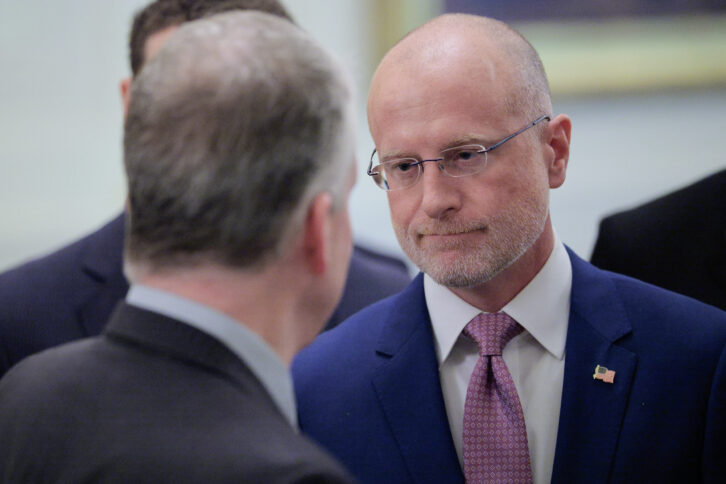
FCC Chairman Brendan Carr speaks with Sen. Dan Sullivan (R-Alaska) after attending the presentation of the Commander-in-Chief trophy in the East Room of the White House on March 20. Credit: Chip Somodevilla/Getty Images)
The Federal Communications Commission has made changes to its rules that ease some restrictions on broadcasters and eliminates others.
The revisions include removing the minimum AM power increase limit and extending technical special temporary authorities up to 180 days.
While Carr celebrated the removal of approximately 1,100 rules during his time as chair, he also indicated the commission is not nearly finished with its efforts.
“On deck for 2026 is licensing and permitting reform, eliminating unnecessary paperwork and smashing technological silos that have held back innovation for decades,” Carr said in a statement.
Of the three FCC commissioners, Carr and Commissioner Olivia Trusty unanimously approved the order.
Commissioner Anna Gomez concurred and dissented in part, stating, “as I have expressed before, I am sincerely concerned about the direct final rule process the commission has been using to eliminate rules.”
The changes also remove the ten-application cap adopted for the 2021 noncom educational FM new station application filing window; and codifies the definition of an authorized station, which LPFM applicants must protect, to include both licensed and granted construction permits.
The FCC voted to update its rules for AM station power increases to eliminate the requirement that stations request at least a 20% increase in nominal power; and update AM station classifications to conform to current classifications used in the Class B and Class D definitions.
The commission said that the National Association of Broadcasters supported the changes and agreed they would offer increased flexibility to AM stations, helping them achieve required community of license coverage.
The commission modified sections of its rules to state that an LPFM submitting an application a filing window for a new construction permit or modification of an existing LPFM authorization must protect FM, LPFM and FM translator applications filed prior to the release of the public notice announcing the filing procedures.
It also clarified that a public notice, which simply announces an upcoming filing window, would not terminate protection requirements for prior-filed applications.
In addition, the commission said it will remove language from its rules that limit an initial STA necessitated by technical or equipment problem to a 90-day window rather than the full 180-day period permitted for STAs for other reasons.
According to the order, NAB agreed that the change reduces burdens on both applicants and FCC staff. In addition, the comments of the licensees of 10 public broadcasters concurred that their stations would greatly benefit from the extension of this STA term. They also asserted that the period is more realistic given the time it takes to procure and replace technical equipment.
The order also stipulated that moving forward, the FCC will replace references to the bureau’s legacy CDBS electronic filing system with references to its new LMS electronic filing system. The commission said that it is making the change since it no longer updates CDBS, and users are instead required to use LMS to search for and file applications and pleadings.
Here is a summary of other rule changes adopted by the commission that affect broadcasters:
Change table of assignments/allotments references
The FCC adopted the proposal in the NPRM to update inconsistent terminology in rule references to the tables governing FM and TV allotments by changing references in certain sections to correspond with the standard language used in others.
The commission noted that in its comments, REC Networks considered the proposal noncontroversial.
Elimination of the NCE FM window application cap
The commission said it will eliminate language concerning the 10-application cap on the number of applications each applicant could submit in the 2021 NCE FM filing window. The FCC acknowledged that several applications remain pending from the 2021 NCE FM window.
It will delegate authority to the Media Bureau to effectuate this change and remove section the cap “upon resolution and finality of the remaining NCE FM applications.”
Revision of the signature rule
The FCC adopted the proposal to expand the definition of who may sign an application on behalf of a corporation, a partnership and an unincorporated association to include a “duly authorized employee.”
Additionally, in light of commenters’ requests, it will codify the term “duly authorized employee,” but the bureau to interpret the term “employee” broadly, as circumstances may require to take account of all types of employees.
Local public notice requirement after acceptance for filing
The order codified the established practice concerning when applicants for new NCE FM, NCE TV or LPFM construction permits must give local public notice of their applications.
It also clarified that the NPRM did not propose any new or additional local public notice obligations on parties.
The Media Bureau will be directed to update LMS to display the date an application is “accepted for filing.”
Redesignate renewal application petition to deny rule
The commission proposed to consolidate the rules for filing petitions to deny against license renewal applications into one rule section, and it adopted the measure finding that “moving all of the petition to deny rules into section will assist licensees and members of the public in complying with the rules.”
The FCC declined codify the existing interpretation of its rules that LPFM minor change applications received on the same day will be treated as simultaneously filed and, if mutually exclusive, directed to use engineering solutions and good-faith negotiation to resolve the mutual exclusivity. It said commenters gave conflicting responses to its benefits.
It also declined to make any changes to its informal objection rule. Currently informal objections are not required to be served upon the applicant, according to the FCC, which often leads to considerable inefficiencies in the resolution of contested proceedings.
Additionally, its current informal objection rule contains no restriction on the number or type of pleadings that can be filed in response to an informal objection, and provides no pleading deadlines.
However, the FCC said disagreement among commenters on how to proceed led the commission to decide to adopt any specific changes at this time.
The Federal Communications Commission has sent a notice of licensed operation and harmful interference to an amateur radio operator in Pittsburgh regarding transmissions on a 911 emergency services channel from a handheld transceiver.
Last summer, the FCC received a complaint from Allegheny County, Pa., Emergency Services concerning interference with one of its UHF “T-Band” emergency communications channels.
The interference affected the county’s west EMS dispatch channel on 470.4375 MHz.
On July 30, 2025, agents from the Columbia Office of the FCC’s Enforcement Bureau conducted an investigation and determined, using direction-finding techniques, that the source of the interference was a signal emanating from the residence of David Kundston, a licensed amateur radio operator with the callsign KD3ASC.
After the agents notified Kundston of the issue, he produced a Baofeng BTech UV-Pro handheld radio.
The BTech UV-Pro Tan edition lists for approximately $165 on Amazon. It is capable of transmitting on the VHF and UHF amateur radio and private land mobile radio bands.
An examination of the radio by the agents determined it had been programmed to monitor the Allegheny County channel in question, and its “audio relay” feature had been activated.
This feature takes audio traffic from one channel and retransmits it on another.
He surrendered the radio to the agents, and they verified that the interference to Allegheny County’s system had ceased, according to the FCC’s account.
Radio stations, including those operating at 470 MHz, must be licensed with the FCC, with the only exception being operation at a power level in accordance with Part 15 of its rules.
The UV-Pro is not certified as a Part 15 device, according to the FCC’s Office of Engineering Technology’s 2024 grant of equipment authorization for the device. It is certified as a Part 90 device, rated for up to seven watts of transmitting power — far above Part 15 power limits.
No person shall interfere with or cause interference to any radio communications of a licensed station, according to FCC rules.
Kundston must respond to the Enforcement Bureau within 10 days of the notice, describing the steps he is taking to avoid operating on unauthorized frequencies.
At its March open meeting, the Federal Communications Commission approved a rule overhaul that it said will help move communities off copper lines and onto new, high-speed networks.
“For too long, outdated rules and regulations have forced providers to maintain aging copper infrastructure and to keep consumers on broken, antiquated networks,” Carr said in a statement. “This vote effectively frees up those billions of dollars so that Americans can benefit from an upgrade to the types of modern, high-speed networks that they want and need.”
Carr added that the commission is taking a “balanced approach” to protect consumers and preserve access to critical services like 911.
During the meeting, the chairman described the process for defining the details in the order as collaborative, of which Commissioners Gomez and Trusty concurred.
Reducing burdens
Specifically, Thursday’s FCC order cuts back red tape for telecom companies looking to retire infrastructure. It removes filing requirements, simplifies the application process for upgrading technology and gives providers permission to stop taking new customers for older voice and low-speed data services running on copper wires.
The FCC also ruled that federal law will override state and local regulations on this issue. If local laws force telecom providers to keep spending money on copper networks after the FCC has already approved their retirement, those local rules will be invalidated, the commission said.
Wireline Bureau Chief Joseph Calascione noted that several adjustments were made to the order before Thursday’s vote. Key changes included:
“Fine-tuning” expectations for 911 connectivity during network discontinuances.
Further defining the services and categories eligible for streamlined processing.
Simplifying application requirements to minimize the burden on providers.
Clarifying the scope of state and local laws that might be subject to federal preemption.
Placing people at risk
In response to the order, the nonprofit Public Knowledge published a statement stating that millions of U.S. citizens living in rural areas, as well as elderly people, people with disabilities or those who rely on specialized medical equipment, still rely on traditional legacy copper lines.
“Everyone agrees that upgrading our national networks will provide an enormous benefit to consumers,” Harold Feld, senior vice president at Public Knowledge wrote. “The question has always how to upgrade the network in a way that honors our national commitment to ensure that all Americans remain connected to 911 – and to each other.”
Public Knowledge is concerned that the order shifts the burden from phone companies to consumers, who will have to prove that enough customers will lose service to prevent the FCC from denying a provider’s application.
Lest you think the FCC isn’t paying attention these days to technical rules for broadcast stations, here’s an instance that suggests otherwise.
The Enforcement Bureau has sent a notice of violation to Morris Broadcasting Co. of New Jersey, owner of gospel-formatted WIMG(AM) in Ewing N.J., and of four towers that make up its directional array in Washington Crossing, Pa., just across the Delaware River.
FCC agents inspected the station in May and August of last year. According to the commission’s notice, they found several issues.
The four towers had red beacons at the top but side markers were at the wrong heights, placed at the mid-level of each structure, not at the one-third and two-thirds levels as required.
Also, some of the antenna lighting was not operational in May, and at least some of the obstruction lighting still was not working in August.
The FCC said Morris did file an FAA notice to aviators (NOTAM) about the outages but failed to renew them later (an FCC agent did so).
Also, the rules require that antenna towers with radio frequency potential at the base must be enclosed but allow access to the bases for technical and maintenance purposes. The agents said the denseness of brush and vegetation on the property prevented ready access to the bases of all four towers.
The rules also require that in most cases, antenna input power of an AM station must be maintained as near as practicable to the authorized antenna input power and may not be less than 90 percent or greater than 105 percent of authorized power. But during the May inspection, the agents said the station was operating with 900 Watts during the daytime, 28.1% of its authorized 3200 Watts.
Last, during the May visit, the agents said WIMG’s EAS equipment would not power on.
Now the FCC has asked the station for additional information concerning these alleged violations and any remedial actions it has taken. The licensee must submit a written statement within 20 days.
Radio World reached out to the station and will report any comment for this story.
[Do you receive our free SmartBrief newsletter each weekday morning? You can sign up here.]
It was introduced by committee Chairman Brian Babin (R-Texas) and has bipartisan support. Cosponsors include Reps. Mike Flood (R-Neb.), Eric Sorensen (D-Ill.), Stephanie Bice (R-Okla.) and Gabe Amo (D-R.I.).
An amendment from Rep. Matt Van Epps (R-Tenn.) specified that enhancement efforts are directed at “particularly transmitter equipment and antennas located in remote areas subjected to an elevated risk of severe weather events.”
The next step for the legislation is to move forward to the full House for a floor vote at a later date.
The commission calls its plan a historic expansion and opportunity for educational and community broadcasters, though one advocacy group says it doesn’t do enough for low-power FM stations.
The plan would permit noncommercial FM, LPFM and noncommercial AM licensees to apply for FM translators operating in the reserved band, 88.1 to 91.9 MHz.
The FCC has said its proposal balances providing more access for noncommercial broadcasters with the need to guard against possible abuse. It proposes a cap of 10 applications per licensee.
Here’s a summary of three filed comments.
LPFM-AG
The Low Power FM Advocacy Group, headed by Dave Solomon, told the commission that the window is welcome but too restrictive.
“The proposed window is confined to Channels 201–220 only. That is the narrowest slice of the FM band and the portion reserved for noncommercial educational FM service,” Solomon wrote.
He said the window risks becoming a “paper opportunity for LPFM” since the commission proposes to leave in place a set of LPFM-specific translator limitations that are “unusually restrictive.” As a result he says the opportunity for LPFMs in this plan is “largely illusory.”
He identified technical barriers for LPFMs as well.
“Those limitations include the 60 dBu overlap requirement, the direct over-the-air input rule and the 10-mile/20-mile siting rule.”
Solomon also says the growth in the number of NCE stations in recent years reduces the number of channels available.
The FCC also proposed a cap of four applications for tribal applicants and two for LPFMs.
According to Solomon, “The better approach would be either to permit four applications for all LPFM applicants or to adopt a neutral standard under which additional LPFM applications may be justified by terrain, rurality, dispersed market geography, insular location, lack of usable reserved-band channels or service to underserved populations.”
He also recommends the FCC implement a one-year holding period on assignments and transfers to discourage “trafficking” of new authorizations.
REC Networks, founded by Michelle Bradley, has taken an active interest in the plan.
According to an ex parte filing, Bradley met in January with several leaders of the Audio Division of the Media Bureau, including Division Chief Albert Shuldiner, to discuss it.
In her filed comments, Bradley told the FCC the national cap of 10 applications seems appropriate and is the same as prior noncommercial filing windows in 2007 and 2021.
However, Bradley warns of potential loopholes that could lead to manipulation of the filing system.
“Specifically, we are concerned that an applicant can intentionally file for a new FM translator to rebroadcast their own station and then immediately change the primary station to a different non-commonly owned station and eventually assign it to a different party based on a pre-planned arrangement,” she wrote.
“This vulnerability is very concerning to the integrity of the strict rules that are being put in place.”
Bradley would go further to prevent potential gamesmanship, proposing a condition that within the first four years of licensed translator operation, the primary station designation can only be changed to another broadcast facility that is commonly owned by the translator permittee/licensee.
Meanwhile a full-service NCE licensee is urging the commission to expand the cap from 10 to 30 applications.
Cedar Cove Broadcasting says a smaller cap could force applicants to focus on large markets instead of rural areas.
“With the proposed 10-application limit to established NCE FM broadcasters, it will most likely limit potential new service to rural areas as NCE FM broadcasters will need to choose between filing applications for larger populated areas and these smaller areas,” the broadcaster told the FCC in a filing by President Victor A. Michael Jr.
Cedar Cove, licensee of eight full-power noncommercial stations and eight translators, says it has done preliminary potential channel availability studies for new NCE FM translator stations and has found available spectrum in most of the top 150 metro markets.
It also would reduce the planned cap for LPFM licensees from two applications to one, due to the limited number of opportunities in larger populated areas, which in turn would give established full-service NCE AM/FM stations a greater opportunity for these new potential NCE FM translators.
It said that even limiting LPFMs to one application could allow an existing LPFM station to potentially double its population coverage area, because those stations are limited to a maximum of 100 wats effective radiated power, whereas new NCE translators can operate with up to 250 watts ERP.
The FCC also plans to limit eligibility in the window to existing licensees and permittees, which drew broad support from commenters.
No dates for the filing window have been announced.
Other filers include Ted Schober, Kyle Magrill, the Educational Information Corp. and Charles De Caro. You can review the filings at https://www.fcc.gov/ecfs/search/search-filings. Enter 26-20 in the “Proceeding” field.
The National Weather Service Sterling, Va., Field Support Center. Credit: John Chase/Getty Images
The U.S. House Science, Space and Technology Committee will hold a markup Wednesday on legislation that includes expanding NOAA Weather Radio VHF network coverage.
Introduced on March 5 by committee Chairman Brian Babin (R-Texas), the NOAA Weather Radio Modernization Act would direct the agency to strengthen emergency alert coverage nationwide through hardware upgrades as well as dissemination of alerts through IP-based protocols.
There are approximately 1,030 U.S. NWR stations licensed in the 162 MHz band, according to data from the RadioLand app. We’ve covered in the past the implications of NWR outages, particularly during the spring and summer months throughout the country.
In a release, Babin used the deadly floods in Texas in 2025 as examples of the consequences when warnings fail to reach those in harm’s way.
The bill, as proposed, would authorize $100 million for FY 2026 to fund NWR modernization efforts, with an additional $20 million each fiscal year from 2026–2031 to keep the radio network operational.
The funds would go toward expanding coverage through the acquisition of additional transmitters, specifically targeting communities without broadband internet access, state or local emergency warning systems or satellite coverage, as well as federal lands such as the National Park System.
Within a year of act’s passage, NOAA would need to conduct a complete assessment of its weather radio network.
The act would direct the agency to better integrate with the Integrated Public Alert and Warning System, as well as to investigate dissemination of weather radio alerts by satellite or through common internet protocols, such as the cloud.
Other elements of the bill include developing options — such as satellite backup capability and commercial provider partnerships — for continuity of service in the event of an outage at a weather forecast office.
It also requires NOAA to research and develop options, including microwave capabilities, to transmit signals to remote areas and, as appropriate, improve the communication of hazardous warnings.
Original cosponsors of the legislation include Reps. Mike Flood (R-Neb.), Eric Sorensen (D-Ill.), Stephanie Bice (R-Okla.) and Gabe Amo (D-R.I.).
The recipient of a construction permit to build a low-power FM station on 99.5 MHz in Miami, Fla., has fought off a challenge at the FCC.
The case involves a group of mutually exclusive applications submitted in the FCC’s 2023 filing window for new LPFMs.
Originally there were five applications in this MX group. Two dropped out by making changes to their applications and becoming “singletons.”
The FCC then applied its “point system” analysis to the remaining three, and it chose two, tentatively deciding that La Familia De Fe Corp and Doral Voice Corp. should submit a voluntary time-sharing proposal.
But each raised concerns about the other.
La Familia and REC Networks argued, among other things, that none of the headquarters addresses in the DVC application and filings with Florida’s secretary of state were within 10 miles of the proposed transmitter site as required by LPFM rules.
Meanwhile Doral Voice told the FCC that La Familia President Rodolfo Martinez had engaged in pirate broadcasting by already broadcasting on 99.5, a frequency time-shared by WHIM(LP) and WBUJ(LP), and that he or his company exert control over WHIM and may have an undisclosed attributable interest in it.
The Media Bureau subsequently awarded a CP for WFRH(LP) to La Familia and rejected the Doral Voice application.
But Doral Voice then asked the bureau to reconsider the dismissal.
Among other reasons it said it subsequently had relocated its headquarters; that Rodolfo Martinez or La Familia really had engaged in unlicensed broadcasting and continue to do so; and that Martinez’s company was fully in control of WHIM.
The FCC Media Bureau now has rejected its reconsideration petition.
For one thing, it cites a precedent that an applicant may not “sit back and hope that a decision will be in its favor and, when it isn’t, to parry with an offer of more evidence.” It said Doral should have raised its localism defense earlier.
But the bureau also decided on separate grounds that the Doral petition was “meritless and repetitive.”
On the issue of local eligibility, the FCC says Doral Voice had “amended its application more than one year after filing the original DVC application, and well after the filing deadline.” So Doral Voice was not local at the time of filing the initial application, as required.
As to the La Familia application, the bureau upheld its decision. It said Doral Voice had failed to establish that La Familia or its president has engaged in pirate broadcasting, or that Martinez failed to disclose an attributable interest in WHIM.
You can read the FCC’s case summary and details of these legal arguments here.
It won’t come as news to you that online audio and podcasting have grown dramatically over recent years; but the latest “Infinite Dial” report from Edison Research at SSRS provides a fresh snapshot including some intriguing twists. The study also explored the use of generative AI for the first time.
Its topline finding is that U.S. podcast and online audio consumption have reached all-time highs.
Eighty-one percent of Americans age 12+ (233 million) listened to online audio in the last month, and 76% in the last week.
Older Americans are pushing the numbers up. Monthly online audio listening among Americans 55+ jumped to 70% compared to 52% just two years ago.
Eighty percent of Americans 12+ (230 million) have listened to or watched a podcast, an all-time high.
Fifty-eight percent have consumed one in the past month, including 68% in the 35- to 54-year-old demo.
Video is broadening podcast consumption; 57% of Americans have both listened to and watched a podcast in the past month. “Whatever your feelings on video podcasts, the data is clear: this is a dual-format medium now,” said Megan Lazovick, Edison vice president, in the announcement.
The study also asked about the use of generative AI, and it found Americans using it in “massive” numbers.
In addition to overall high awareness of gen AI, it found that 57% of Americans age 12+ have actually now used a generative AI assistant, “a milestone that took podcasting 16 years to reach.”
And it said AI users are significantly more engaged across digital media, with 87% having listened to online audio in the last week compared to 61% of non-users.
Affirming a common perception, the study also found that social media platform preference varies sharply by age, with TikTok the most-used among Americans ages 12 to 34.
“Facebook is used most often by 40% of social media users and is dominant among those 55 and older. X skews male and ages 35 to 54, while Snapchat’s audience is overwhelmingly under 35.”
And 84% of Americans use YouTube monthly.
Edison Research conducted the survey of 2,050 individuals 12 and older. Approximately half were drawn from the SSRS Opinion Panel, recruited through probability sampling methods including random-digit dialing and address-based sampling. The sample was weighted to represent the U.S. 12+ population according to census data.

 Connexion