Vue lecture

What’s the Secret to a Successful Fundraiser?
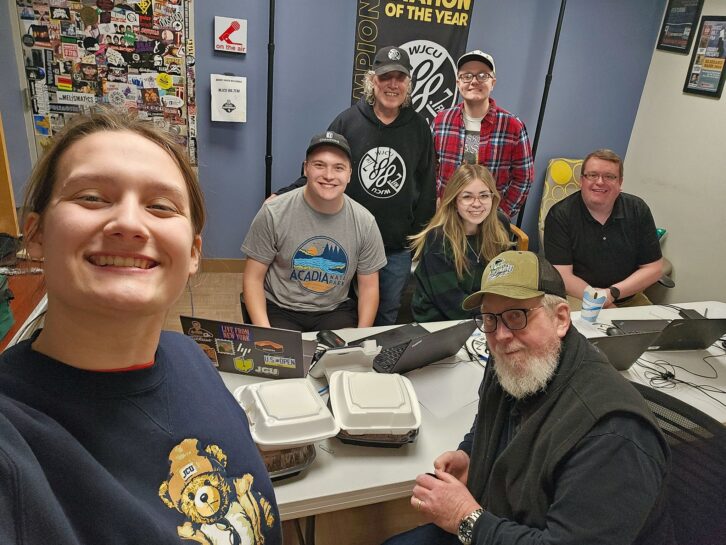
Front: Caitlyn Minney, John RoddyMiddle: Jackson Alexander, Emily Medina, Jasen Sokol Rear: Bill Peters, Nick Colbert
Front: Caitlyn Minney, John Roddy Middle: Jackson Alexander, Emily Medina, Jasen Sokol Rear: Bill Peters, Nick Colbert

Now more than ever, every dollar counts.

For a college media program, a successful fundraiser is a way to prove your worth to campus administrators. For a regional public radio outlet, it might simply be a matter of survival.

So when a college station pulls off a financially record-breaking campaign in its history, it’s worth taking note.

John Carroll University’s 88.7 WJCU(FM) recently raised approximately $108,000 over a 10-day radiothon. The radio station licensed to the private university located in University Heights, Ohio, the Cleveland suburb, broke the school’s record of about $83,000, which itself was a marked jump from approximately $69,000 in 2024.

To understand how WJCU pulled this off, it is worth revisiting the backdrop of a significant event in northeast Ohio’s collegiate radio scene this past fall.

The WCSB effect

On Oct. 3, World College Radio Day, Cleveland State University handed over control of its student-run radio station, 89.3 WCSB(FM), to Ideastream Public Media

Though the operation is still licensed to CSU, Ideastream took over its programming, flipping it to a straight-ahead jazz format. 

Jasen Sokol, who has been director of WJCU since 2020, felt the shockwaves immediately.

By night, Sokol operates as a public address announcer for the Cleveland Monsters AHL hockey team. While at the arena, unprompted, people came up to him through the penalty box glass asking what was going on at Cleveland State.
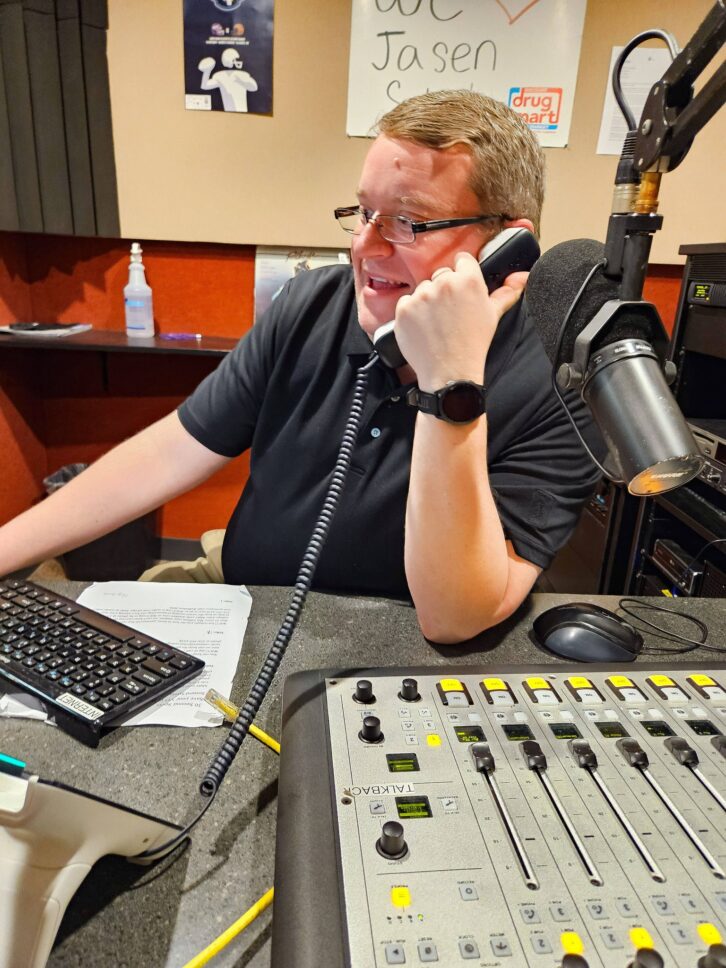
WJCU(FM) Director Jasen Sokol takes a call during its 2026 radiothon.

“I think it really hurt a lot of people, not just the students and the community volunteers there, but all the people that listen to those programs,” Sokol said. 

“And all of us in the college radio community in northeast Ohio too, because it could have been us.”

As a result, Sokol does not take listener or administrative support for granted.

Proving your worth

While WJCU’s radiothon spans exactly 10 days, Sokol insists the effort is a year-round, around-the-clock campaign to prove the station’s value.

“Whether it’s live broadcasts from campus events or involvement fairs, we have to prove our worth constantly,” he said. That visibility has even earned WJCU’s studios a dedicated stop on the university’s prospective student campus tour.

When something good happens — such as the two awards WJCU earned at the 2026 IBS Convention in New York City — Sokol doesn’t waste any time sending out an email blast to campus departments. “Sometimes, you’ve got to be guilty of tooting your own horn,” he joked.

Sokol believes in the strategy. WJCU enjoys a well-placed standing with John Carroll’s administration. “Even members of our senior leadership team were donating,” Sokol said. 

Believe-land
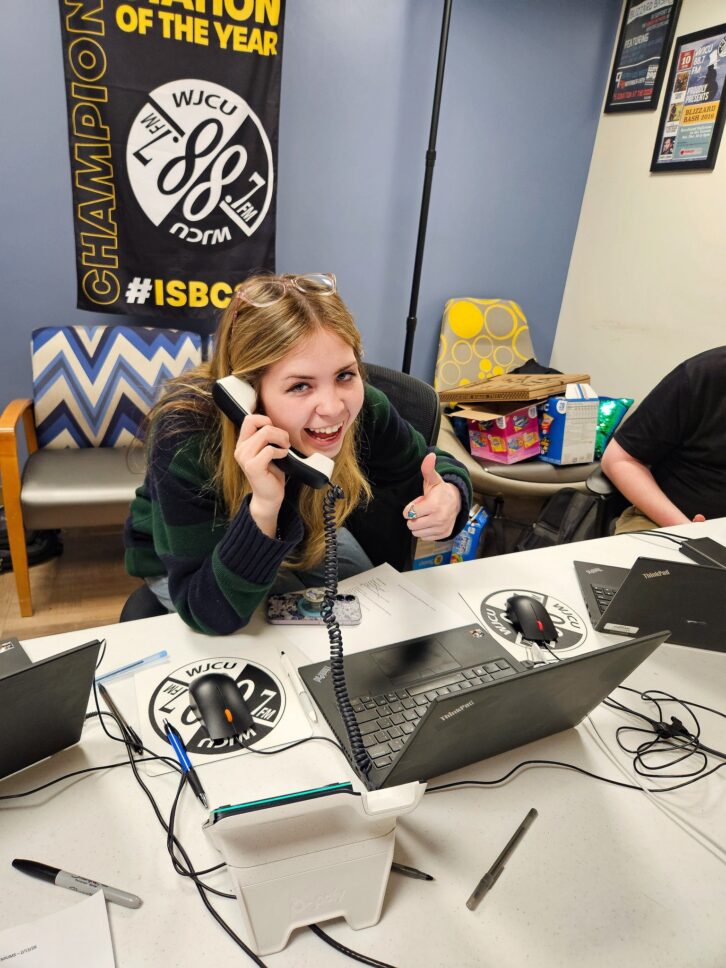
John Carroll University sophomore communications student Emily Medina on the phone during WJCU(FM)'s radiothon.
John Carroll University sophomore communications student Emily Medina on the phone during WJCU(FM)’s radiothon.

Today, about 40 students volunteer with the outlet, spearheaded by an eight-member student executive board. But crucially, the station also taps into the broader Cleveland community.

Approximately 40 community members host shows on WJCU. Many are alumni, including one founding member. 

Another host will celebrate his 45th anniversary on the air next year. It’s a hybrid model that might not work everywhere, but Cleveland supports it, Sokol said.

“The cultural diversity in this town is something that is not only very broad, but it’s celebrated,” Sokol noted. 

Beyond its deep rock-and-roll history, Cleveland’s cultural roots — from Little Italy to Slavic Village to its Paczki Day celebrations — provide a ground for local, niche radio.

But it’s evident in the number of college and community radio stations that are operating across the region. In addition to WJCU, there’s WRUW(FM) at Cleveland’s Case Western Reserve and Baldwin Wallace College’s WBWC(FM) in Berea. To the south, the Class B FM signal of WZIP(FM) is operated by University of Akron.

“I think this is the best location in the nation for college radio,” Sokol said.

There’s also successful high school-operated stations in Streetsboro High School’s WSTB(FM) and the Kenston High School district’s WKHR(FM) in Bainbridge, Geauga County.

Where to start?
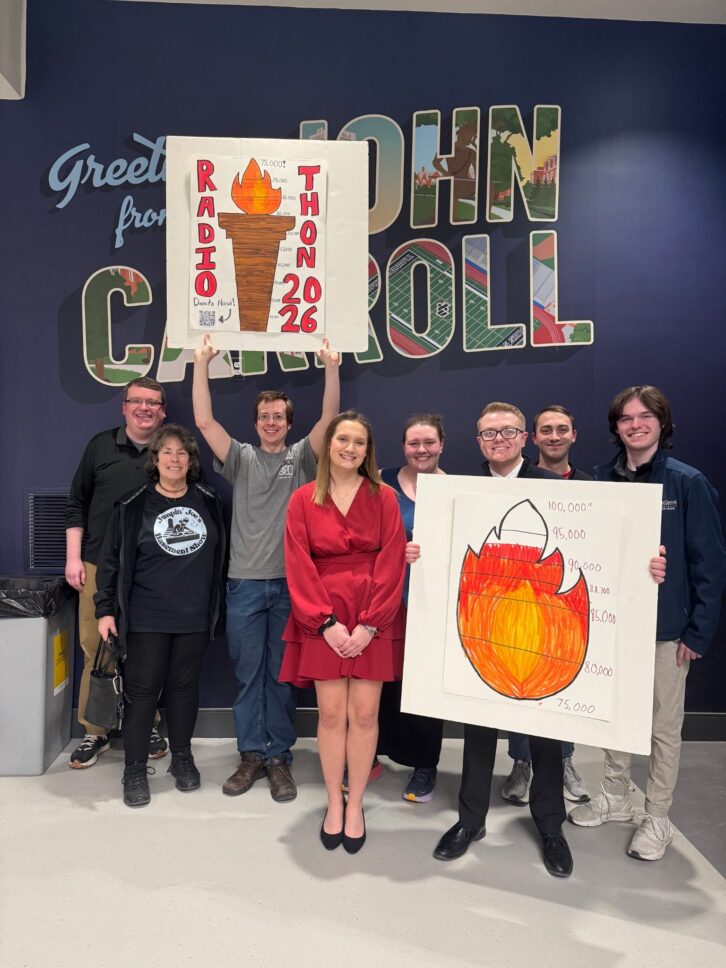
Left to right: Jasen Sokol, Janet DeSouza, Joe Madigan, Caitlyn Minney, Lauren Salata, Nick Colbert, Evan Richwalsky and Owen Close

For a public radio outlet looking to venture into fundraising for the first time, a $100,000 goal might seem daunting. Next year will be WJCU’s 25th radiothon, and Sokol cautions that building this kind of momentum takes time.

“Maybe you receive 75 pledges that are all around 20 or 30 bucks — that’s valuable!” he said.

Planning for WJCU’s spring radiothon begins in mid-September. Sokol said the team locks down themes and tests thank-you gifts before winter break to ensure donors receive high-quality items — like a WJCU Bluetooth speaker with a built-in FM radio for the $250 level, or an invitation to the annual Gold Member Dinner for the $500 level.

The radiothon is strategically scheduled to cover two weekends. The timing, Sokol said, ensures that community volunteers, who largely broadcast on weekends, get two opportunities to ask their dedicated audiences for support.

It pays off: “Jump in Joe’s Basement Show,” an oldies program, raised $25,000 between his two Saturday slots alone, driven by donors actively trying to one-up each other’s pledges on the air.

Meanwhile, a student show received a $10,000 single pledge called in by a former board member.

Finding the value statement

The first step for any successful drive, Sokol said, is training students on how to demonstrate to listeners that their hard-earned dollars are worth spending.

In late January, he works with WJCU’s students to refine their on-air pitches.

“The biggest thing is, we have to have a value statement,” he said. “This is a hard-working, blue-collar town. Why should someone who is living paycheck to paycheck contribute to us instead of the myriad of other causes out there?”

One WJCU student host, Lauren Koppelmann, pitched the station as the singular way she stays connected to her family back home in New Jersey, playing requests so they can share music via the online stream.

“We can still feel like we’re together because of what we’re doing on the radio,” she told her listeners.

Key students driving the station’s success include sports directors Nikolena Samac and Owen Close, and students Zachary Sinutko, Caitlyn Minney and Nick Colbert.

Koppelmann, WJCU’s co-music director and a varsity swimmer, even conceptualized an “inner circle” donor wall for those who contributed over $250.

“It’s something that’s going to last long after she graduates,” Sokol said.
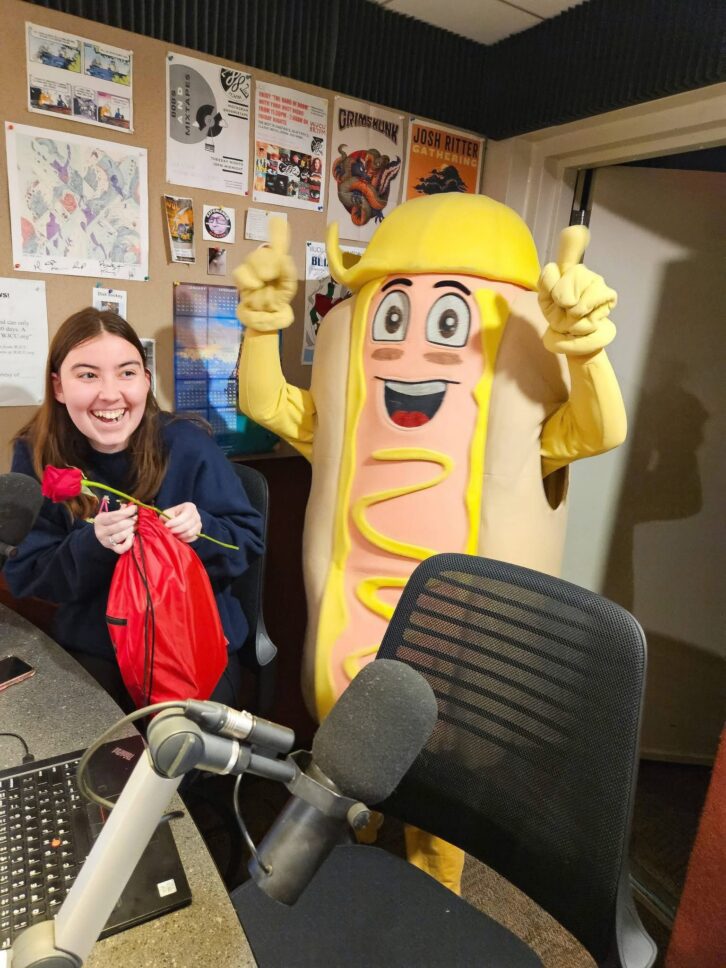
WJCU(FM)'s Emily Davala is gifted a Valentine's Day rose from Cleveland Guardians' mascot, "Mustard."
WJCU(FM)’s Emily Davala is gifted a Valentine’s Day rose from Cleveland Guardians’ mascot, “Mustard.”

During this year’s drive, which overlapped with Valentine’s Day, alumni host Zachary “DJ Z13” Sinutko was out of town for work, so he arranged for “Mustard” — the Cleveland Guardians’ hot dog mascot — to surprise his girlfriend, Emily Davala, with a gift while she was answering phones at the station.

Ultimately, Sokol’s advice to stations hesitant to ask their listeners for money is simple: “Jump in and try it. Even if you raise a few thousand dollars, it’s more than you had.”

[Do you receive the Radio World SmartBrief newsletter each weekday morning? We invite you to sign up here.]

The post What’s the Secret to a Successful Fundraiser? appeared first on Radio World.
  •  

Engineering Sessions Highlight IBS College Media Conference

It was a time for radio engineering to shine at this year’s Intercollegiate Broadcasting Systems conference.

On Friday afternoon, SBE Chapter 15’s Bud Williamson and Andy Gladding hosted multiple sessions, including an introduction to engineering, a technical Q&A and a discussion on the value of membership in the Society of Broadcast Engineers.

The sessions also included Mindy Hoffman, engineer for Audacy, and Scott Fybush, engineering consultant and U.S. sales representative for software automation provider Broadcast Radio.

These were part of a two-day conference where approximately 850 college and high school students gathered in New York City.

The festivities culminated in a boisterous atmosphere inside the Metropolitan Ballroom, where the 2026 IBS Media Awards were presented.

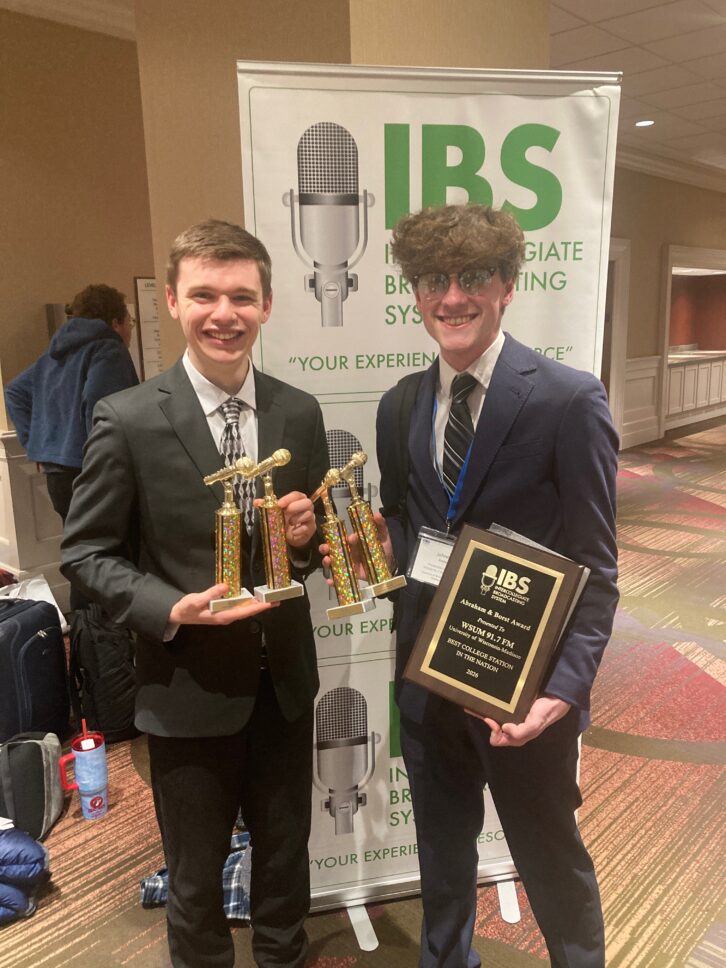
Receiving this year’s best overall college station award was 91.7 WSUM(FM) from the University of Wisconsin-Madison. It also secured the win for best college/university station for a student body greater than 10,000. 

UW student members Vincent Hesprich, sports director, and Johnny Raider, production director, were on-hand to show off the new hardware. In all, the station brings four trophies back to the Badger State. 

UW student members Vincent Hesprich, sports director, and Johnny Raider, production director

Other top honors included:

  • Best college/university station (less than 10,000 students): 91.1 WGCS(FM) Goshen (Ind.) College
  • Best community station: 90.3 WHPC(FM), Nassau County (N.Y.) Community College
  • Best high school station: 88.1 WLTL(FM), Lyons Township (Ill.) High School
  • Tom Gibson Award for outstanding radio engineering: Cornelius Gould and Eric Simna, 88.7 WJCU(FM), John Carroll University

Engineering extra

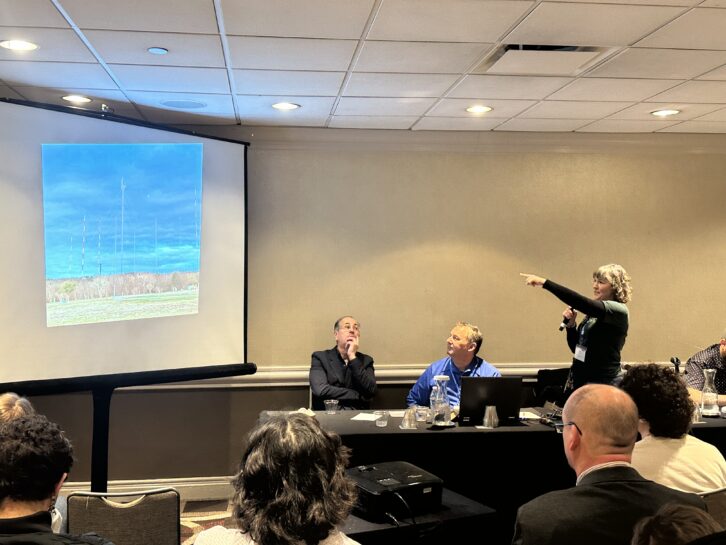
Mindy Hoffman, engineer for Audacy, describes DFW's Cedar Hill tower farm.
Mindy Hoffman, engineer for Audacy, describes DFW’s Cedar Hill tower farm.

Hoffman is also an advisor for Rutgers University’s 90.3 WVPH(FM) in Piscataway, N.J., and she offered a tutorial to the youthful audience. 

She pointed out the visual differences between AM, FM and TV antennas and quizzed her subjects on their functions.

Her presentation also highlighted notable broadcast “tower farms” across North America, ranging from Mount Wilson in Los Angeles to Cedar Hill in Dallas–Ft. Worth and the Mount Royal farm in Montreal. 

She recounted a story of scaling the steps at Mount Royal and looking out at its antennas, which drew oohs and aahs from the crowd.

Hoffman offered two key pieces of advice for student technical directors:

  • If a piece of equipment is malfunctioning, first check the power source.
  • It’s tried and true advice, but if a problem involves a station computer: Unless it is running a specifically scheduled event, turn it off and turn it back on.

As students move into more demanding tech roles, Williamson provided an explainer on the different methods of delivering AoIP commonly used by stations today. 

Williamson and Gladding also encouraged students to capitalize on their physical presence on campus.

“It has to be visible,” Williamson said. “Maybe it’s in front of a mailroom — somewhere with a lot of foot traffic.”

What motivates you

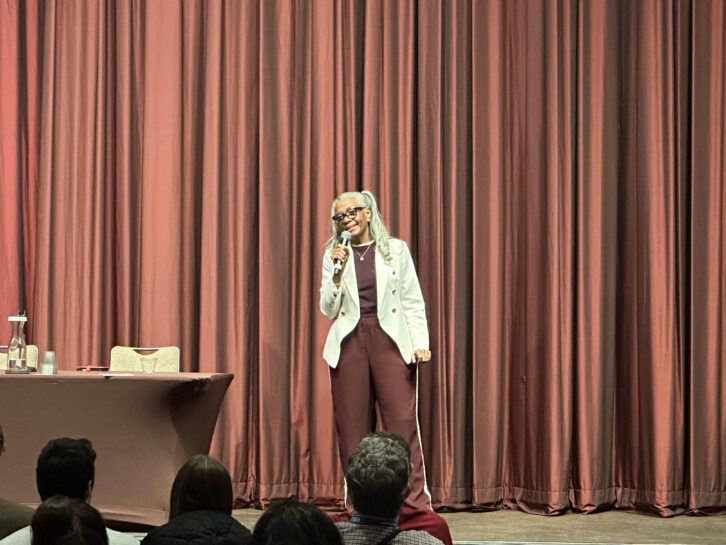
Helen Little of WLTW(FM) delivers the keynote speech at the 2026 IBS Conference.

Keynote speaker Helen Little shared her inspirational career path, which saw her climb the ladder from UNC-Chapel Hill to WPEG(FM) in Charlotte, with subsequent stops in Houston, Dallas and Philadelphia.

At Radio One in Philadelphia, Little became the first African-American female operations manager of a radio station cluster in the country.

While she originally envisioned a career in a warm-weather market like Miami — a sharp contrast to the Blizzard Warnings being hoisted across the tri-state during her speech — a challenge from an ex-boyfriend changed her trajectory. He teased that she could never get a job in New York.

“That was a matter of someone telling me something I couldn’t do, which is one way to motivate me,” Little said. “Listen to your inner voice. Pay attention to your inner compass and let that guide you.”

She moved to New York as the program director of iHeartMedia’s 105.1 WWPR(FM), but eventually realized she missed being on the air. In 2008, she took a chance to become the midday host of the top-rated 106.7 WLTW(FM), a post she has held ever since.

It could have been viewed as a backwards move by some.

But addressing the students, Little emphasized finding personal motivation. “It’s not always going to be money. For me, it’s the fun of it all,” Little said. 

She also touched on modern tools, noting she’ll use ChatGPT for show prep while adhering to iHeart’s “Guaranteed Human” policy.

“AI definitely has a great purpose, but not to make up a story for me to tell,” she said.

The future runway

Little was asked by a student how they could make it to the New York radio market. She admitted that many of her on-air coworkers at iHeart New York have been there for a while.

“In New York, when people get these jobs, they don’t leave,” Little explained. “It creates a bottleneck of opportunity,” she said. “But if you really want to do this, you’ll go where the work is.”

On that note, Saturday morning, a panel featuring Lance Venta of RadioInsight, Sean Ross of Ross on Radio and Pat “DJ Grooves” Cerullo from Loud Radio Pennsylvania discussed the current state of the industry, including for career opportunities.

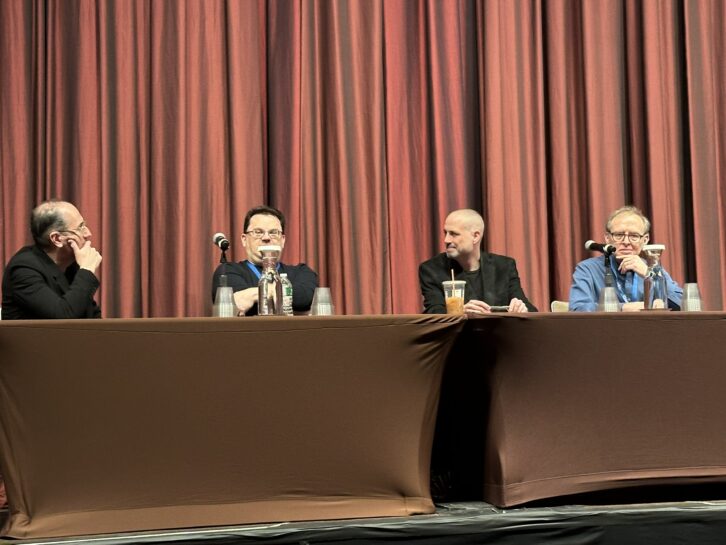
Left to right: George Capalbo, panel moderator, Lance Venta, RadioInsight, Pat “DJ Grooves” Cerullo from Loud Radio Pennsylvania, Sean Ross, Ross on Radio

Venta, who has chronicled radio since he launched the Mid-Atlantic Radio Message Board in 1997, observed a dearth of Gen-Xers at the management level, leaving a gap between aging leadership over 60 and the newest faces in the building. 

The few entry-level positions that are available do often involve relocation, and that’s just not appealing to the current generation, the panelists agreed.

“Overall, there is a future-vision problem,” Venta remarked.

But the panel also celebrated the fact that technology now allows many shows to be produced remotely — a major draw for young talent. 

Cerullo, who operates his Loud Radio network from home, recently hired a 22-year-old Jabez “Bez Musiq” Carrasquilla for afternoon drive. “He’s active on social media and he has a great following, but the linear aspect of radio appealed to him,” Cerullo said.

Ross added that while “great radio” is harder to find, it still exists. He cited the K-Love network as an example: “They have seven great on-air shows and they present themselves with a swagger.”

Fybush, who recalled his first IBS in 1991, chimed in from the audience. He noted that versatility is now mandatory: “Most successful broadcasters are their own ad agencies these days.”

Ultimately, the conference highlighted that while radio faces the same hurdles it has for decades, the next generation is there, waiting, if the industry at large is willing to offer those opportunities.

As Little concluded in her keynote: “Give them a reason to listen, give them a reason to show up and they’ll do it. When you don’t take care of your audience, they start looking elsewhere.”

[Do you receive the Radio World SmartBrief newsletter each weekday morning? We invite you to sign up here.]

The post Engineering Sessions Highlight IBS College Media Conference appeared first on Radio World.

  •