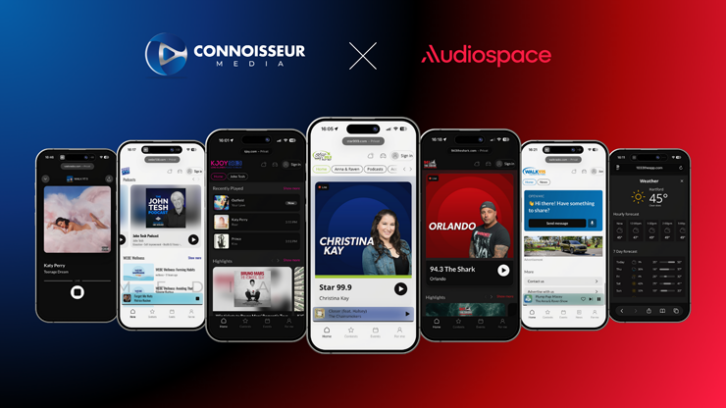
From our Who’s Buying What page: Audiospace has won a contract to develop 240 digital radio platforms for Connoisseur Media.
The first websites and apps rolled out in December.
Audiospace is a Swiss software line from the company Brands Are Live AG. The firm said it is working to expand its global presence.
Connoisseur recently grew by acquiring Alpha Media and its approximately 200 U.S. stations, plus five more in San Francisco, from Bonneville Group. Jeff Warshaw is CEO.
Warshaw was quoted in the press release saying of Audiospace, “They’re not just building apps and websites, they are helping us connect with our listeners while also unlocking new revenue opportunities for our advertisers.”
The announcement was made with Audiospace CEO and founder Jan Müller.
Audiospace develops apps, websites, monetization tools, data infrastructure and additional digital services. The company said it has also been growing in Europe, particularly in Germany.
[Are you receiving the daily Radio World SmartBrief newsletter? Sign up here.]
Few people realize that xHE-AAC, the latest generation of the AAC codec family, includes an option for dynamic-range control of both live and recorded audio.
As an audiophile, that discovery made me ask: What if listeners could finally adjust how wide or narrow the loudness range feels — tailoring it to their environment and personal taste — instead of accepting a one-size-fits-all mix?
That led to live internet testing and a perceptual listening trial to understand how this technology behaves in practice. What happened may be the start of a revolution: dynamic-range control moving from the content producer to the listener’s fingertips.
A little background
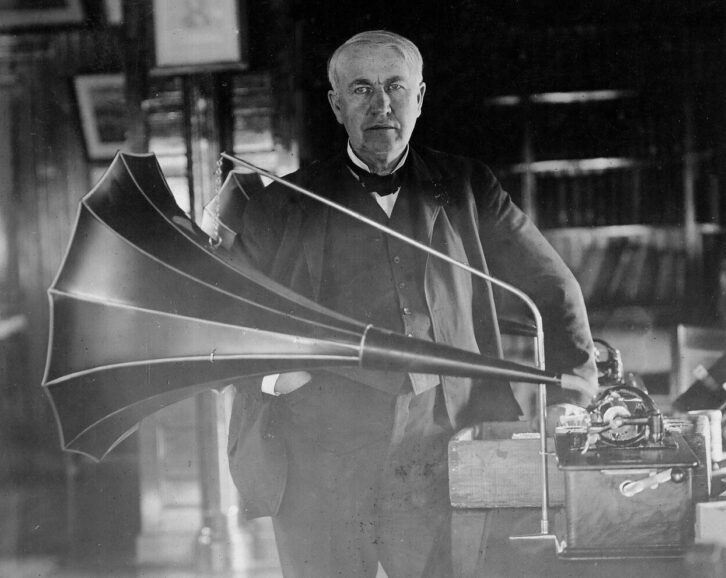
Thomas Edison with his deluxe home cylinder player, taken in his New Jersey offices in 1908
Controlling the dynamic range of audio — the difference between soft and loud passages — has challenged sound engineers since Edison’s day. His early phonographs hissed so badly that he turned to quieter wax cylinders, the first of many compromises between technical limits and artistic intent.
For most of the 20th century, audio engineers fought those limits. Compressors, limiters and automatic gain circuits were used to keep recording and broadcast levels consistent. Now that digital audio has arrived, noise and headroom are no longer the problem.
Today’s delivery chains can preserve the full dynamic range of a symphony hall, yet many people hear that music on phones, smart speakers or in cars, where the equipment or background noise masks quiet detail. The problem flipped: The medium can deliver more than listeners can comfortably use.
From loudness wars to loudness standards
Read more features like this one in our free ebook, “Streaming Best Practices.”
That drive to control audio also triggered “loudness wars” and uneven loudness and the search for measurement standards.
In 2006 the International Telecommunication Union issued ITU-R BS.1770, defining a reliable method of measuring perceived loudness. Suddenly engineers could quantify what once was subjective.
The Audio Engineering Society followed with Technical Document TD1008 in 2021 (now standard AES 77-2023). It recommends loudness “targets” for different media types — speech, music and album vs. track normalization — so that content from different sources play back at consistent levels.
As editor of TD1008, I remember that the committee saw normalization as only an interim, sending stage. An unsolved problem, we wrote, was “content with wide dynamic range.” Classical music, film scores and acoustic jazz simply didn’t fit a target model, and compressing them risks destroying their expressive quality.
The unfinished work: Listener-side control
When the committee drafted TD1008, MPEG DRC was an obscure, file-based feature within xHE-AAC, and real-time DRC capabilities did not exist for streaming services. Because widespread adoption looked remote, the committee understood that loudness normalization still had to be handled before distribution. Consequently, we acknowledged that this document was an “interim” solution. TD1008 serves as a bridge to a time when listeners will finally have the option to hear music exactly as the artists and producers intended.
That meant shifting the dynamic-range control (DRC) from the producer to the listener. Rather than baking compression into audio for all, codecs in future devices would read standardized metadata and decide — at playout — how much to compress or expand. The same recording could sound natural in a quiet living room and intelligible in rush-hour traffic.
Enter xHE-AAC: Codec with built-in loudness and DRC
That codec is here. xHE-AAC (Extended High-Efficiency AAC), developed by Fraunhofer IIS and standardized by ISO/IEC 23003-3, is already in most major streaming services, smartphones, car infotainment systems and even internet browsers. (xHE-AAC is a registered trademark of Fraunhofer in Germany, the United States and other countries.)
xHE-AAC players are compatible with older AAC versions (although its newer encoding and metadata are not playable on older generation decoders).
Inside each xHE-AAC stream are two key data blocks:
Loudness Info — objective measurements of program loudness using the ITU BS.1770 algorithm.
DRC Metadata — a compact set of gain controls that a decoder applies dynamically.
Together, they let the playback devices manage loudness across programs and adapt the dynamic range to the listener’s context — all without altering the source content.
Smartphones could automatically tighten dynamics, going from headphones to the tiny speaker. A connected car system can apply a tighter DRC profile. In the quiet at home, a hi-fi system can play the original digital content with full range for critical listening. Each listener — or device — makes their own choice.
How the metadata works
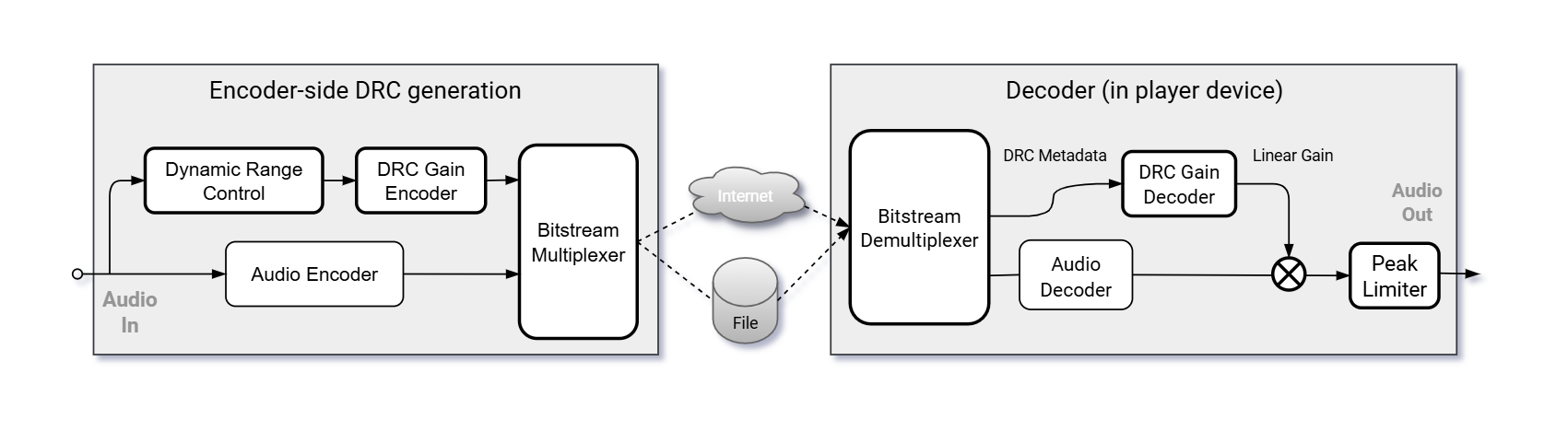
xHE-AAC defines several DRC “presets” ranging from light to heavy control. The encoder stores them inside the audio, and the decoder carries out the loudness management.
Simple diagram of the xHE-AAC encoding and decoding stages, showing the elements that are unique to xHE-AAC’s MPEG DRC with heavier black lines. Click to enlarge.
Because encoding sends the original audio to everyone, quality is maintained (xHE-AAC is more efficient than HE-AAC). The original waveform remains intact, only the playback gain envelope changes according to the encoder’s direction. For producers, this means one well-mastered file can satisfy all streaming or podcast listeners.
This mechanism fulfills exactly what TD1008 anticipated. The document foresaw “consumer hardware and software upgrades” that would make dynamic-range metadata practical. Four years later, those upgrades are possible.
xHE-AAC’s implementation aligns with CTA-2075 and could support the loudness standards cited by TD1008. This would help loudness matching between content sources, such as different streams and podcasts.
Live real-time testing
I am honored to work with a small group of volunteers from classical public radio stations WQXR/New York Public Radio, WETA-FM in Washington, and Qbit GmbH and Fraunhofer IIS, both based in Germany.
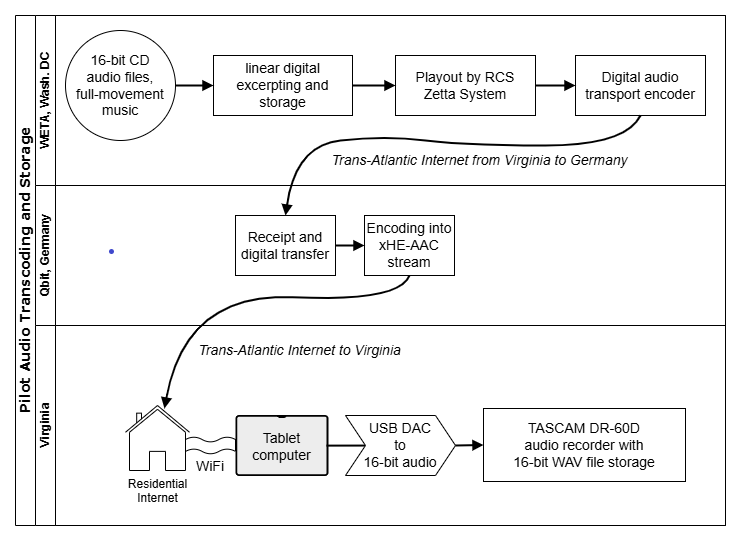
Live digital audio from the stations’ control rooms were sent in full dynamic range via LPCM to Qbit, which encoded a total of four program sources in xHE-AAC audio on a nearly 7,000-mile round trip on the internet.
Here’s the 7,000-mile round trip from WETA and NYPR to Qbit in Germany, where the unprocessed audio was encoded into xHE-AAC and streamed on the internet, and then back to my home, where the stream was decoded on a Lenovo tablet and converted to audio with a USB-to-audio dongle. This audio was recorded on a TASCAM DR-60D as WAV files used in the listening tests. The internet streams were also decoded on Android devices and Chrome browsers for critical listening quality tests.
The streams ran continuously for most of 2025. An Android player app decoded the xHE-AAC and provided controls for selecting DRC modes.
As an audiophile I was thrilled with the sound, both in pristine form and with the coder’s well-designed DRC.
I found that in my old SUV, the DRC allowed me to enjoy every moment of the classical music and no “reaching for the volume control.” An added benefit is that popular music, which seldom needs DRC because it is carefully mixed and processed, is reproduced faithfully and sounds as intended by the artists and producers.
What do listeners think?
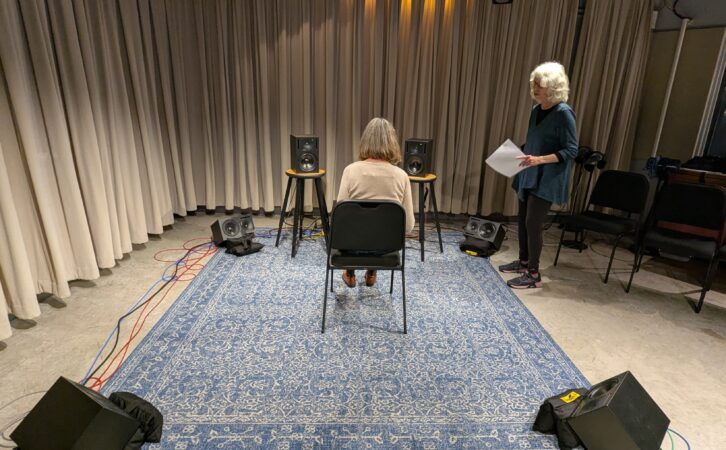
On Nov. 10 we completed a pilot test at New York Public Radio with a group of listeners.
Listening test setup at New York Public Radio in November. Dr. Ellyn Sheffield talks with a participant.
The listener sat in front of a pair of Genelec 1030 monitor speakers, surrounded by four of the same speakers (on the floor) playing road noise recorded at 60 mph in a Lincoln Corsair PHEV on I-66 in Virginia and NYPR’s Mercedes-Benz Sprinter van on the New York City parkway along the Hudson River.
Classical music was selected with varying loudness (drops of >15 LU from loud parts). The road noise at times masked the music, depending on depth of the drops and the noise levels.
The results are being processed now, but data indicate that listeners favor DRC over the same music without DRC under certain circumstances.
In both noise environments, participants stated that it was easier to hear notes and more enjoyable, compared to the original recordings. Some discriminating listeners (recording engineers or musicians) commented on the excellent quality of the DRC.
This was only a pilot, and more extensive testing should be done with a large group of listeners to evaluate the benefits of DRC in a range of conditions, such as earphones, smart phones and smart speakers, as well as popular music.
Looking ahead
The AES Technical Council continues to monitor these advances and plans to revisit TD1008/AES 77 in connection with xHE-AAC. Android and iOS systems and Chromium-based browsers already decode xHE-AAC, so bringing out controls for DRC metadata should be a reasonable step.
It took 140 years to move from Edison’s wax cylinders — plagued by noise and limited range — to a codec that can intelligently shape dynamics for each listener in real time. After more than a century of technology controlling dynamics for the listener, the balance has shifted. Dynamic-Range Control is now literally in the listener’s hands — or more precisely, in their devices.
Many, many thanks go to Dr. Ellyn Sheffield for designing and conducting the perceptual testing, Steve Shultis of New York Public Radio and William Harrison of WETA-FM, Jan and Michael Bläsi of Qbit for encoding and live streaming, and members of Fraunhofer for participating and helping with technical assistance.
Chairman Brendan Carr said the FCC will act this month to enhance unlicensed use in the 6 GHz band.
“The FCC will vote to create a new category of unlicensed devices — GVP devices — that can operate outdoors and at higher power than previously authorized devices,” according to the announcement from his office, headlined “President Trump Unleashes American Innovation With 6 GHz Win.”
The announcement said the action “promises more jaw-dropping innovations and massive consumer benefits for years to come, driving growth in wireless, IoT and related industries.”
This proposal has been pushed by tech companies Apple, Broadcom, Google, Intel, Meta, Microsoft and Qualcomm. In 2024 the Consumer Technology Association told the FCC it supported the idea.
The FCC said GVP devices will support high data rates suitable for AR/VR, short-range hotspots, automation and indoor navigation. These devices, it said, “will overcome limitations of previous device classes by allowing higher power and outdoor mobility.”
Carr said in the announcement that consumers will benefit from better, faster and more affordable wireless services. He said the plan “enables consumers to benefit from supercharged Wi-Fi and a new generation of wireless devices from AR/VR and IoT to a range of innovative smart devices.”
The commission provided this explanation of the technology:
“Geofenced variable power (GVP) devices promise to overcome technical and regulatory constraints of other low-power devices such as low-power indoor (LPI) and very low-power (VLP) devices. GVP devices offer data rates suitable for reality/virtual reality, short-range hotspots, automation processes and indoor location and navigation because they operate at significantly higher power than VLP devices.
“At the same time, GVP devices need not be restricted indoors, as is the case with LPI. These benefits will be made possible by restricting GVP devices from operating in exclusion zones on certain frequencies to protect incumbent licensed services from any significant risk of harmful interference.”
In addition to the pending order to create a new category of GVP devices, the FCC said, it will seek comment on proposals that could provide more utility for unlicensed devices in the 6 GHz band.
“Specifically, the FCC would seek comment on a proposal to allow composite standard-power and LPI access points to operate with additional power under certain circumstances, and a proposal to permit LPI access points to operate on cruise ships.”

 Connexion