
Vue lecture

WKRP (a Real One) Is Willing to Share Its Call Sign
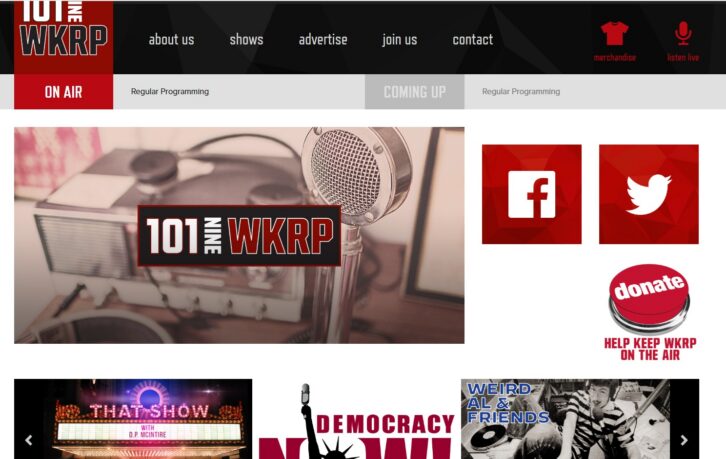
The home page of WKRP-LP
The home page of low-power FM station WKRP.


Text has been updated with additional information.

Would you like your station call letters to be WKRP?

That famous call sign currently is held by a low-power FM station in Raleigh, N.C. And while the station isn’t planning to give it up, it would be willing to share if the price is right.

The licensee issued this announcement:

Oak City Media, a non-profit organization that’s operated a real WKRP for over a decade, is announcing a process by which certain other broadcast stations can share this nostalgic call sign in accordance with FCC regulations, allowing simultaneous use by one AM radio station, a full-power FM station (as ‘WKRP-FM’), full-power television station (with the suffixes ‘-TV’ or ‘-DT’) and one low-power TV station (using the suffixes ‘-CD’ or ‘-LD’).”

Executive Director D.P. McIntire wrote: “For five years, ‘WKRP in Cincinnati’ was the fictional, often dysfunctional setting behind one of the most popular situation comedies in the United States. Originally airing on the CBS television network, immediately after its network run it became a syndication staple for stations, and episodes can still be found on the air in many markets; as can episodes of a revival of the series in the early 1990s.”

He invited broadcast licensees to email him for an info packet “explaining the process, timelines and requirements.”

“At the end of this process, one station in each of these categories will receive authorization to use the WKRP call sign along with Oak City Media,” according to the release.

“The organization meanwhile intends to use proceeds generated through the process to help a number of newer non-profit groups build the ‘third generation’ of LPFM radio stations.”

FCC rules allow applicants to request call signs of their choice if the combination is available.

They state: “Where a requested call sign, without the ‘-FM,’ ‘-TV,’ ‘-CA,’ ‘-DT,’ or ‘-LP’ suffix, would conform to the call sign of any other non-commonly owned station(s) operating in a different service, an applicant utilizing the online reservation and authorization system will be required to certify that consent to use the secondary call sign has been obtained from the holder of the primary call sign.”

McIntire told Radio World that Oak City Media receives several approaches each year from parties interested in obtaining or sharing the call letters.

“We do not want Oak City Media’s involvement in this process to violate either FCC regulations or IRS rules governing 501(c)(3) organizations,” he said, so they’ve created a 501(c)(3) non-profit called IBC Inc., short for Independent Broadcast Consultants.

“Oak City Media will conduct the selection process for whom shares the WKRP call sign,” McIntire said.

“Those who ‘win’ will donate funds to IBC, which in turn will oversee the funds and disburse them to ‘third-generation’ LPFM stations in need until we’ve exhausted what we generate.”

He said the effort has no stated goal amount, “simply to get the most we can so as to provide the biggest ‘pay it forward’ we’re able.”

(See a list of historical uses of WKRP at FCCInfo.com.)

The post WKRP (a Real One) Is Willing to Share Its Call Sign appeared first on Radio World.

  •  

FCC Approves New GVP Devices for 6 GHz Band

No burning decisions specifically about radio broadcasting appeared on the FCC’s January meeting agenda today, but the commission took several actions of interest.

It unanimously adopted an order to enhance unlicensed use in the 6 GHz band for a new product category called “geofenced variable power” or GVP devices that can operate both indoors and outdoors at higher power than previously authorized devices.

“This action enables consumers to benefit from supercharged Wi-Fi and a new generation of wireless devices, from AR/VR and IoT to a range of innovative smart devices,” it said.

We reported on this pending action earlier this month. The proposal has been pushed by tech companies Apple, Broadcom, Google, Intel, Meta, Microsoft and Qualcomm. In 2024 the Consumer Technology Association told the FCC it supported the idea.

Chairman Brendan Carr said that at the recent CES show, “America’s tech industry debuted Wi-Fi 8 routers and chips for launch as soon as this year. This next generation of Wi-Fi will offer blazing fast speeds and massive bandwidth with more efficient power, higher throughput and better client-to-client communications.”

He noted that in 2020 the FCC opened 1,200 MHz in the 6 GHz band for unlicensed use. With this action he said the FCC brings more unlicensed spectrum to the marketplace “and [will] allow innovators to supercharge existing unlicensed bands. … With higher power and outdoor mobility, expect more compelling AR/VR, short‑range hotspots, automation and navigation.”

Gary Shapiro, the executive chair and CEO of the Consumer Technology Association, issued an enthusiastic statement: “Unlicensed spectrum is the foundation for transformative technologies like Wi-Fi, and opening more of the 6 GHz band will supercharge the next wave of innovation, including augmented reality, virtual reality and other game-changing applications.”

Foreign ownership

Separately and unanimously the FCC also codified foreign ownership review requirements.

It said the goal was to maintain strong national security review processes while providing clarity for foreign investment.

“The agency’s longstanding foreign ownership review has helped protect against national security risks when reviewing increasingly complex ownership structures for FCC license holders, namely broadcast, common carrier wireless, and aeronautical licensees,” it said in a statement.

“Today’s action codifies many of those processes to ensure its foreign ownership requirements are clear and consistent, and to streamline the review process.”

The rules codify the policies and practices that it says the FCC has developed over the last decade to review complicated ownership structures under its Section 310(b) rules.

Foreign ownership reviews for broadcast licenses are led by the Media Bureau.

Foreign adversaries

The commission also established new rules intended to create transparency about the control of licensed entities by foreign adversaries. Again the FCC was unanimous.

“Foreign adversaries have made clear their intent to probe and penetrate vulnerabilities across our communications ecosystem,” said Carr.

“We have seen this through cyberattacks like Salt Typhoon. We have seen it in the equipment pipeline, where foreign adversary‑controlled labs could attempt to influence the testing and approval of devices bound for the U.S. marketplace.

“We have seen it in the online marketplace, where millions of prohibited devices linked to foreign adversaries were being sold to American consumers. And we have seen it at the carrier level, where entities with concerning ties to foreign governments have sought to operate in U.S. networks despite clear national‑security risks.”

Carr said the vote “sets up a clear, risk-based reporting structure that requires entities to attest to whether they are owned by, controlled by, or subject to the direction of a foreign adversary.” He called it an agency-wide effort that “builds on a year’s worth of national security initiatives and establishes a uniform system for identifying foreign adversary control across all FCC licensees and authorization holders.”

The order places each license, permit or authorization into a series of schedules, based on a variety of factors including national security risk of foreign adversary control and reporting burdens, and it imposes reporting requirements about equity and controlling interests.

The FCC said, “Today’s action, as well as those spearheaded by the commission over the past year, including establishing the Council on National Security, will strengthen the security of U.S. communications networks by tracking many of the ideas laid out in the pending bipartisan Foreign Adversary Communications Transparency (FACT) Act led by Senator Deb Fischer and moving swiftly to protect national security.”

We will watch for announcements about the paperwork impact of these foreign ownership and foreign adversary rules on broadcasters.

Meantime next month’s FCC meeting will include an agenda item specifically of interest in radio broadcasting: an application window for new FM translators for noncom educational stations.

The post FCC Approves New GVP Devices for 6 GHz Band appeared first on Radio World.

  •  

Here’s How FCC Station Totals Have Changed in 10 Years

Over 10 years, the number of AM radio stations in the United States has dropped by 7%, while the number of noncom FMs has increased 16%. And FM translators and boosters soared 36%.

The FCC has released its latest count of broadcast station licenses, providing the totals as of the end of December 2025.

Here we report those results and compare them to one year ago and to a decade ago:

AM radio: Like others in radio we watch the AM total with particular interest given the challenges of that band and frequent reports of smaller stations going silent. There were 4,342 AM licenses as of the end of December. That’s down 41 stations from a year ago and down 342 from 2015, a decline of 7%. Steadily, the senior band is shrinking.

FM commercial: This category declined slightly over both one and 10 years. There were 6,589 FM commercial stations in December, 36 fewer than a year earlier and down 112 from 2015, a 2% drop.

FM educational: This category is in demand. As of December there were 4,755 noncom FMs. That was an increase of 278 stations in just one year, the result of a recent application window. It’s also an increase of 660 stations over 10 years, a 16% jump. (In late 2002 there were only 2,331 NCE stations.)

FM translators and boosters: There were 8,867 of these in December, down very slightly from a year earlier but up by more than 2,300 licenses compared to a decade ago, for an increase of 39%. Translators grew dramatically in part because of the FCC’s program to provide translators to AM licensees.

Low-power FM: There were 1,994 LPFMs in December, 26 more than a year earlier as new stations from the 2023 LPFM window come online. Ten years ago the number was 1,433. (The LPFM category’s historic peak to date was around 2,200 stations about eight years ago.)

The post Here’s How FCC Station Totals Have Changed in 10 Years appeared first on Radio World.

  •  

Corporation for Public Broadcasting Votes to Dissolve

The Corporation for Public Broadcasting has announced that its board of directors voted to dissolve the organization after 58 years of service.

The decision followed Congress’ rescission of CPB’s federal funding. CPB had announced that it would begin winding down operations this past September. It had still been operating with a staff of approximately 30 members. 

CPB’s board said the decision is its “final act” supporting public media. In a release, the organization cited vulnerability to “future political manipulation or misuse” that a defunded CPB might incur, which it said would threaten public broadcasting’s independence “and the trust audiences place in it.”

It also cited the potential for staff and board members to be subjected to “legal exposure from bad-faith actors.”

A CPB spokesperson said that while an actual stop date has not been determined, the organization will complete the distribution of all remaining funds in accordance with Congress’ intent.

“Today’s decision to dissolve the Corporation for Public Broadcasting marks a grave loss for the American public,” Sen. Ed Markey (D-Mass.) said in a Monday release. Markey described the nation’s public broadcasting system as the “crown jewel” of U.S. media.

The dissolving of CPB continues a tumultuous last year for public media. In November, CPB and NPR reached a settlement after NPR alleged that CPB withheld federal funds appropriated by Congress for public media distribution.

“Public media remains essential to a healthy democracy,” Patricia Harrison, who has been CPB’s president and CEO since 2005, said in the release. “Our hope is that future leaders and generations will recognize its value, defend its independence and continue the work of ensuring that trustworthy, educational and community-centered media remains accessible to all Americans.”

CPB will also provide support to the American Archive of Public Broadcasting to continue digitizing and preserving historic content. Its own archives — dating back to the organization’s founding — will be preserved in partnership with the University of Maryland and made accessible to the public.

First authorized by Congress under the Public Broadcasting Act of 1967, CPB said that it helped build and sustain a nationwide public media system of approximately 1,500 locally owned and operated public radio and television stations.

[Do you receive the Radio World SmartBrief newsletter each weekday morning? We invite you to sign up here.]

The post Corporation for Public Broadcasting Votes to Dissolve appeared first on Radio World.

  •