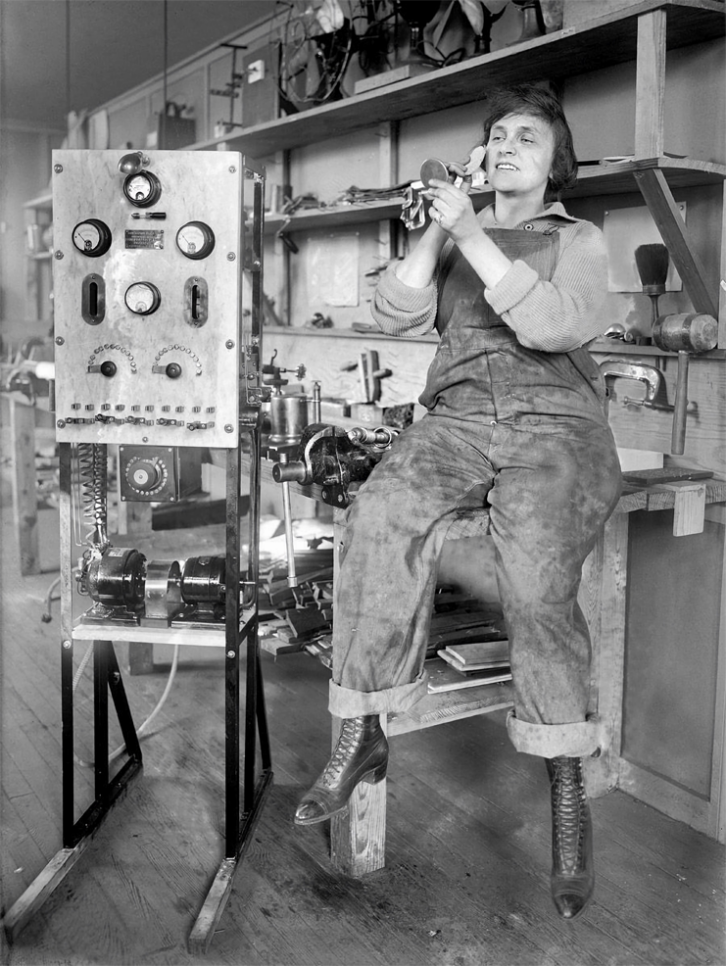
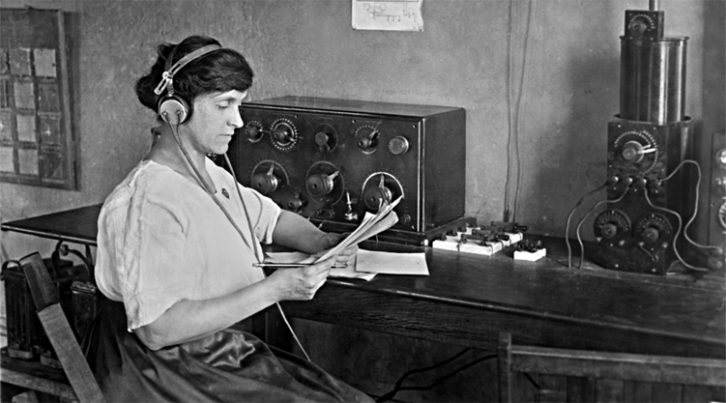
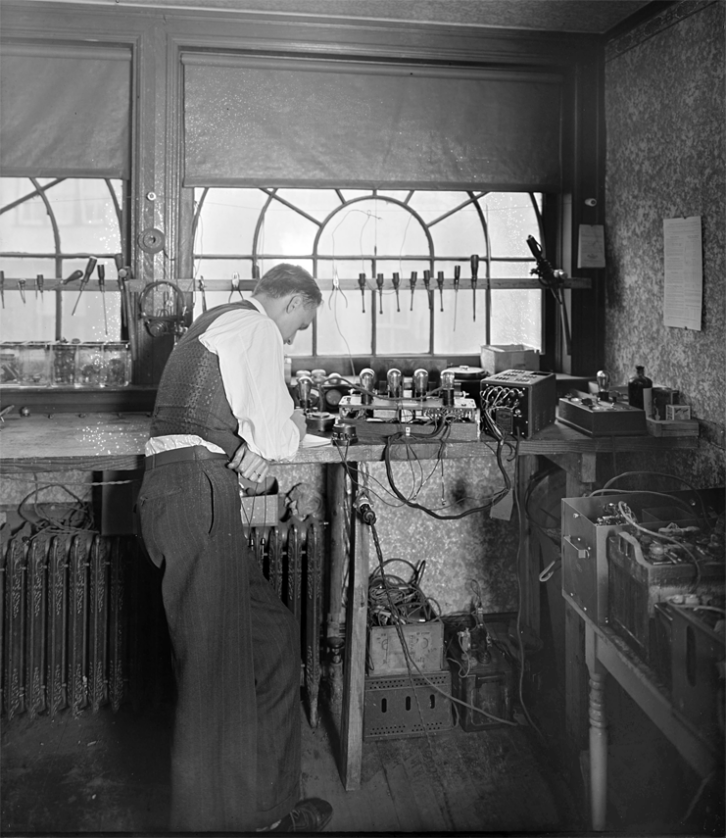
Mary Texanna Loomis and one of her transmitter projects. (Credit: Library of Congress)
In the 1920s, if you wanted to become a commercial radio operator or a shipboard radioman, you needed a Commercial Radio License, issued by the Department of Commerce.
The best way to achieve this was to attend one of the few radio schools that operated in principal cities around the United States. Two of the most distinguished schools were in Washington, D.C.: the National Radio Institute and the Loomis Radio College.
The latter was the only woman-owned radio school in the country. Mary Texanna Loomis was the principal instructor and that rare creature in the 1920s: a female authority on radio.
She was a distant cousin to Dr. Mahlon Loomis, who in 1866 had experimented with “stealing current from the atmosphere” using kites and metallic string.
In one experiment, he flew kites from two peaks of the Blue Ridge Mountains in Virginia and was able to detect a change in current in a galvanometer in one kite when he grounded the line of the other.
Subsequently, he was able to send Morse Code messages between the two locations, a distance of 18 miles. He was experimenting in wireless communication nine years before Guglielmo Marconi was born.
Adult learning
Mary Texanna Loomis was born August 18, 1880, in a homesteader’s shack near Goliad, Texas, the second child of Alvan Isaac and Caroline (Dryer) Loomis. Her middle name was bestowed in honor of the state where she was born.
Mary Texanna Loomis
The family moved to Rochester, N.Y., in 1883, where she had a respectable middle-class upbringing. She was sports-minded in her youth, participating in swimming, horseback riding and strenuous exercise. She also took voice lessons and became a good soprano. She learned to speak three languages: French, Italian and German.
A grandfather was a strong influence; he taught her to use tools and to build mechanical devices, and he helped develop her interest in science and the new inventions of the industrial age.
Loomis married Turner Erving Howard in October of 1898, in Buffalo. The marriage ended in divorce in 1917. It’s not known that she had any children.
After her divorce, she moved to Washington, where she looked unsuccessfully for music employment. But her life took a new turn when she attended a lecture on the emerging technology of wireless communication.
Fascinated, she proceeded to read everything she could find on the subject. At the age of 38, at a time when radio was the field of only a few experimenters and inventors, most if not all of them men, she graduated from radio school and earned her first-class radio telegraphy license.
During World War I, she worked for the Red Cross and as a secretary in a wireless school. It was only then that she learned about the experiments of her distant cousin, and she resolved to open a radio operator’s school in his honor.
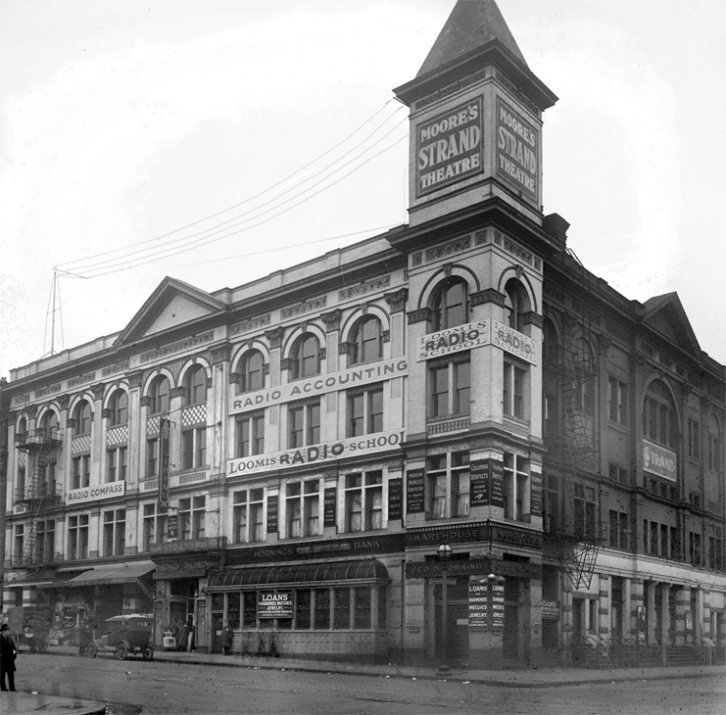
The Loomis Radio School in (Washington, D.C. Credit: Library of Congress)
In 1920, she invested every cent she had and incorporated the Loomis Radio School. Located at 401–411 Ninth Street in the northwest quadrant of the city of Washington, it offered a six-month course preparing students for the first-class commercial radio license exam. Most students who graduated found positions as shipboard radio operators.
Meeting any mishap
Loomis was the school’s president and principal lecturer. She taught radio using the equipment that she constructed herself in the school’s machine shop, and taught her students how to build radio equipment.
“No man can graduate from my school until he learns how to make any part of the apparatus,” she said.
“I give him a blueprint of what I want him to do and tell him to go into the shop and keep hammering away until the job is completed. I want my graduates to be able to meet any emergency or mishap that may arise someday far out on the sea.”
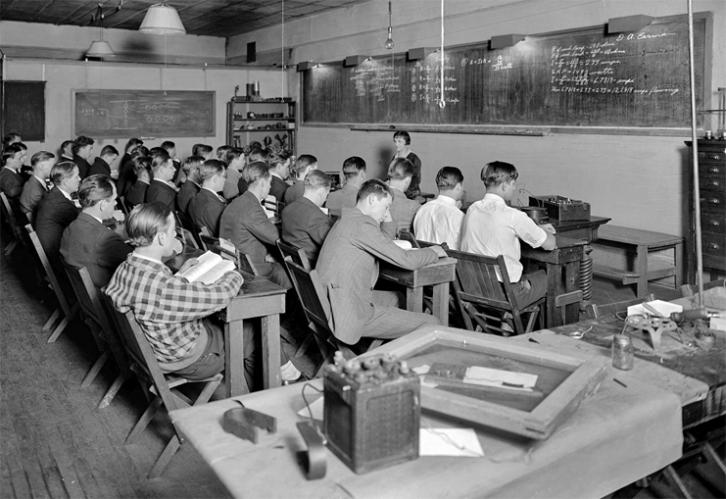
She lived a frugal life in a boarding home, and worked 12 to 15 hours a day teaching, grading papers and writing. The Loomis Radio School offered four courses. One for commercial radio operators led to a first-class commercial radio operators license. A course for technical training taught how to build a receiving set. A third course led to a license as a radio amateur operator. And the fourth was for operators who needed to renew an expired license or who had been military operators and needed only minimal training.
Loomis teaches a class of future radio operators (Credit: Library of Congress)
Her students also gained practical experience operating a radio transmitter through the use of the school’s amateur station, W3YA.
Loomis was a noted lecturer and member of the prestigious Institute of Radio Engineers. She authored and marketed the popular book “Radio Theory and Operating for the Radio Student and Practical Operator.” This was a reference text of 886 pages and 700 illustrations, advertised at a reasonable price and offered postage-paid directly by the school. It found its place as a textbook used by many educational institutions and government agencies.
By 1928 the Loomis book was in its fifth edition and amounted to 1,006 pages. “Radio Broadcast” Magazine called it “one of the most comprehensive volumes in its field.”
She dedicated her book to her cousin Mahlon Loomis.
The depression that began in 1929 affected the school severely, as it did tens of thousands of other businesses. Fewer students could afford the training, and larger schools like the National Radio Institute had more resources to weather the hard times. Further, a new competitor, the Capitol Radio Institute, would open in Washington in 1932.
In 1930, Loomis reorganized the school as the Loomis Radio College, Inc., but it was dissolved in early 1933.
A student works on a radio project in the Loomis Radio School. (Credit: Library of Congress)
Not much is known about Mary Texanna Loomis’ later life. She is known to have relocated to San Francisco in 1938; the census shows that she lived in the St. Francis Hotel and listed her occupation as a stenographer. She died in that city in June of 1960, at the age of 79, and was buried at the Woodlawn Memorial Park in Colma, California.
Sources used in this article include:
“National Electragist,” November 1921: “Woman conducts radio school”, by H.O. Bishop
The Dearborn Independent, Dec. 31, 1921: “Woman conducts radio school”
“The American Magazine”, January 1924: “This young woman founded a radio school”
The Washington Post, March 15, 1931: “Mary Loomis bosses air students to high success”
“The Spectrum Monitor,” July 2022: “The First Lady of Radio” by Scott Caldwell
Another woman active in early radio was Mary Day Lee.
John Schneider has spent his career in broadcast technology development and sales. He is a lifelong radio history researcher. Email him at jschneid93@gmail.com.
Author Steve Herman (W7VOA) has been a licensed amateur radio operator for over 50 years and is a retired Voice of America correspondent.
To the average gamer, the “Hill” is a high-fidelity map in Call of Duty: Black Ops.
But for Alanson “Alan” Higbie, the location outside Berlin, built on piles of wartime rubble, was a real-life cathedral of radomes and reel-to-reel tape decks. Teufelsberg was a key listening post for the U.S. intelligence community’s fight against Communism.
During the 1968 invasion of Czechoslovakia by Warsaw Pact forces, Higbie found himself on the Hill playing a bit part in Cold War history when frightened but courageous Czechs at the other end of amateur radio communications asked him to inform the outside world of their fate.
Higbie’s date with destiny atop a German mountain of debris began with a childhood crystal radio set and an amateur radio license.
Enlisting in the Army
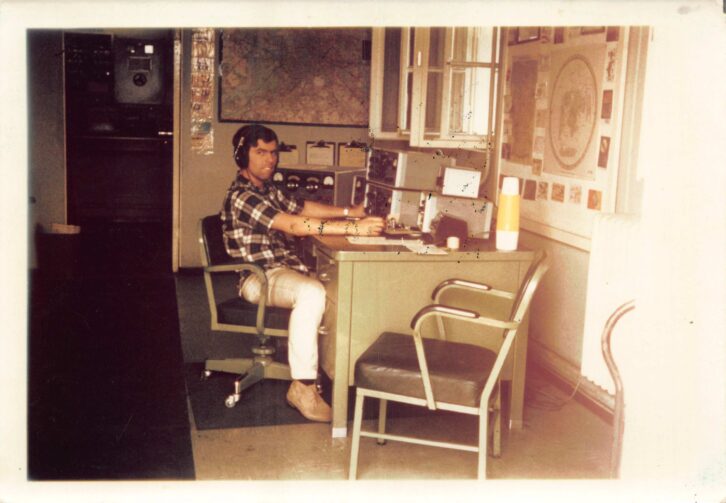
An August 1970 photo of Alan Higbie, manning the West Berlin, Germany MARS station.
As a teen spending his time acquiring knowledge about electronics and radio communication, Higbie seemed destined for a career as an electronic engineer. But a learning plateau with the mathematics beyond basic physics derailed any such plan.
He took a pause from studies as a political science major at the University of Oregon, but that made him vulnerable for the military at the height of the Vietnam War. Higbie, in 1967, took a gamble and signed up for a four-year enlistment with the Army Security Agency, knowing it “would send you where they want you.”
He figured, however, this increased the odds of going to language school or other non-combat component, while it lowered the odds of toting an M16 rifle in the jungles and risking ambush by the Viet Cong. Higbie asked for training in foreign languages, preferring Russian and Mandarin as “those would give me the best shot to get into language school.”
And of course, “you don’t get what you want.”
He got German. Not a bad consolation prize, remembers Higbie, who adds, “I’ve been very lucky in my life.”
After basic training, he was sent to the Defense Language Institute in Monterey, Calif., for six months of intensive German courses.
Higbie struggled in the military’s language school with German. He was called in and told in no uncertain terms that if he flunked out he would not be able to stay in the elite, mostly non-combat cocoon of the Army Security Agency.
“I learned how to study literally at gunpoint and under the threat of death,” says Higbie. “It was a big wake-up call. I still don’t have much aptitude for language. But German is a very easy language for an American to learn.”
Higbie, given orders for Germany with the junior enlisted rank of Specialist 5 — a grade equivalent in pay to a corporal — was initially unclear on what he would be doing there.
“I didn’t realize what the mission of the Army Security Agency really was,” remembers Higbie. He quickly discovered that “we worked with the National Security Agency. They were our bosses. They were civilians on the site.”
Teufelsberg mission
Higbie, in 1967, took a gamble and signed up for a four-year enlistment with the Army Security Agency. He would head to Teufelsberg, Germany, which atop a hill, was ideal for radio communication.
Back then, the NSA was super-secret. Now there are signs on the Baltimore-Washington Parkway guiding motorists to the NSA gate at Fort Meade in Maryland.
Higbie’s new post was Teufelsberg, a pile of rubble atop an unfinished Nazi technical college. Nearly 100 million cubic yards of Berlin rubble was hauled there after the Germans were defeated in the Second World War. That gave rise to a hill at an elevation of about 260 feet above a plateau, affording a spectacular view of Berlin.
The Allies realized the artificial mountain was also an ideal spot for radio reception. The NSA, in 1963, moved in to snoop on the Warsaw Pact communications.
“It was a very, very productive site,” according to Higbie.
The Hill is immortalized in the 21st century in Call of Duty: Black Ops Cold War as the video game’s multiplayer Echelon map. Having seen the game, Higbie, says, “I can attest to how eerily realistic and accurate the interior of the operations center appears in the game version.”
When Higbie discovered the site’s mission, he was intrigued “because it was radios, and I loved working with and listening to radios.”
Amateur beginnings
As a child, Higbie’s parents had gifted him a crystal radio set kit.
“I built it, and I could receive police calls and other things locally. I thought it was pretty cool and then started listening to shortwave – the Voice of America, HCJB — the high-power religious station in Ecuador — and Radio Moscow.”
A friend of Higbie’s parents in Cincinnati, Gordon Foote, a chemical engineer for Procter & Gamble, who had the amateur radio call sign of W8YKO, thought Higbie, then 13, should get a ham radio license.
“He let me visit his station. We talked to somebody in South America.” Higbie went home with a set of instructional Morse Code 78 rpm vinyl records.
The FCC’s entry-level ham test, in addition to questions on basic regulations, operating procedures and electronic theory, required sending and receiving Morse Code at five words per minute.
“I was pretty hooked and (Foote) gave me the Novice class license test.”
Higbie passed and received the call sign KN8SQN. In that era, on the high, shortwave frequencies, Novice licensees could only operate continuous wave (CW) mode, which uses Morse Code.
After a family move to California and a license class upgrade, Higbie became WA6PMK and earned privileges to add a microphone to his ham station. But his love for Morse Code did not abate.
Eavesdropping
Higbie’s assignment at Teufelsberg did not require Morse Code proficiency. He just needed to listen to German voices. Some were intercepted on microwave radio frequencies used to relay telephone calls, including the East German Communist Party novel telephone system.
After a civil uprising in 1953, during which the landlines were sabotaged, East German authorities decided that communications for the Sozialistische Einheitspartei Deutschlands had to be destruction-proof and the microwave system was erected, with high towers in East Berlin and at its various district headquarters around East Germany.
The system was line of sight and thought impervious to eavesdropping, but the NSA discovered it could intercept the side lobes of the electromagnetic waves.
“It was spotty, but sometimes the reception was really good. We had big antennas that were hidden under giant radomes so no one could see in which directions the receiving antennas were pointed,” explains Higbie.
A 1969 photo of Teufelsberg, with the radomes that concealed directional antennas. “No piece of information seemed to be too small,” Higbie recalled.
Although the ruling party officials in East Berlin were not supposed to use the telephones for secret communications, naturally, they did, allowing the intercepts by Higbie and his fellow soldiers to be pieced together to tell a bigger story.
“In the Cold War, there was so much money available for fighting communism. This was a big, big effort. No piece of information seemed to be too small,” recalls Higbie.
When Higbie returned to Germany after the Cold War was over and the Berlin Wall was down, he visited Stasi headquarters, which had been turned into a museum, and noticed the push buttons on the telephone on the desk of the secretary of Erich Mielke, the dreaded head of the Ministerium für Staatsicherheit.
“I recognized the numbers,” remembers Higbie.
Higbie also listened to soldiers in the field and border guards.
Reports of flooding in East Germany, agricultural production … Higbie and the others recorded it on reel-to-reel tape decks and transcribed it for dispatch to the NSA.
One of the site’s targets was the communications of the East German border guards. “We would hear them chasing a ‘fox’, as they called it. Then at some point you come to realize they are chasing real people who are trying to escape across the border to freedom in the West. Sometimes they’d catch the fox — sometimes they didn’t. It’s real. It’s all fun and games until somebody gets their eye poked out.”
Most of the time the intercepts were routine.
On both sides of the Cold War there were a “lot of little people just plodding along,” working around the clock.
Higbie’s colleagues were linguists, with a few years of college who were qualified for the Army Security Agency, but not eligible to be officers as they had not graduated from university.
While there was widespread disillusionment with President Richard Nixon and the war in Vietnam, for those with the U.S. Army Security Agency in Germany, who had volunteered in hopes of avoiding infantry duty in Southeast Asia, there was an esprit de corps.
Those at Teufelsberg took their job seriously, realizing they were on the front lines separating two alliances and ideologies, in a Cold War that if turned hot might result in leaders in Washington and Berlin authorizing the launch of nuclear weapons.
“We were paying very close attention when the Warsaw Pact was conducting its exercises. It’s a common cover for military aggression to begin as having an exercise,” noted Higbie.
Extended duty
The situation was especially tense in 1968 after the first secretary of the Communist Party of Czechoslovakia, Alexander Dubček, initiated political liberalization, seeking to create “socialism to a human face.”
But the mass protests in Prague in favor of reform spooked the hardline generals in Moscow. On Aug. 20, several hundred thousand Soviet, Bulgarian, Hungarian and Polish troops invaded Czechoslovakia to crush the newfound freedoms.
East German troops were pulled out of the invasion force at the last minute to avoid comparisons to the Nazis rolling into Czech territory in 1939. Despite that, the Americans atop Teufelsberg were very busy. To increase available manpower, instead of working eight-hour shifts, they were now at their listening posts for 12 hours on and 12 hours off.
Higbie had a routine that when he was off the clock, he would volunteer to run phone patches on the site’s Military Affiliate Radio System (MARS) shortwave station.
Phone patches – a telephone/radio relay system – allowed soldiers, sailors and airmen to talk for free with their spouses or parents across the Atlantic Ocean. The radio signals would be bounced off the ionosphere.
It was low-fidelity and not duplex — one would have to say “over” for the radio operators on both ends to switch from transmit to receive or vice versa. This was an era well before cell phones and the internet. A few minutes of trans-Atlantic talking through telephones would have cost approximately $12 for a few minutes of conversation – that’s equivalent to $100 in today’s money.
“It wasn’t my job, but I would help the Signal Corps guys that were assigned to that. By running some phone patches, I could also operate the station on amateur frequencies using my German amateur radio call sign, DL4QQ,” Higbie said.
That is, in addition to volunteering to help with the morale-boosting MARS operation, Higbie had access to the elaborate HF radio gear solely for his amateur radio hobby, his way of relaxing.
Amateur radio lifeline
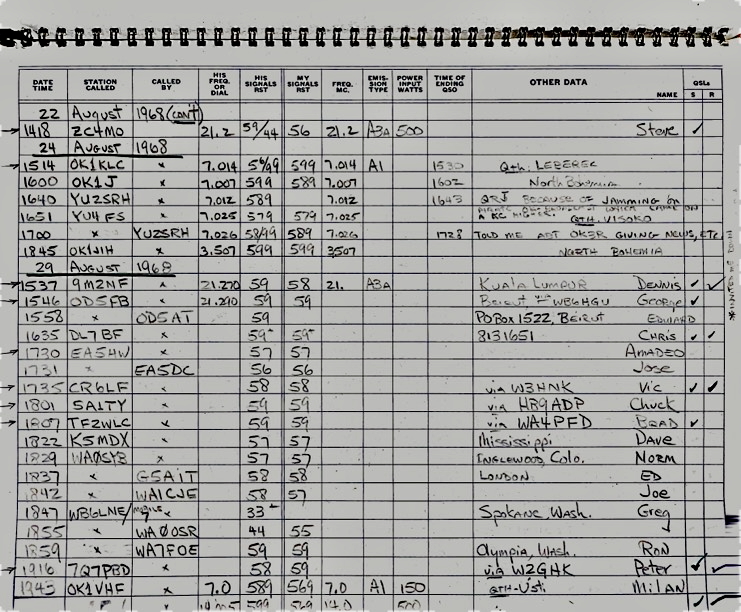
Higbie’s logbook, operating with the amateur radio callsign DL4QQ, from Aug. 24, 1968. Click to enlarge.
Amateur radio operators’ two-way conversations are typically an exchange of signal reports, their name and locations, mention of their equipment and perhaps, the weather.
The ham setup at Andrews Barracks in Lichterfelde was first rate: a Collins S-Line transceiver, a high-power transmitting amplifier and a directional yagi antenna mounted on a tower.
In the days after the Russian military invaded Czechoslovakia, Higbie began having unusual conversations on the amateur frequencies.
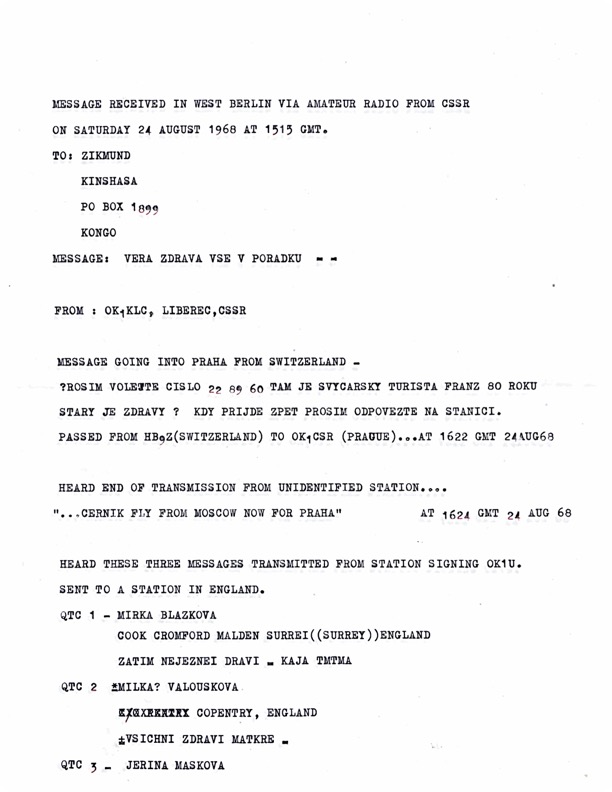
Using Morse Code on the 40-meter band, Higbie made contact with OK1KLC and other stations in Czechoslovakia and listened to other radio amateurs engaged in brief conversations in German and English.
Instead of just talking about ham gear and the weather, the Czech operators pleaded with those in western Europe to relay urgent messages to relatives who were not behind the Iron Curtain.
Since Higbie was using a German call sign, others had no idea he was in the U.S. military. Some of the Czechs, to protect their identity and detection, began using fake call signs, which is normally a taboo. They sent messages for relay to England, the Congo and other destinations.
Call sign OK1J, identifying himself as located in North Bohemia, asked that “you give this news for all the world. Thank you very much, okay?” The Czechs want the world to know that Prime Minister Oldřich Černík, a staunch supporter of the Prague Spring reforms “fly from Moscow now.”
Days earlier, Černík had been forced to go to the Soviet Union and when he returned to the Czech capital he implored the public to cooperate with the invaders, while dubiously promising he would continue to support reform.
As Higbie wrote down these messages, he heard deliberate interference on the frequencies the Czechs were using. Most likely the Soviets were engaged in jamming to try to prevent the transmissions from Czechoslovakia getting through to the West.
A typed copy of Higbie’s QSOs as DL4QQ, from Aug. 24, 1968. Click to enlarge.
One Czech operator said he would like to continue to transmit but “I have to get off now” because helicopters with direction finding equipment were trying to locate him and the other amateur radio stations.
Another radio amateur, tapping away in Morse Code in German, revealed that “many foreign soldiers stop our automobiles and take our gasoline, seize transistor radios, take bread and other food” and had also imposed a 9 p.m. curfew.
The Czech operators asked that the information be passed to the BBC. Higbie says he complied with this request to dispatch the message to the newsroom in London.
On the streets, Czech citizens engaged in non-violent resistance, taking down street signs to confuse the invaders, confronting tanks with offerings of flowers and shouted, “Ivan Go Home!”
Warsaw Pact troops fatally shot more than 100 peaceful protestors.
A fellow American amateur radio operator stationed in Berlin, who was an officer with military intelligence and not in Higbie’s chain of command, asked Higbie to share this type of information with him and his unit, but Higbie politely declined.
“This was ham-to-ham kind of stuff, and I felt a little strange and would be like a betrayal of the amateur spirit, so I declined the offer as it wasn’t an order, wasn’t part of my job,” Higbie recalls.
Higbie ironically adhered to a strict line between his amateur radio hobby and U.S. intelligence, despite his day job of intercepting radio signals and phone calls from East German officials and soldiers on behalf of the NSA.
“We like to keep it a hobby. I was young. I really had a firm set of ethics,” remembers Higbie. “It just didn’t seem right to me.”
The military intelligence office, surprisingly, “as a ham, he respected that and that was the last I heard of it.”
By Aug. 27, it was all over in Prague.
A doleful Dubček, who had been arrested and flown to Moscow, addressed his nation.
“We hope that you will trust us even though we might be forced to take some temporary measures that limit democracy and freedom of opinion,” said Dubček.
On the other side
The Communists in Prague would remain submissive to the Kremlin until the 1989 Velvet Revolution which climaxed with dissident writer Václav Havel being elected president. The Cold War would end two years later with the dissolution of the Soviet Union.
Higbie was long gone from Teufelsberg by then. Although after his initial four years he had become an instructor of special intelligence, teaching others the specialized vocabulary related to the communications systems they were monitoring, Higbie did not re-enlist in 1971.
He gained admission to the University of California – Berkeley, resuming his college education. Higbie grew his hair long but kept up his grades, graduated and then went to law school at the University of San Francisco. He moved to Colorado where he passed the bar exam and became a trial lawyer, specializing in criminal defense and personal injury cases.
Higbie is still an amateur radio operator, call sign K0AV, and he takes special enjoyment in digging out weak and distant signals. Occasionally, he finds himself engaged in a Morse Code chat with fellow hams in the Czech Republic. The conversations usually are centered on mundane topics, such as an exchange of weather reports.
But Higbie sometimes wonders if the person on the other end might be one of those who sent him a dramatic message during those fateful days of Czech history in the summer of ’68.
“Show Us Your Mic Collection” is a new Radio World feature in which intrepid broadcasters and readers show off their microphones. Have a submission? Email us at radioworld@futurenet.com.
Does the “cool factor” of your gear actually change how you work? Is there a psychological boost to using equipment that is high-end, sleek and just plain fun to operate? Or is it all just window dressing?
Meet Geoffrey Hacker, a design engineer and collector who views microphones not just as transducers, but as masterpieces of industrial design.
With a doctorate in Industrial-Organizational Psychology from the University of South Florida, Hacker is uniquely qualified to explore the intersection of form and function. His fascination lies in the “why” — specifically, how great curves, lines, and colors affect the human experience.
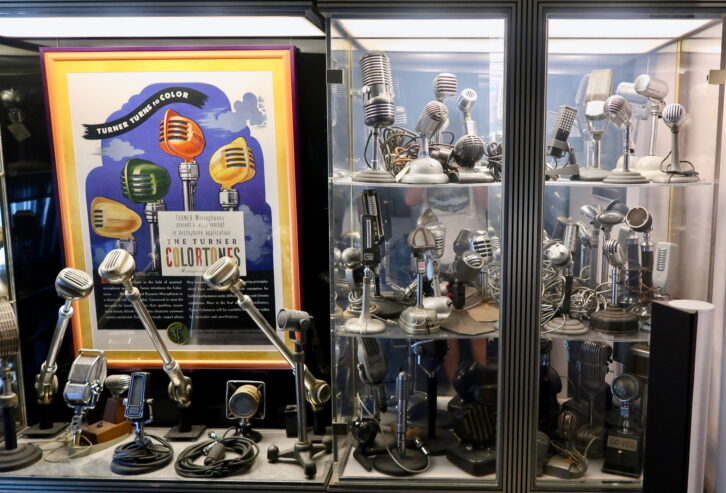
Geoffrey Hacker’s glass-enclosed mic collection, which includes an entire Art Deco color collection of the Turner Colortones microphones. These mics are rare due to limited manufacturing, and because the plastic or lacquer over metal meant they were easily damaged due to chipping, fading or stage use, which made them less popular.
Hacker’s journey into collecting began 20 years ago with microphones, which eventually led him to the world of rare, hand-built automobiles. As the founder of Undiscovered Classics, he now spends much of his time researching, restoring, and showing one-of-a-kind prototype cars.
But he hasn’t forgotten his audio roots. Many of us in the broadcast industry know that if a studio is clean and the gear looks “pro,” talent and engineers are less likely to blame an error on “crappy gear” — and they tend to treat the equipment with more respect.
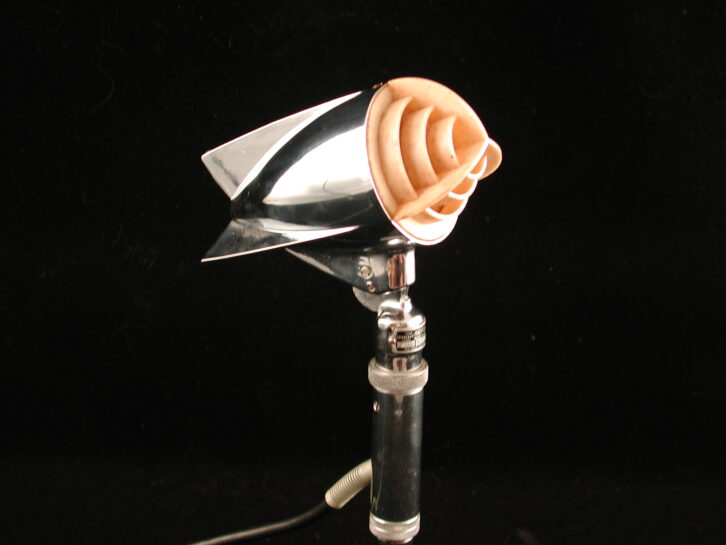
“I’ve always loved design,” Hacker told us. “Around 2005, I came across an Astatic 600. It was only produced for a single year, and that rarity piqued my interest. As I researched its history, I discovered a wider range of stunning designs across various manufacturers than I ever could have imagined.”
The Astatic 600 Conneaut “Rocket Ship” Microphone. The company started out in Youngstown, Ohio in the 1960s and later moving to Conneaut, Ohio. It was founded by two amateur radio operators.
Hacker’s collection blossomed from there, fueled by advice from collectors and historians across the country.
We noted in particular Hacker’s Turner Colortone mics — and he has them in all colors, made specifically in 1955–1956. They were short-lived due to the fact they were plastic/lacquer coated and didn’t hold up well on stage.
But Hacker’s core background is neither professional audio nor radio. In fact, Hacker credits his friend, Tim Masters, a musician and recording artist, for testing the models in his collection.
“I am strictly driven by the design aspect,” Hacker explained, “that’s what fuels my passion for collecting.” As a result, while Hacker has used a few of them for his recording studio, he’s never personally tested a microphone he acquired.
His Astatic 600 is his personal favorite, as it’s what he said kicked off the mic collecting hobby. “However, I recently found an American C-5 after searching for over 15 years,” he told us. “That was a major win for the collection.”
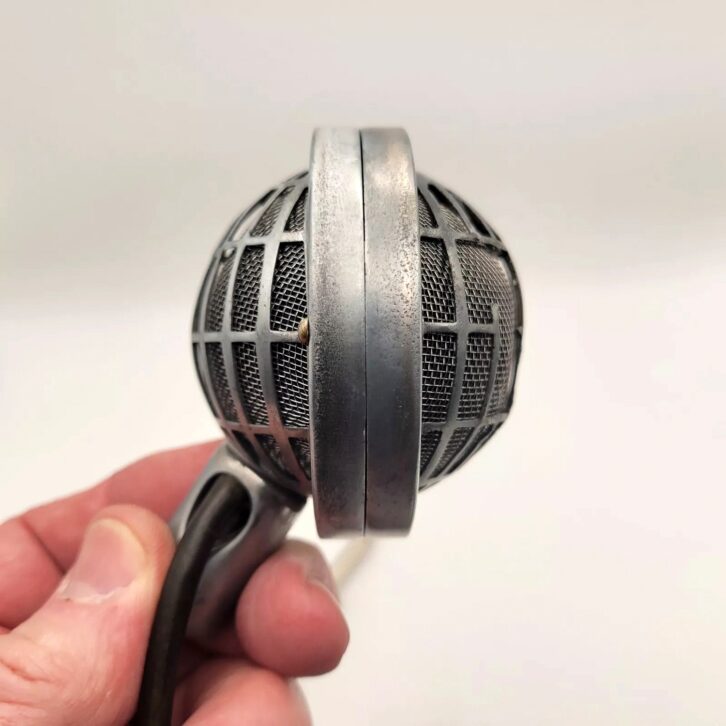
After 15 years, Hacker uncovered an American C-5 microphone. From the late 1930s into the early 1940s, carbon and crystal mics like this were quickly considered inferior due to dynamic and ribbon mics of the decade.
Which one is the best sounding?
Hacker simply isn’t sure. He asks you, the reader, if you have used any of the models in his collection and what your audio impressions are.
If you’ve used any of the mics in Geoffrey’s collection and want to share your technical feedback or memories of the gear, we want to hear from you! Contact us at Radio World or email Geoffrey directly.

 Connexion