Vue lecture

Wireless Microphone Spectrum Alliance Pushes for Spectrum Access
Wireless Microphone Spectrum Alliance

With major U.S. events like the Super Bowl, FIFA World Cup, America 250 and the 2028 Olympics becoming ever more important for broadcasters, the Wireless Microphone Spectrum Alliance (WMSA) has been highlighting the need for spectrum to operate wireless microphones. This spectrum is particularly critical for high-profile events that include global broadcasts, multiple live performances, in-game/in-event announcements, and more, the group said.

The push to raise awareness about the importance of spectrum for the production of major events comes at a time when the Federal Communications Commission is planning to auction off more C-Band spectrum and the U.S. Congress has authorized spectrum sales.

WMSA was formed last year in an effort to raise awareness with the FCC, Congress, the White House and NTIA about how critical wireless microphones are to live performance, broadcast and cultural events, the association said. Comprised of a coalition of manufacturers, audio engineers and broadcast professionals, WMSA’s mission is to preserve and protect spectrum for professional wireless use so events like these can proceed with uninterrupted audio quality.

For example, the events surrounding the Super Bowl create a major demand on radio frequency spectrum for wireless microphones. It is the most amount of wireless deployed for a single sporting event and these requirements continue to increase.

[Related: “WMSA Puts the Spotlight on Sound”]

For such events, WMSA noted that producers require:

  • Massive scale: Hundreds of wireless channels are needed for talent, crew, referees and sideline personnel.
  • Frequency coordination: Game Day Coordinators allocate spectrum, prioritizing operations, venue, teams and broadcasters.
  • Interference mitigation: Professional audio engineers use techniques like multiplexing, directional antennas, and meticulous frequency planning to help prevent signal clashes.
  • Equipment: High-end wireless systems, specialized software and robust distribution gear are essential.

Across all platforms, use of wireless microphones supports content creation sectors valued at approximately two trillion dollars in economic value globally and poised to pass three trillion dollars by 2025, according to A. Guttman.

WMSA believes that spectrum is under threat as the remaining spectrum accessible to wireless microphones in the 470–608 MHz band – which is shared with broadcasters, white space devices, public safety operations, etc. – is insufficient.

For example, spectrum scans taken in various U.S. cities after 2017, following the incentive auction and loss of access to the 600 MHz band, show limited or no available TV channels for wireless microphones.

This has necessitated an increasing reliance on Special Temporary Authority (STA) grants by the FCC to access spectrum typically not allowed for wireless mics in order to support medium and large-sized events. However, STAs are ad hoc, unpredictable, burdensome on staff and, according to the WMSA, simply not a viable long-term solution to this continuing and growing need.

Data from the Paris 2024 Olympic Games revealed that 89 percent of all audio links used were within the 470–694 MHz range.

WMSA has recently met with the FCC and other organizations in Washington, D.C., to work on solutions for this to help preserve existing spectrum and get access to new spectrum for wireless microphones. WMSA is encouraged by the progress of those meetings.

The current focus on spectrum for commercial 6G use is on bands above 2.5 GHz and not on the TV-UHF band used by wireless mics. However, WMSA continues to remain vigilant that the focus does not shift to the TV-UHF frequency range.

WMSA said it has successfully engaged with relevant U.S. Federal agencies to secure access to additional spectrum.

[Visit Radio World’s News and Business Page]

The post Wireless Microphone Spectrum Alliance Pushes for Spectrum Access appeared first on Radio World.
  •  

Nebraska Public Media Agrees to Acquire Omaha’s KOOO(FM)

Nebraska Public Media has agreed to acquire Class C0 FM 101.9 KOOO(FM) and convert its license to noncommercial radio.

The acquisition is pending approval by the FCC. Terms of the deal were not immediately disclosed.

KOOO is licensed to La Vista and has full-market coverage of Omaha–Council Bluffs, operating with 100,000 watts ERP. The station is owned by NRG Media and runs a variety hits format as “The Keg.”

The signal will give Nebraska Public Media its first dedicated signal in the Omaha market. According to a release, it plans to run news/talk programming during the day, including Omaha news and statewide news updates.

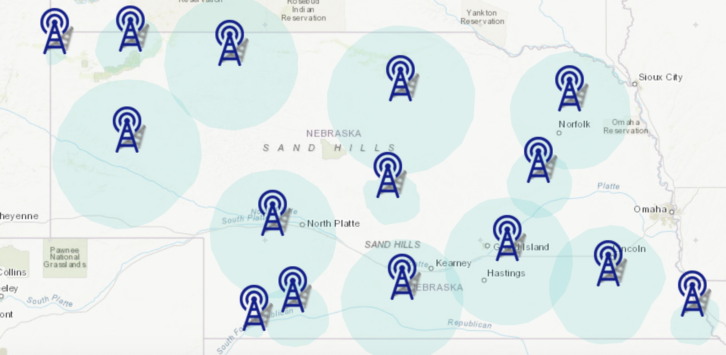
Existing FM affiliates of Nebraska Public Media, from the organization's website.
Existing FM affiliates of Nebraska Public Media, from the organization’s website.

The organization’s plans for the signal also include adult album alternative music during the evenings and overnight. “The format choice reflects Omaha’s history of supporting alternative and independent music,” the release said.

The Omaha market does have an existing full-time NPR affiliate with 91.5 KIOS(FM), which is owned by Omaha Public Schools.

NRG Media is selling its five other Omaha stations to Usher Media, according to RadioInsight.

[Do you receive the Radio World SmartBrief newsletter each weekday morning? We invite you to sign up here.]

The post Nebraska Public Media Agrees to Acquire Omaha’s KOOO(FM) appeared first on Radio World.

  •  

Corporation for Public Broadcasting’s Harrison Delivers Final Remarks

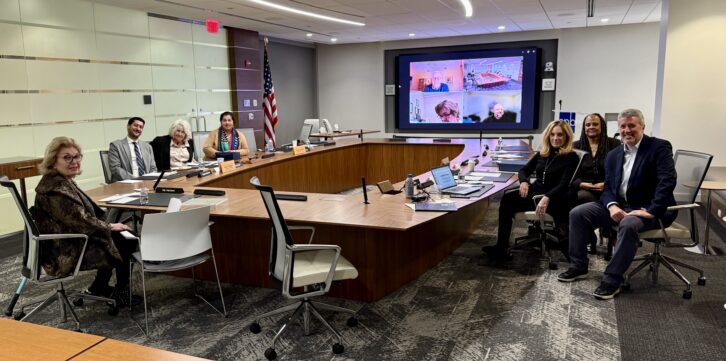
CPB's final board meeting on Jan. 29.
CPB’s final board meeting on Jan. 29.

On Thursday, Corporation for Public Broadcasting President and CEO Patricia Harrison delivered her final remarks during the organization’s last board meeting.

In remarks obtained by Radio World, Harrison said that following Congress’ rescission of federal funding for public media, CPB realized it could no longer operate in the manner the American public has come to expect.

“In a profound irony, it is precisely because public media remains so essential to American civic life that CPB’s final act must be to dissolve for the greater good,” Harrison said.

Harrison, 87, became CEO of CPB in 2005.

CPB’s board of directors voted to dissolve the organization at the beginning of the month, after 58 years of operation.

On the Senate floor Thursday, Sen. Ed Markey (D-Mass.) honored Harrison in his remarks.

“Throughout her tenure, Harrison ensured that CPB’s investments strengthened service to local communities and delivered lasting public value,” he said.

Why?

In her remarks, Harrison attempted to address the exact reasoning behind the organization’s defunding.

 “Was it a burden to the taxpayer?” she asked. “Was this a cost-saving move? No. Unlike in other countries where citizens are heavily taxed — for example, the BBC and the NHK — American public media outlets reflect the free-enterprise and volunteer ethic of our citizens.

“For $1.65 a year in taxes — less than the cost of a cup of coffee — every American has access to content that inspires independent thinking and understanding of the rights and responsibilities of Americans living in a vibrant democracy,” she said. 

But in the wake of the federal rescission of funding for public media, CPB came to the realization that it had limited time to protect its legacy and the work it had done, Harrison said. 

“The longer CPB tried to exist without funding, the higher the prospect that our remaining funds would never reach the public media system already reeling from the defunding,” she said.

The organization was also concerned that any remaining funding could become subject to content-based restrictions and compliance demands that would “further harm stations” and erode public trust.

“After all of the political attacks and congressional defunding, we recognized a hard truth: Without funding and independence, CPB risked becoming a liability to public media rather than a protector of it — something that looked intact from the outside but was hollow at its core,” she said.

Compliance

According to Harrison, CPB was the first organization to sue the Trump administration over “attacks” on public media’s independence and the withholding of appropriated funds. She said that the organization refused to comply with executive directives that violated its mission or the editorial independence of local stations, continuing to fund PBS and NPR until the end.

“We could have survived by complying with demands for political control over news coverage, by rewriting history, by limiting the stories and information shared with the American public, by abandoning diverse talent, or by supporting content that increases divisiveness through disinformation,” Harrison said.

“But that was never going to happen on our watch, and that is less than what the American people deserve.”

Since October, Harrison said that CPB has granted approximately $170 million to the public media system. It has also invested in the American Archive of Public Broadcasting and helped to fund national distribution of locally produced programming through American Public Television, she said.

Legacy

Harrison concluded her remarks by thanking CPB’s board, PBS’ CEO Paula Kerger and then she closed with a call to action.

“The future of public media and our nation depends on each of you. It depends on our collective ability to look upon the next evolution of media and ensure it is harnessed for the purpose of educating and connecting all people,” she said.

“Together, we will prove that a nation of neighbors will survive.”

Radio World welcomes letters to the editor on this or any story. Email radioworld@futurenet.com.

The post Corporation for Public Broadcasting’s Harrison Delivers Final Remarks appeared first on Radio World.

  •  

Connoisseur Media Replatforms With Super Hi-Fi

Super Hi-Fi + Connoisseur

Super Hi-Fi and Connoisseur Media have announced a partnership bringing Super Hi-Fi’s AI-powered radio operating system to several of Connoisseur’s stations.

The deal involves an expanded business relationship too, with Jeff Warshaw joining the board of Super Hi-Fi.

Billed as a replatforming of select Connoisseur stations, Super Hi-Fi’s AI Radio operating system is now being used on 95.9 WERV(FM) in Aurora, Ill., and 104.1 KKUS(FM) in Tyler, Texas, as well as Connoisseur properties in Columbia, S.C., San Antonio and Lincoln, Neb., according to a release. The company expects more instances of AI Radio to launch on its stations this year.

AI Radio is an operating system that runs in the cloud and is centered around “Program Director,” which Super Hi-Fi said is powered by AI technologies that schedule, produce and send each station’s audio to a playout device at the transmitter.

The platform will allow Connoisseur to replace “outdated workflows” with Super Hi-Fi’s AI-driven services, promising lower overall operating costs while elevating audio production standards.

“Our mission is to have the best live and local radio experience in every market across America, and Super Hi-Fi’s unique capabilities will allow us to do that in ways the industry just didn’t have before,” Warshaw, the CEO of Connoisseur Media, said in a release.

The release also indicated that Warshaw will join Super Hi-Fi’s board of directors.

Connoisseur became a top 10 radio group by station count last year with its acquisition of Alpha Media’s 207 stations.

Since that deal was made, Connoisseur has spun off signals in a handful of markets, including 15 signals in Missouri, its Bakersfield, Calif. properties and four stations in Minnesota and South Dakota.

[Related: “Audiospace Wins Digital Contract From Connoisseur”]

The post Connoisseur Media Replatforms With Super Hi-Fi appeared first on Radio World.

  •  

CPB Approves Interconnection Payments to Stations

As one of its final acts, the Corporation for Public Broadcasting will award funds for program distribution directly into the hands of eligible public media stations.

In a message to station managers sent Thursday, CPB CEO Patricia Harrison announced that its board has approved approximately $12 million in remaining interconnection funds for the initiative.

But she noted that stations have not historically received these funds directly.

The grants are specifically earmarked as “interconnection dollars” — a category defined by the Public Broadcasting Act and the appropriations legislation that provided the funding. The legislation charges CPB with supporting the systems and technologies that enable public media content to be distributed to stations and then to listeners.

Stations that receive funding can choose to spend it directly with national public media interconnection providers — such as PBS, the newly formed Public Media Infrastructure or NPR — or on other technology that enhance their ability to distribute content to audiences, a CPB spokesperson said. 

CPB had announced it awarded a $57 million grant to PMI for distribution in September. A contentious dispute with NPR followed. NPR manages the Public Radio Satellite System, the primary distribution channel for public media outlets.

When asked by Radio World if the announcement reflects a renewed harmony with NPR following the dispute, the CPB spokesperson said that as the corporation shuts down, it is critical that the distribution system at large work in partnership to preserve public media.

PMI, NPR, PBS and other partners “stand ready to serve together” as stations consider how to invest in distribution, technology and service to their communities, Harrison said in the statement. 

She added that CPB has already made large investments at the national level to sustain the system.

“This final interconnection allocation builds on that foundation by giving stations the flexibility to invest directly in the technologies, services and partnerships that best meet their local needs and evolving audience expectations,” Harrison wrote.

Additional information on the grant awards and the distribution process will follow, she indicated.

CPB’s board of directors voted to dissolve the organization earlier this month after 58 years of service. It had announced it would begin winding down operations in September following Congress’ rescission of federal funding for public media.

[Do you receive the Radio World SmartBrief newsletter each weekday morning? We invite you to sign up here.]

The post CPB Approves Interconnection Payments to Stations appeared first on Radio World.

  •  

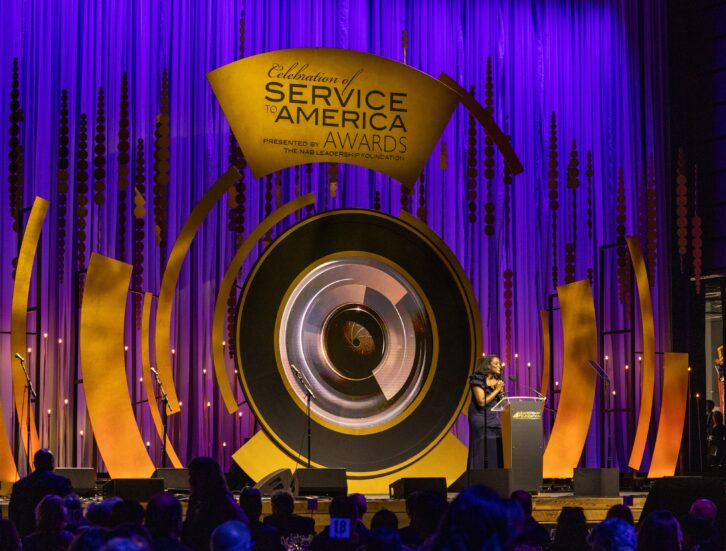
Entries Open for Celebration of Service to America Awards

The 2025 Celebration of Service to America Awards. Credit: NABLF

The National Association of Broadcasters Leadership Foundation is now accepting entries for the 2026 Celebration of Service to America Awards

The awards honor the role local radio and TV stations play in serving communities across the country. Last year’s winners included 830 WCCO(AM) in the Twin Cities, 98.7 WYCT(FM) in Pensacola, Fla., 570 WWNC(AM) in Asheville, N.C., 1090 WBAL(AM) in Baltimore and the Beasley Media Group.

All stations and broadcast groups are encouraged to submit their most impactful community service campaigns that took place last year. The entry window will close on March 23 at 11:59 p.m. PT.

This year, the foundation is introducing an Original Content Podcast category to recognize stations that are offering content to their local areas and beyond via a podcast app or station website, according to a release.

Additionally, the First Informers Award will recognize one radio and one television station as exemplary sources of immediate information during emergencies, crises or natural disasters.

“No other media platform matches the power of local television and radio to reach people in real time where they live and work,” NAB Leadership Foundation President Michelle Duke said in the release.

Winners will be notified in early April, and awards will be presented at the Celebration of Service to America Awards Gala in Washington, D.C., on June 9. The foundation said that members of Congress and other policymakers are expected to attend.

The Celebration of Service to America Awards is presented by Bonneville International and Hearst Television.

The NAB Leadership Foundation was established as a nonprofit entity by the National Association of Broadcasters to dedicate resources to developing programs that serve broadcast professionals.

[Visit Radio World’s News and Business Page]

The post Entries Open for Celebration of Service to America Awards appeared first on Radio World.

  •  

Ocean State Media to Acquire WVEI(FM) From Audacy

Rhode Island-based Ocean State Media Group has announced an agreement to acquire 103.7 WVEI(FM) in Westerly, R.I., from Audacy.

The transaction is subject to FCC approval. WVEI had been the Providence-area simulcast for Boston’s sports-formatted 93.7 WEEI(FM) since 2004.

WVEI was also the Providence-area home for Boston Red Sox baseball.

In a release, the public media group cited the benefit of listeners being able to tune to a single frequency for its programming. Previously, Ocean State Media relied on a network of five frequencies across Rhode Island and southeastern Massachusetts: 89.3 WNPN(FM) in Newport, 89.5 WNPW(FM) in Westerly, 90.7 WNPH(FM) in Portsmouth, 102.7 WNPE(FM) in Narragansett Pier and 1290 WPVD(AM) in Providence, which is also heard on a 102.9 FM translator.

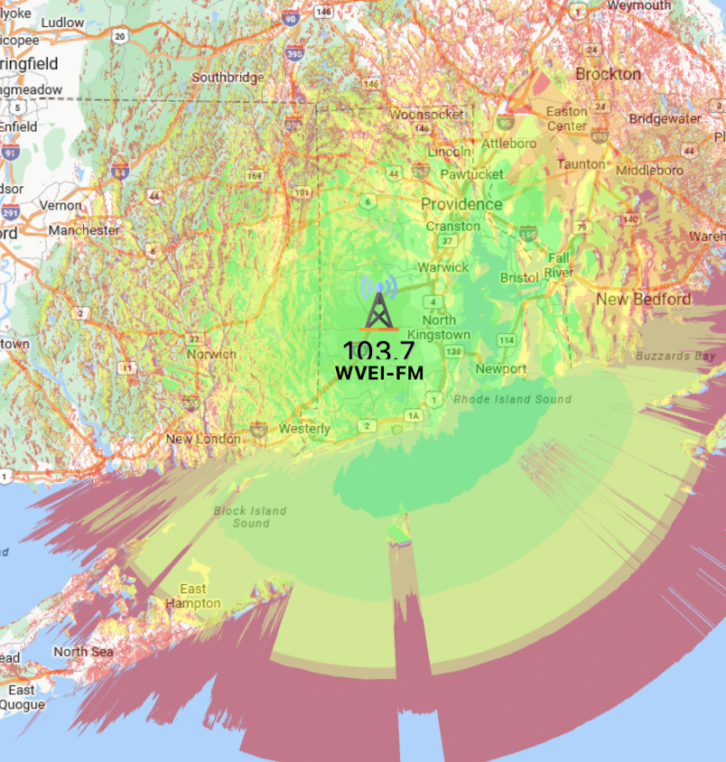
WVEI operates with a Class B FM signal at 37 kW ERP, easily covering the state.

WVEI(FM)'s Longley-Rice coverage area, from the RadioLand app.
WVEI(FM)’s Longley-Rice coverage area, from the RadioLand app.

Ocean State Media CEO Pam Johnston, in a podcast interview posted on the outlet’s website, cited a cost of $4.9 million and said the transition to take over the signal could take up to 90 days.

It will involve consolidating operations and “transitioning from five frequencies to one,” including transmission equipment that would be financed over a period of time.

“The change will improve broadcast quality while also allowing for long-term operational efficiencies,” a release on the outlet’s website said.

Rhode Island Public Radio merged with PBS affiliate WSBE(TV) in 2023, a deal finalized in April 2024. In June 2025, Rhode Island PBS and “The Public’s Radio” were rebranded as Ocean State Media.

In 2023, Audacy closed its Providence local sales and marketing office for WVEI.

[Do you receive the Radio World SmartBrief newsletter each weekday morning? We invite you to sign up here.]

The post Ocean State Media to Acquire WVEI(FM) From Audacy appeared first on Radio World.

  •  

Study: Local Radio and TV Supports 2.46 Million U.S. Jobs

A new study commissioned by the National Association of Broadcasters touts the economic benefits U.S. radio and TV stations provide for their states big and small.

The research, conducted by Woods & Poole Economics and supported by BIA Advisory Servicesfound that local broadcasting supports approximately 2.46 million jobs nationwide, including about 909,000 in radio.

“No other industry gives more to Americans for free,” said Curtis LeGeyt, president and CEO of NAB, in a release.

The study identified some $1.19 trillion in Gross Domestic Product from local broadcasting, including approximately $437 billion from radio.

In total, it found that radio and TV stations directly employ approximately 310,000 Americans and generate $54 billion in GDP through journalism, programming, engineering and advertising.

Advertising on local TV and radio stations, the study found, generates approximately $997 billion in GDP and helps sustain around 1.37 million jobs.

State-by-state

Rank State Radio GDP (Billions) Commercial Radio Stations
1 California $51.12 656
2 Texas $39.11 776
3 Florida $27.51 445
4 New York $26.44 374
5 Illinois $18.39 322
6 Pennsylvania $16.36 351
7 Ohio $15.13 289
8 Georgia $14.03 349
9 North Carolina $13.32 332
10 Virginia $13.03 264
Source: 2025 Woods & Poole Economics, Inc. 

Texas leads the nation in the sheer number of commercial radio stations, according to the study, with 776. The Lone Star State supports approximately 81,120 jobs and generates $39 billion in GDP.

While Texas has more stations, California sees the highest economic return from radio, generating $51 billion in radio-related GDP and supporting 100,000 jobs.

Even a rural state like Wyoming, with a population of just 587,000, is served by 126 commercial stations— about one station per 4,600 people — and supports approximately 2,170 jobs.

Projections through 2028

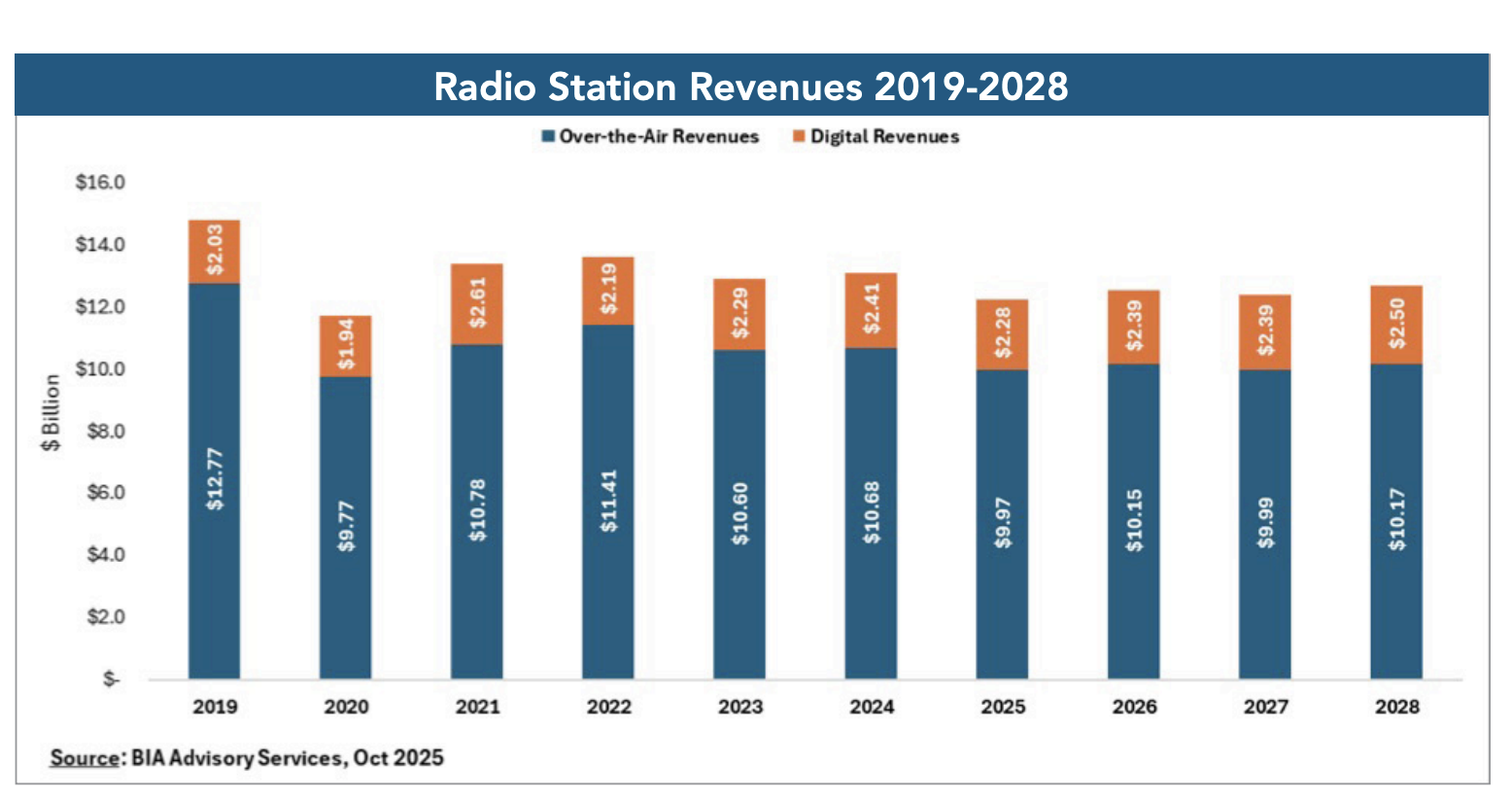
Radio Station Revenues 2019-2028
A year-by-year look and projection of radio OTA and digital revenues, from BIA Advisory Services. Click to enlarge.

The study also uses BIA Advisory Services data to project revenue through the year 2028.

Radio over-the-air revenue, according to the study, is projected to dip slightly, from $10.68 billion in 2024 to $10.17 billion in 2028.

Digital revenue for radio in that same period is projected to grow from $2.28 billion to $2.55 billion.

All of the estimates provided in the report are for 2024. The estimates of local television and radio employment were obtained from the U.S. Department of Commerce Bureau of the Census, according to the study. Employment estimates by detailed industry for broadcasting and advertising were used to create U.S. and state employment estimates for TV and radio.

Woods & Poole Economics is a firm that specializes in long-term county economic data and demographic data projections, while BIA Advisory Services provides forecasting and valuation services for the media industry.

[Do you receive the Radio World SmartBrief newsletter each weekday morning? We invite you to sign up here.]

The post Study: Local Radio and TV Supports 2.46 Million U.S. Jobs appeared first on Radio World.
  •  

Northeast Ohio Gets FM Primary EAS Station

In greater Cleveland, there is now an FM alternative for Emergency Alert System participants.

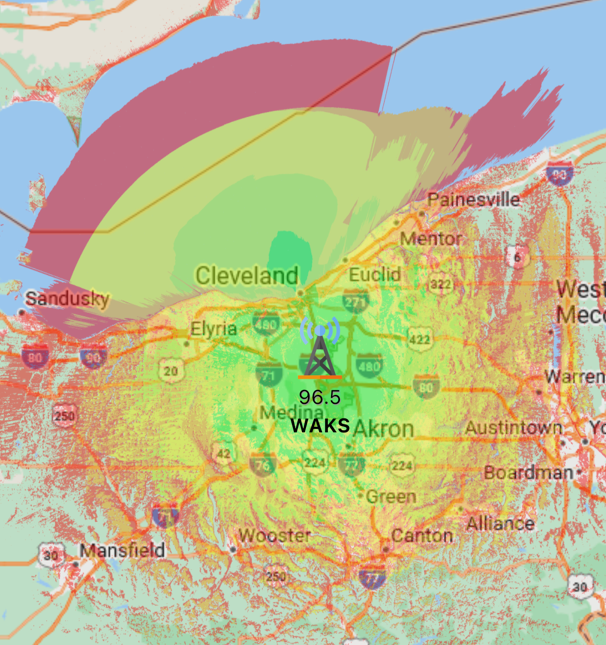
On FM, iHeartMedia’s 96.5 WAKS(FM), licensed to Akron but with its transmitter located in Brecksville, is now providing local, state and national LP-1 level EAS alerts for radio, TV or cable operators to monitor with their EAS equipment, in addition to sister station 1100 WTAM(AM), the 50,000-watt Cleveland AM.

According to Greg Savoldi, iHeartMedia’s director of engineering in Cleveland and the chairman of the Ohio State Emergency Communications Committee, the addition is due to the proliferation of man-made electrical interference on the AM band.

WTAM is the LP-1 station, while WAKS will be designated as LP-1A.

WAKS
The Longley-Rice coverage areas of 96.5 WAKS(FM), from the RadioLand app.

Savoldi said the project was developed last year and is now ready for use by any radio, TV or cable operator in the central and east lakeshore EAS operational area that extends along Lake Erie from Erie County east to the Pennsylvania border.

WCLV(FM), on 90.3, remains the LP-2 station in the operational area, according to Savoldi.

Per the Ohio EAS plan, all stations are required to monitor at least two LP-class stations.

[Do you receive the Radio World SmartBrief newsletter each weekday morning? We invite you to sign up here.]

The post Northeast Ohio Gets FM Primary EAS Station appeared first on Radio World.
  •  

BSW Transfers Ownership to CEO Bryan Seeley

After 44 years at Broadcast Supply Worldwide, Tim Schwieger has chosen to retire, transferring ownership to Bryan Seeley, BSW’s sitting president and CEO.

Seeley, who joined BSW in 2012, was promoted to his current role one year ago in January 2025. At the time, Schwieger remained at the company as chairman of the board.

“This transition ensures continuity for our customers and staff,” said Schwieger in a company press release. “Bryan understands our core values, our clients and our commitment to exceptional service.”

BSW says operations, staff and services will continue without interruption.

Tim Schwieger (left) and Bryan Seeley

In the release, Seeley said it’s an honor to follow in Schwieger’s footsteps.

“BSW’s clients and employees can expect the same dedication, integrity and rigorous commitment to flexibility they’ve always known, along with a continued focus on growth and innovation,” he said.

[Related: “Seeley: Broadcast Equipment Dealers Will Always Have a Place in This Industry“]

Prior to becoming president and CEO, Seeley was BSW’s director of marketing and sales. BSW says Seeley played a key role in launching a new website and modernized point-of-sale system, and has been responsible for a market expansion and diversification of product offerings.

He has 25 years in the audio industry and a degree in jazz performance from Cornish College of the Arts.

BSW’s corporate offices are located in Tacoma, Wash., with its shipping center located in Ohio. The broadcast equipment supplier has been in business since 1973.

[Sign Up for Radio World’s SmartBrief Newsletter]

The post BSW Transfers Ownership to CEO Bryan Seeley appeared first on Radio World.

  •  

Radio Gives Back This Holiday Season

With the Christmas holiday just a couple of days away in the United States, broadcasters across the country have been raising funds to benefit the less fortunate. From city-wide radiothons to toy drives to fundraising for local children’s hospitals, our radio circles have been busy giving back to their communities. In this story, we feature a roundup of heartwarming stories that have been sent to Radio World’s inbox.

We know that these stories represent a very small percentage of all the community events taking place across the U.S. Want to share how your station giving back this holiday season? Email me at elle.kehres@futurenet.com.

Helping Our Furry Friends

WBEN(AM) and WLKK(FM) — Audacy stations in Buffalo — raised $132,000 during the 22nd-annual “SPCA Serving Erie County Radiothon” presented by Trocaire College. Proceeds from the radiothon help the SPCA provide vital care, including food, shelter and medical attention to pets and wildlife.

“This annual event really brings the community together and the amount raised is a testament to the generosity of our listeners,” said Tim Wenger, senior vice president and market manager for Audacy Buffalo. “We love supporting SPCA’s mission and giving second chances to pets and animals in Buffalo.”

The radiothon took place on Dec. 11. Throughout the day, station hosts featured interviews and stories showcasing the impact of the SPCA Serving Erie County in the Buffalo community. Listeners were also invited to adopt a new pet, with half-off adoption fees for animals six months and older.

Toys for South Florida

Also on Dec. 11: WXKB’s annual “Turn Up for Toys Toy Drive” raised more than $26,000 for the Salvation Army. The Beasley Media Group station also collected a box truck full of bikes and toys to help families across southwest Florida celebrate the holiday season.

The four-hour live broadcast, held from 6 a.m. to 10 a.m., was powered by the passion and commitment of Budman and Marija of the WXKB “Wild Bunch Morning Show,” along with the support of listeners, community partners and the Beasley Fort Myers team.

“I’m really proud of Budman and Marija,” said Adam Star, WXKB operations manager. “They made Christmas possible for so many families, and it’s a powerful reminder of the impact we can have when we come together and use the power of radio.”

A Busload of Gifts

Speaking of toy drives: WNVZ(FM), an Audacy station in Norfolk, Va., hosted its 20th-annual “Stuff the Bus Toy Drive,” benefiting Toys for Tots. The drive, which ran from Dec. 1–5, brought in 10,438 toys and 170 bicycles.

During the week, WNVZ hosts did live broadcasts from various Hampton Roads venues. The local community came out to stuff the bus with new, unwrapped toys, including Congresswoman Jen Kiggans, Mayor Phillip Jones and Sheriff Rocky Holcomb.

Shaggy, a dedicated supporter since the Toy Drive’s inception, received the Commander’s Award from Toys for Tots, the highest recognition given by the U.S. Marine Corps to individuals who have made significant contributions to the Toys for Tots mission. His dedication was further acknowledged by a letter of gratitude from Governor Glenn Youngkin.

Stronger Together

Dec. 11 was indeed a very busy day for radio! Beasley Media Group Charlotte’s WNKS(FM) spread holiday cheer with purpose during its “Secret Santa Radiothon,” raising more than $25,000 for the Autism Strong Foundation during a 13-hour live broadcast.

Organizers said listeners showed up in a big way — calling, donating and sharing personal stories to support families touched by autism. The funds raised will help the Autism Strong Foundation continue providing financial assistance, fostering community and delivering hope to those navigating the autism journey.

Golfing for Charity

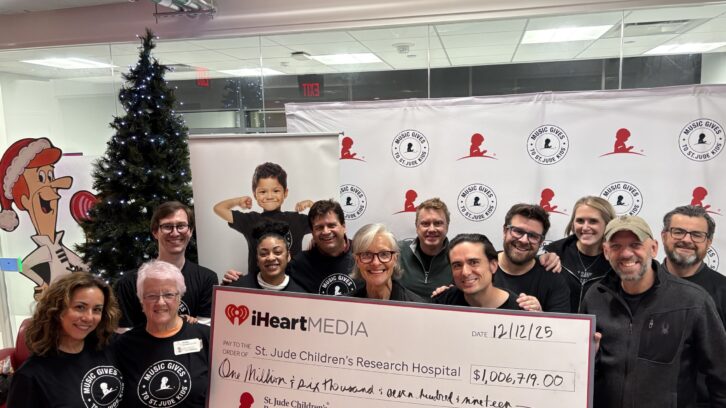
iHeartMedia Houston’s annual “St. Jude Week” kicked off on Dec. 8 with a golf competition. With subsequent radiothons held across the cluster on Dec. 11 and 12, the radio group raised more than $1 million for the children’s hospital.

The “St. Jude Houston Golf Classic,” held at the Golf Club of Houston, was an event led by Paul Lambert, president of iHeartMedia Houston, with the help of on-air personalities Michael Berry and Doug Pike. The Golf Classic raised over $400,000. Radiothons at the end of the week broadcast on KODA(FM), KTBZ(FM), KTRH(AM), KBME(AM) and KPRC(AM) raised over $600,000.

“Because of fundraisers like ours, families at St. Jude never have to worry about a bill for treatment, travel, housing or food,” said Marc Sherman, executive vice president of programming. “Their only focus can be helping their child fight for life. That’s the gift our donors, listeners and sponsors make possible — and we are profoundly grateful for their compassion and support.”

Since 2013, iHeartMedia Houston has raised more than $7 million for St. Jude Children’s Research Hospital.

Making Wishes Come True

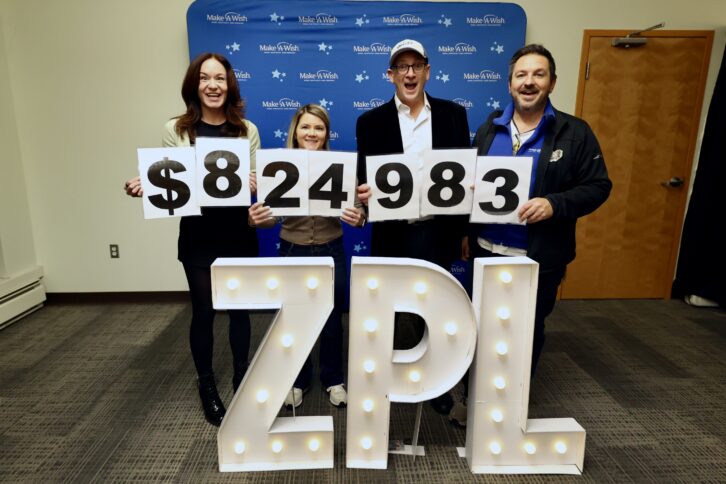
The 29th-annual “Make-A-Wish Request-A-Thon” on Cumulus Media’s WZPL(FM) in Indianapolis raised $824,983 and granted 82 wishes during its 36-hour, live special broadcast Dec. 4–5. The event benefitted the Make-A-Wish Foundation of Ohio, Kentucky and Indiana.

WZPL sounded a bit different for those 36 hours because the station played anything that donating listeners requested — from the Ohio State Fight song to N’Sync’s “Merry Christmas, Happy Holidays,” to songs from KPop Demon Hunters and everything in between.

Organizers said “The Smiley Morning Show” team was live on-air for the entire 36 hours, fueled by caffeine and a desire to help as many Hoosier kids as possible. Cumulatively, the Make-A-Wish Request-A-Thon has raised over $13 million for the Make-A-Wish Foundation over the past 29 years.

Radio Keeps Giving

iHeartMedia San Diego’s eight radio stations participated in the 8th-annual “iHeart Rady Children’s Giveathon” — held in partnership with Rady Children’s Hospital — on Dec. 9–10.

Participating iHeart San Diego stations, including included KHTS(FM), KIOZ(FM), KMTI(FM), KGB(FM), KSSX(GM), KOGO(AM), KGB(AM) and KLSD(AM), held live broadcasts from their studios each day of the Giveathon between 6 a.m.–6 p.m. During the broadcasts, stations’ on-air personalities interviewed current and former patients, families and physicians who shared their stories and experiences with listeners.

The two-day Giveathon raised over $415,000 in donations to benefit local patients in the community, bringing the eight-year total to more than $3.6 million in raised funds. Donations made to Rady Children’s help fund lifesaving technology and research and provide a safety net for children with little or no private medical insurance.

“The generosity of our listeners will help ensure that every child gets the best care possible, right here in our community,” said Noreen Ippolito, market president for iHeartMedia San Diego.

[Sign Up for Radio World’s SmartBrief Newsletter]

The post Radio Gives Back This Holiday Season appeared first on Radio World.
  •  

High Winds Knock Heritage Kansas AM Station Off Air

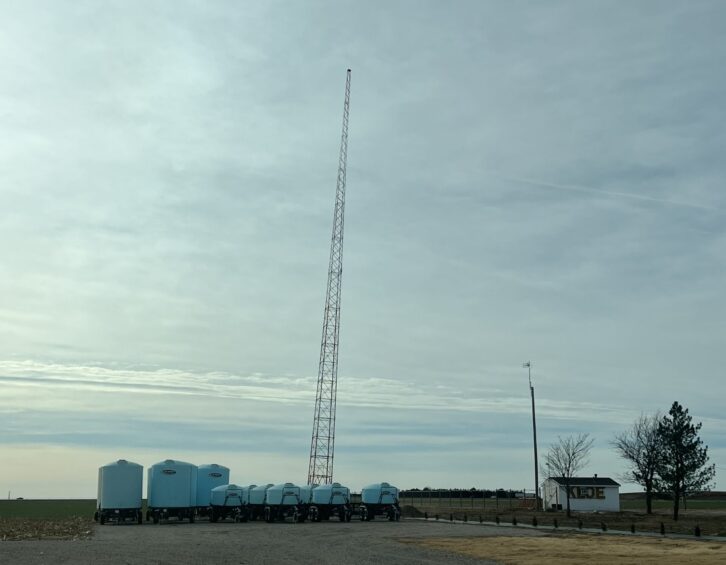
KLOE(AM)'s tower in Goodland, Kan. Credit: Kyle Bauer
Area residents noticed KLOE(AM)’s tower in Goodland, Kan., was leaning after a high-wind event last Thursday. Credit: Kyle Bauer

A longtime AM station in northwest Kansas is off the air after wind gusts exceeding 80 mph left its tower leaning.

Licensed to Goodland, KLOE(AM) broadcasts on 730 kHz with 1 kW daytime and 20 watts at night. It transmits from a single tower located along Old U.S. Highway 24, just north of Interstate 70 and west of Goodland.

According to owner Kyle Bauer, two of the four insulators supporting the tower broke during high winds that swept through Kansas late on the afternoon of Dec. 18. A third insulator broke this past weekend. Bauer’s Kansas Broadcast Company owns KLOE and sister station 102.5 KKCI(FM) in Goodland, along with three stations in nearby Colby.

One of the insulators at the base of the KLOE tower. Credit: Kyle Bauer

While power outages plagued the area and affected the Goodland and Colby stations, the company received calls on Friday that KLOE’s tower was leaning.

Bauer said the structure itself appears intact. The tower sits in a wheat field, and the closest structure — KLOE’s transmitter building — is approximately 320 feet away. If the tower falls, Bauer said, no other property is at risk.

KLOE dates back to 1948, according to the FCC. It has used the same transmitter location ever since and Bauer believes the structure is the original tower.

He is currently in contact with a tower crew to determine if the structure can be saved. The specific insulators designed for the tower are not readily available.

“And most everybody I’ve talked to is in agreement that you don’t want to go back that route,” he told Radio World. 

Returning to the air

Instead, Bauer hopes to anchor the tower directly to the concrete foundation. If successful, he plans to install a folded unipole antenna, an option he has already priced.

However, if the tower cannot be salvaged, Bauer said the station will likely go silent.

“Which really saddens me, after the work we put back into it,” he said. 

Kansas Broadcast Company had invested in the site, including cleaning up the transmitter grounds, adding LED tower lights and remodeling the KLOE studio. 

The company did not carry insurance on the tower, with Bauer citing the uncertain future of AM broadcasting.

Bauer acquired KLOE last year after winning an auction for Rocking M Media’s former Kansas stations. Late last year, the station also switched to a “solid gold” oldies format.

High winds are common on the High Plains, and Bauer estimated that northwest Kansas sees winds in excess of 80 mph at least once a year.

Ironically, the forecast for this Christmas week calls for highly unusual weather for the region: multiple days of winds below 10 mph. It will also be exceedingly warm — temperatures Monday in western Kansas reached nearly 80F, with near-record warmth also expected Christmas Eve and Christmas Day.

Conditions suitable for tower inspection, Bauer noted.

KLOE does not have an FM translator. Some of its programming, including the “Good Neighbor Hour,” will continue streaming and via KKCI.

[Do you receive the Radio World SmartBrief newsletter each weekday morning? We invite you to sign up here.]

The post High Winds Knock Heritage Kansas AM Station Off Air appeared first on Radio World.

  •  

AES Show Moves to Nashville in 2026

The Audio Engineering Society has announced that its 2026 AES Show will be held in Nashville on Halloween weekend — Friday, Oct. 30 through Sunday, Nov. 1, 2026 — at the Gaylord Opryland Resort & Convention Center. It’s a move the organization expects will help revitalize its North American convention.

According to the organization, the AES Show Nashville will offer new programming extending beyond the scope of previous AES Conventions.

From pre-show events and experiences, to studio tours and involvement with the local audio community, AES said that the new location will capitalize on Nashville’s extensive audio legacy while also promoting audio science and its related initiatives.

The AES Show has traditionally been held in major coastal metropolises — New York, Los Angeles and occasionally San Francisco — so the move to Music City marks a major, but canny, shift.

Nashville has a uniquely concentrated ecosystem of world-class studios, live music venues, audio education institutions, pro audio manufacturers, engineers, artists, and audio professionals, major record labels and more.

[Do you receive the Radio World SmartBrief newsletter each weekday morning? We invite you to sign up here.]

The post AES Show Moves to Nashville in 2026 appeared first on Radio World.
  •  

Moody Radio Chicago Reduces Power Due to FAA Interference

Terminal 1 at O'Hare
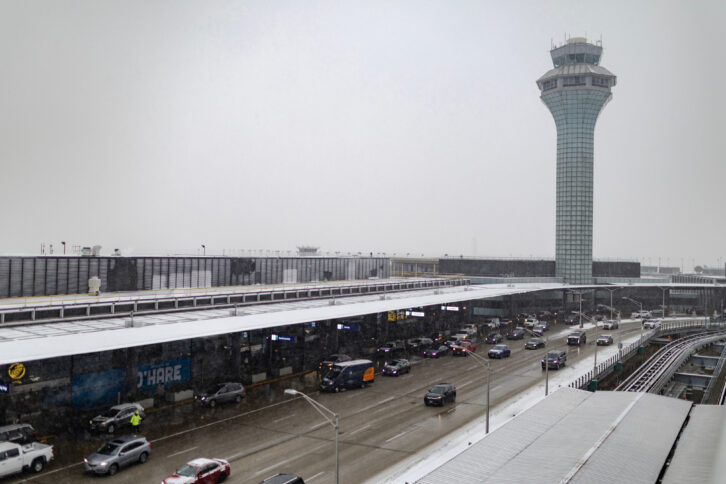
Travelers arrive at drop-off points in Terminal 1 at Chicago O’Hare International Airport on Nov. 29. Credit: Jim Vondruska/Bloomberg via Getty Images

Moody Bible Institute’s 90.1 WMBI(FM) in Chicago is currently operating at 10 kW transmitter power output due to interference with communication equipment at nearby Chicago O’Hare International Airport.

The issue stems back to November. The station went off the air completely after being notified by the FCC that the Federal Aviation Administration detected an “aspect” of its 90.1 FM signal causing minor interference with local air traffic control.

The flagship station of the Moody Radio network, WMBI is a grandfathered Class B station that ordinarily operates with 100 kW ERP. WMBI’s transmitter site, located off Army Trail Blvd. in Addison, Ill., is approximately five miles southwest of O’Hare.

In a reduced power notification filing with the FCC on Dec. 10, Moody said that the FAA recently introduced communications that are highly sensitive to background noise.

As a result of the new communications equipment, WMBI must filter out spurs as low as –80 dB at 133 MHz, Moody wrote in its FCC filing.

WMBI’s equipment is within specification thresholds, Moody wrote, but it was still causing interference with the FAA on its new communication channels.

In the filing, Moody said that it has been able to filter WMBI’s exciter output, but it is only able to make use of approximately 10 kW of its licensed 35 kW TPO.

Moody said that with the busy holiday travel season, it desires to wait until January before moving forward, as it has spent “considerable time” getting to this point. It has price quotes for full transmitter power output filters and is “considering all options.”

WMBI requested special temporary authority to operate at the 10 kW TPO through March 1.

November FCC notification

On Nov. 17, Moody Radio announced on its Facebook page that the Chicagoland signal went off the air due to unexpected technical issues.

Three days later, Wes Ward, Moody Global Media’s vice president, posted that the station was notified by the FCC after the FAA detected the air traffic control interference.

“Out of an abundance of caution, we temporarily paused broadcasting via our 90.1 FM signal due to their request,” Ward wrote.

Moody said that WMBI’s transmitter was operating normally, within required thresholds.

“It appears that recent changes in system sensitivity on the FAA’s receiving side have made it easier for portions of nearby FM signals — including Moody Radio — to be detected,” Ward wrote.

Ward wrote that other radio stations throughout the U.S. have encountered similar issues and are also making adjustments.

After both testing on WMBI’s end and work by engineers from the FAA and FCC, WMBI is confident it has identified a permanent solution, Ward wrote.

When reached by Radio World, a Moody spokesperson said that due to its ongoing work with federal agencies, it would have more to say on the matter at a later date.

Radio World has also reached out to the FAA for further comment.

[Do you receive the Radio World SmartBrief newsletter each weekday morning? We invite you to sign up here.]

The post Moody Radio Chicago Reduces Power Due to FAA Interference appeared first on Radio World.

  •  

Netflix and iHeartMedia Announce Video Podcast Partnership

iHeartMedia and Netflix have announced a new video podcasting partnership. The agreement grants Netflix permission to share the content of approximately 15 original iHeartPodcasts.

The lineup of podcasts joining the streamer includes “The Breakfast Club”; “My Favorite Murder”; “Dear Chelsea”; “This Is Important”; “Bobby Bones Presents: The Bobbycast”; and “The Psychology of Your 20s.”

According to a joint press release, the agreement includes all new episodes from the podcast lineup, as well as some library episodes from each show. New video podcast episodes will launch on Netflix in early 2026 in the U.S., with more markets to follow.

In the release, Bob Pittman, CEO of iHeartMedia, said he is excited to expand the world of podcasting with the creation of a new category — video podcasts.

“Netflix has a leading video-first service, and this partnership perfectly complements our strong audio foundation,” said Pittman. “Working with Netflix — an important leader in entertainment — gives fans one more way to connect with the personalities they love and opens the door to new audiences, including viewers discovering these shows for the first time.”

He added that iHeartPodcasts included in the partnership are now available in both an audio format and as a “natural video extension.”

Lauren Smith, Netflix VP of content licensing and programming strategy, said the streamer looks forward to offering subscribers “highly-entertaining podcasts featuring some of the world’s most dynamic personalities.”

Per the press release, iHeartMedia will retain all audio-only rights and distribution for the shows included in the deal. All podcasts will continue to be available on iHeartRadio and everywhere podcasts are heard.

[Do you receive the Radio World SmartBrief newsletter each weekday morning? We invite you to sign up here.]

The post Netflix and iHeartMedia Announce Video Podcast Partnership appeared first on Radio World.

  •