 Connexion
KiwiSDR 2 is a Definitive Receiver for Enthusiasts
Over the years, I have owned and used many radios to tune into international shortwave radio broadcasts, including the iconic Panasonic RF-2200 from the 1980s. But few have impressed me as much as the KiwiSDR 2.
Made by KiwiSDR NZ in New Zealand, the KiwiSDR 2 is a software-defined radio with its own computer, packed into a small metal box. It connects to the user’s home network via an ethernet cable, sets up through a few easy steps and is controlled directly using a web-based interface.
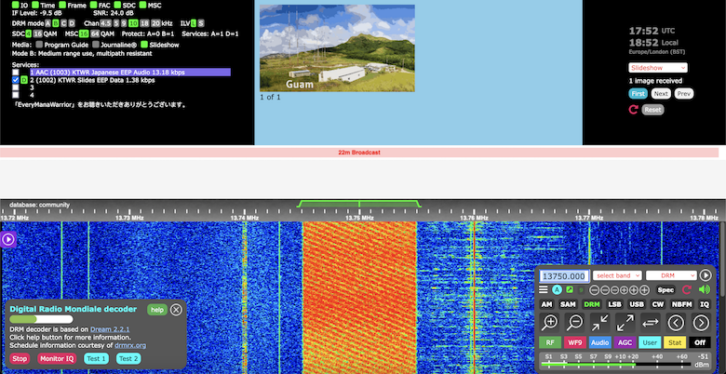
This interface can be experienced for free, with access to KiwiSDRs around the globe. It provides the user with a clickable graphic display of live radio signals across the spectrum.
The interface also allows the user to select stations by direct keyboard entry, by band or by moving their mouse across the display and clicking on whatever feed strikes their fancy.
The KiwiSDR interface supports a range of tuning formats as well, from AM and single sideband (SSB) to DRM and various RF-based data formats.
Let me put it this way: If a crystal radio is the 1903 Wright Flyer of broadcast listening, the KiwiSDR 2 is the USS Enterprise.
A reborn receiver
KiwiSDR NZ was formed in 2023 to relaunch the KiwiSDR, a version of this radio that was built on a PC plug-in board.
The KiwiSDR 1 was introduced in 2016, manufactured and marketed by SeeedStudio (yes, there are three letter Es in its name) in Shenzhen.
“Supply shortages during COVID stopped production in 2021,” said Peter Munn, CEO of KiwiSDR NZ and ham radio callsign ZL2P.
“We decided to relaunch a newer design called the KiwiSDR 2 using our own New Zealand-based company with manufacturing by Triode in Auckland.”
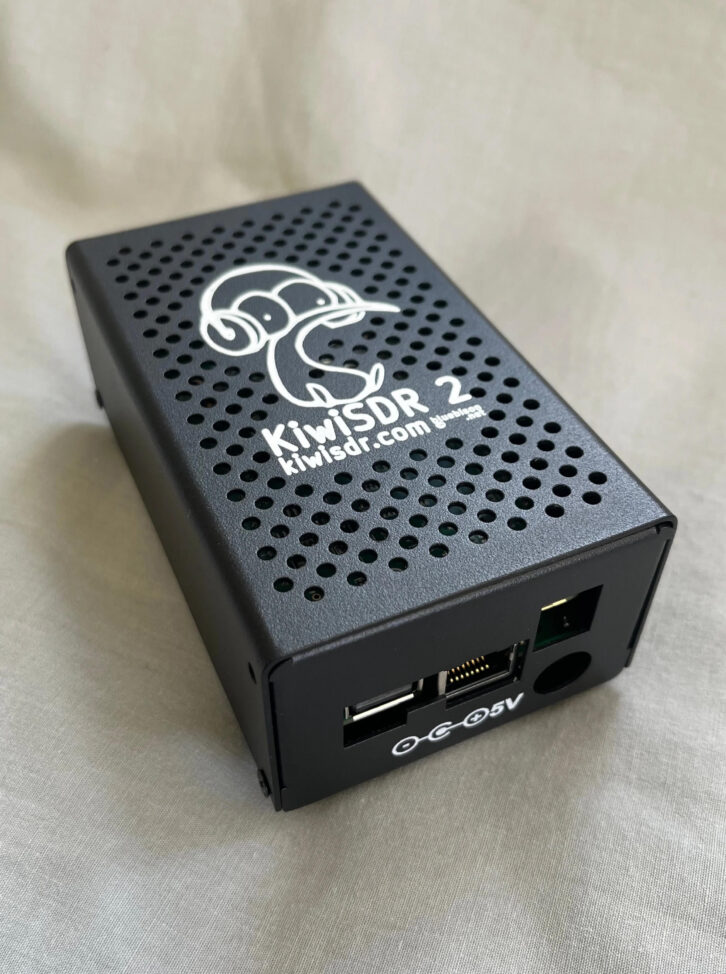
In terms of capabilities, the KiwiSDR 2 receives signals in the shortwave radio band (3–30 MHz) plus VLF/LF/MW and the AM broadcast band, covering from 10 kHz to 30 MHz in total.
An external antenna is required to operate. Options range from traditional wire antennas to magnetic loops and active probes.
The KiwiSDR 2 comes with a connectable GPS antenna, so that users who wish to share their unit on the KiwiSDR tuning site can show their locations. When connected in this way, up to four users can connect simultaneously, each one tuning and listening independently to a different frequency over the entire frequency range.
“All signal processing occurs locally within the Kiwi hardware and the browser of the connected user, including what we call extensions for decoding modes typically encountered on shortwave,” Munn told Radio World.
“An example of this is the Digital Radio Mondiale decoder now that some shortwave broadcasters support this mode. For ham radio operators, there are decoders for the modes FT8, WSPR, CW, FSK and SSTV. For commercial users FAX, ALE 2G, NAVTEX, DSC, Selcall and HFDL.”
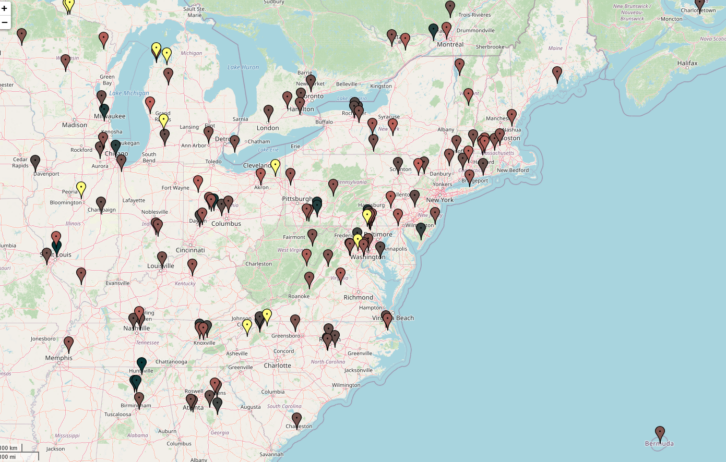
As well, said John Seamons, KiwiSDR 2 designer/developer and ham radio callsign(s) ZL4VO/KF6VO, some users have used external downconverters to bring VHF/UHF signals to the Kiwi, effectively using it as a 30 MHz wide intermediate frequency (IF) receiver.
“The Kiwi software supports these configurations such that VHF/UHF frequencies are shown on the display.”
Worth noting: Unlike other SDRs, the KiwiSDR 2 is a self-contained device controlled entirely from a web browser. “This means no attachment to a PC and the associated software/driver installation with the inevitable grief that results,” said David Bray, KiwiSDR NZ’s logistics manager and ham radio callsign ZL2BA.
“The KiwiSDR 2 is also internet-enabled, meaning connections can occur not only from a web browser on the same local network as the Kiwi but from a web browser located anywhere in the world.”
The Kiwi’s reverse proxy allows internet access even when using broadband connections that disallow incoming connections, e.g. Starlink, 4/5G mobile networks, and some ISPs.
“In this way, it is truly plug-and-play from a networking perspective, which has been very important to our customer base,” Bray said.
“You simply visit my.kiwisdr.com after hardware setup to see the URL link required to access your Kiwi from the internet and local network.”
Helping monitor coverage
So it’s a consummate listening device for enthusiasts and the foundation for a global listening community able to share access to their radios worldwide.
But the KiwiSDR 2 also would be profoundly useful for any broadcaster wanting to monitor their coverage and signal quality remotely, and in real time.
All they have to do is to install KiwiSDR 2s and antennas in strategic locations and connect them to the web. Then coverage checks are a matter of logging onto the KiwiSDR tuning website and clicking on their remote receivers.
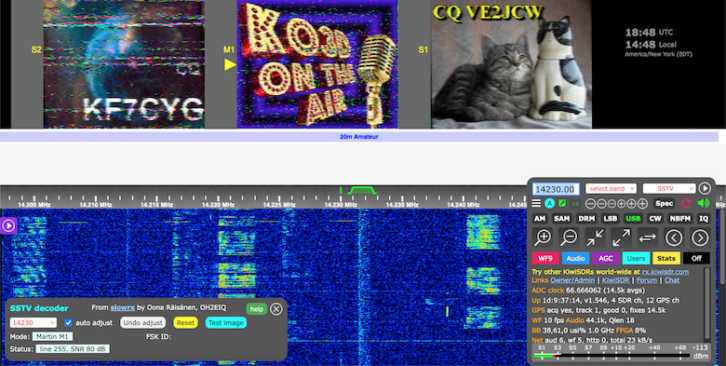
TWR, formerly Trans World Radio, is one such KiwiSDR user. The global Christian media outlet broadcasts on its own medium and shortwave transmitters from several locations worldwide, and is carried by partner ministries in many countries using medium-wave and local FM radio networks.
“TWR uses KiwiSDR monitor receivers on all continents,” said TWR Broadcast Engineer Dave Pedersen. “They are located in both reception areas and at TWR transmitter sites. Some sites are publicly available and visible on the KiwiSDR maps.”
According to Pedersen, most of TWR’s KiwiSDRs have standardized on the W6LVP loop antenna, with the rest using other active loop antennas.
“KiwiSDRs are used on both MW [AM] and SW depending on the broadcasts to be monitored,” he said.
“The TWR receivers are typically housed in a rack-mount custom enclosure with a linear power supply to lower the noise floor. We use the included Kiwiclient and Kiwirecorder utilities to sample data at preset times. The retrieved samples are stored for later analysis as many samples are made at different times of the day or night. Data analysis is performed by proprietary software developed by TWR.”
Based on the KiwiSDR’s remote monitoring performance to date, investing in these radios has been an excellent choice.
“The KiwiSDRs are working well for TWR,” said Pedersen. “Most propagation analysis was already well understood, but much has been learned about east-west MW [AM] propagation in tropical regions.
“Monitoring has confirmed that signal strength is not as much of an issue as the global noise floor rising from EMI caused by switch-mode power supplies and unshielded data cables. Signal-to-noise ratio has degraded significantly worldwide due to unmanaged RF spectrum pollution.”
His conclusion: “TWR will continue to use and expand the network as monitoring needs change. The KiwiSDR receiver continues to be the best technical solution for TWR use due to remote access and control, and the ability to process multiple data gathering sessions simultaneously.”
The listening experience
According to KiwiSDR NZ, more than 875 KiwiSDR users have made their receivers accessible to the public using the company’s online map.
One of these users is the Maritime Radio Historical Society. It is a nonprofit society that is keeping Morse Code alive by operating MRHS stations KPH, KFS and K6KPH in continuous wave (CW) Morse Code each Saturday.
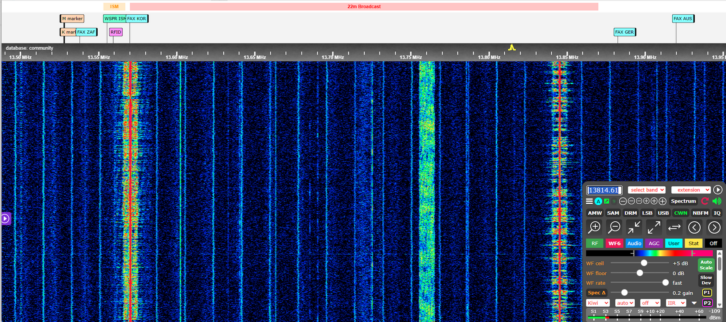
The transmission site for all MRHS stations is the original 1914 Marconi site in Bolinas, Calif. The receive site at Point Reyes, Calif., was chosen by Dr. Harold Beverage for RCA and built in 1930.
Bill Ruck is a broadcast engineer and MRHS member. “Our Point Reyes location is a pretty wonderful high-frequency receive site because it is on a peninsula surrounded by the Pacific Ocean,” he said.
“We have a number of KiwiSDRs installed here that the public can access online, and they’re amazing, with all the features you’d ever want. The only problem that we have to deal with is too much gain, because the KiwiSDRs do not have a front-end passband filter. So you have to be very careful about your dynamic range in order to maximize reception without overloading the analog-to-digital converter.”
Try it now
I found the KiwiSDR 2 a joy to work with. Its clickable interface is simple enough for beginners to poke around and have fun with, while supporting sufficient functions to keep an expert engaged and intrigued for hours.
I run mine using a low-cost MLA-30 active loop antenna in my attic (find them on Amazon), and the performance is exceptional.
And when I need to make sense of an incoming signal too weak for my system to make sense of in suburbia? I use the KiwiSDR radio map to click on a nearby user who is in the country with a far better antenna than mine to bring that signal in.
Are there downsides to the KiwiSDR 2? A couple.
First, because the radio relies on the internet for tuning, you cannot count on it when the web is down. The KiwiSDR 2 also does not include built-in Wi-Fi.
Is either of these a deal breaker? For me, no. The web is rarely down where I live. Should that happen, I have standalone radios like the excellent Sangean ATS-909X2 to tune into AM, FM and shortwave. (My venerable RF-2200 failed after 39 years of faithful service.)
I also have an Ethernet connection in my second-floor Radio Room where my antenna connections are located. So meeting this KiwiSDR 2 requirement is no problem for me. (Note: Many wireless routers have Ethernet ports.)
The KiwiSDR 2 is an exceptional wideband radio receiver, one that belongs in any serious radio listening post. The best part: You can try it out for free on the web as soon as you finish reading this. In other words, right now.
[Related: “The World Is at Your Mouse Click”]
The post KiwiSDR 2 is a Definitive Receiver for Enthusiasts appeared first on Radio World.