
 Connexion
Letter: The Many Maryland and Pennsylvania FM Short Spacings
In this letter to the editor, the author comments on the Signal Spot column, “When Markets Collide.” Radio World welcomes letters to the editor on this or any story. Email radioworld@futurenet.com.

Our region has other examples of short-spaced full-sized FM stations.
On 105.1, WAVA(FM), licensed to Arlington, Va., collides with 105.1 WIOV(FM) in Ephrata, Pa. Here in north-central Baltimore County, Md., in the communities of Timonium, Mays Chapel, Cockeysville and Hunt Valley, WAVA and WIOV jump back-and-forth in moving vehicles.
Three decades ago, when I lived southwest of here in Columbia, WAVA was dominant on a stationary Pioneer tuner with rabbit ears, but when WAVA signed off its top 40 format for the last time in 1992, the country music of WIOV rolled in clearly; co-channel noise was under WAVA many days.
Moving in another direction, WIOV is a close neighbor to Philadelphia’s WDAS(FM) 105.3. WBEB(FM) 101.1 is short spaced to WROZ(FM) 101.3, licensed to Lancaster, Pa., although WROZ’s 1,200-foot antenna is approximately 15 miles west of Lancaster, farther away from Philadelphia’s antenna farm in Roxborough.
WYCR(FM) 98.5 in York-Hanover, Pa., — hyphenated on the license since 1962 — is short to WMZQ(FM) 98.7 in Washington, D.C, with its transmitter in Falls Church, Va. WYCR is also short to WKRZ(FM) 98.5 in the Scranton-Wilkes Barre region; WKRZ was the old WBRE(FM) mono in Wilkes Barre, which would come in on studio monitors when I would sign-off WYCR at midnight 51 years ago.
WIAD(FM) 94.7 in Bethesda, Md., is very short to WDSD(FM) 94.7 in Smyrna, Del. Both stations are non-directional.
Another short-spaced situation exists between WIHT(FM) 99.5 in Washington, D.C., and 50kw WVCY(FM) on 99.5 in Wilmington, Del. WIHT and WIAD share a tower with TV stations in Bethesda. WIHT is higher above its average terrain — approximately 750 feet — than is the Wilmington 99.5.
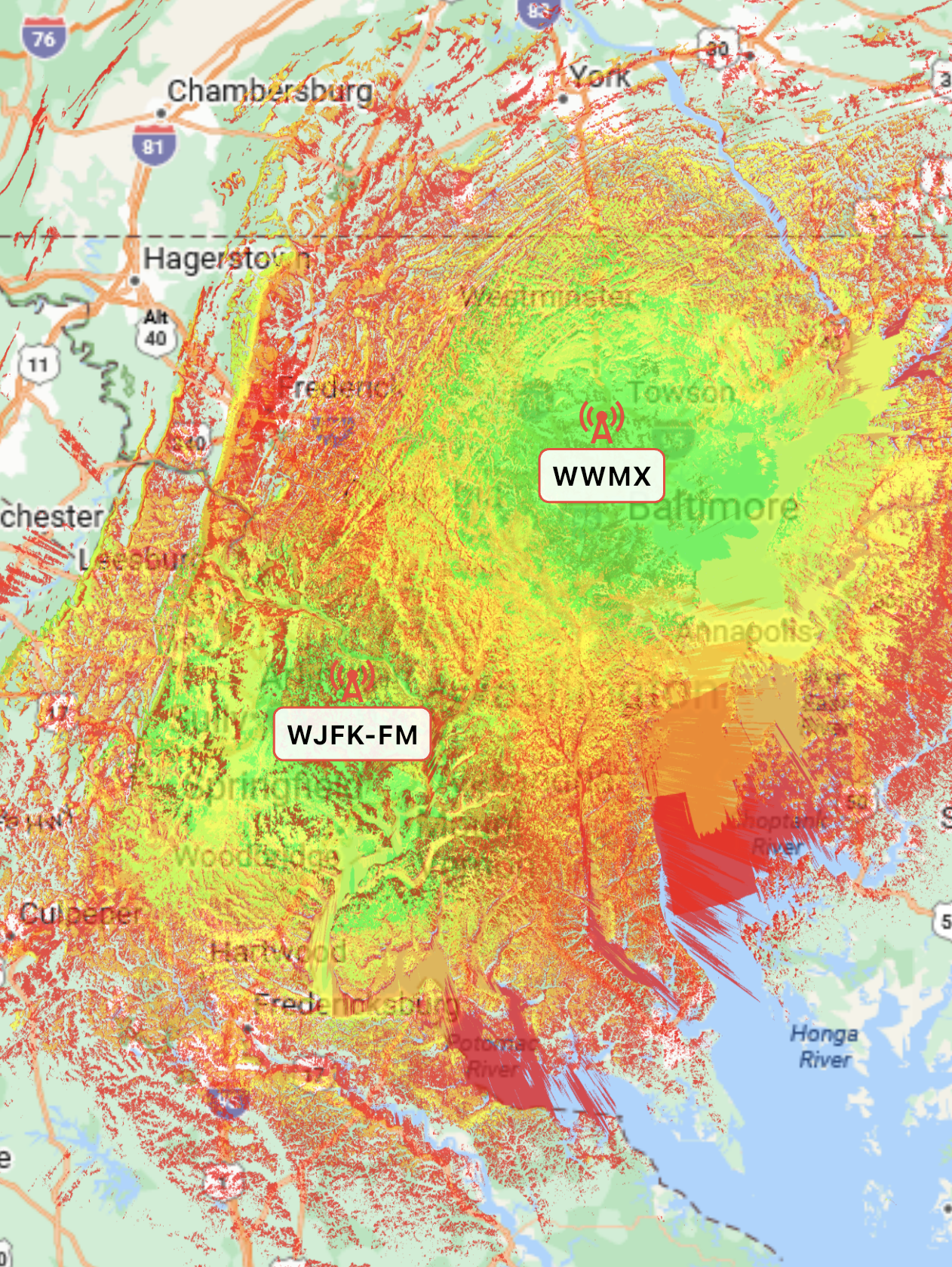
A few years ago, WWMX(FM) 106.5 Baltimore and WJFK(FM) 106.7 in Manassas, Va., “adjusted” their signals to lessen adjacent-channel interference. Non-directional WWMX lowered its antenna height and moved to a tower several feet from the one it had been using, and the coverage maps for WJFK show a slight change of its directional pattern.
But one of the more unusual situations in our area involves 100.7. It is licensed to WZBA(FM) in Westminster. The directional facility is 15 miles southeast of Westminster, in Owings Mills, about 15 miles from the center of Baltimore. WZBA is short spaced to 100.7 stations WLEV(FM) in Allentown, Pa., and WQPO(FM) in Harrisonburg, Va., hence the directionality in Owings Mills.
The previous owners kept the station at 50kw and 350 feet into the early 1980s in Westminster, while the other 100.7 stations raised their antennas. But WZBA’s bigger problem is 100.7 WZXL(FM) in Wildwood, N.J. That station’s signal path traverses both the Delaware Bay and the Chesapeake Bay.
Wildwood’s 100.7 lands on top of WZBA in Harford County and parts of Baltimore County, especially in spring and summer. WZBA bought a translator in Harford County on 107.5 FM and promotes it on and off the air to help reception. Harford, thanks to geography, is one of the counties in the Baltimore area least affected by overlap from Washington, D.C., radio. It is important to Baltimore stations to pick up audiences there, although less so than 20 years ago thanks to streaming.
— Leonard Roberts, Baltimore County, Md.
[Check Out More Letters at Radio World’s Reader’s Forum Section]
The post Letter: The Many Maryland and Pennsylvania FM Short Spacings appeared first on Radio World.
